150 Names That Mean Destruction, Destroyer, Chaos, or Ruin
Names connected with destruction are rarely simple.
A few genuinely translate to destruction, destroyer, ruin, or ravager. Others belong to gods, spirits, monsters, and legendary figures associated with war, fire, death, chaos, storms, or the ending of worlds.
Then there are modern word names such as Havoc, Raze, Tempest, and Ruin. These may work brilliantly for fictional characters, gaming profiles, pets, teams, or creative projects, but they are not traditional baby names with ancient origins.
This guide separates all three groups instead of tossing every dark-sounding word into one suspiciously dramatic list.
Quick Answer: What Names Mean Destruction?
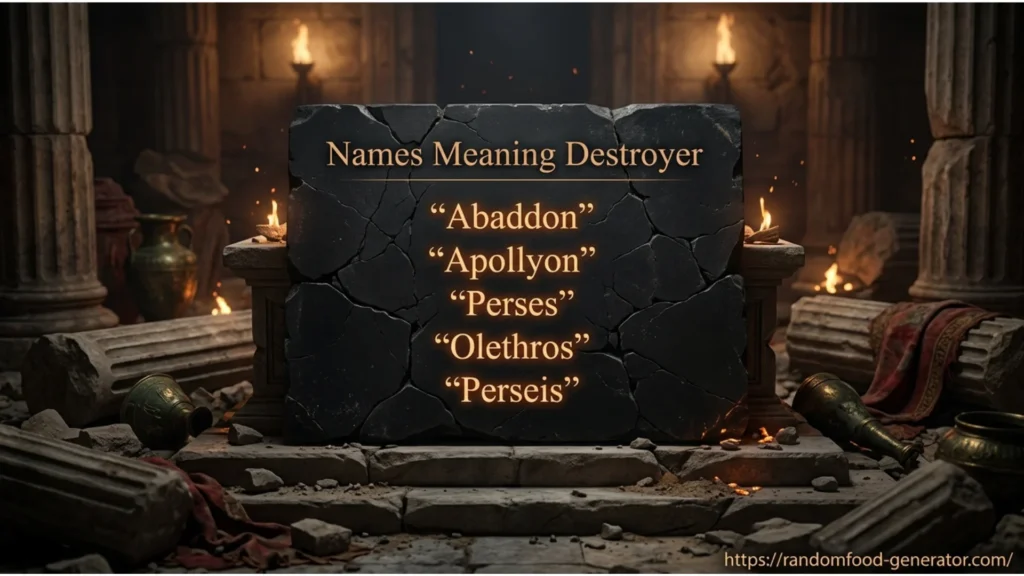
The clearest names and terms connected with destruction include:
- Abaddon: Destruction or ruin
- Apollyon: Destroyer
- Perses: Destroyer or ravager
- Perseus: Possibly destroyer
- Perseis: Connected with destroying or sacking
- Olethros: Destruction, ruin, or doom
- Hakai: Destruction in Japanese, but normally a vocabulary word
- Hametsu: Ruin, downfall, or destruction in Japanese
- Hakaisha: Destroyer in Japanese, but a title or common noun
- Bane: A cause of ruin, harm, or death
- Raze: To destroy completely
- Havoc: Widespread destruction or disorder
- Ruin: Destruction or collapse
- Calamity: A disastrous event
- Cataclysm: A violent and destructive event
Abaddon and Apollyon appear together in Revelation 9:11, where Abaddon is connected with destruction and Apollyon is identified as “Destroyer.” Perses is a Greek mythological name derived from words connected with destroying or ravaging. (BibleGateway, Theoi Greek Mythology)
A Necessary Accuracy Note
Not every name in this article literally means destruction.
The entries fall into four groups:
- Direct meanings: Names or historical terms that translate to destruction, destroyer, ruin, or a closely related concept.
- Mythological associations: Names belonging to figures associated with destruction, death, storms, war, fire, or chaos.
- Vocabulary and word names: Ordinary words such as Raze, Havoc, Ruin, and Tempest used creatively as names.
- Fictional name ideas: Dramatic combinations suited to stories, games, teams, pets, and fantasy worlds.
This distinction matters. Kali is associated with time, death, power, and destruction, but the name itself is more closely connected with blackness or time. Shiva is called the Destroyer within the Trimurti, but Shiva’s name traditionally carries the sense of auspiciousness.
Likewise, Japanese words such as Hakai and Hametsu genuinely mean destruction or ruin, but that does not automatically make them established Japanese personal names.
Also check: 200+ Names That Mean Smart
Names That Directly Mean Destruction or Destroyer
1. Abaddon
Origin: Hebrew and biblical
Meaning: Destruction, ruin, or place of destruction
Abaddon is among the strongest direct answers to the question “What name means destruction?”
In biblical usage, the term can refer to destruction or the realm of destruction. Revelation presents Abaddon as the Hebrew name of the angel of the abyss.
2. Apollyon
Origin: Greek and biblical
Meaning: Destroyer
Apollyon is identified as the Greek counterpart of Abaddon in Revelation 9:11.
It comes from a Greek verb meaning to destroy. The name is extremely dramatic and better suited to fiction, gaming, or symbolic use than an ordinary child’s name.
3. Perses
Origin: Ancient Greek mythology
Meaning: Destroyer or ravager
Perses was a Titan associated with destruction.
The name is linked with Greek verbs meaning to destroy, ravage, sack, or burn. It is one of the clearest Greek names connected directly with destruction.
4. Perseus
Origin: Ancient Greek mythology
Meaning: Possibly destroyer
Perseus was the hero who defeated Medusa.
One traditional interpretation connects his name with the same Greek root meaning to destroy or sack. The precise etymology remains debated, so “possibly destroyer” is more accurate than presenting it as an unquestioned translation.
5. Perseis
Origin: Ancient Greek mythology
Meaning: Connected with destroying, slaying, or sacking
Perseis was an Oceanid nymph in Greek mythology.
Her name has been linked with a Greek verb meaning to destroy, slay, or sack with fire.
6. Olethros
Origin: Ancient Greek
Meaning: Destruction, ruin, doom, or death
Olethros was the personified spirit of destruction and ruin.
The alternate Latinized spelling Olethrus may also appear.
7. Olethrus
Origin: Greek, Latinized form
Meaning: Destruction or ruin
Olethrus is a variant form of Olethros.
It has a dark, ancient sound that works especially well for a fictional villain, fallen kingdom, or destructive supernatural force.
8. Bane
Origin: English word name
Meaning: Cause of ruin, harm, distress, or death
Bane is now familiar as a dark fictional name, but it is originally an English word.
Someone or something described as a person’s bane causes misery, ruin, or serious harm.
9. Raze
Origin: English word name
Meaning: To destroy completely
Raze is a sharp modern choice for a fictional character, game username, or team.
As a verb, it means to demolish or destroy something completely.
10. Ruin
Origin: English word name
Meaning: Destruction, collapse, or decay
Ruin is highly unconventional as a real personal name but effective in fantasy writing.
It suggests the remains of something destroyed as well as the process of destruction itself.
11. Havoc
Origin: English word name
Meaning: Widespread destruction and disorder
Havoc feels energetic and chaotic.
It works naturally as a fictional surname, codename, pet name, gaming identity, or team name.
12. Doom
Origin: English and Germanic word name
Meaning: Terrible fate, judgment, or destruction
Doom originally referred to judgment or a final decision.
Its modern associations are much darker and usually involve inevitable destruction or catastrophe.
13. Calamity
Origin: English and Latin-rooted word name
Meaning: Disaster or severe misfortune
Calamity has appeared as a nickname and fictional character name.
It feels Western, rebellious, and destructive without literally referring to a person who destroys.
14. Cataclysm
Origin: Greek-rooted English word
Meaning: Violent disaster or large-scale destruction
Cataclysm is far too heavy for most everyday naming situations.
It is highly effective for a fantasy event, supernatural weapon, villain, game clan, or destructive power.
15. Ravage
Origin: French-rooted English word
Meaning: To devastate or destroy severely
Ravage has a powerful sound and a direct destructive association.
It is better treated as a creative codename than a conventional personal name.
16. Shatter
Origin: English word name
Meaning: To break suddenly into pieces
Shatter is a modern action-based name suitable for fictional characters and games.
It implies violent breaking rather than general destruction.
17. Breaker
Origin: English word and title
Meaning: One who breaks
Breaker has a strong occupational or title-like structure.
It can work for a warrior, machine, ship, horse, or action character.
18. Scourge
Origin: English and French-rooted word
Meaning: A source of severe suffering or destruction
Scourge is commonly used as a title for a destructive enemy or force.
It sounds more like an earned title than a birth name.
19. Devastation
Origin: Latin-rooted English word
Meaning: Severe destruction
Devastation is not an established personal name.
It may work as the title of a fictional event, supernatural ability, weapon, band, or gaming clan.
20. Destroyer
Origin: English title
Meaning: One who destroys
Destroyer is a direct title rather than a traditional given name.
Its greatest value is in fantasy, mythology-inspired fiction, gaming, wrestling, ships, or character epithets.
The Greek names Perses, Perseis, Perseus, and Olethros are tied to destruction, ruin, or the act of ravaging, while Abaddon and Apollyon offer the clearest biblical answers. (Theoi’s Perses entry, Theoi’s Greek personifications guide)
Girl Names Associated With Destruction and Chaos
The names in this section do not all literally translate to destruction. Their connections come from mythology, war, death, rage, storms, fire, or destructive legends.
21. Kali
Origin: Sanskrit and Hindu tradition
Association: Time, death, power, transformation, and destruction
Kali is a major Hindu goddess and is widely revered as a divine mother, protector, and liberating force.
Her meaning and religious importance should not be reduced to a one-dimensional “evil destroyer” description.
22. Sekhmet
Origin: Ancient Egyptian
Meaning: The powerful one
Association: War, plague, destruction, healing, and protection
Sekhmet was a lioness-headed Egyptian goddess.
She could bring destruction and disease but was also invoked for healing and protection.
23. Eris
Origin: Ancient Greek
Meaning: Strife or discord
Eris personified conflict, rivalry, and discord.
She is one of the strongest girl names for a character representing chaos.
24. Ate
Origin: Ancient Greek
Meaning: Delusion, folly, or ruin
Ate was the personification of reckless action and delusion leading people toward ruin.
Despite being only three letters, its likely English pronunciation may not be obvious to every reader.
25. Enyo
Origin: Ancient Greek
Association: War and the destruction of cities
Enyo was a Greek war goddess closely associated with Ares.
Ancient descriptions connect her with bloodshed and the destruction of towns.
26. Bellona
Origin: Roman mythology
Association: War and battle
Bellona was a Roman goddess of war.
The name feels more wearable than many darker mythological options, although its primary association remains warfare.
27. Nemesis
Origin: Ancient Greek
Meaning: Retribution or righteous indignation
Nemesis did not simply represent destruction.
She personified punishment and retribution, especially against arrogance and undeserved good fortune.
28. Lyssa
Origin: Ancient Greek
Meaning: Rage, fury, or madness
Lyssa personified uncontrollable rage and frenzy.
The name sounds soft despite its intense mythological meaning.
29. Tiamat
Origin: Mesopotamian mythology
Association: Primordial sea, chaos, and cosmic conflict
Tiamat is often represented as a primordial force of chaos.
Later retellings frequently depict her as a destructive dragon, although ancient Mesopotamian traditions are more complex than modern fantasy summaries suggest.
30. Morrigan
Origin: Irish mythology
Association: War, fate, sovereignty, and death
The Morrígan is a powerful figure in Irish mythology.
Her name’s exact etymology is debated, so it should not be simplistically translated as destruction.
31. Badb
Origin: Irish mythology
Meaning: Crow
Badb was associated with war, battlefields, prophecy, and death.
She is sometimes treated as one aspect or member of the Morrígan.
32. Macha
Origin: Irish mythology
Association: War, sovereignty, horses, and fate
Macha appears as the name of several figures in Irish tradition.
Her mythological connections are broader than destruction alone.
33. Hel
Origin: Old Norse mythology
Association: Underworld and death
Hel ruled a realm of the dead in Norse mythology.
The name relates more closely to concealment or the underworld than destruction.
34. Ereshkigal
Origin: Mesopotamian mythology
Meaning: Lady of the great earth
Association: Underworld and death
Ereshkigal ruled the Mesopotamian underworld.
She is a death-associated figure rather than a goddess whose name means destroyer.
35. Persephone
Origin: Greek mythology
Association: Underworld, death, seasonal return, and rebirth
Persephone was queen of the Greek underworld.
Her name’s exact original meaning remains uncertain.
36. Atropos
Origin: Ancient Greek
Meaning: Unturning or inflexible
Association: Ending life
Atropos was one of the three Fates.
She cut the thread of life, determining when a person’s life ended.
37. Ker
Origin: Ancient Greek mythology
Meaning: Doom or death spirit
Ker was a personified spirit of violent or fated death.
The plural form is Keres.
38. Keres
Origin: Ancient Greek mythology
Meaning: Spirits of doom or violent death
The Keres were female spirits associated with cruel and violent forms of death.
They differ from Thanatos, who represented a more peaceful death.
39. Morta
Origin: Roman mythology
Association: Death and fate
Morta was one of the Roman Fates.
Her name is related to Latin words for death.
40. Morana
Origin: Slavic mythology
Association: Winter, death, and seasonal ending
Morana is linked with winter and death in Slavic tradition.
Regional variants include Marzanna, Morena, and Mara.
41. Marzanna
Origin: Slavic mythology
Association: Winter and death
Marzanna is another form of the Slavic seasonal figure connected with winter’s death and spring’s return.
42. Pele
Origin: Hawaiian mythology
Association: Volcanoes, fire, creation, and destruction
Pele is associated with volcanic fire.
Her power can destroy landscapes while also creating new land, making her a symbol of both devastation and renewal.
43. Oya
Origin: Yoruba tradition
Association: Storms, winds, lightning, change, and transformation
Oya is a powerful orisha associated with storms and major transformation.
Her sacred cultural importance goes well beyond the narrow category of destructive names.
44. Durga
Origin: Sanskrit and Hindu tradition
Meaning: Inaccessible, fortress-like, or difficult to approach
Association: Protection and defeating destructive forces
Durga is a major Hindu goddess who defeats demons and protects cosmic order.
Her name does not literally mean destruction.
45. Chamunda
Origin: Hindu tradition
Association: Fierce goddess and demon-slayer
Chamunda is a fierce form of the Divine Mother.
The name should be used with respect for its religious and cultural significance.
46. Bhairavi
Origin: Sanskrit and Hindu tradition
Meaning: Fierce, formidable, or terrifying feminine form
Bhairavi is a goddess name and also appears within Indian musical terminology.
Its energy is fierce, but it is not a literal translation of destroyer.
47. Hecate
Origin: Ancient Greek mythology
Association: Magic, crossroads, night, spirits, and boundaries
Hecate is frequently mislabeled as a goddess of destruction.
Her primary associations involve magic, crossroads, torches, night, and liminal spaces.
48. Medusa
Origin: Ancient Greek mythology
Association: Deadly gaze, protection, and monstrous transformation
Medusa could turn observers to stone in later Greek tradition.
Her image was also used as a protective symbol.
49. Lamia
Origin: Greek mythology
Association: Child-devouring monster and night terror
Lamia was originally a queen in myth and later became a monstrous figure.
The name has strong gothic and horror associations.
50. Lilith
Origin: Ancient Mesopotamian and Jewish tradition
Association: Night spirit
Lilith does not mean destroyer.
Her history involves complex traditions relating to night spirits and later folklore.
51. Nyx
Origin: Ancient Greek
Meaning: Night
Nyx was the primordial personification of night.
She belongs in a dark-name collection, but her name directly means night rather than destruction.
52. Pandora
Origin: Ancient Greek
Meaning: All-gifted or all-giving
Association: Release of suffering into the world
Pandora is frequently included in chaos-themed name lists.
Her name does not mean chaos or destruction; the connection comes from her myth.
53. Tempest
Origin: English word name
Meaning: Violent storm
Tempest is a dramatic modern option that can represent natural destruction.
54. Fury
Origin: English word and Roman mythological title
Meaning: Violent anger
The Furies were spirits of vengeance in classical mythology.
As a modern name, Fury feels intense and action-oriented.
55. Calamity
Origin: English word name
Meaning: Disaster
Calamity has occasionally appeared as a nickname, most famously in the historical nickname Calamity Jane.
It is still far more natural for a character than a child.
Boy Names Associated With Destruction
56. Shiva
Origin: Sanskrit and Hindu tradition
Meaning: Auspicious or gracious
Association: Destruction, transformation, yoga, time, and regeneration
Shiva is known as the Destroyer within the Trimurti.
However, destruction in this religious context is tied to transformation, renewal, and the cosmic cycle rather than simple violence. The Metropolitan Museum of Art provides useful cultural context.
57. Rudra
Origin: Sanskrit and Vedic tradition
Meaning: Often interpreted as roarer or howler
Association: Storms, wildness, disease, healing, and destructive power
Rudra is a Vedic deity later closely associated with Shiva.
58. Hara
Origin: Sanskrit and Hindu tradition
Meaning: One who takes away or removes
Hara is an epithet of Shiva.
It can be interpreted as one who removes evil, suffering, ignorance, or existence at the end of a cosmic cycle.
59. Mahakala
Origin: Sanskrit and Buddhist and Hindu traditions
Meaning: Great time or great death
Mahakala is a powerful sacred figure associated with time and the ending of all things.
It is not merely a fantasy villain name.
60. Bhairava
Origin: Sanskrit and Hindu tradition
Meaning: Frightful, formidable, or terrifying
Bhairava is a fierce manifestation of Shiva.
61. Nergal
Origin: Mesopotamian mythology
Association: War, plague, death, and the underworld
Nergal was associated with devastating war and disease.
62. Erra
Origin: Mesopotamian mythology
Association: War, plague, destruction, and political disorder
Erra appears as a destructive deity in Mesopotamian literature.
63. Set
Origin: Ancient Egyptian mythology
Association: Desert, storms, disorder, violence, and foreign lands
Set was a complicated Egyptian deity.
Although often linked with chaos and violence, he could also protect the sun god against the serpent Apep.
64. Apep
Origin: Ancient Egyptian mythology
Association: Chaos and cosmic destruction
Apep was a giant serpent representing chaos and the enemy of the solar order.
The Greek form is Apophis.
65. Apophis
Origin: Greek form of an Egyptian name
Association: Chaos and cosmic threat
Apophis is the Greek rendering of Apep.
It sounds natural in science fiction because the name has also been used in modern astronomy and popular culture.
66. Surtr
Origin: Norse mythology
Meaning: The black one
Association: Fire and world-ending destruction
Surtr is a fire giant who plays a major role during Ragnarök.
67. Fenrir
Origin: Norse mythology
Association: Destructive wolf and Ragnarök
Fenrir is the monstrous wolf destined to kill Odin during Ragnarök.
The name itself does not directly translate to destruction.
68. Jörmungandr
Origin: Norse mythology
Meaning: Enormous monster or great beast
Association: World serpent and Ragnarök
Jörmungandr encircles the world and battles Thor during Ragnarök.
69. Loki
Origin: Norse mythology
Association: Trickery, conflict, disruption, and Ragnarök
The exact etymology of Loki remains debated.
He is associated with chaos in popular culture, but describing the name as literally meaning chaos is inaccurate.
70. Typhon
Origin: Greek mythology
Association: Storms, monsters, and attempted overthrow of Zeus
Typhon was one of the most destructive monsters in Greek mythology.
71. Ares
Origin: Ancient Greek mythology
Association: War and battle fury
Ares was the Greek god of war.
His name does not literally mean destruction.
72. Mars
Origin: Roman mythology
Association: War
Mars was the Roman god of war and an important guardian of the Roman state.
73. Alastor
Origin: Ancient Greek
Meaning: Avenger
Alastor was used for an avenging spirit or punishing force.
It is often interpreted too loosely as destroyer, but “avenger” is more accurate.
74. Thanatos
Origin: Ancient Greek
Meaning: Death
Thanatos personified death.
Unlike the Keres, he was generally associated with nonviolent death.
75. Hades
Origin: Ancient Greek mythology
Association: Underworld and the dead
Hades does not mean destruction.
It is the name of the Greek underworld ruler and, by extension, his realm.
76. Yama
Origin: Sanskrit and South Asian traditions
Association: Death, justice, and the afterlife
Yama is a sacred figure in Hindu, Buddhist, and other South Asian traditions.
77. Mara
Origin: Sanskrit and Buddhist tradition
Association: Death, temptation, obstruction, and illusion
Mara appears as a force opposing awakening in Buddhist tradition.
The name has separate origins and meanings in other languages.
78. Anubis
Origin: Egyptian mythology
Association: Embalming, funerary rites, and the dead
Anubis is death-related but not a destroyer.
He guided and protected the dead.
79. Osiris
Origin: Egyptian mythology
Association: Death, resurrection, fertility, and the afterlife
Osiris represents renewal after death more than destruction.
80. Balor
Origin: Irish mythology
Association: Destructive eye and supernatural battle
Balor was a powerful leader of the Fomorians.
His deadly eye makes the name especially suitable for fantasy villains.
81. Vulcan
Origin: Roman mythology
Association: Fire, volcanoes, metalworking, and destructive flames
Vulcan was the Roman god of fire and smithing.
82. Hephaestus
Origin: Greek mythology
Association: Fire, metalworking, volcanoes, and crafting weapons
Hephaestus was a creator and craftsman rather than a god of destruction.
His fire association makes him relevant to destructive-themed lists, but the distinction should remain clear.
83. Kagutsuchi
Origin: Japanese mythology
Association: Fire and destructive birth myth
Kagutsuchi is a Japanese fire deity whose birth caused the death of his mother, Izanami.
This is a sacred mythological name, not an ordinary Japanese baby name.
84. Susanoo
Origin: Japanese mythology
Association: Storms, seas, disorder, and heroic monster-slaying
Susanoo is a major Shinto deity.
The name should not be simplified to “destruction.”
85. Raiden
Origin: Japanese mythological title
Meaning: Thunder and lightning
Raiden is associated with the Japanese thunder deity, more formally called Raijin.
It has become familiar as a character name in global popular culture.
86. Raijin
Origin: Japanese mythology
Meaning: Thunder god
Raijin is associated with thunder, lightning, and storms.
87. Angra Mainyu
Origin: Zoroastrian tradition
Meaning: Destructive spirit
Angra Mainyu represents destructive or hostile spirit within Zoroastrian religious thought.
This is one of the stronger historical expressions directly involving destructiveness, though it is a sacred theological term rather than a conventional personal name.
88. Mot
Origin: Canaanite mythology
Meaning: Death
Mot was a god or personification of death.
89. Resheph
Origin: Ancient West Semitic mythology
Association: Plague, war, fire, and protection
Resheph could carry destructive and protective functions.
90. Namtar
Origin: Mesopotamian mythology
Meaning: Fate or destiny
Association: Disease, death, and the underworld
Namtar was associated with fate and disease.
Greek Names That Mean Destruction, Chaos, or Ruin
Greek mythology offers some of the clearest names in this category.
Direct or Near-Direct Greek Choices
- Apollyon: Destroyer
- Perses: Destroyer or ravager
- Perseus: Possibly destroyer
- Perseis: Connected with destroying or sacking
- Olethros: Destruction, doom, or ruin
- Ate: Ruin, delusion, or reckless folly
- Eris: Strife or discord
- Enyo: War goddess connected with destroyed cities
- Lyssa: Rage or madness
- Alastor: Avenger
- Nemesis: Retribution
- Ker: Doom or death spirit
- Keres: Spirits of violent death
- Thanatos: Death
- Typhon: Destructive storm monster
- Ares: War deity
- Deimos: Terror
- Phobos: Fear
- Hybris: Violence, reckless pride, or outrage
- Dysnomia: Lawlessness
Perses and Olethros are the strongest choices when literal meaning matters. Eris means strife, Ate represents ruinous delusion, while Enyo is associated with warfare and the destruction of cities. (Theoi’s Perses guide, Ate guide, Eris guide, Enyo guide)
Japanese Names and Words Connected With Destruction
Here is the important part most competing lists quietly step around:
Japanese words that mean destruction are not automatically Japanese personal names.
Hakai and Hametsu are valid Japanese words, but they are ordinarily nouns. Using one for a fictional villain, attack, weapon, power, team, or game username is different from claiming it is an established Japanese baby name.
91. Hakai — 破壊
Meaning: Destruction, demolition, or disruption
Normal use: Vocabulary word, not a standard personal name
92. Hametsu — 破滅
Meaning: Ruin, downfall, or destruction
Normal use: Vocabulary word
93. Hakaisha — 破壊者
Meaning: Destroyer or person who destroys
Normal use: Common noun or title
94. Hakaishin — 破壊神
Meaning: God of destruction
Normal use: Mythological or fictional title
95. Metsubō — 滅亡
Meaning: Downfall, ruin, destruction, or extinction
Normal use: Vocabulary word
96. Horobi — 滅び
Meaning: Ruin, destruction, or downfall
Normal use: Vocabulary word
97. Kaimetsu — 壊滅
Meaning: Devastation or annihilation
Normal use: Vocabulary word
98. Shōmetsu — 消滅
Meaning: Disappearance, extinction, or annihilation
Normal use: Vocabulary word
99. Zetsumetsu — 絶滅
Meaning: Extinction
Normal use: Vocabulary word
100. Hōkai — 崩壊
Meaning: Collapse, breakdown, or disintegration
Normal use: Vocabulary word
101. Metsu — 滅
Meaning: Destruction, extinction, or to destroy
Normal use: Kanji or shortened dramatic term
102. Bakuhatsu — 爆発
Meaning: Explosion or eruption
Normal use: Vocabulary word
103. Saigai — 災害
Meaning: Disaster or calamity
Normal use: Vocabulary word
104. Arashi — 嵐
Meaning: Storm
Normal use: Word and occasional name element
Arashi has legitimate use within Japanese naming and popular culture, but it means storm rather than destruction.
105. Homura — 炎 or 焔
Meaning: Flame or blaze
Normal use: Word and possible given name depending on kanji
Homura is more plausible as a personal name than Hakai or Hametsu, although usage and kanji should still be checked.
106. Ikazuchi — 雷
Meaning: Thunder
Normal use: Literary or dramatic word
107. Kaminari — 雷
Meaning: Thunder
Normal use: Common vocabulary word
108. Yami — 闇
Meaning: Darkness
Normal use: Vocabulary word, not usually a standard given name
109. Kuro — 黒
Meaning: Black
Normal use: Word, nickname, surname element, or fictional name
110. En — 炎
Meaning: Flame
Normal use: Kanji whose reading and naming use depend on context
Japanese dictionaries define Hakai as destruction and Hametsu as ruin, downfall, or destruction. Those dictionary definitions do not classify them as ordinary given names. (Jiten Online: Hakai, Jiten Online: Hametsu)
Japanese Boy Names With a Destructive Theme
For male fictional characters, stronger culturally grounded choices include:
- Raiden: Thunder and lightning
- Raijin: Thunder god
- Susanoo: Storm deity
- Kagutsuchi: Fire deity
- Arashi: Storm
- Homura: Flame
- Hakai: Destruction, but as a codename
- Hakaisha: Destroyer, but as a title
- Metsu: Destruction or extinction, best as a codename
- Ikazuchi: Thunder, best for fantasy use
Japanese Girl Names With a Destructive Theme
There are very few conventional Japanese girl names that literally mean destruction.
For fiction, writers sometimes use:
- Homura: Flame
- Arashi: Storm
- Yami: Darkness
- En: Flame
- Hakai: Destruction
- Hametsu: Ruin
- Kaimetsu: Annihilation
The final three are vocabulary words, not standard feminine names. A real child’s Japanese name should use culturally appropriate, legally accepted kanji and natural readings rather than a machine-translated villain word.
Names That Mean Chaos and Destruction
111. Chaos
Origin: Greek-rooted English word
Meaning: Formless disorder or confusion
Chaos is highly unconventional but immediately understandable.
112. Discord
Origin: Latin-rooted English word
Meaning: Conflict or disagreement
Discord is also the Roman equivalent name associated with Eris.
113. Riot
Origin: English word name
Meaning: Violent disorder
Riot has become a rare modern name and nickname.
114. Anarchy
Origin: Greek-rooted English word
Meaning: Absence of governing authority
Anarchy represents disorder rather than destruction itself.
115. Bedlam
Origin: English word
Meaning: Uproar or chaos
Bedlam developed from the popular name of Bethlem Royal Hospital, so its historical background makes it more complicated than a simple edgy word.
116. Mayhem
Origin: English legal and common word
Meaning: Violent disorder or severe disruption
Mayhem works naturally for a pet, fictional character, or team.
117. Vortex
Origin: Latin-rooted word
Meaning: Whirling mass or powerful circular movement
Vortex suggests something that pulls everything into its center.
118. Maelstrom
Origin: Dutch-rooted word
Meaning: Powerful whirlpool or state of violent confusion
Maelstrom is strong but cumbersome as a conventional personal name.
119. Tempest
Origin: Latin-rooted English word
Meaning: Violent storm
Tempest is among the more wearable chaos-related word names.
120. Storm
Origin: English and Germanic word name
Meaning: Violent weather
Storm is an established modern nature name used across genders.
121. Cyclone
Origin: Greek-rooted English word
Meaning: Rotating storm
Cyclone suits a superhero, team, horse, vehicle, or game character.
122. Tornado
Origin: Spanish-rooted English word
Meaning: Violently rotating column of air
Tornado is normally a title or codename rather than a personal name.
123. Quake
Origin: English word
Meaning: Shake or earthquake
Quake is short, aggressive, and strongly associated with destruction.
124. Tremor
Origin: Latin-rooted English word
Meaning: Shaking or vibration
Tremor works particularly well for an earth-powered fictional character.
125. Avalanche
Origin: French-rooted word
Meaning: Large mass of falling snow, ice, or rock
Avalanche suggests unstoppable natural force.
Names That Mean Fire and Suggest Destruction
These names and words relate primarily to fire. Their destructive meaning is symbolic rather than always literal.
126. Blaze
Meaning: Bright, powerful fire
Blaze is an established modern given name.
127. Ember
Meaning: Glowing piece of burning material
Ember feels softer and more wearable than Blaze or Inferno.
128. Ash
Meaning: Powder left after burning
Ash may also be short for Ashley, Ashton, or Asher and can refer to the ash tree.
129. Cinder
Meaning: Partly burned piece of material
Cinder works naturally as a fantasy or gothic name.
130. Inferno
Meaning: Extremely large or intense fire
Inferno is best reserved for fiction, teams, and gaming identities.
131. Scorch
Meaning: Burn the surface
Scorch feels like an action character’s codename.
132. Pyre
Meaning: Structure used for ceremonial burning
Pyre has an elegant sound but a heavy funerary meaning.
133. Flame
Meaning: Visible burning gas
Flame is more natural as a nickname or stage name than a conventional first name.
134. Wildfire
Meaning: Uncontrolled fire spreading through vegetation
Wildfire makes a dramatic fictional name but should be used sensitively because real wildfires cause loss of life and property.
135. Agni
Origin: Sanskrit and Hindu tradition
Meaning: Fire
Agni is the Vedic and Hindu fire deity.
The name means fire, not destruction.
136. Fintan
Origin: Irish
Meaning: Possibly white fire or white ancient one
Fintan is a traditional masculine name with debated etymology.
137. Seraphina
Origin: Hebrew-rooted Latin form
Association: Burning or fiery
Seraphina derives from seraphim, traditionally interpreted as fiery or burning beings.
138. Aidan
Origin: Irish
Meaning: Little fire
Aidan is a familiar and wearable fire-related name.
139. Enya
Origin: Irish
Meaning: Kernel or grain
Enya is sometimes incorrectly placed on fire-name lists. Its established Irish origin does not mean fire.
140. Phoenix
Origin: Greek mythology
Association: Fire, death, and rebirth
Phoenix symbolizes renewal after destruction rather than destruction alone.
Names That Mean Darkness and Fit a Destructive Theme
141. Nyx
Meaning: Night
142. Nox
Meaning: Night
143. Erebus
Meaning: Deep darkness or nether darkness
144. Melaina
Meaning: Black or dark
145. Ciara
Meaning: Dark or black
146. Ciarán
Meaning: Little dark one
147. Adham
Meaning: Dark or black
148. Onyx
Meaning: Dark gemstone name
149. Sable
Meaning: Black or dark-colored
150. Umbra
Meaning: Shadow
These names fit the same visual style as destruction-themed names, but darkness and destruction are not synonyms. Treating every black, shadow, or night name as “destructive” would merely produce another inaccurate internet list, and civilization already has enough of those.
Names That Suggest a Destroyer of Worlds
There is no large traditional category of names that literally translates to destroyer of worlds.
Most options are titles, mythological associations, or modern creative names.
Strong choices include:
- Apollyon: Destroyer
- Abaddon: Destruction
- Perses: Destroyer or ravager
- Shiva: Cosmically associated with destruction and transformation
- Kali: Associated with time, death, and destruction
- Mahakala: Great time or great death
- Surtr: Fire giant involved in Ragnarök
- Fenrir: World-threatening wolf of Ragnarök
- Jörmungandr: World serpent
- Tiamat: Primordial chaos figure
- Typhon: Monstrous challenger of Zeus
- Apep: Serpent of cosmic chaos
- Erra: Mesopotamian destructive deity
- Nergal: War, plague, and death deity
- Angra Mainyu: Destructive spirit
- Ragnarök: World-ending event, not a person’s name
- Cataclysm: Modern destructive word name
- Worldbreaker: Fictional title
- Doombringer: Fictional title
- Annihilator: Fictional title
Names Frequently Mislabeled as “Destroyer of Worlds”
Apocalypse does not literally mean world destruction. Its Greek root means revelation or unveiling.
Armageddon refers to the place or setting of a final battle in biblical interpretation, not a personal name meaning destroyer.
Ragnarök is an event in Norse mythology, not the name of a destroyer.
Shiva is associated with cosmic dissolution and transformation, but the personal name itself does not translate to destroyer.
Female Names Meaning Destroyer
The strongest answers are:
- Apollyon: Grammatically and traditionally masculine in its biblical context, but usable as a fictional unisex name
- Perseis: Connected with destroying or sacking
- Kali: Destruction-associated goddess
- Sekhmet: Destructive and protective goddess
- Enyo: Goddess linked with war and destroyed cities
- Eris: Strife and discord
- Ate: Ruinous folly and delusion
- Tiamat: Chaos and cosmic conflict
- Nemesis: Retribution
- Morrigan: War, death, and fate
- Pele: Volcanic creation and destruction
- Oya: Storms and transformation
- Bellona: War
- Lyssa: Rage
- Calamity: Modern disaster word name
For a girl’s name with a literal destructive root, Perseis is stronger than most commonly repeated options. For a mythological association, Kali, Sekhmet, Enyo, Eris, and Tiamat are clearer choices.
Male Names Meaning Destroyer
The strongest male options include:
- Apollyon: Destroyer
- Perses: Destroyer or ravager
- Perseus: Possibly destroyer
- Abaddon: Destruction or ruin
- Olethros: Destruction
- Shiva: Destroyer and transformer within the Trimurti
- Rudra: Fierce storm deity
- Hara: One who takes away
- Mahakala: Great time or death
- Erra: Destructive deity
- Nergal: War and plague deity
- Typhon: Destructive monster
- Surtr: World-burning fire giant
- Apep: Force of cosmic chaos
- Angra Mainyu: Destructive spirit
Last Names Connected With Destruction
Few established surnames literally mean destruction. Most surnames in this style relate instead to war, fire, storms, weapons, or strength.
Real Surname-Style Options
- Brand: Connected with an old Germanic word for firebrand or sword
- Brandt: Germanic surname linked with fire or sword imagery
- Sturm: German word and surname meaning storm
- Krieg: German word and surname meaning war
- Donner: German word and surname meaning thunder
- Hammer: Occupational surname relating to a hammer user
- Brenner: German occupational or place-related surname associated with burning
- Ash: Usually connected with the ash tree, not destruction
- Burns: Often topographic and related to a stream, not necessarily fire
- Savage: Historically linked with wildness rather than destruction
- Battle: English surname and place-derived name
- Spear: Weapon-related surname
- Blade: Modern surname and word name
- Storm: Rare surname and modern word name
- Brandes: Germanic surname related to Brand
Fictional Destructive Surnames
For stories and games, stronger invented or word-based surnames include:
- Ashfall
- Blackstorm
- Doomveil
- Emberbane
- Havoc
- Ironruin
- Nightbreaker
- Pyreborn
- Ravage
- Raze
- Shadowfall
- Stormrend
- Worldbreaker
- Wraithburn
- Voidscar
These are creative constructions rather than historical surnames with verified etymologies.
Best Destruction Names by Style
Most Accurate Direct Meanings
- Abaddon
- Apollyon
- Perses
- Perseis
- Olethros
- Hakai
- Hametsu
- Hakaisha
- Bane
- Raze
Best for Girls
- Perseis
- Eris
- Enyo
- Kali
- Sekhmet
- Tiamat
- Nemesis
- Lyssa
- Morrigan
- Pele
Best for Boys
- Perses
- Apollyon
- Abaddon
- Shiva
- Rudra
- Mahakala
- Erra
- Nergal
- Typhon
- Surtr
Best Unisex Options
- Havoc
- Raze
- Chaos
- Storm
- Tempest
- Blaze
- Ash
- Ember
- Onyx
- Eclipse
Best for Villains
- Apollyon
- Abaddon
- Olethros
- Typhon
- Apep
- Tiamat
- Mahakala
- Cataclysm
- Doom
- Worldbreaker
Best for Gaming Usernames
- Emberbane
- Raze
- Scorch
- Voidscar
- Havoc
- Hakaisha
- Pyreborn
- Nightbreaker
- Doomveil
- Stormrend
Dark but Wearable
- Aidan
- Blaze
- Ember
- Phoenix
- Onyx
- Storm
- Ciara
- Ciarán
- Kali
- Eris
How to Choose a Destruction-Themed Name
Decide Whether You Need a Real Name or a Character Name
A real child’s name needs to function at school, work, on official documents, and in ordinary conversation.
A fictional villain can comfortably be named Cataclysm Worldbreaker. A dentist may have more administrative difficulty.
Separate Literal Meaning From Mythological Association
Apollyon means destroyer.
Shiva is associated with cosmic destruction and transformation, but Shiva does not literally translate to destroyer.
Nyx means night, not destruction.
Hecate is connected with magic and crossroads, not destruction.
Check Cultural and Religious Significance
Kali, Shiva, Durga, Mahakala, Oya, Agni, Yama, and Susanoo belong to living or historically important religious traditions.
Using one for a child, business, fantasy villain, or disposable game character deserves more care than selecting an ordinary English word.
Verify Japanese Kanji
Japanese names cannot be reliably created by translating an English concept and grabbing the first matching kanji.
The kanji, reading, legal acceptability, gender expectations, naming customs, and natural usage all matter.
Consider What the Name Actually Communicates
Destruction can symbolize:
- Ending a harmful cycle
- Clearing space for renewal
- Defeating evil
- Radical transformation
- Uncontrolled chaos
- Fire and natural power
- War and vengeance
- Death and rebirth
A name such as Phoenix communicates renewal. Havoc communicates disorder. Apollyon communicates a destroyer. Those are related, but hardly identical.
Frequently Asked Questions
What name means destruction?
Abaddon is the strongest direct answer. It is connected with destruction or ruin in Hebrew and biblical usage.
Other close options include Olethros, meaning destruction or ruin; Perses, meaning destroyer or ravager; and the Japanese word Hakai, meaning destruction.
What name means destroyer?
Apollyon directly means “Destroyer” in the biblical context of Revelation 9:11.
Perses is another strong option and is interpreted as “Destroyer” or “Ravager” in Greek mythology.
What names mean chaos or destruction?
Names and words connected with chaos or destruction include:
- Abaddon
- Apollyon
- Perses
- Olethros
- Eris
- Ate
- Tiamat
- Apep
- Typhon
- Havoc
- Chaos
- Riot
- Tempest
- Cataclysm
- Raze
Eris directly means strife or discord, while Tiamat, Apep, and Typhon are associated with mythological chaos.
What is a name that means fragile?
Delilah is commonly interpreted from Hebrew as meaning delicate, weak, or languishing.
Adino is another biblical name possibly meaning delicate, while the rare Yiddish name Eidel means delicate.
A name meaning delicate does not necessarily suggest poor character or helplessness. Meanings often develop from ancient vocabulary whose emotional associations differ from modern English.
What names mean weak?
Names historically connected with weakness include:
- Delilah: Delicate, weak, or languishing
- Mahlah: Derived from a Hebrew root associated with being weak or sick
- Mahli: Derived from the same root
- Claudius: Possibly connected with a Latin word meaning lame
- Claudia: Feminine form of Claudius
The Claudius etymology is traditional but not completely certain. These meanings should also be discussed respectfully rather than treated as jokes about disability.
What names mean half?
There are very few established personal names that reliably mean exactly “half.”
Demi is the closest familiar option because the French-derived prefix demi- means half or partial. However, Demi is also commonly used as a short form of Demetria, whose original meaning is connected with the goddess Demeter rather than half.
Semi and Hemi are prefixes meaning half, but they are not common traditional personal names.
The prefix demi- is defined as “half” or “partial” by Merriam-Webster.
What Greek name means destruction?
Perses is the strongest Greek name meaning destroyer or ravager.
Olethros means destruction, ruin, or doom.
Apollyon means destroyer, while Perseis is connected with a Greek root meaning to destroy or sack.
What Japanese name means destruction?
There is no widely established Japanese baby name that simply and naturally means destruction.
Hakai means destruction, but it is normally a noun.
Hametsu means ruin, downfall, or destruction, but it is also a vocabulary word rather than a conventional first name.
For a fictional codename, Hakai, Hametsu, Hakaisha, or Metsu may work. For a real personal name, consult a knowledgeable native speaker and verify the kanji and naming customs.
What girl name means destruction?
Perseis has one of the strongest etymological connections with destroying or sacking.
Girl names associated with destruction include Kali, Sekhmet, Enyo, Eris, Tiamat, Morrigan, Pele, and Oya.
What boy name means destruction?
Abaddon means destruction or ruin.
Perses means destroyer or ravager, while Apollyon means destroyer.
What names mean death and destruction?
Names linked with death and destruction include:
- Abaddon
- Apollyon
- Kali
- Mahakala
- Thanatos
- Hel
- Morana
- Nergal
- Erra
- Surtr
- Apep
- Typhon
- Tiamat
- Angra Mainyu
- Olethros
Thanatos directly means death, while Olethros represents destruction or ruin.
Does Shiva mean destroyer?
No. Shiva’s name is traditionally associated with auspiciousness or graciousness.
Shiva is known as the Destroyer within the Hindu Trimurti, but that is a divine role and title associated with cosmic transformation, not the literal translation of the name.
Does Kali mean destruction?
Not literally.
Kali is associated with time, death, destruction, power, liberation, and transformation. Her name is connected with Sanskrit concepts involving time and blackness.
Is Hecate a goddess of destruction?
Hecate is primarily associated with magic, crossroads, night, torches, spirits, and boundaries.
She may appear in dark-themed name collections, but calling her a goddess of destruction is inaccurate.
Is Ragnarok a name meaning destroyer of worlds?
Ragnarök is the name of a sequence of world-ending events in Norse mythology.
It is not traditionally the personal name of a god or destroyer.
Conclusion
The most accurate names meaning destruction are not the hundreds of randomly generated fantasy words repeated across naming sites.
The strongest direct choices are:
- Abaddon for destruction or ruin
- Apollyon for destroyer
- Perses for destroyer or ravager
- Perseis for a name linked with destroying or sacking
- Olethros for destruction or ruin
For mythological power, Kali, Shiva, Sekhmet, Enyo, Eris, Tiamat, Typhon, Surtr, Nergal, and Apep carry strong destructive associations without necessarily translating to destruction.
For fictional characters, gaming names, and creative projects, Havoc, Raze, Cataclysm, Tempest, Ruin, Scorch, Emberbane, and Worldbreaker deliver the intended intensity without pretending to be ancient historical names.
Choose according to meaning, cultural context, and actual use. A powerful name should carry a strong story, not merely survive five minutes in a translation generator.