
What Is Steak Tartare? The Classic Raw Beef Dish Explained
What is steak tartare? It is a French dish made from raw ground or finely minced beef, usually seasoned with ingredients such as onion, capers, parsley, mustard, Worcestershire sauce, salt and pepper. It is commonly served as a mound with a raw egg yolk on top or mixed through the beef. Because the meat is not cooked, steak tartare is fundamentally different from a rare steak or burger.
The dish is known for its rich, savory beef flavor, soft texture and sharp, tangy seasonings. It is often served with toast, crostini or bread, and may come with fries or salad. Its history connects French bistro cooking with the name of the Tatars of Central Asia, although the familiar story about horsemen tenderizing meat beneath their saddles is a legend rather than documented history.
What Is Steak Tartare?
Steak tartare, sometimes called tartar steak, is a raw beef dish made by chopping or mincing beef into small pieces and combining it with seasonings. The finished mixture is commonly shaped into a mound or thick patty. Unlike a cooked burger, it has no cooking step: the beef is served raw.
The classic version often includes finely chopped onion, capers, parsley or chives, mustard, Worcestershire sauce, salt and pepper. A raw egg yolk is a familiar part of the presentation. The classic steak tartare egg yolk pairing adds richness: the yolk may sit in the center of the mound and be stirred into the meat at the table, helping bind the mixture and enrich its texture.
Menus and recipes may use the names steak tartare, beef tartare or tartar steak. In French, the dish is commonly called tartare de boeuf. The word “tartare” is also used more broadly for some raw fish or meat preparations, including salmon tartare and tuna tartare, but steak tartare specifically refers to the beef version.
Is Steak Tartare Safe to Eat? USDA and FDA Guidance
USDA advises against eating raw meat dishes like tartare. As the agency states: “Raw meat dishes like tartare may be more common this time of year, but they still come with health risks.” Raw ground beef and raw eggs can expose people to E. coli, including E. coli O157:H7, Salmonella, Listeria and Campylobacter.
USDA cites a 2012 E. coli O157:H7 outbreak in Wisconsin that sickened 17 people and was caused by a raw ground beef dish. E. coli infection can cause severe stomach cramps and diarrhea, kidney failure and even death. These are serious foodborne-illness risks, not simply concerns about whether someone enjoys the taste of raw meat.
Grinding matters because bacteria that may be present on the surface of a whole cut can be mixed throughout the meat when it is ground or minced. With a raw minced dish, there is no cooked exterior separating the inside from the surface. This is the mechanism behind USDA’s guidance that ground beef should always be cooked to an internal temperature of 160 °F, measured with a food thermometer. Color is not an accurate indicator of doneness.
The FDA Food Code requires restaurants serving raw or undercooked animal foods to provide a consumer advisory with two parts. The disclosure identifies the raw or undercooked menu items. The reminder tells customers: “Consuming raw or undercooked meats, poultry, seafood, shellfish, or eggs may increase your risk of foodborne illness, especially if you have certain medical conditions.” The Food Code’s advisory guidance specifically names carpaccio and steak tartare among meats traditionally served raw.
Young children, pregnant women, older adults and people with weakened immune systems face a significantly increased risk from raw or undercooked animal foods and should avoid them. There is no USDA- or FDA-endorsed method for preparing raw ground beef at home that makes steak tartare safe. The agencies’ guidance does not describe a home preparation routine that removes the risks of eating raw ground beef.
For the USDA’s consumer guidance on raw meat, see Tis the Season to Avoid Raw Meat.
Steak Tartare Ingredients
Traditional steak tartare ingredients are simple, but each contributes a distinct note. The beef provides the central savory flavor, while the seasonings add freshness, sharpness, salt and acidity. A raw egg yolk is often included for richness and to bind the chopped meat.
- Raw beef, finely chopped or minced with a knife.
- Onion, finely chopped for a sharp, aromatic flavor.
- Capers, which add a salty, tangy accent.
- Parsley or chives for a fresh herbal note.
- Mustard and Worcestershire sauce for pungent, savory seasoning.
- Salt and pepper to season the beef.
- A raw egg yolk, commonly placed on top or mixed through the meat.
Exact combinations vary. Some presentations place seasonings around the beef or serve them separately so the diner can adjust the flavor at the table. That approach makes the dish interactive, but it does not change the food-safety considerations associated with raw beef and egg.
What Is Steak Tartare Called in French?
The French name for beef tartare is tartare de boeuf. It may also appear on menus under the shorter name tartare. “Steak tartare” is the familiar English-language name, while “tartar steak” is another term used for the same general dish.
The name does not mean that the beef is served with tartar sauce today. The connection between tartare and tartar sauce belongs to the dish’s culinary history, particularly its earlier identity as steak à l’Américaine. The names became associated through an older style of serving the beef with tartar sauce on the side.
Why Is It Called Steak Tartare?
The word tartare refers to the Tatar, also historically written Tartar, people of Central Asia. A popular story says Tatar horsemen placed meat beneath their saddles to tenderize it during long journeys and then ate it raw. The story became widely repeated, including through the account of the 13th-century French chronicler Jean de Joinville.
That saddle story is a caricature or popular legend, not documented evidence of how steak tartare originated. The idea that the original meat was horse rather than beef is also treated as a likely myth. The name’s association with the Tatars should therefore be separated from claims that the modern dish was invented through that particular practice.
The question “why is it called steak tartare” also has a French culinary chapter. In the early 20th century, the dish was generally known in Europe as steak à l’Américaine, meaning “in the American style.” Escoffier’s 1903 Le Guide Culinaire included “Beefsteak à l’Américaine.” A version in the 1922 edition was served with tartar sauce on the side, helping connect the dish with the tartare name.
Who Invented Beef Tartare? Origins and History
There is no single, securely documented inventor of modern beef tartare. The dish appeared on French bistro menus in the late 19th century, became more common in the early 20th century and was truly popular by the 1950s. Its development is better understood as part of restaurant and bistro cooking than as the work of one identifiable creator.
Its earlier name, steak à l’Américaine, reflects the way the preparation was described in European cooking at the beginning of the 20th century. Escoffier’s 1903 cookbook recorded a beefsteak à l’Américaine, and the 1922 edition described a version accompanied by tartar sauce. Over time, the tartare name became established for the raw minced-beef dish.
The Tatar origin story remains part of the dish’s popular history, but it should not be mistaken for a proven account. The saddle-tenderizing tale and the suggestion that the original meat was horse are legends or theories, not documented facts about the invention of steak tartare.
Regional Variations and Other Tartare Dishes
The best-known version is beef tartare, but “tartare” can describe other raw meat or fish dishes. Salmon tartare and tuna tartare use the same broad naming idea for preparations centered on uncooked fish. The word alone does not mean that every tartare is made from beef.
A less-common French variation is tartare aller-retour. Unlike the completely raw classic, this version is lightly seared on both sides and remains mostly raw inside. It is a variation in preparation, not the same fully raw presentation that defines traditional steak tartare.
Ingredients and presentation can differ from one menu to another. The familiar foundation remains finely chopped or minced raw beef with seasonings, often accompanied by a raw egg yolk and bread or toast.
What Does Steak Tartare Taste Like?
Steak tartare tastes rich, savory and distinctly beef-forward. The texture is soft and finely minced rather than chewy like a cooked steak. When a raw egg yolk is mixed through the beef, it adds a smooth, rich quality and helps bind the small pieces together.
The seasonings provide much of the contrast. Capers bring a sharp, salty tang; onion adds bite; mustard and Worcestershire sauce contribute pungent, savory notes; and parsley or chives add freshness. The result is more heavily seasoned and richer-tasting than a simple slice of raw beef.
The flavor depends on the balance of beef and accompaniments. The meat remains the central taste, while the seasonings provide the sharper notes. For someone asking what is beef tartare like to eat, the short description is a soft, richly seasoned raw beef mixture with a tangy finish.
How Is Steak Tartare Served and Eaten?
Steak tartare is often formed into a mound or thick patty and presented with a raw egg yolk on top. The yolk may be mixed into the beef at the table. Other seasonings can be arranged around the meat or served separately, allowing diners to adjust the taste.
Toast, crostini or slices of bread are common accompaniments. A portion of tartare can be spooned onto the bread, making the crisp or toasted base a contrast to the soft minced mixture. Fries and salad are also typical sides.
Some menus present the components separately, while others combine the seasonings before serving. The familiar table-side mixing is part of the dish’s presentation, not a cooking step: classic steak tartare remains raw.
Steak Tartare vs Carpaccio vs Rare Burger
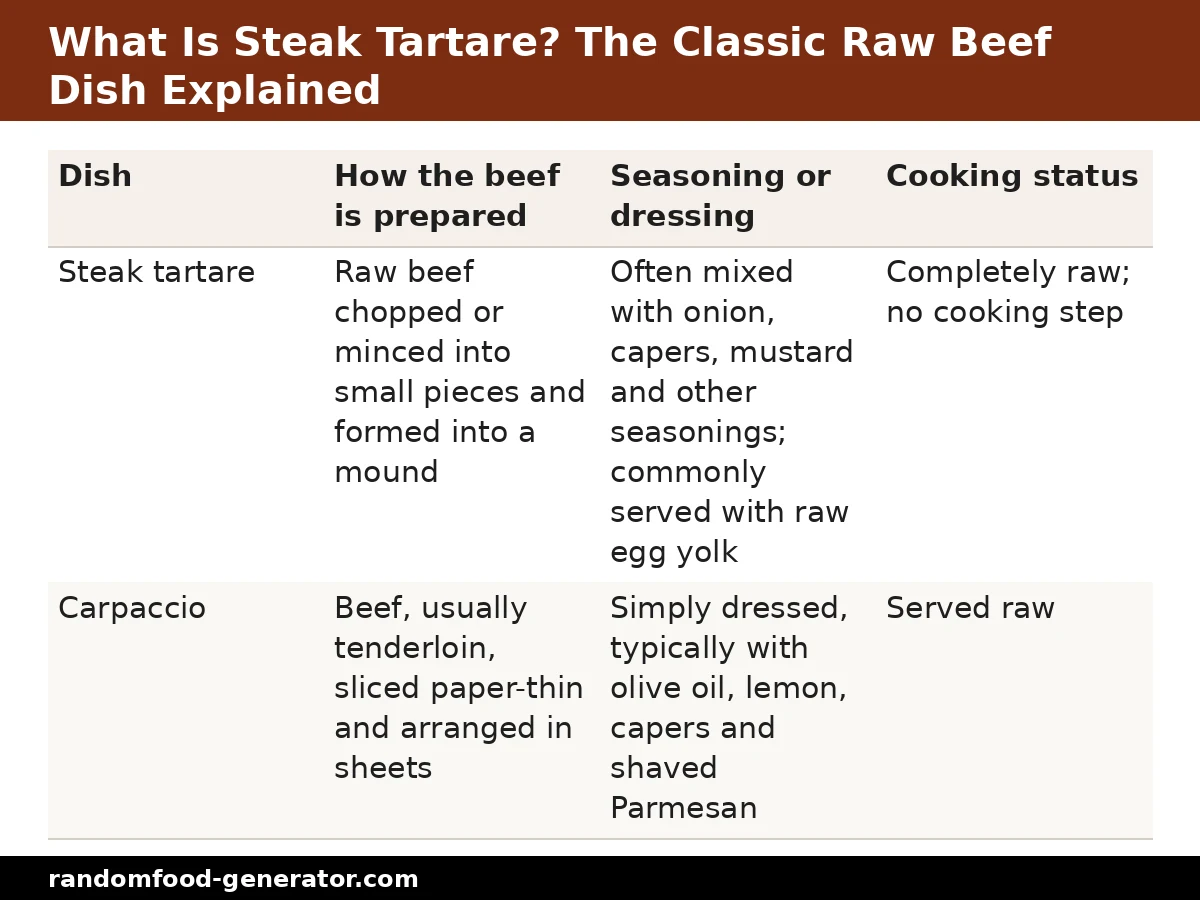
Steak tartare, carpaccio and a rare burger may all be discussed in relation to beef, but they are prepared and served differently. The clearest distinction is the form of the meat: tartare is minced, carpaccio is sliced paper-thin, and a rare burger is cooked ground beef.
| Dish | How the beef is prepared | Seasoning or dressing | Cooking status |
|---|---|---|---|
| Steak tartare | Raw beef chopped or minced into small pieces and formed into a mound | Often mixed with onion, capers, mustard and other seasonings; commonly served with raw egg yolk | Completely raw; no cooking step |
| Carpaccio | Beef, usually tenderloin, sliced paper-thin and arranged in sheets | Simply dressed, typically with olive oil, lemon, capers and shaved Parmesan | Served raw |
| Rare burger | Ground beef shaped into a patty | Seasoned and served as a burger | Cooked, though rare; USDA says ground beef should reach 160 °F |
The difference between steak tartare vs carpaccio is mainly the cut and presentation. Tartare is chopped or minced and more heavily seasoned, producing a richer, more assertive mixture. Carpaccio is sliced into very thin sheets and lightly dressed, giving it a more delicate, beef-forward flavor.
Carpaccio is Italian and is associated with Venice and Harry’s Bar. Accounts of its creation place it between the 1950s and 1963, and the dish was named for the painter Vittore Carpaccio. Tartare is associated with French bistro cooking. In a carpaccio vs tartare comparison, both are served raw, but their textures and dressings are quite different.
A rare burger is different from both because it is cooked. However, USDA’s ground-beef guidance still applies: ground beef should always be cooked to an internal temperature of 160 °F, checked with a food thermometer. A burger that looks brown or pink cannot be judged accurately by color alone.
How to Read the Menu Footnote
In the United States, a menu may mark steak tartare with an asterisk or place it in a section accompanied by a food-safety note. That notice is the FDA Food Code consumer advisory for raw or undercooked animal foods. It is not decorative fine print; it identifies a menu item served raw and reminds customers of the potential foodborne-illness risk.
The advisory has two required parts: a disclosure naming the raw or undercooked item, and a reminder about the increased risk of foodborne illness. Because the Food Code’s guidance specifically names steak tartare and carpaccio as meats traditionally served raw, diners may see the advisory beside either dish.
FAQs
What is steak tartare made of?
Steak tartare is made from raw ground or finely minced beef seasoned with ingredients such as onion, capers, mustard, Worcestershire sauce, salt and pepper. It is commonly served with a raw egg yolk on top or mixed through the beef, along with bread or toast.
Is steak tartare really raw?
Yes. Traditional steak tartare is served completely uncooked. The absence of a cooking step is a defining feature of the dish, and it is why US restaurant menus must carry the FDA consumer advisory for raw or undercooked animal foods.
Is steak tartare safe to eat?
USDA advises against raw meat dishes like tartare because raw ground beef and raw eggs can expose people to E. coli, Salmonella, Listeria and Campylobacter. USDA says ground beef should be cooked to 160 °F. Young children, pregnant women, older adults and people with weakened immune systems should avoid raw or undercooked animal foods.
What does steak tartare taste like?
It is rich and savory, with a soft minced-beef texture. Capers, onion, mustard and Worcestershire sauce add sharp, tangy seasoning, while the egg yolk contributes richness. It is commonly eaten spooned onto toast or bread.
What is the difference between steak tartare and carpaccio?
Steak tartare is minced beef mixed with seasonings and shaped into a mound. Carpaccio is beef sliced paper-thin and simply dressed, typically with olive oil, lemon, capers and Parmesan. Carpaccio has a lighter, more delicate presentation.
Why is it called “tartare”?
The name refers to the Tatars of Central Asia and is also connected with the dish’s early-1900s identity as steak à l’Américaine served with tartar sauce. The story about horsemen tenderizing meat under their saddles is a popular legend, not documented history.