Food in Colombia: Essential Dishes From Bandeja Paisa to Ajiaco
Food in Colombia is not one fixed menu. The country’s cooking changes across Caribbean islands and coastlines, Pacific communities, Andean highlands, the Orinoco plains and the Amazon. That regional variety is the best way to understand Colombian food: a hearty bandeja paisa from Antioquia, ajiaco in Bogotá, coastal arepas, and warm pandebono from Valle del Cauca all belong to the same national food culture without tasting alike.
Popayán has been a UNESCO Creative City of Gastronomy since 2005, a recognition that reflects the importance of food traditions in Colombian cultural life. This guide follows six gastronomic regions, then looks closely at the dishes visitors are most likely to hear about. A regional approach makes food in colombia easier to understand without reducing it to one national recipe. If you enjoy comparing signature dishes around the world, you can also explore this wider guide to the best food in the world.
What is Colombian food? A regional cuisine, not one national recipe
For readers asking what is colombian food, the short answer is a regional collection of local ingredients, everyday home cooking, street snacks and dishes prepared for family gatherings or celebrations. Corn, potatoes, plantain, yuca, rice, beans, meat, fish and fresh herbs appear in different combinations depending on the region. The same dish name can also describe several local versions. Sancocho is the clearest example: it is found across the country, but the meat and details change from place to place.
That is why traditional colombian food is best explored by region instead of treated as a single list of identical recipes. The Andean highlands are associated with dishes such as bandeja paisa and ajiaco; the Caribbean has its own arepa styles and coconut rice; and the Pacific-Andean area around Valle del Cauca is known for pandebono. These differences are part of what makes colombian dishes so varied.
Colombia’s six gastronomic regions
A useful way to organize food in colombia is through six broad gastronomic regions. The names describe large cultural and geographic areas, not rigid borders around every recipe. Some dishes travel nationwide, while others are closely associated with a particular department or city.
- Insular region: the Caribbean islands. It belongs in the national picture alongside the mainland regions and reminds visitors that Colombian food is not limited to inland cities.
- Caribbean region: the northern coast, where arepa de huevo, arroz con coco and coastal versions of sancocho help define the food landscape.
- Pacific region: the western coast, with strong local food traditions; pandebono is associated with Valle del Cauca in the Pacific-Andean area.
- Andean region: the highlands, including Antioquia, Bogotá and Tolima, home to bandeja paisa, ajiaco and lechona tolimense.
- Orinoco region: the eastern plains, also called the Llanos. Sancocho’s regional variations are one way to understand how a nationwide dish changes across areas.
- Amazonian region: the southern Amazon area, another distinct part of the country’s food geography. As with the Orinoco, a single national dish name should not be mistaken for one fixed regional recipe.
Andean food: bandeja paisa, ajiaco and lechona
1. Bandeja paisa: Antioquia’s generous platter
Bandeja paisa is one of the best-known Colombian dishes and is strongly associated with Antioquia and the Paisa region of the Andes. It is a large platter built around red beans and white rice, with ground beef, chicharrón (fried pork belly), chorizo, morcilla (blood sausage), a fried egg, a small arepa, avocado, ripe plantain and hogao, a tomato-and-onion sauce. The plate is visually abundant, with several separate portions arranged together rather than served as one mixed stew.
The dish is linked to the working food traditions of coffee pickers and muleteers, or arrieros, who needed a substantial meal. It is also known as bandeja de arriero or bandeja montañera. Bandeja paisa is often called Colombia’s national dish, but Colombia has no single official national dish. A 2005 proposal to formalize that status faced resistance because the dish was considered too regional to represent the whole country. It is more accurate to call it a celebrated national favorite than an officially designated national dish.
2. Ajiaco santafereño: Bogotá’s chicken and potato soup
Ajiaco is a classic Bogotá dish, usually called ajiaco santafereño. It is a chicken and potato soup made with three potato varieties. The small yellow papa criolla breaks down as it cooks and helps thicken the broth. Corn on the cob and guascas, a distinctive herb, give the soup its characteristic composition.
Ajiaco is traditionally served with cream, capers and avocado, with white rice on the side. The toppings and accompaniments let each diner finish the bowl to taste. On a cool day in the highlands, it is a comforting meal and one of the clearest introductions to Bogotá’s food identity.
TasteAtlas lists bandeja paisa at 4.1 and ajiaco at 4.0 on its Bogotá dishes page. These are ratings attributed to TasteAtlas, not a universal ranking or an official national judgment.
3. Lechona tolimense: a celebration dish from Tolima
Lechona is closely associated with Tolima in the Andean region. It is made from a whole pig roasted and stuffed with rice, peas and pork. It is served in portions, commonly with arepa, and is especially connected with celebrations and Christmas-season eating. Unlike a quick street snack, lechona is a dish that takes preparation and is often shared at a gathering.
4. Changua and tamales tolimenses
Changua is a Bogotá-style breakfast soup made with milk and egg. Its mild, warm character makes it very different from the large, meat-heavy bandeja paisa. Tamales tolimenses are associated with Tolima and are another traditional dish worth recognizing, particularly when exploring regional meals and festive food.
Insular food: the Caribbean islands
The Insular region covers Colombia’s Caribbean islands and is distinct in the six-region framework from the mainland Caribbean coast. It deserves its own place in any overview of Colombian food geography. When exploring island menus, look for local preparations and ask how a dish is made rather than assuming that a mainland specialty represents every island table.
Caribbean food: arepas, empanadas and coconut rice
5. Colombian arepas: three styles to know
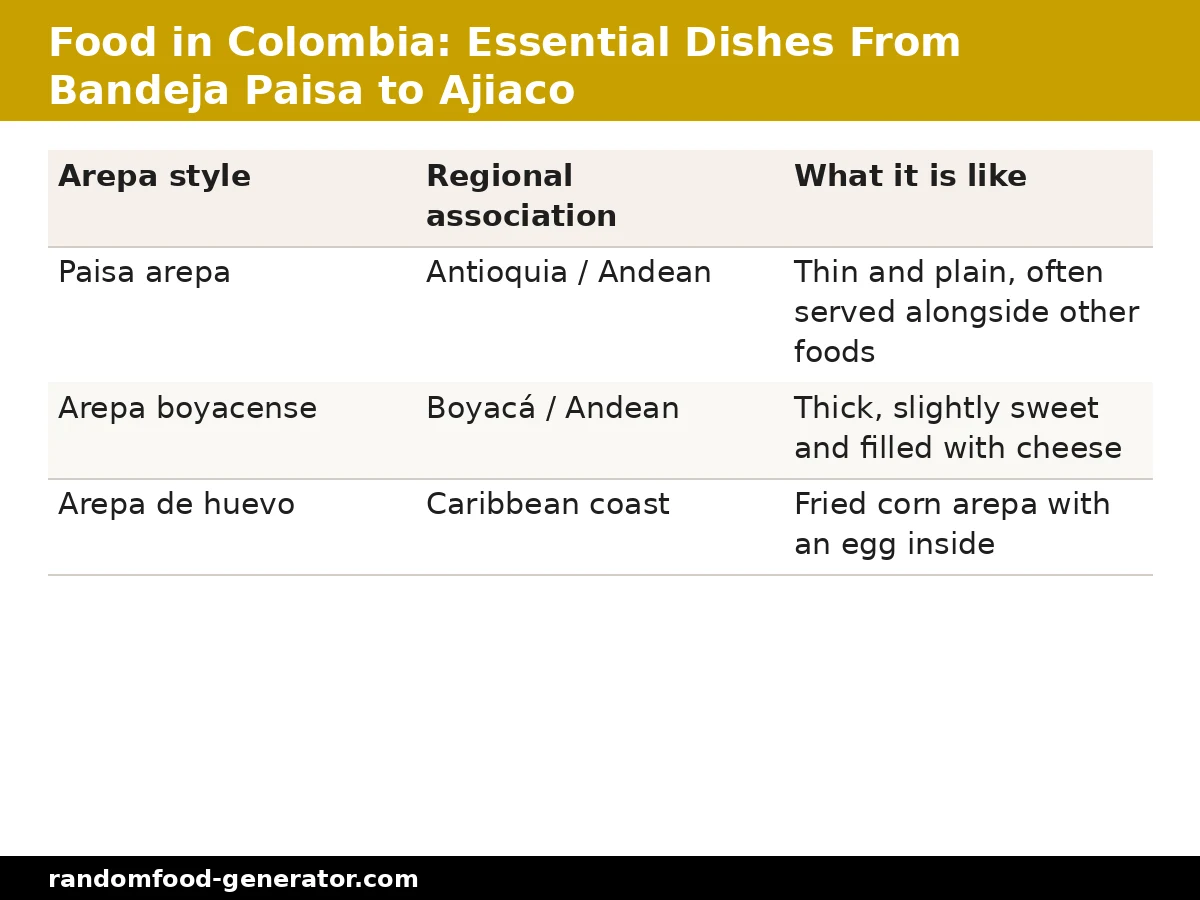
Colombian arepas are corn cakes that may be grilled or fried. They are eaten across the country, but the shape, thickness, sweetness and filling change by region. The thin, plain paisa arepa is associated with Antioquia; the arepa boyacense from Boyacá is thicker, sweet and cheese-filled; and the Caribbean arepa de huevo is a fried corn arepa with an egg inside.
| Arepa style | Regional association | What it is like |
|---|---|---|
| Paisa arepa | Antioquia / Andean | Thin and plain, often served alongside other foods |
| Arepa boyacense | Boyacá / Andean | Thick, slightly sweet and filled with cheese |
| Arepa de huevo | Caribbean coast | Fried corn arepa with an egg inside |
There is no single correct way to describe all colombian arepas. Asking which regional style is being served is more useful than expecting every arepa to look or taste the same.
6. Colombian empanadas: a popular street-food choice
Colombian empanadas are fried turnovers made with corn dough. A typical filling combines seasoned ground beef and potato, although chicken and rice are also used. They are commonly eaten as street food or a snack, with ají picante, a hot sauce served alongside. The sauce gives diners control over the heat rather than making every empanada spicy by default.
7. Sancocho: a soup with regional versions
Sancocho is a hearty soup or stew found throughout Colombia. Depending on the region, it may be made with chicken, beef, pork or fish, with fish versions especially associated with the coasts. Plantain, yuca, potato and corn make it filling. Because every region has its own version, the name describes a family of related dishes rather than one standardized recipe.
That regional flexibility makes sancocho a useful dish to ask about in the Caribbean, Pacific, Orinoco and Amazonian regions. The ingredients and balance of flavors can change with local cooking traditions, so the version served in one place should not be treated as the only authentic one.
8. Arroz con coco and arroz con pollo
Arroz con coco is a Caribbean coconut rice dish and a useful example of how a familiar staple can take on a regional identity. It is a natural accompaniment to coastal meals. Arroz con pollo is another familiar name among Colombian dishes: a chicken-and-rice preparation. It belongs in the wider picture of everyday food alongside more region-specific specialties such as bandeja paisa, ajiaco and lechona.
Pacific food: pandebono and plantain
9. Pandebono: warm cheese bread from Valle del Cauca
Pandebono is a baked cheese bread associated with Valle del Cauca, in the Pacific-Andean area. Its dough is made with cassava, or yuca, starch and cornmeal. The small breads are often eaten warm at breakfast or as a snack, with coffee or hot chocolate. Fresh from the oven, pandebono is valued for its soft, chewy center and cheese flavor.
10. Patacones: fried green plantain
Patacones are made from green plantain that is fried and served as a side. They are eaten on both the Caribbean and Pacific coasts. Their role is simple but important: they add a crisp, starchy element to a meal and show how plantain appears in more than one regional food tradition.
Orinoco food: the Llanos region
The Orinoco region, also known as the Llanos, is the eastern plains. Sancocho’s regional variations illustrate how a nationwide dish changes across Colombia.
Amazonian food: a distinct regional tradition
The Amazonian region is another distinct part of Colombia’s food geography. Local preparations should be explored on their own terms rather than assumed to match dishes from Bogotá or Antioquia. Sancocho remains a nationwide dish family with regional versions, not one fixed recipe.
Breads, snacks and Christmas foods
Pandebono, buñuelos and arepas show how corn, cassava starch and cheese appear in different Colombian snacks. Their shapes and occasions are not interchangeable: one is baked bread, one is a fried cheese fritter, and arepas range from plain griddled cakes to filled or fried versions.
| Food | Regional association | What it is | How it is eaten |
|---|---|---|---|
| Pandebono | Valle del Cauca / Pacific-Andean | Baked cheese bread made with cassava starch and cornmeal | Warm at breakfast or as a snack with coffee or hot chocolate |
| Buñuelos colombianos | Nationwide, especially Christmas season | Round fried cheese fritters made with costeño cheese and corn or cassava starch | Traditionally with natilla |
| Paisa arepa | Antioquia / Andean | Thin, plain corn cake | Served alongside meals |
| Arepa boyacense | Boyacá / Andean | Thick, sweet, cheese-filled corn cake | As a regional snack or accompaniment |
| Arepa de huevo | Caribbean coast | Fried corn arepa with an egg inside | As a coastal snack or street food |
11. Buñuelos colombianos: cheese fritters for the holidays
Buñuelos colombianos are round fried cheese fritters made with costeño cheese and corn or cassava starch. They are especially associated with the Christmas season and are traditionally eaten with natilla, a custard. Their round shape and crisp fried exterior make them easy to recognize among Colombian snacks.
Buñuelos are not the only seasonal food to look for. Lechona, natilla and tamales are also classic Christmas-season choices, with tamales appearing in many regions. These foods are part of the social side of Colombian cooking: they are tied to gatherings and celebrations as much as to everyday meals.
12. Other regional foods worth recognizing
- Hormigas culonas: Santander’s roasted big-bottomed ants, a famous regional delicacy. They are best understood as a specific local food tradition rather than a dish that represents the whole country.
- Hogao: a tomato-and-onion sauce served with dishes such as bandeja paisa.
- Ají picante: hot sauce often served with empanadas, allowing each person to add heat as desired.
- Natilla: a custard traditionally served with buñuelos during the Christmas season.
Is Colombian food spicy?
Generally, Colombian everyday cooking is seasoned rather than intensely hot. Heat often comes from ají picante served on the side, so diners can decide how much to add. That distinction matters when trying colombian food for the first time: a dish may be rich, savory or aromatic without being chili-hot.
What to try first: a simple Colombian food itinerary
For a first taste of food in colombia, begin with one dish that represents the region you are visiting. In Bogotá, try ajiaco santafereño. In Antioquia, choose bandeja paisa if you want a substantial platter. In Tolima, look for lechona. Along the Caribbean coast, compare arepa de huevo with arroz con coco, and try a coastal version of sancocho. In Valle del Cauca, have pandebono warm.
Then add a snack: a corn-dough empanada with ají picante, a buñuelo during the Christmas season, or a patacón alongside a meal. If you want a wider perspective beyond Colombia, return to the guide to the best food in the world and compare how different countries build their food identities around regional specialties.
The most useful question is not which single dish is the best, but which regional version you are trying. Colombian cuisine is diverse by design. Ajiaco, bandeja paisa, sancocho, arepas, lechona, empanadas, pandebono and buñuelos each tell a different part of the story.
FAQs
What is the most famous food in Colombia?
Bandeja paisa from Antioquia is one of the best-known dishes and is often called the national dish. However, Colombia has no single official national dish. Ajiaco from Bogotá is another essential name to know.
What is bandeja paisa made of?
Bandeja paisa is a large platter with red beans, white rice, ground beef, chicharrón, chorizo, morcilla, a fried egg, a small arepa, avocado, ripe plantain and hogao, a tomato-and-onion sauce.
What is ajiaco?
Ajiaco is Bogotá’s chicken and potato soup. It is made with three potato varieties, including papa criolla, along with corn and guascas. It is traditionally served with cream, capers and avocado, with white rice on the side.
Are Colombian arepas all the same?
No. Arepas vary by region. Antioquia is associated with thin, plain paisa arepas; Boyacá with thick, sweet, cheese-filled arepa boyacense; and the Caribbean coast with fried arepa de huevo, which has an egg inside.
What do Colombians eat at Christmas?
Lechona, buñuelos and natilla are classic Christmas-season foods. Tamales are also eaten in many regions during the season.
Is Colombian food spicy?
Generally, no. Everyday Colombian cooking is usually seasoned rather than hot. Ají picante is commonly served on the side, allowing each diner to control how much heat to add.