340 Greek Names That Mean Death: Gods, Spirits, Fates and Fallen Heroes
Introduction
Greek names that mean death are the deepest well in all of dark naming, because the Greeks did not have one god of death — they had an entire civilisation of the dead. Thanatos was death’s gentle face, the Keres his violent sisters, the Fates cut every mortal thread, and below the earth a whole geography of fire-rivers, asphodel meadows, judges, ferrymen and monsters waited for every soul. This list collects 340 of those names, each one listed once and labelled for what it truly is: an attested god or spirit, a hero whose death the poets recorded, a cult title, a Greek vocabulary word, a piece of living folklore — or, in one clearly-marked final section, a modern coinage built on real Greek roots.
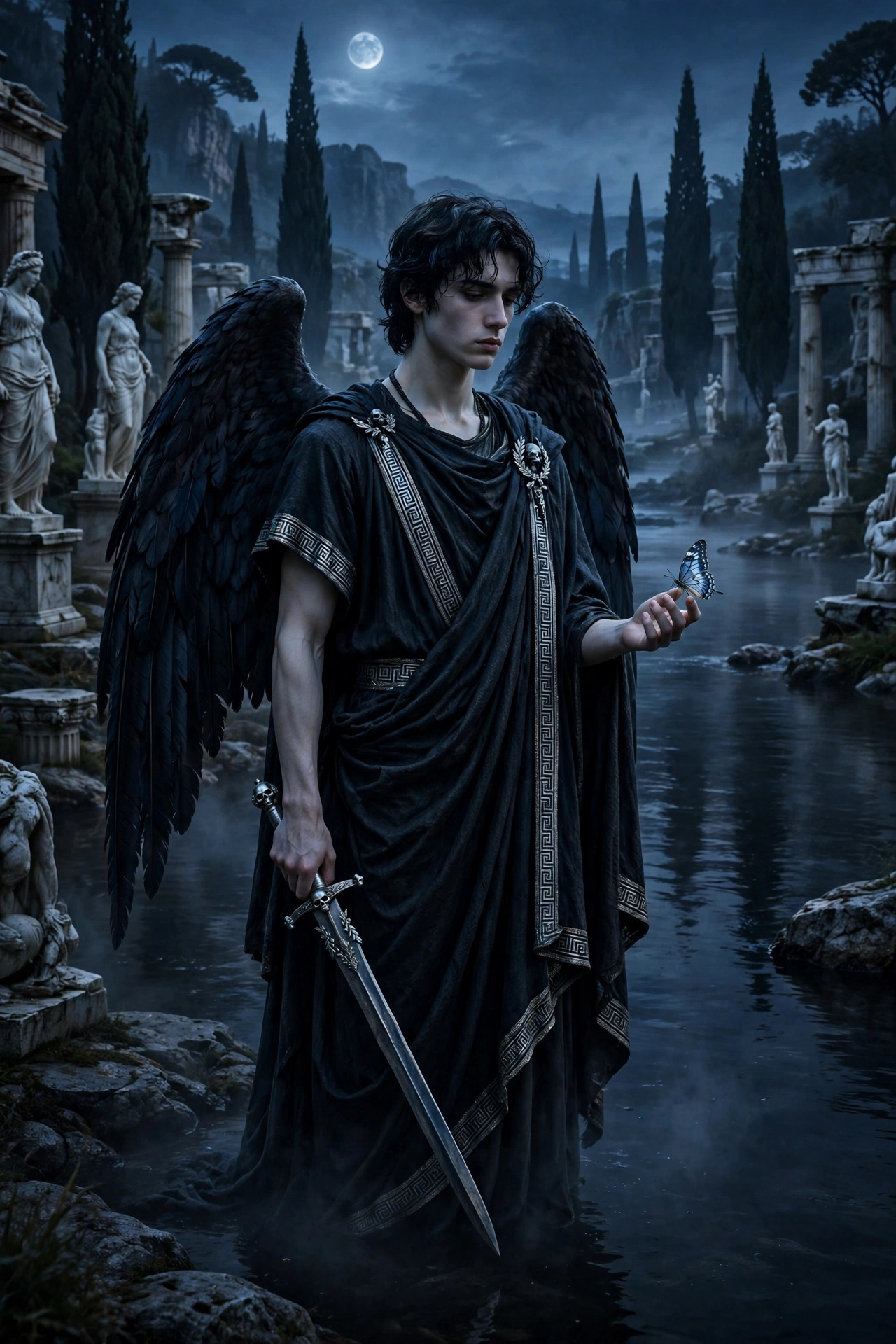
That honesty matters, because death in Greek thought was a family affair. Thanatos was the son of Nyx (Night) and twin of Hypnos (Sleep); his brother Moros was Doom itself. Hesiod’s Theogony gives the family tree of Night’s terrifying children, and you can read more about Thanatos — how the Greeks imagined him with sword and butterfly, cutting a lock of hair from the dying — before you choose. If your interest is wider than Greece, our companion lists cover names that mean death bringer across many cultures and the specifically Japanese tradition in Japanese girl names that mean death.
Quick Picks: The 15 Best Greek Names That Mean Death
The essential fifteen: the names with the strongest mythology, the best sounds and the clearest death meanings in the whole Greek tradition.
| Name | Origin | Meaning |
|---|---|---|
| Thanatos | Greek | Death |
| Hades | Greek | The unseen one |
| Persephone | Greek | Bringer of death (folk etymology: ‘she who destroys the light’) |
| Hecate | Greek | Far-shooting (often glossed) |
| Nyx | Greek | Night |
| Charon | Greek | Fierce brightness (often glossed) |
| Melinoe | Greek | Dark-minded (melas + noos) |
| Moros | Greek | Doom; fate |
| Ker | Greek | Doom; violent death |
| Atropos | Greek | The unturnable |
| Styx | Greek | Hateful; shuddering |
| Lethe | Greek | Forgetfulness; oblivion |
| Nemesis | Greek | Retribution |
| Zagreus | Greek | Great hunter |
| Achlys | Greek | Mist of death |
Greek Gods and Rulers of the Dead
Start with the genuine pantheon of death: the king and queen of the underworld, Death and Sleep as twin brothers, the ferryman, the judges, and the dream-gods who visited the dying. Every name in this section is attested in Greek myth or religion.
| Name | Origin | Meaning | Note |
|---|---|---|---|
| Hades | Greek | The unseen one | King of the dead; his name became the underworld itself |
| Persephone | Greek | Bringer of death (folk etymology: ‘she who destroys the light’) | Queen of the underworld, goddess of spring’s return |
| Thanatos | Greek | Death | The god of death himself, twin brother of Sleep |
| Hypnos | Greek | Sleep | Death’s twin — the Greeks called sleep ‘the brother of death’ |
| Hecate | Greek | Far-shooting (often glossed) | Goddess of ghosts, necromancy and crossroads |
| Zagreus | Greek | Great hunter | Orphic god torn apart and reborn — death and return |
| Melinoe | Greek | Dark-minded (melas + noos) | Ghost-bringing goddess, daughter of Persephone, half dark, half light |
| Macaria | Greek | Blessed one | Daughter of Hades; her name softens death into ‘blessed death’ |
| Hermes | Greek | Boundary marker (often glossed) | As psychopompos he guided souls of the dead to the underworld |
| Morpheus | Greek | Shaper of forms | God of dreams who appeared to the dying in human shape |
| Phobetor | Greek | Frightener | Dream god who took animal shapes in nightmares; also called Icelus |
| Phantasos | Greek | Apparition | Dream god of unreal, phantom objects |
| Epiales | Greek | One who leaps upon | Daimon of nightmares who crushed sleepers’ chests |
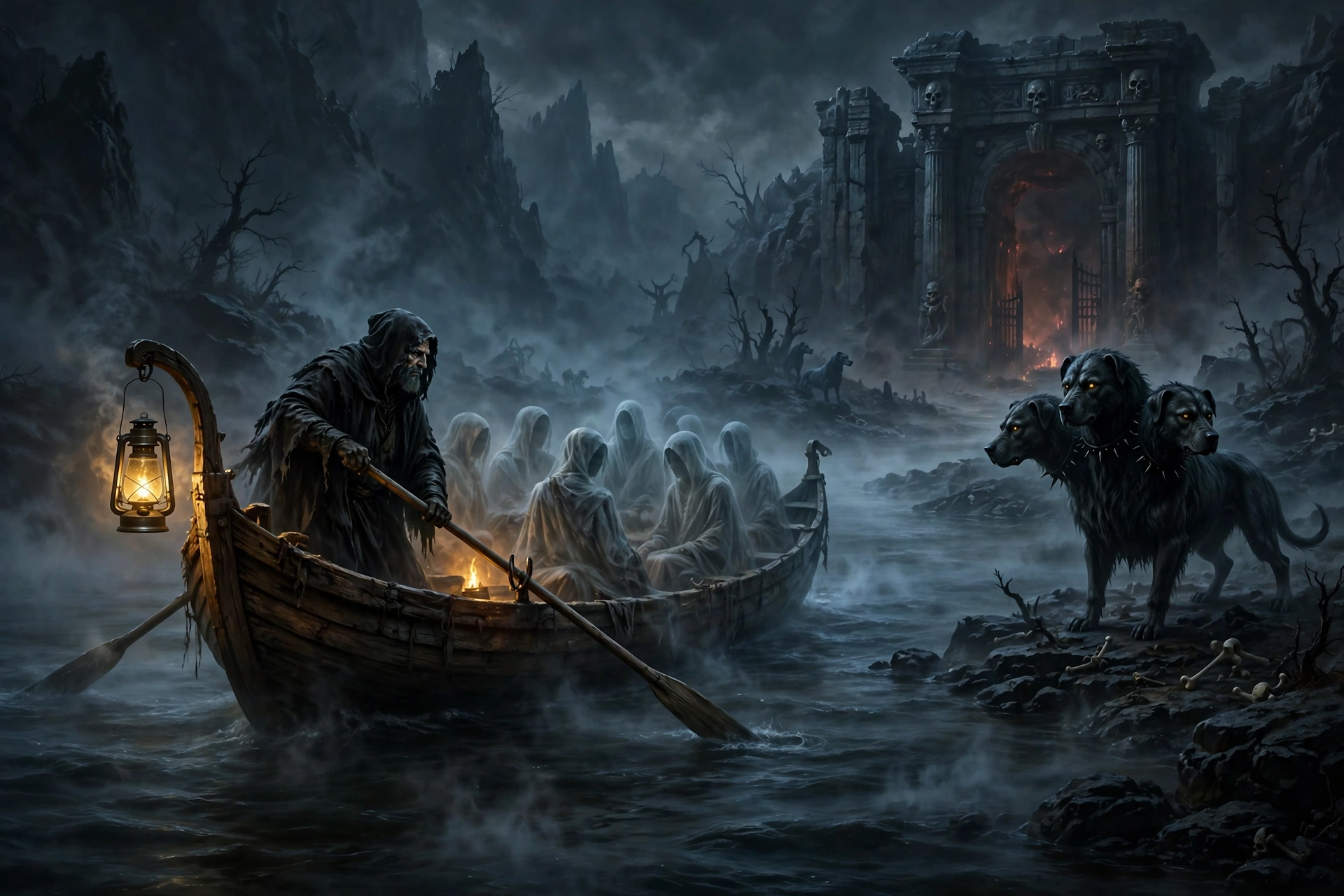
| Charon | Greek | Fierce brightness (often glossed) | Ferryman who rows the dead across the Styx for a coin |
| Minos | Greek | King of Crete | Judge of the dead in the underworld |
| Rhadamanthus | Greek | Showing the rod (judge) | Judge of the dead, famed for inflexible justice |
| Aeacus | Greek | Keeper of the keys | Judge of the dead who held the underworld’s keys |
| Triptolemus | Greek | Thrice-ploughed (often glossed) | Eleusinian hero made a judge of the dead in later myth |
| Ascalaphus | Greek | Owl (name of a gardener) | Underworld gardener turned into a screech owl for testifying against Persephone |
| Erebos | Greek | Darkness | Primordial darkness, father of Aether and Day with Night |
| Nyx | Greek | Night | Primordial Night, mother of Death, Doom and the Fates |
| Tartarus | Greek | The deep pit | Both a primordial god and the abyss beneath the underworld |
| Acheron | Greek | River of pain (achos = anguish) | River god whose waters the dead must cross |
| Styx | Greek | Hateful; shuddering | Goddess-river of the underworld oath — even gods feared to swear falsely by her |
| Serapis | Greco-Egyptian | From Osiris-Apis | Greco-Egyptian god of the afterlife worshipped across the Greek world |
For the female side of this pantheon in more depth, see girl names that mean darkness or death.
Daimones: Greek Spirits of Death, Doom and Suffering
The Greeks personified everything that brings death — doom, pain, famine, lies, old age and battlefield slaughter — as daimones, mostly children of Night and Strife in Hesiod’s Theogony. This is the richest genuine vein of Greek death names, and the one copycat lists barely touch.
| Name | Origin | Meaning | Note |
|---|---|---|---|
| Moros | Greek | Doom; fate | The driving force of doom — brother of Death himself |
| Ker | Greek | Doom; violent death | A death-spirit who feasted on the battlefield dead |
| Oizys | Greek | Misery; woe | Daughter of Night, personified suffering |
| Momus | Greek | Blame; mockery | Son of Night, god of cruel satire |
| Apate | Greek | Deceit | Daughter of Night who walks with lies |
| Geras | Greek | Old age | The withering that leads all mortals to the grave |
| Eris | Greek | Strife | Whose children are Pain, Famine and Murder |
| Ate | Greek | Ruin; delusion | Spirit of blind folly that precedes destruction |
| Dysnomia | Greek | Lawlessness | Daughter of Eris, companion of ruin |
| Horkos | Greek | Oath | The curse that falls on oath-breakers |
| Ponos | Greek | Toil; hardship | Son of Eris in Hesiod’s grim catalogue |
| Limos | Greek | Starvation; famine | The hunger that walks beside death |
| Lethe | Greek | Forgetfulness; oblivion | Daughter of Eris — and the underworld river of forgetting |
| Lupe | Greek | Pain; grief | One of the Algea, the spirits of suffering |
| Ania | Greek | Distress; trouble | An Algea spirit of anguish |
| Achos | Greek | Anguish; grief | The pain-spirit inside the word ‘Acheron’ |
| Penthos | Greek | Grief; mourning | The daimon of lamentation for the dead |
| Phonoi | Greek | Murders | Hesiod’s plural spirits of slaughter, used as a name |
| Machai | Greek | Battles; fights | Spirits of combat in Hesiod’s Theogony |
| Hysminai | Greek | Quarrels; fighting | Battle-spirits, daughters of Eris |
| Androktasiai | Greek | Man-slaughters | The battlefield killing-spirits of the Theogony |
| Neikea | Greek | Quarrels; feuds | Spirits of arguments that end in blood |
| Amphilogiai | Greek | Disputes | Daughters of Eris who contest every word |
| Pseudea | Greek | Lies; falsehoods | Hesiod’s ‘lying words’, children of Strife |
| Achlys | Greek | Mist of death | The cloud that dims the eyes of the dying — older than Chaos in Orphic verse |
| Eurynomos | Greek | Wide-ruling (ironically) | Corpse-eating daimon who stripped flesh from the dead, leaving bones |
| Alastor | Greek | Avenger; the unforgotten | Spirit of blood-feuds and family vengeance |
| Poine | Greek | Retribution; penalty | The spirit of punishment for murder |
| Praxidike | Greek | Exacting justice | Goddess who exacted retribution — also an epithet of Persephone |
| Anaideia | Greek | Ruthlessness; shamelessness | Personified pitilessness, worshipped at Athens |
| Hybris | Greek | Insolent pride | The arrogance that drags heroes to their doom |
| Kakia | Greek | Vice; wickedness | Spirit Heracles rejected at the crossroads |
| Phthonos | Greek | Envy; jealousy | The grudging spirit of ill-will |
| Deimos | Greek | Terror; dread | Son of Ares who panics armies |
| Phobos | Greek | Fear; flight | Deimos’s brother — root of the word ‘phobia’ |
| Enyo | Greek | War; horror | Goddess who delights in the destruction of cities |
| Polemos | Greek | War | Daimon of war itself — ‘war is the father of all’ |
| Kydoimos | Greek | Battle din; confusion | The uproar of the battlefield personified |
| Homados | Greek | Battle noise | The roar and clash of armies as a spirit |
| Proioxis | Greek | Onslaught; pursuit | Battle daimon of the forward charge |
| Palioxis | Greek | Back-flight; retreat | Battle daimon of the rout that follows slaughter |
| Alke | Greek | Battle prowess; strength | Spirit of courage in the press of fighting |
| Ioke | Greek | Pursuit; rout | The spirit of the chase after a broken army |
| Bia | Greek | Force; violence | Silent enforcer of Zeus, sister of Kratos |
| Kratos | Greek | Strength; power | The pitiless might that chained Prometheus |
| Arai | Greek | Curses | Female underworld spirits who carried curses of the wronged dead |
| Olethros | Greek | Destruction; death | In later Greek, doom itself personified |
| Alphito | Greek | Barley-groats | A nursery bogey used to frighten Greek children |
The Fates, Night Goddesses and Doom-Bringers
Above even the death gods stood the weavers of destiny: the three Fates with their thread, spindle and shears, plus the inescapable goddesses and the grey, dread sisters of myth.
| Name | Origin | Meaning | Note |
|---|---|---|---|
| Clotho | Greek | The spinner | Fate who spins the thread of life |
| Lachesis | Greek | The allotter | Fate who measures each life’s thread |
| Atropos | Greek | The unturnable | Fate who cuts the thread — ‘atro-‘ in atropine comes from her |
| Moira | Greek | Fate; one’s allotted portion | The concept of doom itself, used as a modern name |
| Aisa | Greek | Destiny; due portion | Homeric name for fate, sister-concept to Moira |
| Ananke | Greek | Necessity; compulsion | Primordial force even the gods obey |
| Nemesis | Greek | Retribution | Goddess who measured out doom to the proud |
| Adrasteia | Greek | The inescapable | Cult name of Nemesis — she from whom none can flee |
| Rhamnusia | Greek | She of Rhamnous | Nemesis under her great cult title in Attica |
| Heimarmene | Greek | That which is allotted | Fate personified in later Greek philosophy |
| Tyche | Greek | Fortune; chance | The luck that saves or dooms — cities prayed to her |
| Deino | Greek | Terrible; dreadful | One of the Graeae, the grey-born sisters who shared one eye |
| Pemphredo | Greek | Wasp; alarm (often glossed) | Graeae sister, grey from birth |
| Stheno | Greek | Strong; mighty | Elder Gorgon sister, immortal and lethal |
| Euryale | Greek | Far-leaping; wide sea | Gorgon whose scream could shatter stone |
| Medusa | Greek | Guardian (from medein) | The mortal Gorgon whose head killed long after her own death |
| Brimo | Greek | The angry; the terrifying | Cult name of Hecate and Persephone at Pherae |
| Despoina | Greek | The Mistress | Arcadian underworld goddess, daughter of Demeter and Poseidon |
| Angelos | Greek | Messenger | Daughter of Hera in Syracusan lore, driven to the underworld |
| Kore | Greek | Maiden | Persephone’s other great name — the girl who became queen of the dead |
| Asteria | Greek | Of the stars | Titaness who leapt into the sea rather than submit to Zeus |
The thread-cutting theme continues in our list of names that mean fate from cultures around the world.
Underworld Rivers, Realms and Monsters
Greek death had a geography — rivers of fire and wailing, meadows of asphodel — and it had guardians. These names come from the landscape and bestiary of the underworld, from Cerberus at the gate to the Harpies who snatched souls away.
| Name | Origin | Meaning | Note |
|---|---|---|---|
| Cocytus | Greek | Lamentation; wailing | River of tears in the underworld |
| Phlegethon | Greek | Blazing; flaming | River of fire that borders Tartarus |
| Asphodel | Greek | Flower of the dead | The grey meadow where ordinary souls wander |
| Elysium | Greek | The blessed fields | Paradise of heroes in the Greek afterlife |
| Cerberus | Greek | Spotted (folk etymology) | The hound of Hades — three heads, serpent tail, no exits |
| Orthrus | Greek | Morning twilight (often glossed) | Two-headed brother of Cerberus |
| Echidna | Greek | She-viper | Mother of monsters, half woman, half snake |
| Typhon | Greek | Whirlwind; smoke | Father of monsters, buried under Etna |
| Hydra | Greek | Water serpent | The Lernaean serpent that grew two heads for each one cut |
| Chimera | Greek | She-goat | Fire-breathing lion-goat-serpent of Lycia |
| Sphinx | Greek | Strangler (folk etymology) | The riddle-poser who devoured those who failed |
| Lamia | Greek | Throat; gullet | Child-devouring queen turned monster — Greece’s original bogeywoman |
| Empusa | Greek | One-footed | Shape-shifting underworld demon with a leg of bronze and a leg of a donkey |
| Mormo | Greek | Frightful one | The Corinthian bogey who bit naughty children |
| Gello | Greek | Demoness | Ghost who stole children in Greek folklore since Sappho’s day |
| Ladon | Greek | Dragon of the Hesperides | Serpent who guarded the golden apples and never slept |
| Campe | Greek | Crooked one | She-dragon jailer of Tartarus, slain by Zeus |
| Aello | Greek | Storm wind | Harpy who snatched people to the Erinyes |
| Celaeno | Greek | The dark one | Harpy prophetess of Aeneas’s hunger |
| Ocypete | Greek | Swift-flying | Harpy sister, fastest of the snatchers |
| Podarge | Greek | Swift-footed | Harpy mother of Achilles’ immortal horses |
| Scylla | Greek | She who rends | Six-headed terror of the straits of Messina |
| Charybdis | Greek | She who sucks down | The whirlpool that swallowed ships whole |
| Sybaris | Greek | Monster of Delphi | A lamia-like creature hurled into a chasm by Eurybarus |
| Onoskelis | Greek | She-ass’s leg | Beautiful demoness of Greek magic texts who strangled men |

Heroes and Villains Who Died at Troy
The Iliad and Odyssey are, among other things, literature’s greatest casualty list. These are real named figures of the Trojan cycle who died — kings, princes, healers, prophets and foot-soldiers whose deaths Homer and the tragedians recorded.
| Name | Origin | Meaning | Note |
|---|---|---|---|
| Achilles | Greek | Grief of the people (folk etymology) | Greatest Greek hero — chose a short, glorious life and died at Troy |
| Patroclus | Greek | Glory of the father | Achilles’ beloved companion, killed by Hector |
| Hector | Greek | Holding fast | Troy’s champion, killed by Achilles beneath the walls |
| Paris | Greek | Prince of Troy (meaning unknown) | His arrow killed Achilles; he died by Philoctetes’ bow |
| Priam | Greek | King of Troy | Killed at his own altar by Neoptolemus |
| Astyanax | Greek | Lord of the city | Hector’s infant son, thrown from Troy’s walls |
| Troilus | Greek | Son of Troy | Young prince whose death was fated before Troy could fall |
| Protesilaus | Greek | First of the people | First Greek to leap ashore at Troy — and first to die |
| Antilochus | Greek | In place of a warrior (often glossed) | Nestor’s son, died shielding his father from Memnon |
| Sarpedon | Greek | Son of Zeus | Lycian prince whose death Zeus himself mourned with bloody rain |
| Memnon | Greek | Steadfast; resolute | Ethiopian king, dawn’s son, killed by Achilles |
| Penthesilea | Greek | Grief of the people | Amazon queen killed by Achilles, who mourned her beauty |
| Deiphobus | Greek | Fear of the host (often glossed) | Trojan prince killed on the night Troy fell |
| Machaon | Greek | Warrior-surgeon | Healer of the Greek army, killed in battle |
| Cycnus | Greek | Swan | Invulnerable son of Poseidon, strangled by Achilles |
| Asclepius | Greek | To cut open (folk etymology) | God of healing, struck dead by Zeus for raising the dead |
| Neoptolemus | Greek | New war | Achilles’ son, killed at Delphi after Troy’s fall |
| Agamemnon | Greek | Very steadfast | Murdered in his bath by his wife and her lover |
| Cassandra | Greek | She who entangles men (often glossed) | Prophetess no one believed, murdered with Agamemnon |
| Iphigenia | Greek | Strong-born | Sacrificed by her own father at Aulis for a wind |
| Polyxena | Greek | Many strangers (hospitable) | Trojan princess sacrificed on Achilles’ tomb |
| Hecuba | Greek | Queen of Troy | Watched her children die; in one telling became a hound of Hecate |
| Aegisthus | Greek | Goat strength (often glossed) | Agamemnon’s murderer, killed by Orestes |
| Clytemnestra | Greek | Renowned wooer (often glossed) | The axe (or net and dagger) that ended Agamemnon |
| Ajax | Greek | Eagle (or ‘of the earth’) | Driven mad by Athena, he fell on his own sword |
| Glaucus | Greek | Grey-green; gleaming | Lycian captain killed by Ajax |
| Lycaon | Greek | Wolf-man | Priam’s son, cut down unarmed by Achilles |
| Polydorus | Greek | Many gifts | Priam’s youngest son, murdered for gold by his host |
| Simoisius | Greek | Of the river Simois | Trojan youth compared in death to a felled poplar |
| Imbrius | Greek | Of Imbros | Spearman killed by Teucer at Troy |
| Iphition | Greek | Strong one | Trojan warrior killed by Achilles in the river |
| Orsilochus | Greek | Mountain ambush (often glossed) | Cretan twin killed by Aeneas |
| Crethon | Greek | Twin of Orsilochus | Died beside his brother at Aeneas’s hands |
| Adrastus | Greek | Inescapable | Trojan captive executed by Agamemnon |
| Tros | Greek | Founder of Troy | His name lived on in the city he founded |
| Mydon | Greek | Charioteer | Killed by Antilochus at Troy |
| Antiphus | Greek | In return (often glossed) | Son of Priam killed by Agamemnon |
| Iphidamas | Greek | Subduing with strength | Trojan who died far from his bride |
| Leucus | Greek | White; bright | Odysseus’s companion killed at Troy |
| Democoon | Greek | Of the people | Priam’s son killed by Odysseus |
| Antinous | Greek | Opposing mind | First suitor to die by Odysseus’s arrows |
| Eurymachus | Greek | Wide battle | Second great suitor killed in the hall of Ithaca |
| Amphinomus | Greek | On both sides law (often glossed) | The decent suitor who died anyway |
| Leodes | Greek | Lion-man (often glossed) | Suitor and priest beheaded mid-prayer by Odysseus |
| Melanthius | Greek | Black flower | Odysseus’s treacherous goatherd, executed in the Odyssey |
| Ctesippus | Greek | Horse owner | Suitor killed by Philoetius in the hall |
| Thersites | Greek | Bold; audacious | Ugliest man at Troy, beaten — and in later myth killed — by Achilles |
| Dolon | Greek | Crafty; deceitful | Trojan spy caught and killed on a night raid |
| Rhesus | Greek | King (Thracian) | Thracian king murdered in his sleep before he could fight |
| Pandarus | Greek | All-gifted (variant of Pandaros) | The archer who broke the truce, killed by Diomedes |
| Asius | Greek | Of Asia (Trojan ally) | Trojan captain killed by Idomeneus |
| Hypsenor | Greek | Proud; lofty | Trojan priest’s son killed by Eurypylus |
| Atymnius | Greek | Unharmed (ironically) | Beautiful youth killed by Antilochus |
| Maris | Greek | Of the sea (Lycian) | Brother of Atymnius, killed at Troy |
| Thoon | Greek | Swift | Trojan warrior killed by Diomedes |
| Echeclus | Greek | Spear-holder (often glossed) | Trojan killed by Patroclus |
| Deicoon | Greek | Frightening host (often glossed) | Trojan killed by Agamemnon |
| Eurypylus | Greek | Wide gate | Greek hero of the Epigoni cycle, killed by Neoptolemus |
| Podes | Greek | Foot (name of a herald) | Trojan herald killed by Menelaus |
| Coeranus | Greek | Lord; ruler | Lycian charioteer killed saving his king |
| Stichius | Greek | Of the ranks | Athenian captain killed by Hector |
| Arcesilaus | Greek | Defending men | Boeotian captain killed by Hector |
| Menesthes | Greek | Remaining strong (often glossed) | Athenian leader fallen at Troy in the catalogues |
Tragic Figures Who Died in Greek Myth
Beyond Troy, Greek myth is a graveyard of beautiful, terrible deaths: lovers turned to flowers, seers who foresaw their own ends, the Seven against Thebes, and Greece’s most famous ghost story.
| Name | Origin | Meaning | Note |
|---|---|---|---|
| Actaeon | Greek | Hunter of the coast (often glossed) | Torn apart by his own hounds after seeing Artemis bathing |
| Adonis | Greek / Phoenician | Lord | Killed by a boar; his blood became the anemone |
| Hyacinthus | Greek | Hyacinth flower (pre-Greek origin) | Struck dead by Apollo’s discus; became the hyacinth |
| Narcissus | Greek | Numbness; sleep (narke) | Wasted away gazing at his own reflection |
| Echo | Greek | Repeating sound | Faded to a voice after Narcissus’s rejection |
| Icarus | Greek | Follower (often glossed) | Flew too close to the sun and drowned in the sea that took his name |
| Phaethon | Greek | Shining; radiant | Drove the sun chariot and burned the world before Zeus struck him down |
| Orion | Greek | Hunter (meaning debated) | Slain by Artemis or the scorpion, set among the stars |
| Hippolytus | Greek | Looser of horses | Dragged to death by his own horses after Aphrodite’s curse |
| Antigone | Greek | Against birth; worthy of one’s parents | Buried alive for burying her brother |
| Haemon | Greek | Bloody (from haima, blood) | Antigone’s betrothed, who died on her tomb |
| Eteocles | Greek | True glory | Killed his brother Polynices and was killed by him |
| Polynices | Greek | Many strifes | His unburied corpse starts the tragedy of Antigone |
| Jocasta | Greek | Shining moon (often glossed) | Oedipus’s mother and wife, who hanged herself |
| Laius | Greek | Of the people | Oedipus’s father, killed at the crossroads |
| Oedipus | Greek | Swollen foot | Blinded himself when the truth of his birth came out |
| Eurydice | Greek | Wide justice | Orpheus’s wife, lost twice to the underworld |
| Orpheus | Greek | Darkness of the night (often linked) | Torn apart by maenads after failing to rescue Eurydice |
| Linus | Greek | Flax; the dirge-song | Heracles’ music teacher, killed by his own pupil |
| Arachne | Greek | Spider | Hanged herself after Athena destroyed her weaving; became the first spider |
| Niobe | Greek | Snowy (folk link) | Her fourteen children were shot by Apollo and Artemis; she wept into stone |
| Daphne | Greek | Laurel | Turned into a tree to escape Apollo — death of her human form |
| Syrinx | Greek | Pan-pipe reed | Became a reed to escape Pan, who made her into his pipes |
| Leuce | Greek | White poplar | Hades’ first love, who died and became the white poplar of Elysium |
| Minthe | Greek | Mint | Underworld nymph trampled by Persephone into the mint plant |
| Clytie | Greek | Famous (often glossed) | Wasted away watching the sun, becoming the heliotrope |
| Biblis | Greek | Of Byblos | Wept herself into a spring for love of her brother |
| Caeneus | Greek | New; strange | Laphith hero the Centaurs buried alive under fir trees |
| Elpenor | Greek | Man of hope (often glossed) | Odysseus’s youngest man, who fell off a roof and begged for burial in Hades |
| Hylas | Greek | Of the woods | Heracles’ beloved, pulled under by water nymphs and never found |
| Lityerses | Greek | Reaper of Phrygia | Harvest demon who reaped strangers’ heads, killed by Heracles |
| Busiris | Greek | House of Osiris (Egyptian via Greek) | Egyptian king who sacrificed strangers, killed by Heracles |
| Geryon | Greek | War-cry (often glossed) | Three-bodied monster of the far west, killed by Heracles |
| Antaeus | Greek | Opponent | Giant who drew strength from the earth, lifted and crushed by Heracles |
| Talos | Greek | Sun; bronze man | Bronze giant of Crete who bled out his single vein of ichor |
| Perdix | Greek | Partridge | Daedalus’s nephew, thrown from the Acropolis and changed into a partridge |
| Aesacus | Greek | Branch of myrtle (often glossed) | Threw himself into the sea grieving his dead wife; became a diver bird |
| Meleager | Greek | Of the hunt (often glossed) | His life was bound to a brand; when it burned, he died |
| Ancaeus | Greek | Embrace (often glossed) | Argonaut killed by the Calydonian boar |
| Castor | Greek | Beaver; excellence (disputed) | The mortal Dioscurus — his death split the twins between earth and sky |
| Lynceus | Greek | Lynx-eyed | Sharpest sight in the world; killed with his brother Idas fighting the Dioscuri |
| Tydeus | Greek | Of Tydeus (patronymic) | One of the Seven against Thebes; died gnawing his killer’s skull in Athena’s disgust |
| Capaneus | Greek | Of the chariot (often glossed) | Struck by Zeus’s lightning mid-blasphemy on Thebes’ wall |
| Amphiaraus | Greek | Double-cursed (often glossed) | Seer who foresaw his death at Thebes and was swallowed by the earth |
| Parthenopaeus | Greek | Virgin-faced | Beautiful son of Atalanta, killed at Thebes |
| Hippomedon | Greek | Horse-ruler | One of the Seven, killed beneath Thebes’ walls |
| Eteoclus | Greek | True glory (variant root) | First of the Seven to die at Thebes |
| Mecisteus | Greek | Greatest (superlative) | Argive hero killed at Thebes |
| Melanippus | Greek | Black horse | Theban who mortally wounded Tydeus and died by Amphiaraus |
| Idmon | Greek | Knowing one | Argonaut seer who sailed knowing he would die |
| Tiphys | Greek | Helmsman of the Argo | Died of sickness mid-voyage in the Argonautica |
| Canthus | Greek | Corner of the eye (name of an Argonaut) | Argonaut killed in Libya |
| Mopsus | Greek | Seer (name disputed) | Argonaut prophet who died of a snakebite in Libya |
| Aeson | Greek | Father of Jason | Drank bull’s blood (or was driven to it) fleeing Pelias |
| Pelias | Greek | King of Iolcus | Boiled in a pot by his own daughters at Medea’s trick |
| Absyrtus | Greek | Brother of Medea | Murdered and dismembered by his sister to slow pursuit |
| Creusa | Greek | Princess; ruler | Jason’s bride, burned alive in Medea’s poisoned robe |
| Alcestis | Greek | Strength; valiant | Died in her husband’s place, wrestled back from Death by Heracles |
| Laodamia | Greek | Tamer of the people | Leapt into the fire after her dead husband Protesilaus |
| Evadne | Greek | Pleasing (often glossed) | Threw herself on her husband Capaneus’s funeral pyre |
| Archemorus | Greek | Beginner of doom | The baby Opheltes, killed by a serpent — his games became the Nemean Games |
| Acrisius | Greek | King of Argos | Killed by his own grandson Perseus’s discus, as prophesied |
| Erechtheus | Greek | Earth-shaker (name of a king) | Athenian king struck down by Poseidon after sacrificing his daughter |
| Pyramus | Greek / Babylonian via Greek | Fire (folk link) | Died by his own sword beneath the mulberry — Greek myth’s Romeo |
| Thisbe | Greek / Babylonian via Greek | Meaning uncertain | Followed Pyramus in death in the Babylonian-Greek love tragedy |
| Philinnion | Greek | Little beloved | The famous revenant of Phlegon of Tralles — Greek literature’s best-documented ghost |
Greek Word Names for Death, Grave, Shadow and Ashes
These are real Greek vocabulary words connected to death, offered honestly as word names rather than traditional given names — the same transparent approach we use for modern coinages below. Several (Psyche, Melaina) double as attested names or cult words.
| Name | Origin | Meaning | Note |
|---|---|---|---|
| Nekros | Greek | Corpse; the dead | Greek word name — labelled honestly as a word, not a traditional name |
| Skia | Greek | Shadow; shade of the dead | The word for a ghost’s shadow in Greek epic |
| Spodos | Greek | Ashes | The ashes of the funeral pyre as a name |
| Taphos | Greek | Grave; tomb; funeral | Root of the word ‘epitaph’ |
| Mnema | Greek | Tomb; memorial | The monument that keeps a name alive |
| Sema | Greek | Sign; grave marker | The marker on a hero’s tomb in the Iliad |
| Konis | Greek | Dust; ashes | ‘Dust to dust’ in Greek |
| Choe | Greek | Funeral libation | The drink offering poured for the dead |
| Skotos | Greek | Darkness; gloom | The darkness of the underworld as a word |
| Zophos | Greek | Gloom; westward darkness | The murk under the earth where the sun never comes |
| Eidolon | Greek | Phantom; image of the dead | Helen’s phantom went to Troy; Odysseus saw the eidola of heroes |
| Phasma | Greek | Apparition; ghost | Source of the word ‘phantasm’ |
| Nekyia | Greek | Rite of summoning the dead | The title of Odyssey Book 11, where Odysseus calls up the dead |
| Tainaron | Greek | Cape Taenarum | The headland cave said to be an entrance to Hades |
| Aornos | Greek | Birdless | The lake (Greek Aornos, Roman Avernus) whose fumes killed birds — an entrance to the dead |
| Melaina | Greek | Black (feminine) | Used in cult for Black Demeter of the underworld mysteries |
| Kelainos | Greek | Black; dark (masculine) | Epithet form used of dark gods and horses of Hades |
| Skoteini | Modern Greek | Dark (feminine) | Modern Greek word name — labelled modern |
| Mavros | Modern Greek | Black | Modern Greek word and surname, used here as a name |
| Oneiron | Greek | Dream | The dream that visits like a messenger from the dead |
| Psyche | Greek | Soul; breath | The soul herself, beloved of Eros — the part that survives death |
| Soros | Greek | Funeral urn; coffin | The vessel of the ashes in Greek burial |
| Kenos | Greek | Empty; void | The emptiness death leaves — word name |
| Threnos | Greek | Dirge; lament | The sung lament for the dead; root of ‘threnody’ |
| Algos | Greek | Pain | Singular of the Algea, the pains |
| Nosos | Greek | Disease; sickness | The Greek word behind ‘nosology’ |
| Loimos | Greek | Plague; pestilence | Personified in tragedy as death that empties cities |
Epithets and Cult Names of the Dark Gods
Greek gods of death were called by many names in worship — euphemisms and cult titles used at real sanctuaries. We list them separately and label them as what they are: alternate cult names of Hades, Persephone, Hecate and their circle, not separate people.
| Name | Origin | Meaning | Note |
|---|---|---|---|
| Aidoneus | Greek | Hades under his oldest cult name | The name used in early Greek religion for the lord of the dead |
| Plouton | Greek | The wealthy one | Hades as giver of the earth’s riches — source of Roman ‘Pluto’ |
| Klymenos | Greek | The renowned one | Euphemistic cult name for Hades at Hermione |
| Polydegmon | Greek | Receiver of many | Hades as host of all the dead |
| Eubouleus | Greek | Of good counsel | Chthonic cult title shared by Hades and Zeus of the underworld |
| Agesilaos | Greek | Leader of peoples | Cult epithet of Hades, marshalling the nations of the dead |
| Katachthonios | Greek | The subterranean one | Epithet form, as in Zeus Katachthonios of the world below |
| Leptynis | Greek | Orphic epithet of Persephone | A rare name from the Orphic Hymns |
| Enodia | Greek | Of the roads; at the crossroads | Hecate where three roads meet — where the dead were left offerings |
| Trioditis | Greek | Of the three ways | Hecate of the crossroads, haunt of ghosts |
| Kleidouchos | Greek | Holder of the keys | Hecate who holds the keys of Hades |
| Phosphoros | Greek | Light-bearer | Hecate (and the morning star) carrying torches through the dark |
| Mene | Greek | Moon | The moon goddess form, kin to Hecate and Selene |
| Smintheus | Greek | Of the mice; plague-bringer | Apollo Smintheus, whose arrows opened the Iliad with plague and death |
| Enyalios | Greek | Warlike | Ares under his oldest war-name, sometimes a separate god |
| Daeira | Greek | The knowing one | Eleusinian goddess of the mysteries, linked to the underworld |
| Chtonia | Greek | Of the earth; of the underworld | Demeter Chthonia — the earth that receives the dead |
| Skotia | Greek | The dark one | Aphrodite Skotia, worshipped at Sparta beside tombs |
| Epitymbia | Greek | She upon the tombs | Aphrodite ‘of the tombs’, a genuinely attested death-side cult name |
| Antaia | Greek | She who meets; the encountering | Epithet of Demeter and Hecate, who meet the traveller on dark roads |
Modern Greek Names and Folklore Figures
Death never left Greek culture: modern folklore still sends Charos riding for souls, and modern Greek naming keeps both the dark figures and the names that answer them, like Anastasia, ‘resurrection’.
| Name | Origin | Meaning | Note |
|---|---|---|---|
| Charos | Modern Greek | Death personified | In modern Greek folklore Charos rides out to take souls — Thanatos’s living descendant |
| Charontas | Modern Greek | Charon (folklore form) | The ferryman’s name in modern Greek folk song |
| Thanos | Modern Greek | Short for Athanasios, ‘immortal’ | Honest note: the root means immortal — the death association is modern pop culture |
| Athanasios | Greek | Immortal | The full saint’s name behind Thanos; included for honesty’s sake |
| Anastasia | Greek | Resurrection | The name that answers death — hugely popular in Greece and beyond |
| Anestis | Greek | Resurrected one (masculine) | Masculine counterpart of Anastasia |
| Lazaros | Greek | Lazarus — ‘God has helped’ | The man raised from the dead after four days in the tomb |
| Melanthi | Modern Greek | Black flower | A genuine modern Greek girl’s name with a funereal beauty |
| Mavroudis | Modern Greek | Dark; blackish one | Modern Greek masculine name built on mavros, black |
Modern Coinages from Greek Death Roots — Clearly Labelled
To be fully transparent: the names in this final section are modern inventions built on real Greek roots (nekros ‘dead’, Moros ‘doom’, Ker ‘violent death’, Nyx ‘night’, Erebos ‘darkness’, Lethe ‘oblivion’). Other lists mix names like these in silently and pretend they are ancient. We think they can be beautiful — for characters, stories and games — but you deserve to know exactly what they are.
| Name | Origin | Meaning | Note |
|---|---|---|---|
| Nekara | Greek-rooted (modern coinage) | From nekros, the dead | Modern coinage — labelled honestly, not an ancient name |
| Nekira | Greek-rooted (modern coinage) | From nekros, the dead | Modern feminine coinage on the nekros root |
| Nekon | Greek-rooted (modern coinage) | From nekros, the dead | Short masculine coinage |
| Nekris | Greek-rooted (modern coinage) | From nekros, the dead | Coinage echoing Greek -is name endings |
| Nekrosia | Greek-rooted (modern coinage) | From nekros, the dead | Elaborate fantasy coinage on the nekros root |
| Nekton | Greek-rooted (modern coinage) | From nekros, the dead | Compact coinage; also a real word for swimming sea-life |
| Nekana | Greek-rooted (modern coinage) | From nekros, the dead | Soft-sounding coinage on a hard root |
| Morian | Greek-rooted (modern coinage) | From Moros, doom | Modern coinage on the name of Doom himself |
| Moriana | Greek-rooted (modern coinage) | From Moros, doom | Feminine expansion of the Moros root |
| Morik | Greek-rooted (modern coinage) | From Moros, doom | Short, sharp coinage |
| Moria | Greek-rooted (modern coinage) | From Moros, doom | Also Tolkien’s mine of doom — fantasy coinage |
| Morvain | Fantasy (modern coinage) | From Moros, doom | Fantasy-style coinage, labelled as such |
| Morvane | Fantasy (modern coinage) | From Moros, doom | Softer fantasy variant, modern invention |
| Keralin | Greek-rooted (modern coinage) | From Ker, violent death | Coinage on the Keres, the death-spirits |
| Kerana | Greek-rooted (modern coinage) | From Ker, violent death | Feminine coinage on the Ker root |
| Keris | Greek-rooted (modern coinage) | From Ker, violent death | Short coinage echoing Eris |
| Kerova | Greek-rooted (modern coinage) | From Ker, violent death | Slavic-flavoured coinage on a Greek root |
| Nyxia | Greek-rooted (modern coinage) | From Nyx, night | Modern coinage on the name of Night |
| Nyxara | Greek-rooted (modern coinage) | From Nyx, night | Elaborate feminine coinage |
| Nyxon | Greek-rooted (modern coinage) | From Nyx, night | Masculine coinage on the Nyx root |
| Nyxley | English (modern coinage) | From Nyx, night | Surname-style modern coinage |
| Nyxian | Greek-rooted (modern coinage) | Of Nyx, of the night | Adjectival coinage used as a name in fantasy |
| Nyxelle | Greek-rooted (modern coinage) | From Nyx, night | French-flavoured modern coinage |
| Nyktos | Greek-rooted (modern coinage) | From nyx / nyktos, night | Built on the Greek genitive of night — coinage |
| Nyktia | Greek-rooted (modern coinage) | From nykt-, night | Feminine coinage on the night root |
| Erebia | Greek-rooted (modern coinage) | From Erebos, darkness | Coinage; also a genus of dark butterflies |
| Erebon | Greek-rooted (modern coinage) | From Erebos, darkness | Masculine coinage on the darkness root |
| Erebella | Greek-rooted (modern coinage) | From Erebos, darkness | Romanticised coinage, clearly modern |
| Skotara | Greek-rooted (modern coinage) | From skotos, darkness | Coinage on the word for underworld gloom |
| Skotian | Greek-rooted (modern coinage) | From skotos, darkness | Adjectival coinage as a name |
| Skotessa | Greek-rooted (modern coinage) | From skotos, darkness | Feminine coinage with a Greek -essa ending |
| Letha | Greek-rooted (modern coinage) | From Lethe, forgetfulness | Coinage on the river of oblivion |
| Lethan | Greek-rooted (modern coinage) | From Lethe, forgetfulness | Masculine coinage on the Lethe root |
| Lethia | Greek-rooted (modern coinage) | From Lethe, forgetfulness | Feminine coinage on the Lethe root |
| Lethon | Greek-rooted (modern coinage) | From Lethe, forgetfulness | River-name style coinage |
| Lethara | Greek-rooted (modern coinage) | From Lethe, forgetfulness | Elaborated coinage on the river of the dead |
| Styxia | Greek-rooted (modern coinage) | From Styx, the hateful river | Coinage on the underworld’s great oath-river |
| Stygian | Greek-rooted (modern coinage) | Of the Styx; hellish | A real English adjective used as a name — labelled a coinage |
| Achlya | Greek-rooted (modern coinage) | From Achlys, mist of death | Coinage on the death-mist spirit |
| Achlysia | Greek-rooted (modern coinage) | From Achlys, mist of death | Extended coinage on the Achlys root |
| Thana | Greek-rooted (modern coinage) | From Thanatos, death | Simple modern coinage — not an ancient Greek name |
| Thanik | Greek-rooted (modern coinage) | From Thanatos, death | Short coinage on the death root |
| Kelaina | Greek-rooted (modern coinage) | Feminine of Kelainos, black | Plausible feminine form — a coinage, not attested |
| Oneira | Greek-rooted (modern coinage) | Dreams (plural of oneiron) | The dream-world as a name — coinage |
| Phasmara | Greek-rooted (modern coinage) | From phasma, apparition | Coinage on the Greek word for a ghost |
| Skiara | Greek-rooted (modern coinage) | From skia, shade | Coinage on the word for a dead soul’s shadow |
| Spodia | Greek-rooted (modern coinage) | From spodos, ashes | Coinage on the ashes root |
| Taphia | Greek-rooted (modern coinage) | From taphos, grave | Coinage on the tomb root |
| Mnemara | Greek-rooted (modern coinage) | From mnema, memorial tomb | Coinage on the memorial root |
| Erethos | Greek-rooted (modern coinage) | Darkness-flavoured invention | Free fantasy coinage — included and labelled as pure invention |
How to Choose a Greek Name That Means Death
Decide how literal you want to be. Thanatos, Ker and Moros mean death and doom outright; Persephone, Hecate and Melinoe carry the underworld by association and myth; and names like Charon, Clotho or Achlys are connoisseur picks whose meanings reward anyone who asks. For a child, the association-level names (Persephone, Thanatos softened in modern Greek use, Melinoe, Charon) wear best; for a character, pet or creative project, the daimones offer unlimited atmosphere.
Check the label. This list separates attested myth names from cult epithets, Greek word names and modern coinages so you never pass off an invention as an ancient name. If authenticity is your priority, stay in the first six sections. If sound is your priority, the coinage section is honest about what it is — and several coinages, like Nyxia and Nekara, are genuinely striking.
Learn the pronunciation before you commit: Thanatos is THAN-uh-toss, Melinoe is mel-IN-oh-ee, Hecate is HEK-uh-tee (or he-KAH-tee in some traditions), Lethe is LEE-thee, and Persephone is per-SEF-oh-nee. A name this storied deserves to be said right. For boys specifically, our list of boy names that mean death or darkness gathers the strongest masculine picks from every culture.
Frequently Asked Questions
What is the Greek name for death itself?
Thanatos — both the Greek word for death and its god, the twin brother of Hypnos (Sleep) and son of Nyx (Night). For violent death specifically, the word and spirit is Ker; for doom, Moros.
What are good Greek girl names that mean death?
Persephone (queen of the dead), Melinoe (the ghost-bringing goddess), Hecate (goddess of ghosts), Ker, Atropos and Lachesis (the Fates), Achlys (the mist of death) and Despoina are the strongest attested choices, each with real mythology behind her.
What are good Greek boy names that mean death?
Thanatos, Hades, Moros, Charon, Zagreus and Thanatos’s twin Hypnos lead the list, with fallen heroes like Achilles, Hector and Patroclus offering a more wearable, story-driven kind of darkness.
Are names like Thanara or Thanarion real Greek names?
No. Derivatives like those are modern inventions built on the Thanatos root; ancient Greek sources do not attest them. Our final section includes modern coinages too, because they can be lovely for fiction — but we label them as coinages instead of presenting them as ancient names.
Who are the Keres, and why do they matter for death names?
The Keres are female death-spirits of violent death — sisters of Thanatos who haunted battlefields and drank the blood of the fallen. Ker (singular) and coinages honestly built on the root, like Kerana, derive from them. They are the darker counterpart to Thanatos’s peaceful passing.
Conclusion
No culture named death more thoroughly than Greece: its gods and spirits, its rivers and monsters, its Fates with their shears, and hundreds of heroes whose deaths became immortal stories. These 340 Greek names that mean death are organised so you can choose with your eyes open — ancient where ancient matters, modern where modern is honestly labelled, and always with the real meaning attached.