400 Names That Mean Puppet: Marionette, Doll and Puppet-Theatre Names
Introduction
Somewhere tonight, a child is being put to bed by a puppet: a frog on a television screen, a wooden boy in a storybook, a shadow hero flickering on a Javanese screen. Puppets are humanity’s oldest actors, and their names — Pinocchio, Guignol, Petrushka, Karagöz — are among the most story-soaked names in the world.
This list is built from the real puppet stock, and that is what makes it different. There are no invented names welded together from puppet-sounding stems. Every entry below is a genuine puppet, doll, character, tradition figure or puppet-word with a checkable home: the commedia masks of Italy, the wayang heroes of Java, the bunraku lovers of Osaka, the booth troupe of Punch and Judy, the great ventriloquist dummies, the Muppets, and the names that mean doll traditions of forty cultures. Every name appears exactly once.
Start with the Quick Picks for the immortals. Go to the word-name tables if you want a name that literally means puppet or doll, and to the puppet masters’ table if the person behind the curtain is your hero.
Quick Picks: The 15 Best Names That Mean Puppet
| Name | Origin | Meaning |
|---|---|---|
| Pinocchio | Italian | The wooden puppet who wanted to be a real boy |
| Guignol | French | Lyon’s beloved hand puppet and silk-weaver hero |
| Punch | English | The hook-nosed star of Punch and Judy |
| Judy | English | Punch’s wife and partner in the booth |
| Petrushka | Russian | Russia’s mischievous glove-puppet clown |
| Karagöz | Turkish | The shadow-puppet trickster; his name means black eye |
| Hacivat | Turkish | Karagöz’s learned, pompous partner |
| Pulcinella | Italian | The original commedia puppet clown, ancestor of Punch |
| Pierrot | French | The sad white-faced clown of the puppet stage |
| Arlecchino | Italian | Harlequin, the acrobatic servant of commedia |
| Kasperle | German | Germany’s cheeky puppet hero |
| Geppetto | Italian | Pinocchio’s maker, the puppet master himself |
| Marion | French | Little Mary; the name inside the word marionette |
| Matryoshka | Russian | The nesting doll; her name means little mother |
| Bambola | Italian | Doll |
Commedia dell’Arte: The Original Puppet Masks
Italian commedia dell’arte gave the world its puppet archetypes: half the glove puppets of Europe are these masked servants, masters and lovers in local dress. Pulcinella, Pierrot and Arlecchino are in the Quick Picks; the rest of the troupe is here.
| Name | Origin | Meaning | Note |
|---|---|---|---|
| Pantalone | Italian | The miserly old master | The red-trousered Venetian merchant of commedia |
| Dottore | Italian | The doctor | The pompous, word-drunk Doctor of Bologna |
| Capitano | Italian | The captain | The braggart soldier who runs from every fight |
| Colombina | Italian | Little dove | The clever servant girl, commedia’s quickest wit |
| Brighella | Italian | The schemer | The sly, guitar-playing servant of Bergamo |
| Tartaglia | Italian | The stutterer | The shortsighted, stammering mask |
| Pedrolino | Italian | Little Peter | The naive servant from whom Pierrot descends |
| Mezzetino | Italian | Half-measure | The cunning servant in motley stripes |
| Truffaldino | Italian | The trickster | Goldoni’s servant of two masters |
| Coviello | Italian | The dancer | The acrobatic Neapolitan mask |
| Fracassa | Italian | The smasher | A blustering variant of the Captain |
| Beltrame | Italian | The simpleton | Milan’s foolish husband mask |
| Giangurgolo | Italian | Johnny Gobbler | Calabria’s big-nosed, gluttonous mask |
| Stenterello | Italian | Little hardship | Florence’s chattering puppet favourite |
| Meneghino | Italian | The Milanese servant | Milan’s beloved puppet mask |
| Gianduja | Italian | Johnny Joy | Turin’s honest, wine-loving puppet hero |
| Fagiolino | Italian | Little bean | Bologna’s quick-witted puppet servant |
| Sandrone | Italian | The boor | Modena’s rough-mannered puppet mask |
| Rugantino | Italian | The bully | Rome’s swaggering puppet tough |
| Cassandro | Italian | The old man | Siena’s foolish elder mask |
| Pagliaccio | Italian | The clown; straw man | The clown of Leoncavallo’s opera |
| Scaramouche | Italian / French | The skirmisher | The black-clad rascal of commedia and pantomime |
| Burattino | Italian | Puppet; jumping jack | The Italian word for a puppet, also a stage figure |
| Isabella | Italian | The lover | The innamorata, commedia’s leading lady |
| Flaminia | Italian | The lover | A classic innamorata name |
| Silvia | Italian | The lover | Another traditional innamorata name |
| Lelio | Italian | The lover | The leading innamorato of the troupe |
| Florindo | Italian | The lover | The young hero opposite the innamorata |
Punch and Judy: The Booth Troupe
Mr Punch arrived in England in 1662 and never left. A traditional booth show still uses the same supporting cast it has for three centuries — all of them usable, story-soaked names.
| Name | Origin | Meaning | Note |
|---|---|---|---|
| Joey | English | The clown | Joey the Clown, Punch’s cheerful friend; ‘joey’ became slang for any clown |
| Toby | English | The dog | Toby the Dog, the only ‘real’ animal actor in the booth, wore a ruff |
| Hector | English | The horse | Hector the Horse, Toby’s partner in the show |
| Polly | English | Pretty Polly | The pretty girl of the traditional show |
| Jack Ketch | English | The hangman | Named for the real 17th-century executioner |
| Doctor | English | The doctor | The quack who revives Punch with a stick, not medicine |
| Constable | English | The policeman | The officer forever failing to arrest Punch |
| Bobby | English | The policeman | The constable’s nickname in many booth scripts |
| Devil | English | The devil | The Devil who comes to carry Punch off — and loses |
| Crocodile | English | The crocodile | The famous sausage-stealing crocodile of the booth |
| Beadle | English | The church officer | The pompous beadle of traditional scripts |
Folk Puppets of Europe
Every European country has its own booth hero, most of them direct cousins of Pulcinella: Prague’s Spejbl, Vienna’s Hanswurst, Ghent’s Pierke and the Greek shadow hero Karagiozis.
| Name | Origin | Meaning | Note |
|---|---|---|---|
| Spejbl | Czech | The father | Prague’s famous wooden father puppet, created in 1920 |
| Hurvinek | Czech | The son | Spejbl’s mischievous son, a Czech national treasure |
| Manicka | Czech | The friend | Written Mánička; Hurvinek’s clever friend |
| Zeryk | Czech | The dog | The Skupa puppets’ faithful dog |
| Katerina | Czech | The grandmother | Mánička’s grandmother in the Spejbl shows |
| Kasper | German | The puppet hero | The full form behind Kasperle in the Quick Picks |
| Seppl | German | The friend | Kasper’s loyal, slow-witted companion |
| Hanswurst | German / Austrian | Jack Sausage | The gluttonous clown of the old Viennese stage |
| Gretel | German | The grandmother | The wise old woman of the Kasper plays |
| Jan Klaassen | Dutch | The Dutch Punch | Amsterdam’s puppet trickster since the 1600s |
| Katrijn | Dutch | The wife | Jan Klaassen’s formidable wife |
| Tchantches | Belgian | The hero of Liège | The tough, kind-hearted puppet of Liège folklore |
| Woltje | Belgian | The Brussels hero | The little man of the Brussels puppet theatres |
| Pierke | Belgian | The Ghent hero | Ghent’s cheeky working-class puppet |
| Dom Roberto | Portuguese | The booth hero | The star of Portugal’s traditional glove-puppet plays |
| Rosa | Portuguese | The heroine | Dom Roberto’s beloved in the folk plays |
| Cristobal | Spanish | The Spanish Punch | Don Cristóbal, hero of Spanish puppet farce and Lorca’s plays |
| Cristobita | Spanish | Little Cristobal | The puppet in Lorca’s adult puppet farce |
| Perlimplin | Spanish | The puppet hero | Don Perlimplín, the cuckolded hero of Lorca’s puppet-stage farce |
| Karagiozis | Greek | The shadow hero | Greece’s beloved hunchbacked shadow-puppet trickster |
| Hadjiavatis | Greek | The partner | The Greek counterpart of Hacivat |
| Giorgos | Greek | The uncle | Barba Giorgos, the proud shepherd of the shadow screen |
| Morfonios | Greek | The dandy | The preening beau of Greek shadow theatre |
| Stavrakas | Greek | The tough | The swaggering strongman of the Karagiozis plays |
| Aglaia | Greek | The wife | Karagiozis’s wife in the shadow plays |
| Jakel | Danish | Master Jakel | Mester Jakel, Denmark’s traditional glove-puppet hero |
| Gnafron | French | The cobbler | Guignol’s best friend in the Lyon plays |
| Madelon | French | The wife | Guignol’s wife in the Lyon tradition |
| Cadet | French | The youngster | A young character of the Lyon puppet stage |
The Karagöz Shadow Troupe
Ottoman shadow theatre filled its screen with the whole of Istanbul society. Karagöz and Hacivat are in the Quick Picks; here is the rest of the cast, each a genuine traditional figure.
| Name | Origin | Meaning | Note |
|---|---|---|---|
| Celebi | Turkish | The gentleman | The soft-spoken, wealthy young dandy of the plays |
| Zenne | Turkish | The lady | The female characters, played as shadow figures |
| Tiryaki | Turkish | The addict | The comic opium smoker of the troupe |
| Beberuhi | Turkish | The dwarf | The short, quick-tongued dwarf figure |
| Pisekar | Turkish | The presenter | The master of ceremonies who opens the show |
| Kavuklu | Turkish | The counterpart | The Kavuklu of the related orta oyunu folk theatre |
| Balama | Turkish | The Greek singer | The Rum musician figure of the plays |
| Ruspi | Turkish | The strongman | A wrestler figure of the shadow screen |
| Kulhanbeyi | Turkish | The tough | The bathhouse bully of old Istanbul |
Wayang: Indonesia’s Shadow and Rod Puppets
Javanese and Balinese wayang is the world’s grandest puppet tradition, a UNESCO masterpiece in which a single dalang performs hundreds of carved leather figures. Its clown-servants, the Punokawan, are the most beloved puppets in Indonesia.
| Name | Origin | Meaning | Note |
|---|---|---|---|
| Semar | Javanese | The wise clown-god | The fat, divine clown who guides every hero |
| Gareng | Javanese | The clown son | Semar’s son, with his crooked hands and feet |
| Petruk | Javanese | The clown son | Semar’s tall, long-nosed son |
| Bagong | Javanese | The clown son | Semar’s youngest, shadow-born clown son |
| Togog | Javanese | The dark clown | Semar’s counterpart on the side of the villains |
| Bilung | Javanese | The small clown | Togog’s tiny companion |
| Limbuk | Javanese | The maid clown | The stout female clown of the women’s scenes |
| Cangik | Javanese | The maid clown | Limbuk’s tall, thin mother |
| Arjuna | Sanskrit / Javanese | The archer hero | The perfect knight of the Mahabharata plays |
| Bima | Javanese | The strong hero | The mighty second Pandawa brother |
| Yudistira | Javanese | The eldest king | The righteous eldest Pandawa |
| Nakula | Javanese | The twin | One of the handsome Pandawa twins |
| Sadewa | Javanese | The twin | The wisest of the Pandawa brothers |
| Kresna | Javanese | The divine king | Krishna in his Javanese wayang form |
| Gatotkaca | Javanese | The flying hero | Bima’s son, the iron-muscled flying knight |
| Hanuman | Sanskrit | The monkey god | The divine monkey of the Ramayana plays |
| Anoman | Javanese | The white monkey | Hanuman’s Javanese wayang name |
| Srikandi | Javanese | The warrior princess | The woman who fights beside Arjuna |
| Sinta | Javanese | The heroine | Sita in her Javanese form |
| Rahwana | Javanese | The demon king | Ravana, the ten-headed villain king |
| Kumbakarna | Javanese | The sleeping giant | Rahwana’s giant brother |
| Abimanyu | Javanese | The young hero | Arjuna’s son, the tragic young knight |
| Sri | Javanese | The rice goddess | Dewi Sri, goddess of rice and fertility |
| Samba | Javanese | The prince | Kresna’s son in the wayang cycles |
| Baladewa | Javanese | The plough king | Kresna’s elder brother |
| Dursasana | Javanese | The villain prince | The cruel Korawa brother |
Bunraku and Karakuri: Japan’s Puppet Arts
Japan raised puppetry to high art twice: in bunraku, where three black-robed masters work a single life-sized figure, and in the karakuri ningyō, the clockwork dolls that served tea centuries before robots.
| Name | Origin | Meaning | Note |
|---|---|---|---|
| Ningyo | Japanese | Doll; puppet | The Japanese word for doll, written ‘human figure’ |
| Karakuri | Japanese | Mechanism | The clockwork trick-work inside Japan’s mechanical dolls |
| Bunraku | Japanese | Puppet theatre | The art form itself, named for impresario Uemura Bunrakuken |
| Ohatsu | Japanese | The heroine | The courtesan heroine of The Love Suicides at Sonezaki |
| Tokubei | Japanese | The hero | Ohatsu’s lover in Chikamatsu’s great puppet tragedy |
| Koharu | Japanese | The heroine | The heroine of The Love Suicides at Amijima |
| Jihei | Japanese | The hero | The paper merchant torn between love and duty |
| Osono | Japanese | The wife | Jihei’s devoted wife in the Amijima tragedy |
| Gonpachi | Japanese | The swordsman | A dashing figure of bunraku and kabuki legend |
| Hikosuke | Japanese | The retainer | A loyal servant figure of the puppet stage |
| Chikamatsu | Japanese | The playwright | Chikamatsu Monzaemon, Shakespeare of the puppet theatre |
| Monzaemon | Japanese | The playwright | The given name of the great bunraku dramatist |
| Gidayu | Japanese | The chanter | Takemoto Gidayū, founder of bunraku’s chanting style |
| Okaru | Japanese | The heroine | The devoted wife of the Chūshingura puppet epic |
| Kanpei | Japanese | The retainer | Okaru’s husband in the forty-seven ronin story |
| Yuranosuke | Japanese | The leader | The hero who leads the forty-seven ronin |
Shadow and Water Puppets of Asia
Beyond wayang and bunraku, Asia’s puppet map includes Vietnam’s water puppets, performed waist-deep in ponds, and China’s shadow plays, whose role types — Sheng, Dan, Jing, Chou — are real performance terms used here as names and labelled as such.
| Name | Origin | Meaning | Note |
|---|---|---|---|
| Teu | Vietnamese | The clown host | The round-bellied clown who hosts every water puppet show |
| Sheng | Chinese | The male role | The male role type of Chinese shadow and opera stages |
| Dan | Chinese | The female role | The female role type of the Chinese stage |
| Jing | Chinese | The painted-face role | The forceful painted-face character type |
| Chou | Chinese | The clown role | The comic role type of the Chinese stage |
| Togalu | Indian | The doll dance | From Togalu Gombeyaata, Karnataka’s string puppet tradition |
| Pava | Indian | The glove puppet | From Pavakoothu, Kerala’s glove puppet theatre |
| Wukong | Chinese | The Monkey King | Sun Wukong, the star hero of Chinese puppet plays |
| Ravana | Sanskrit | The demon king | The villain of India’s shadow puppet Ramayana |
Puppets and Dolls of the Ancient World
Puppets are older than writing’s everyday use: jointed dolls filled Egyptian and Greek tombs, Roman children played with sigilla at Saturnalia, and Plato used the puppet pulled by cords as his image of human nature.
| Name | Origin | Meaning | Note |
|---|---|---|---|
| Pupa | Latin | Doll; puppet; little girl | The Latin word that gives us the word ‘puppet’ itself |
| Kore | Greek | Girl; doll | The Greek word for a maiden and for a doll |
| Plagon | Greek | Doll | From Greek plagones, the jointed dolls of antiquity |
| Neurospastos | Greek | Pulled by strings | The Greek term for a string puppet; a word name |
| Ushabti | Egyptian | The answerer | The servant figures buried to work in the afterlife |
| Shabti | Egyptian | The answerer | Another form of the Egyptian funerary figure’s name |
| Kachina | Hopi | Spirit doll | The carved spirit figures of the Pueblo peoples |
| Sigilla | Latin | Little images | The small figures exchanged at Rome’s December festival |
| Golem | Hebrew | The clay figure | The clay man brought to life in Jewish legend |
| Mandrake | English | The root figure | The human-shaped root used as a folk effigy; a word name |
| Talos | Greek | The bronze man | Crete’s bronze automaton, the ancient world’s great puppet-figure |
Puppet and Doll Words Used as Names
Many languages’ everyday words for puppet or doll are pretty enough to be names, and some already are. These are labelled honestly as word names; Bambola itself is in the Quick Picks.
| Name | Origin | Meaning | Note |
|---|---|---|---|
| Kukla | Turkish / Slavic | Doll; puppet | The everyday word across Turkey and the Slavic world; also a famous TV puppet |
| Muneca | Spanish | Doll | Written Muñeca; Spain and Latin America’s doll word |
| Poupee | French | Doll | Written Poupée; the French doll word |
| Bambolina | Italian | Little doll | The Italian diminutive of Bambola |
| Pupazzo | Italian | Puppet | Italy’s word for a cloth puppet |
| Fantoche | French | Puppet | The French word for a gaudy puppet |
| Marioneta | Spanish | Marionette | The Spanish word, straight from Marion |
| Marionnette | French | Marionette | The French word, source of the English one |
| Burattinaio | Italian | Puppeteer | The Italian word for the puppet master himself |
| Titere | Spanish | Puppet | Written Títere; the Spanish puppet word |
| Titella | Catalan | Puppet | Catalonia’s puppet word, also a surname |
| Txotxongilo | Basque | Puppet | The wonderfully long Basque word for a puppet |
| Panpina | Basque | Doll | The Basque word for a doll |
| Mamulengo | Brazilian Portuguese | Hand puppet | The folk puppet theatre of northeast Brazil |
| Pop | Dutch | Doll | The Dutch and Afrikaans word for doll |
| Lutka | Polish / Serbian | Doll | A Slavic doll word used as a pet name |
| Babika | Slovak | Doll | Written Bábika; Slovakia’s doll word |
| Papusa | Romanian | Doll | Written Păpușă; Romania’s doll word |
| Kukolka | Russian | Little doll | The Russian diminutive, used as an endearment |
| Pandora | Greek | All-gifted | Also the name of the 18th-century fashion dolls sent between courts |

Names That Mean Doll Around the World
Our companion list of names that mean doll goes deeper; these are the standouts — real names and pet names whose meaning in their home language is doll.
| Name | Origin | Meaning | Note |
|---|---|---|---|
| Hina | Japanese | Doll | The dolls of the Hina Matsuri doll festival; a real girl’s name |
| Gudiya | Hindi | Doll | Used across India as a girl’s pet name |
| Guddu | Hindi | Doll; darling | The boy’s counterpart pet name |
| Putul | Bengali | Doll | A Bengali name and pet name meaning doll |
| Wawa | Chinese | Doll; baby | From wawa, doll; a Chinese pet name |
| Buba | Hebrew | Doll | The everyday Hebrew word for doll, used as a nickname |
| Aroosak | Persian | Doll | Iran’s doll word, from the word for a little bride |
| Bebek | Turkish | Baby; doll | Turkey’s word used as an endearment |
| Dumya | Arabic | Doll | The Arabic word for a doll, a rare word name |
| Lalka | Polish | Doll | Poland’s doll word, used as a pet name |
Famous Dolls Whose Names Parents Borrow
The 20th century’s doll box is a name treasury: Barbie’s whole circle, the Bratz and American Girl lines, Japan’s Licca and Britain’s Sindy, and the storybook dolls Hitty and Raggedy Ann. Dolls ‘come alive’ in the imagination the same way puppets do — see also our list of girl names that mean magic.
| Name | Origin | Meaning | Note |
|---|---|---|---|
| Barbie | American | The fashion doll | Barbara Millicent Roberts, the 1959 original |
| Ken | American | The boyfriend doll | Barbie’s partner since 1961 |
| Midge | American | The best friend doll | Barbie’s oldest friend, from 1963 |
| Christie | American | The friend doll | One of the first Black fashion dolls, from 1968 |
| Skipper | American | The little sister doll | Barbie’s younger sister |
| Francie | American | The cousin doll | Barbie’s mod cousin of the 1960s |
| Teresa | American | The friend doll | Barbie’s Latina friend |
| Kira | American | The friend doll | Barbie’s Asian-American friend of the 1990s |
| Becky | American | The photographer doll | Barbie’s friend, a school photographer |
| Stacie | American | The sister doll | Another of Barbie’s younger sisters |
| Chelsea | American | The youngest sister doll | The smallest sister in the Barbie family |
| Kelly | American | The baby sister doll | The original name of Barbie’s youngest sister |
| Krissy | American | The baby doll | Barbie’s baby sister |
| Blaine | American | The surfer doll | The Australian surfer of the Cali Girl line |
| Allan | American | The friend doll | Ken’s buddy since 1964, later spelled Alan |
| Brad | American | The friend doll | Christie’s boyfriend in the 1970s line |
| Curtis | American | The friend doll | Another early doll in Barbie’s circle |
| Yasmin | American | The Bratz doll | The first Bratz character, of Persian heritage |
| Cloe | American | The Bratz doll | The Bratz character nicknamed Angel |
| Sasha | American | The Bratz doll | The Bratz character nicknamed Bunny Boo |
| Jade | American | The Bratz doll | The Bratz character nicknamed Kool Kat |
| Felicity | American | The colonial doll | The original American Girl of the Revolution |
| Josefina | American | The New Mexico doll | American Girl’s 1824 New Mexico heroine |
| Kirsten | American | The pioneer doll | The Swedish immigrant American Girl |
| Addy | American | The Civil War doll | American Girl’s heroine who escapes slavery |
| Samantha | American | The Victorian doll | The 1904 American Girl |
| Molly | American | The wartime doll | The World War II American Girl |
| Kit | American | The Depression-era doll | Kit Kittredge of 1934 Cincinnati |
| Kaya | American | The Nez Perce doll | American Girl’s 1764 Native heroine |
| Rebecca | American | The 1914 doll | The Russian-Jewish immigrant American Girl |
| Nanea | American | The Hawaiian doll | The Pearl Harbor era American Girl |
| Blythe | American | The big-eyed doll | The 1972 doll revived as a cult favourite |
| Sindy | British | The British fashion doll | Britain’s answer to Barbie, from 1963 |
| Licca | Japanese | The Japanese fashion doll | Licca-chan, Japan’s beloved doll since 1967 |
| Jenny | Japanese | The Japanese fashion doll | Takara’s fashion doll, Licca’s friend |
| Raggedy Ann | American | The rag doll | The doll of Johnny Gruelle’s 1918 storybooks |
| Raggedy Andy | American | The rag doll | Ann’s brother, introduced in 1920 |
| Kewpie | American | The cherub doll | Rose O’Neill’s cupid dolls, from 1909 |
| Hitty | American | The wooden doll | Heroine of the Newbery-winning doll memoir of 1929 |
Ventriloquist Dummies: The Wooden Comedians
The ventriloquist’s dummy is the puppet that talks back, and the great ones are as famous as their partners. Ventriloquism itself is the art of illusion — a voice thrown into carved wood.
| Name | Origin | Meaning | Note |
|---|---|---|---|
| Charlie McCarthy | American | The monocled dummy | Edgar Bergen’s tuxedoed, top-hatted partner |
| Mortimer | American | The dummy | Mortimer Snerd, Bergen’s good-natured country dummy |
| Effie | American | The dummy | Effie Klinker, Bergen’s sharp-tongued spinster figure |
| Danny | American | The dummy | Danny O’Day, Jimmy Nelson’s television dummy |
| Farfel | American | The dummy dog | Jimmy Nelson’s floppy-eared dog figure |
| Jerry | American | The dummy | Jerry Mahoney, Paul Winchell’s partner |
| Knucklehead | American | The dummy | Knucklehead Smiff, Winchell’s second figure; a nickname entry |
| Lamb Chop | American | The sock puppet lamb | Shari Lewis’s beloved lamb, a sock with eyelashes |
| Charlie Horse | American | The sock puppet horse | Shari Lewis’s guitar-playing horse |
| Hush Puppy | American | The sock puppet dog | Shari Lewis’s shy Southern dog |
| Johnny | Spanish / American | The dummy | Señor Wences’s puppet drawn on his own hand |
| Pedro | Spanish / American | The head in a box | Wences’s famous talking head in a box |
| Madame | American | The dummy | Wayland Flowers’s outrageous, glamorous Madame |
| Walter | American | The dummy | Jeff Dunham’s grumpy retired old man |
| Peanut | American | The dummy | Dunham’s purple, hyperactive creature figure |
| Bubba | American | The dummy | Bubba J, Dunham’s cheerful redneck figure |
| Lester | American | The dummy | Willie Tyler’s cool, shades-wearing partner |
| Winston | American | The singing turtle | Terry Fator’s impressionist turtle |
| Scorch | American | The dragon puppet | Ronn Lucas’s fire-breathing dragon |
Muppet and Sesame Street Puppets
Jim Henson’s foam-and-fleece troupe is the most influential puppet company in history: its characters’ names — Kermit, Fozzie, Gonzo, Elmo — are now given to children, pets and storm systems alike.
| Name | Origin | Meaning | Note |
|---|---|---|---|
| Kermit | American | The frog | The calm green host of The Muppet Show |
| Fozzie | American | The bear | The Muppets’ hopeful, hopeless comedian bear |
| Gonzo | American | The whatever | The blue daredevil of mysterious species |
| Rizzo | American | The rat | The wisecracking Muppet rat |
| Scooter | American | The gofer | The Muppet Theatre’s earnest stage manager |
| Rowlf | American | The dog | The piano-playing dog, Henson’s first star character |
| Statler | American | The heckler | One of the two balcony hecklers |
| Waldorf | American | The heckler | Statler’s partner in heckling |
| Beaker | American | The lab assistant | Dr Honeydew’s meeping guinea pig |
| Bunsen | American | The scientist | Dr Bunsen Honeydew of Muppet Labs |
| Sweetums | American | The ogre | The huge, gentle Muppet ogre |
| Janice | American | The guitarist | The laid-back guitarist of the Electric Mayhem |
| Floyd | American | The bassist | The hip bass player of the Mayhem |
| Zoot | American | The saxophonist | The silent sax man of the band |
| Lips | American | The trumpeter | The shy trumpet player |
| Animal | American | The drummer | The wild drummer; a word name in context |
| Camilla | American | The chicken | Gonzo’s great love, a hen |
| Beauregard | American | The janitor | The Muppet Theatre’s slow, strong janitor |
| Robin | American | The frog | Kermit’s small nephew, the singing frog |
| Ernie | American | The Sesame friend | Bert’s rubber-duck-loving roommate |
| Bert | American | The Sesame friend | Ernie’s serious, bottle-cap-collecting partner |
| Oscar | American | The Grouch | Oscar the Grouch of the trash can |
| Elmo | American | The little monster | Sesame Street’s beloved red monster |
| Abby | American | The fairy | Abby Cadabby, Sesame’s fairy-in-training |
| Zoe | American | The monster | Sesame’s orange, tutu-wearing monster |
| Rosita | American | The monster | Sesame’s bilingual turquoise monster |
| Telly | American | The monster | The anxious, triangle-loving Telly Monster |
| Grover | American | The monster | Sesame’s lovable, furry blue superhero-in-waiting |
| Herry | American | The monster | Herry Monster, the gentle strongman |
| Snuffy | American | The Snuffleupagus | Big Bird’s huge, kind best friend |
| Roosevelt | American | The schoolboy | Roosevelt Franklin of Sesame’s 1970s skits |
| Prairie | American | The schoolgirl | Prairie Dawn, Sesame’s earnest little reporter |
Classic Television Puppets
Before the Muppets, television belonged to another wooden and cloth generation: Howdy Doody, Kukla and Ollie, Sooty and Basil Brush raised the first TV children.
| Name | Origin | Meaning | Note |
|---|---|---|---|
| Sooty | British | The bear glove puppet | The silent yellow bear who has waved a magic wand since 1948 |
| Sweep | British | The dog puppet | Sooty’s squeaking grey dog friend |
| Soo | British | The panda puppet | The panda who keeps Sooty and Sweep in line |
| Basil | British | The fox glove puppet | Basil Brush, the laughing fox — Boom Boom! |
| Gordon | British | The gopher puppet | Gordon the Gopher of 1980s children’s BBC |
| Orville | British | The duck puppet | The green duckling who wished he could fly |
| Emu | British | The puppet bird | Rod Hull’s silent, house-wrecking emu |
| Roland | British | The rat puppet | Roland Rat, TV’s self-styled superstar rat |
| Spit | British | The dog puppet | Spit the Dog, Bob Carolgees’s dribbling puppet |
| Pob | British | The puppet | The spitting, sweater-unravelling Pob of Channel 4 |
| Hartley | British | The hare puppet | Hartley Hare of Pipkins |
| Ollie | American | The dragon puppet | The gentle dragon of Kukla, Fran and Ollie |
| Buelah | American | The witch puppet | Buelah Witch of the Kuklapolitan Players |
| Fletcher | American | The rabbit puppet | Fletcher Rabbit of Kukla, Fran and Ollie |
| Howdy | American | The cowboy marionette | Howdy Doody, star of TV’s first children’s hit |
| Clarabell | American | The clown | The silent clown of the Howdy Doody Show |
| Dilly | American | The puppet | Dilly Dally, Howdy Doody’s easygoing friend |
| Phineas | American | The villain | Mayor Phineas T. Bluster of Doodyville |
| Moose | American | The puppet | Mr Moose of Captain Kangaroo, teller of knock-knock jokes |
| Bunny | American | The rabbit puppet | Bunny Rabbit of Captain Kangaroo |
| Andy Pandy | British | The marionette | The striped-suited toddler of Watch with Mother |
| Looby | British | The doll | Looby Loo, Andy Pandy’s rag doll friend |
| Bill | British | The flower pot man | One of the Flower Pot Men |
| Ben | British | The flower pot man | The other Flower Pot Man |
| Weed | British | The flower | Little Weed, the Flower Pot Men’s friend |
| Muffin | British | The mule puppet | Muffin the Mule, TV’s early puppet star |
| Pinky | British | The pig puppet | One of the singing twins Pinky and Perky |
| Perky | British | The pig puppet | The other singing pig |
| Topov | British | The monkey puppet | Topov the Monkey of 1960s children’s TV |
| Morph | British | The clay puppet | Tony Hart’s little terracotta man, a stop-motion pioneer |
Puppets and Dolls of Story and Stage
Literature’s puppets are unforgettable: Collodi’s whole Pinocchio company, Hoffmann’s clockwork Olimpia, and the doll-ballet Coppélia, whose heroine is not a girl at all but a life-sized doll.
| Name | Origin | Meaning | Note |
|---|---|---|---|
| Stromboli | Italian | The puppet master | Pinocchio’s fearsome puppet-show owner |
| Figaro | Italian | The cat | Geppetto’s cat in Pinocchio |
| Cleo | Italian | The goldfish | Geppetto’s goldfish in Disney’s Pinocchio |
| Lucignolo | Italian | Candlewick | Pinocchio’s donkey-bound friend, called Lampwick in English |
| Jiminy | American | The cricket | Jiminy Cricket, Pinocchio’s conscience |
| Monstro | Italian | The whale | The great whale who swallows Geppetto |
| Coppelia | French | The doll | The life-sized dancing doll of the 1870 ballet |
| Swanilda | French / Germanic | The heroine | The real girl who impersonates the doll Coppélia |
| Franz | French | The hero | The young man in love with the doll |
| Coppelius | French | The doll maker | The sinister maker of Coppélia |
| Olimpia | German | The automaton doll | The clockwork doll of Hoffmann’s The Sandman |
| Nathanael | German | The student | The student who falls in love with Olimpia |
| Clara | German | The heroine | The girl of The Nutcracker, ballet of living dolls and toys |
| Fritz | German | The brother | Clara’s toy-breaking brother |
| Drosselmeyer | German | The godfather | The clockmaker who gives the Nutcracker |
| Velveteen | English | The rabbit | The Velveteen Rabbit, who becomes real through love; a word name |
| Corduroy | American | The bear | The toy-shop bear of Don Freeman’s picture book |
Effigy and Spirit Dolls
Dolls have carried spirits for millennia: Yoruba twin figures, Asante Akua dolls, and the poppet of European folk magic. These are the most mysterious names on the list, and their meanings are labelled with care.
| Name | Origin | Meaning | Note |
|---|---|---|---|
| Ibeji | Yoruba | The twin figure | The carved twin figures of Yorubaland; Ibeji is also a real twin name |
| Akua | Asante | The doll bearer | The mother of the first Akua’s doll; a real Ghanaian name |
| Akuaba | Asante | Akua’s doll | The round-headed fertility doll of Ghana |
| Nkisi | Kongo | The power figure | The spirit-charged figures of the Congo; a word name |
| Poppet | English | Little doll; effigy | The old English word for a doll and a folk-magic figure |
| Juju | West African | Charm; spirit object | A word name for a charged charm figure |
| Effigy | English | Likeness figure | The figure made in someone’s image; a word name |
| Judas | Spanish tradition | The effigy | The papier-mâché Judas figures of Mexican Holy Week |
| Guy | English | The effigy | The stuffed Guy Fawkes figure of Bonfire Night — the origin of the word ‘guy’ |
Horror Dolls and Screen Puppets
The dark side of the toy box: cinema’s killer dolls are so famous that several of their names now chart for real babies. Handle with care — some of these carry a chill.
| Name | Origin | Meaning | Note |
|---|---|---|---|
| Chucky | American | The killer doll | The Good Guy doll of Child’s Play |
| Tiffany | American | The bride doll | Chucky’s bride, in doll and human form |
| Annabelle | American | The haunted doll | The Raggedy Ann doll of The Conjuring films |
| Slappy | American | The ventriloquist dummy | The evil dummy of Goosebumps |
| Brahms | American | The porcelain doll | The doll son of The Boy |
| Megan | American | The AI doll | The android doll of M3GAN |
| Tina | American | The talking doll | Talky Tina of The Twilight Zone |
| Hugo | British | The dummy | The sinister dummy of Dead of Night (1945) |
| Fats | American | The dummy | The dummy who may be alive in Magic (1978) |
| Blade | American | The puppet | The hook-handed leader of the Puppet Master puppets |
| Jester | American | The puppet | The spinning-headed jester of Puppet Master |
| Tunneler | American | The puppet | The drill-headed Puppet Master figure |
| Torch | American | The puppet | The flame-throwing Puppet Master figure |
| Toulon | American | The puppet master | Andre Toulon, creator of the Puppet Master puppets |
| Zuni | American | The fetish doll | The hunting doll of Trilogy of Terror |
| Robert | American | The haunted doll | Robert the Doll of Key West, a real museum exhibit |
| Okiku | Japanese | The haunted doll | The hair-growing doll of Hokkaido’s Mannen-ji temple |
| Billy | American | The dummy; the puppet | The dummy of Dead Silence and the puppet of Saw |
Supermarionation and Stop-Motion Puppets
Gerry Anderson’s marionettes flew Thunderbirds to the rescue, and stop-motion turned clay and fabric into stars from Morph to Coraline. These puppets never had strings in their stories — only in the studio.
| Name | Origin | Meaning | Note |
|---|---|---|---|
| Parker | British | The chauffeur | Lady Penelope’s faithful driver in Thunderbirds |
| Penelope | British | The agent | Lady Penelope Creighton-Ward of Thunderbirds |
| Brains | British | The engineer | International Rescue’s genius in Thunderbirds |
| Kyrano | British | The manservant | The Tracy household’s servant in Thunderbirds |
| Virgil | British | The pilot | Virgil Tracy, pilot of Thunderbird 2 |
| Scarlet | British | The captain | Captain Scarlet, the indestructible Spectrum agent |
| Marina | British | The mermaid | The silent heroine of Stingray |
| Venus | British | The doctor | Dr Venus of Fireball XL5 |
| Coraline | American | The heroine | The stop-motion heroine who finds a door |
| Wybie | American | The friend | Coraline’s neighbour Wyborn |
| Beldam | American | The Other Mother | The button-eyed villain of Coraline |
| Kubo | American | The storyteller | The one-eyed hero of Kubo and the Two Strings |
| Norman | American | The ghost-seer | The hero of ParaNorman |
| Agatha | American | The witch | The misunderstood witch of ParaNorman |
| Eggs | American | The boxtroll boy | The boy raised by Boxtrolls |
| Winnie | American | The friend | Winnie Portley-Rind of The Boxtrolls |
| Wallace | British | The inventor | Aardman’s cheese-loving clay inventor |
| Gromit | British | The dog | Wallace’s silent, sensible clay dog |
| Wendolene | British | The wool-shop owner | Wallace’s first love interest |
| Preston | British | The cyber dog | The robot dog villain of A Close Shave |
| Piella | British | The villain | Piella Bakewell of A Matter of Loaf and Death |
| Fluffles | British | The poodle | Piella’s long-suffering poodle |
| Feathers | British | The penguin | Feathers McGraw, the silent clay villain |
| Shaun | British | The sheep | Shaun the Sheep, Aardman’s clay star |
| Timmy | British | The lamb | Shaun’s little cousin with his own show |
| Bitzer | British | The sheepdog | The long-suffering clay farm dog |
| Shirley | British | The big sheep | The largest sheep of the flock |
| Ginger | British | The hen | The heroine hen of Chicken Run |
| Rocky | British | The rooster | The American rooster of Chicken Run |
| Fowler | British | The old rooster | The RAF veteran rooster of Chicken Run |
| Bunty | British | The hen | The plump, optimistic hen of Chicken Run |
| Babs | British | The hen | The knitting hen of Chicken Run |
| Mac | British | The hen | The Scottish engineer hen of Chicken Run |
| Chas | British | The clay friend | Morph’s pal in the Tony Hart programmes |
Puppet Masters, Dalangs and Puppeteers
Behind every puppet is a master: the Javanese dalang who performs all night, the bunraku tayū who voices every character, and the modern masters whose surnames have become bywords for the craft. The craft itself — strings, rods and control — is surveyed in Wikipedia’s Puppet article.
| Name | Origin | Meaning | Note |
|---|---|---|---|
| Dalang | Javanese | The puppet master | The wayang puppeteer who voices hundreds of figures in one night |
| Tayu | Japanese | The chanter | The bunraku narrator who voices every role |
| Henson | American | The master | Jim Henson, creator of the Muppets; a surname used as a name |
| Sarg | American | The marionettist | Tony Sarg, father of the modern American marionette stage |
| Baird | American | The marionettist | Bil Baird, whose puppets sang in The Sound of Music |
| Tillstrom | American | The puppeteer | Burr Tillstrom, creator of Kukla, Fran and Ollie |
| Bergen | American | The ventriloquist | Edgar Bergen, partner of Charlie McCarthy |
| Winchell | American | The ventriloquist | Paul Winchell, voice and partner of Jerry Mahoney |
| Shari | American | The puppeteer | Shari Lewis, creator of Lamb Chop |
| Bungoro | Japanese | The bunraku master | Yoshida Bungorō, the great bunraku puppet master |
| Oz | American | The puppeteer | Frank Oz, performer of Miss Piggy and Yoda |
| Obraztsov | Russian | The puppet master | Sergei Obraztsov, founder of Moscow’s great puppet theatre |
India’s Puppet Traditions
India may have the oldest living puppetry of all: Rajasthan’s kathputli string puppets, Bengal’s putul dancers, and Kerala and Tamil shadow and glove traditions a thousand years old.
| Name | Origin | Meaning | Note |
|---|---|---|---|
| Kathputli | Indian | Wooden doll | Rajasthan’s famous string puppets; literally ‘wooden doll’ |
| Putala | Indian | Doll | The doll of Bengal’s Putala Nach doll dances |
| Pavai | Indian | Doll; maiden | The doll of Tamil puppet traditions |
| Bommai | Indian | Doll | The Tamil word for the shadow puppets of Tholu Bommalata |
| Kundhei | Indian | The puppet dance | Odisha’s rod puppet tradition, Kundhei Nacha |
| Amar | Indian | The hero | Amar Singh Rathore, hero of the kathputli plays |
| Dhola | Indian | The hero | The wandering hero of the Dhola-Maru folk epics |
| Maru | Indian | The heroine | The princess of the Dhola-Maru ballads |
Puppets of Latin America
Brazil’s mamulengo stages and Mexico’s figure traditions close the tour: folk theatres where the puppet heroes are as local and beloved as Punch or Kasperle.
| Name | Origin | Meaning | Note |
|---|---|---|---|
| Benedito | Brazilian | The puppet hero | The black hero of the mamulengo plays |
| Joao | Brazilian | The puppet hero | João Redondo, the red-faced hero of Portuguese and Brazilian booths |
| Rosinha | Brazilian | The heroine | The sweetheart of the mamulengo stage |
| Catrina | Mexican | The skeleton figure | La Calavera Catrina, Mexico’s elegant skeleton figure |
How to Choose a Puppet Name
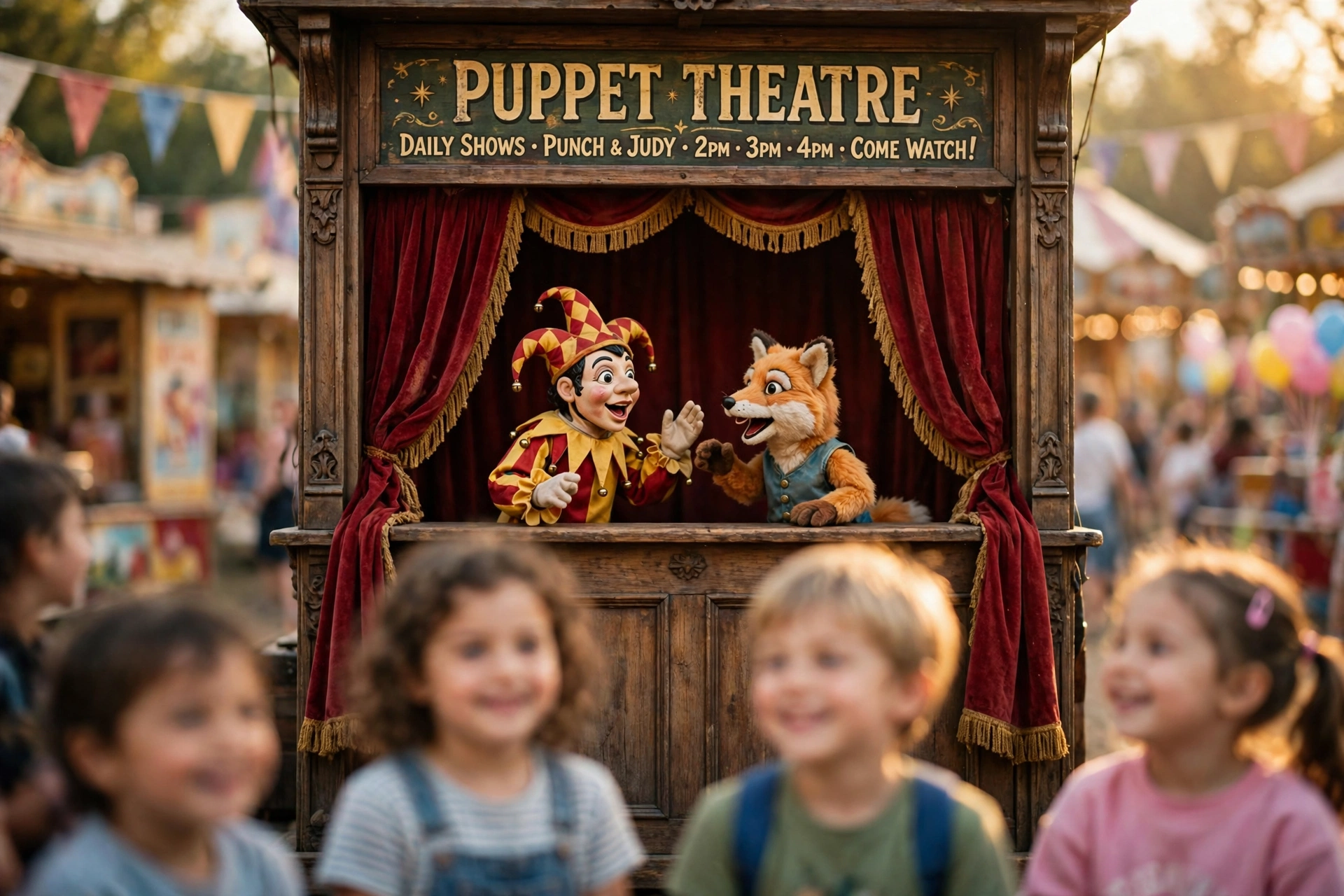
Start with the kind of puppet. Glove-puppet clowns (Punch, Kasperle, Petrushka, Guignol) give cheeky, high-energy names with centuries of folk history. Shadow heroes (Karagöz, Semar, Karagiozis) are moodier and more poetic. Doll names (Bambola, Kukla, Hina) are the softest and most wearable for a baby, while the puppet masters (Dalang, Henson, Gidayu) honour the maker rather than the made.
Then check the story. Some puppet names carry darkness as well as charm: Chucky, Slappy and Annabelle are horror icons now, and parents should choose them knowingly. Others — Marion above all — carry a beautiful secret: the first marionettes were little figures of the Virgin Mary in church plays, marionnettes, “little Marys”, which is why Marion sits inside the word marionette itself.
Finally, say the name without the story. A name like Petrushka or Tchantches is a delight in its home culture and a spelling lesson elsewhere; a name like Pierrot, Kukla or Marion travels anywhere. Choose the puppet whose strings you are happy to hold.
Frequently Asked Questions
What name literally means puppet?
Several languages’ everyday words double as names: Kukla in Turkish and Slavic languages, Ningyo in Japanese, Titere in Spanish, Panpina in Basque, Pupa in Latin (the root of the English word puppet), and Kathputli in Hindi, which literally means ‘wooden doll’. Bambola, Muneca and Poupee all literally mean doll.
Why is Marion linked to puppets?
Because the word marionette comes from Marion. In medieval France, little jointed figures of the Virgin Mary used in church plays were called marionnettes — ‘little Marys’, Marion being a pet form of Mary. The name spread from those figures to all string puppets.
What is the most famous puppet name?
Pinocchio, Carlo Collodi’s wooden boy of 1883, is the world’s most famous puppet, with Kermit the Frog the most famous puppet of the television age. For pure puppet-theatre history, Punch (from Pulcinella) and the Javanese clown-god Semar rival them.
What is a dalang?
A dalang is the puppet master of Indonesian wayang: one performer who manipulates hundreds of shadow or rod puppets, voices every character, sings, and leads the gamelan orchestra through performances that last all night. In Japan the equivalent masters are the bunraku tayu (chanter) and the puppet handlers of Osaka.
Are puppet names suitable for real babies?
Many are: Marion, Pierrot, Kukla, Hina, Colombina and Kasper are ordinary or revivable names in their home cultures, and doll names like Licca and Barbie are established given names. Save the horror dolls (Chucky, Annabelle, Slappy) and the joke figures for pets, characters and stage names, where the darkness is the point.
Conclusion
From a Latin doll word that became ‘puppet’ itself, through the shadow screens of Java and Istanbul to a frog in a television studio, these 400 names map the whole secret life of puppets. There is a name here for every temperament: a clown for a comedian, a shadow hero for a dreamer, a doll word for a daughter, a dalang for a son who will pull the strings himself. Choose the figure you would most like to bring to life — and give it a name that already has.