Bowl of Rice: Calories by Type, Portion Sizes and Basics
A bowl of rice does not have one fixed calorie count. The total depends on the grain and how much cooked rice the bowl holds. One US measuring cup of cooked long-grain white rice weighs 158 g and has 205 calories; a half cup (79 g) is about 103 calories. A cup of cooked brown rice weighs 202 g and has 248 calories, while short- or medium-grain white rice weighs 186 g and has 242 calories.
Those differences matter because a cup is a volume measure, not a fixed weight. A typical bowl holds roughly 1 to 1½ US measuring cups, and a rice-cooker scoop is smaller than a standard US cup. The comparisons below explain calories by type, portion sizes, and dry-to-cooked measurements.
Quick answer: how many calories are in a bowl of rice?
For plain cooked rice, one cup is a useful starting point: long-grain white has 205 calories, short- or medium-grain white has 242, and long-grain brown has 248. If you are asking how many calories in a bowl of rice, check the grain and cooked weight first. Jasmine and basmati can be estimated using the long-grain white reference of about 205 calories per 158 g cup; USDA has no separate cooked entry for either variety.
- 1 cup long-grain white: 158 g, 205 calories.
- 1 cup short- or medium-grain white: 186 g, 242 calories.
- 1 cup long-grain brown: 202 g, 248 calories.
At 1½ cups, those amounts work out to about 308, 363, and 372 calories, respectively. The actual calories in a bowl of rice depend on its measured portion, not its appearance.
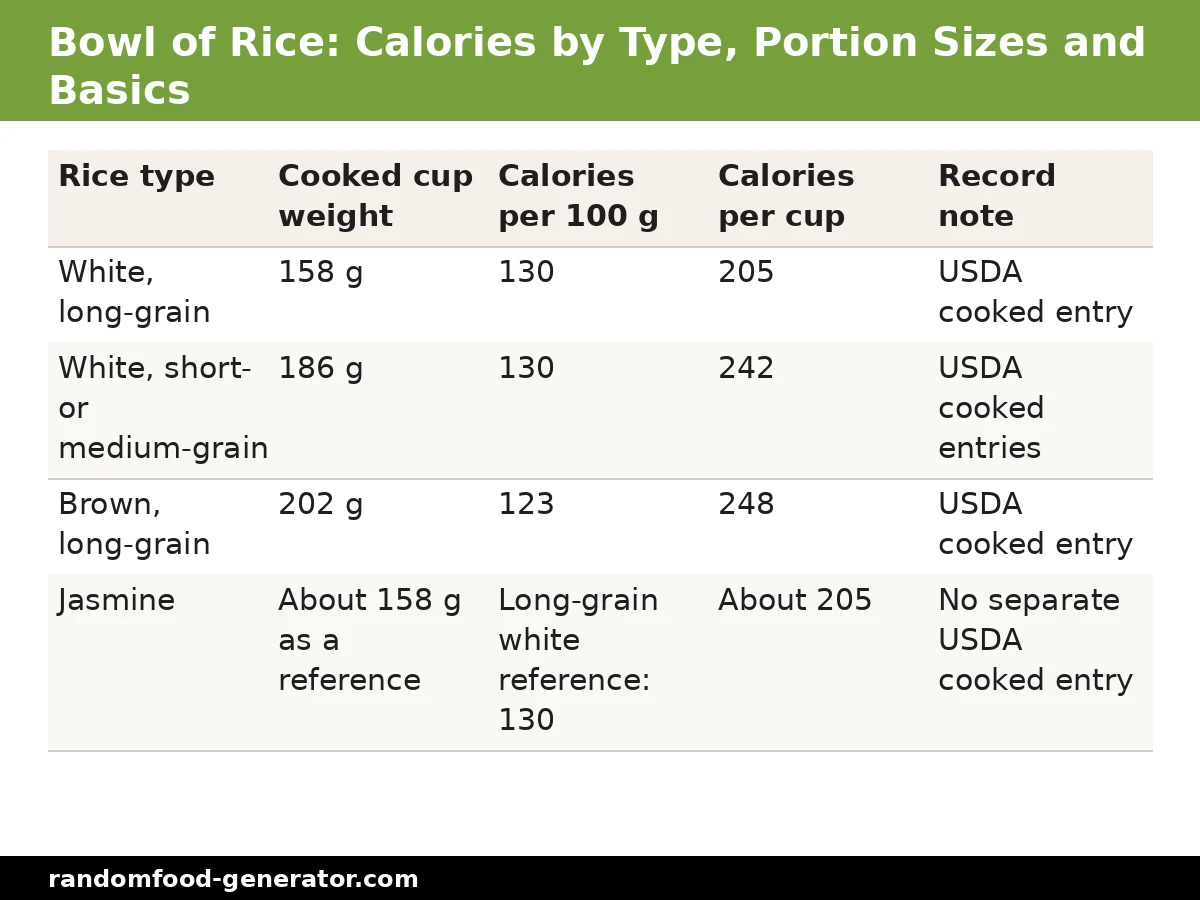
Calories by rice type (1 cup cooked)
This comparison uses USDA cooked entries. Jasmine and basmati use the long-grain white reference rather than separate cooked records.
| Rice type | Cooked cup weight | Calories per 100 g | Calories per cup | Record note |
|---|---|---|---|---|
| White, long-grain | 158 g | 130 | 205 | USDA cooked entry |
| White, short- or medium-grain | 186 g | 130 | 242 | USDA cooked entries |
| Brown, long-grain | 202 g | 123 | 248 | USDA cooked entry |
| Jasmine | About 158 g as a reference | Long-grain white reference: 130 | About 205 | No separate USDA cooked entry |
| Basmati | About 158 g as a reference | Long-grain white reference: 130 | About 205 | No separate USDA cooked entry |
Brown rice is slightly lower per 100 g than long-grain white rice, but its cup has more calories because it weighs more. Short- and medium-grain white rice also packs more weight into a cup than long-grain white rice. This is why a cup of cooked rice calories comparison should always include the gram weight.
USDA records: cup weights, calories and entry names
The exact record helps explain what a calorie number describes. These USDA FoodData Central SR Legacy entries are the references for the figures above:
| Rice type | Cooked USDA entry and FDC ID | Cooked cup weight | Cooked calories per cup | Dry comparison |
|---|---|---|---|---|
| White, long-grain | Rice, white, long-grain, regular, enriched, cooked (168878) | 158 g | 205 | Rice, white, long-grain, regular, enriched, raw (168877): 185 g and about 675 calories per dry cup |
| White, short- and medium-grain | USDA SR Legacy cooked entries (168880 / 168882) | 186 g | 242 | No separate dry comparison listed here |
| Brown, long-grain | Rice, brown, long-grain, cooked (169704) | 202 g | 248 | No separate dry comparison listed here |
| Jasmine and basmati | No separate USDA cooked entry | About 158 g as a long-grain white reference | About 205 as a reference | Dry package labels typically list about 160 calories per ¼ cup (45 g) |
“White rice” alone does not identify grain length or whether the rice is raw or cooked. Check the full entry name, FDC ID, and gram weight before comparing two nutrition pages.
Dry vs. cooked rice: why the serving changes
Dry rice absorbs water as it cooks, increasing its weight and volume. The USDA raw entry for long-grain white rice lists 365 calories per 100 g. One dry cup weighs 185 g and is about 675 calories. The cooked entry lists 205 calories for a 158 g cup.
| Measurement | Weight | Calories | State |
|---|---|---|---|
| 100 g long-grain white rice | 100 g | 365 | Dry/raw |
| 1 cup long-grain white rice | 185 g | About 675 | Dry/raw |
| About ⅓ cup long-grain white rice | Roughly 60 g | — | Approximate dry amount for 1 cooked cup |
| 1 cup long-grain white rice | 158 g | 205 | Cooked |
One cup of dry rice cooks into about three cups cooked. In reverse, one cooked cup starts with roughly 60 g, or about ⅓ cup, dry. The yield is approximate, and raw and cooked rice have separate USDA records. Cooking adds water and changes weight and volume, but it does not change the calories in the rice itself. Use the value that matches the state you measured.
Jasmine rice calories and basmati rice calories
Jasmine and basmati are long-grain white rice varieties, but USDA SR Legacy publishes no separate cooked entry for either. The long-grain white cooked entry is the reference: about 205 calories per 158 g cup. Treat this as an estimate, not as a distinct USDA jasmine or basmati record.
Dry package labels for jasmine and basmati typically list about 160 calories per ¼ cup (45 g) dry. That is package-label information, not a USDA cooked value. Keep dry-label servings separate from cooked-bowl estimates.
Plain sushi rice uses short- or medium-grain cooked rice. Seasoned sushi rice includes sugar and rice vinegar, generally runs higher than plain rice, and varies by recipe. USDA publishes no single standard entry for seasoned sushi rice, so a standard calorie figure is not published.
What is a bowl of rice? Start with the cup-weight problem
A bowl is a serving vessel, not a standardized measure. A typical served bowl holds roughly 1 to 1½ US measuring cups of cooked rice, or about 160–240 g depending on the grain. That describes typical serving practice; it is not a USDA-defined bowl size.
One cooked cup weighs 158 g for long-grain white rice, 186 g for short- or medium-grain white rice, and 202 g for long-grain brown rice. Packed rice weighs more than loosely fluffed rice in the same vessel. The grain and the way it is served both affect the bowl’s weight.
For a useful bowl of rice calories estimate, weigh the cooked portion when possible. If you use volume, identify the rice type and cup size rather than treating every bowl as equivalent.
The rice-cooker cup trap: 180 ml is not a US cup
The plastic scoop packed with many rice cookers holds 180 ml. A standard US measuring cup holds 240 ml, making the cooker scoop three quarters of a US cup. The two measures are not interchangeable in recipes or calorie comparisons.
If a cooker recipe uses its included scoop, keep using that measure for the recipe. For nutrition comparisons, check whether a stated cup means 180 ml or 240 ml. Weighing cooked rice in grams avoids this cup-size confusion.
How much dry rice makes one bowl?
About ⅓ cup, or roughly 60 g, of dry long-grain white rice cooks into approximately one cup of cooked rice. A full dry cup weighs 185 g and makes about three cooked cups. A typical bowl of 1 to 1½ cooked cups therefore starts with roughly ⅓ to ½ cup dry, using the same approximate yield.
Cooking yield can vary, so weigh the cooked rice if you are dividing a batch into consistent portions. Use dry nutrition values for dry measurements and cooked values for cooked portions; do not apply a dry-cup calorie figure to a cooked bowl.
White rice calories and brown rice calories: what the numbers show
Per 100 g, cooked long-grain brown rice has 123 calories, compared with 130 for cooked long-grain white rice. Brown rice has 1.6 g fiber per 100 g; the white long-grain entry has 0.4 g per 100 g.
Per cup, the result is different: long-grain white rice is 205 calories at 158 g, while long-grain brown rice is 248 calories at 202 g. The brown-rice cup weighs more, which explains why its cup total is higher even though its calories per 100 g are slightly lower.
| Cooked rice entry | Protein per cup | Carbohydrate per cup | Fat per cup | Fiber reference |
|---|---|---|---|---|
| White, long-grain (158 g) | 4.3 g | 44.5 g | 0.4 g | 0.6 g per cup; 0.4 g per 100 g |
| Brown, long-grain (202 g) | 5.5 g | 51.7 g | 2.0 g | 1.6 g per 100 g |
These figures describe plain cooked rice. Toppings, sauces, or preparation methods add ingredients beyond the plain grain, so a complete rice bowl or mixed dish has a different total.
How much rice per person? Understanding rice portion size
How much rice per person depends on the meal and serving style. A typical bowl is roughly 1 to 1½ US measuring cups cooked, or about 160–240 g depending on the grain. It is a serving description, not a fixed rule.
For consistent portions, decide how much cooked rice to serve and weigh it into bowls. A small, deep bowl can hold more rice than it appears to, especially when the grains are packed. A gram weight is clearer than judging the portion by the vessel alone.
Bowl styles across cuisines
In Japan, short-grain rice is served in a ceramic chawan. It is also the base of donburi, topped with meat, egg, or tempura, and is used for sushi. Toppings make a donburi a different food from plain rice.
In Korea, bap is served in metal or stone bowls. A hot stone dolsot keeps the bottom of bibimbap rice crisping. In China, long-grain rice is eaten as fan with shared dishes and is also used for fried rice and congee.
Across South and Southeast Asia, basmati is used for biryani and pulao, while fragrant jasmine rice is served alongside Thai curries and stir-fries. The variety and meal change, but portion comparisons still depend on the grain, cooked weight, and any added ingredients.
Why websites disagree about rice calories
Pages may use different rice varieties, raw or cooked records, or USDA databases. One may cite an SR Legacy entry while another uses an FNDDS record. Cup weights also differ: the cooked references here range from 158 g to 202 g per cup.
Some comparisons mix dry and cooked values. A dry cup of long-grain white rice weighs 185 g and is about 675 calories; a cooked cup weighs 158 g and has 205 calories. These describe different states and should not be compared as equal portions. Check the variety, preparation state, gram weight, and record name.
The same care helps when comparing a Chipotle chicken bowl calorie estimate, a Chipotle burrito, a Panda Express bowl, or other menu items with rice. For another nutrition-number comparison, see the site’s In-N-Out nutrition guide.
How to measure a bowl more consistently
Weigh cooked rice in grams and match it to the correct cooked reference. If you use a cup, make sure it is a 240 ml US measuring cup and note whether the rice is loosely filled or packed. Do not mistake a 180 ml rice-cooker scoop for a full US cup.
Keep plain rice separate from seasoned sushi rice, fried rice, biryani, pulao, congee, and topped bowls. For the database reference, use USDA FoodData Central and match the record name to the rice measured.
FAQs
How many calories are in a bowl of rice?
It depends on the bowl and grain. One cooked cup of long-grain white rice (158 g) has 205 calories; a cup of long-grain brown rice (202 g) has 248. A bowl holding more than one cup has a higher total.
How much does a cup of cooked rice weigh?
Long-grain white rice weighs 158 g per cooked cup, short- or medium-grain white rice weighs 186 g, and long-grain brown rice weighs 202 g. The grain determines the cup weight.
Does brown rice have fewer calories than white rice?
Per 100 g, brown rice has slightly fewer calories: 123 compared with 130. Per cup, brown rice has 248 calories and white long-grain rice has 205 because the brown-rice cup weighs more.
How many calories are in a bowl of jasmine rice?
USDA has no separate cooked jasmine entry. Use the long-grain white reference of about 205 calories per 158 g cooked cup; a larger bowl contains more.
How much dry rice makes one bowl?
About ⅓ cup, or roughly 60 g, of dry long-grain white rice cooks into approximately one cup cooked. A full dry cup (185 g) makes about three cups cooked.
Why do websites give different calorie counts for a cup of rice?
They may use different varieties, raw or cooked entries, databases, or cup weights. Check the USDA entry name and gram weight before comparing calorie totals.