270 Boy Names That Mean Royalty: King, Prince and Emperor Names
Introduction
Some names whisper; royal names announce. Boy names that mean royalty carry the weight of thrones, crowns and courts — words for king, prince, emperor and sovereign drawn from dozens of languages, plus the names of men who actually wore the crown. A monarchy is one of humanity’s oldest institutions, and nearly every culture on earth has left us names that mean king or ruler, from Latin Rex to Sanskrit Rajan to Yoruba Oba.
This list is organised by what the name actually claims. You will find names that literally mean king, names that mean prince or lord, emperor and sovereign names, royal names from the Bible and the ancient world, and deep benches of Sanskrit, Arabic, Persian, African, Celtic, Norse and Slavic royal names — many of them missed by shorter lists. Every name appears once, with its real origin and meaning; where a name is famous because a king bore it rather than because of its literal meaning, the note says so honestly.
If you like strong, commanding names generally, you may also enjoy our collections of boy names that mean protector and names that mean danger.
Quick Picks: The 15 Best Boy Names That Mean Royalty
| Name | Origin | Meaning | Note |
|---|---|---|---|
| Alexander | Greek | Defender of men | Alexander the Great, the archetypal conqueror-king |
| Cyrus | Persian | Name of Persia’s Great King | Founder of the Persian Empire |
| Darius | Persian | He who holds firm the good | Borne by three kings of Persia |
| Malik | Arabic | King | One of the most used royal names on earth |
| Rajan | Sanskrit | King | Classic, dignified Indian royal name |
| Rex | Latin | King | Short, sharp and unmistakable |
| Sultan | Arabic | Sovereign, ruler | The classic title of Muslim kings |
| Frederick | Germanic | Peaceful ruler | Borne by Prussian and Holy Roman kings |
| Henry | Germanic | Home ruler | Eight kings of England bore it |
| Louis | French | Famous warrior | Eighteen kings of France bore it |
| Albert | Germanic | Noble and bright | Prince Albert; kings of Belgium |
| Kingston | English | The king’s town | Modern surname-style favourite |
| Basil | Greek | Kingly, royal | From basileus, the Greek word for king |
| Vladimir | Slavic | Renowned ruler | Princes of Kyiv and rulers of Russia |
| Magnus | Latin | Great | A favourite of Scandinavian kings |
Boy Names That Mean King
These are the direct hits — names whose core meaning is “king” itself, in languages from Latin and Irish to Hebrew and Welsh.
| Name | Origin | Meaning | Note |
|---|---|---|---|
| Rex | Latin | King | The Roman word itself; also a dinosaur-sized nickname |
| Roy | French / Gaelic | King (from French roi) | Also linked to Gaelic ruadh, “red” |
| Leroy | French | The king | Le roi — a surname turned first name |
| Elroy | French | The king | A variant formed on the same le roi root |
| Fitzroy | Norman French | Son of the king | Historically given to royal sons |
| Delroy | French | Of the king | Popular in Jamaica and Britain |
| Ryan | Irish | Little king | From rí, king, with a diminutive ending |
| Rory | Irish / Scottish Gaelic | Red king | Ruairí — the last High King of Ireland bore it |
| Basil | Greek | Kingly, royal | Basil II was a Byzantine emperor |
| Kingston | English | The king’s town | Place name turned bold first name |
| Kingsley | English | The king’s meadow | Gentle surname-style option |
| King | English | King | A direct word name, famously used as a surname |
| Regis | Latin | Kingly, of the king | Saint Regis; also a luxury hotel name |
| Regulus | Latin | Little king, prince | Also the brightest star in Leo |
| Melech | Hebrew | King | The plain Hebrew word, used as a name |
| Malik | Arabic | King | Distinct from Malak, which means angel |
| Kendrick | English / Welsh | Royal power | Also read as “chief hero” |
| Cynric | Old English | Royal power | A King of Wessex in the 6th century |
| Kinsey | English | King’s victory | From the Old English name Cynesige |
| Rexford | English | King’s ford | A stately surname name |
| Reyes | Spanish | Kings | A common Spanish surname, from rey |
| Rey | Spanish | King | Short and international |
| Tudor | Welsh | Ruler of the people | The Welsh dynasty that ruled England |
| Lear | British literary | The legendary King Lear | Meaning unknown — the king is the point |
| Riordan | Irish | Royal poet | The king’s own bard and historian |
| Ardri | Irish | High king | From Ard Rí, the High King of Ireland |
| Brennus | Celtic | Linked to the Celtic word for king | The Gaulish chief who sacked Rome |
| Vortigern | Welsh / British | Overlord, high king | A real 5th-century British ruler |
| Pendragon | Welsh | Chief, head (dragon = leader) | Title of Uther and Arthur’s line |
Boy Names That Mean Prince or Lord
Not every royal name claims the throne itself. These mean prince, lord, chief or a noble rank just below the crown — often more wearable for it.
| Name | Origin | Meaning | Note |
|---|---|---|---|
| Prince | Latin | Prince; first, chief | From princeps, “first citizen” |
| Brendan | Irish | Prince | From the Welsh word brennin, king |
| Armel | Breton | Bear-prince | A 6th-century Welsh-Breton saint |
| Mael | Breton | Prince, chief | Short, strong and underused |
| Tiernan | Irish | Little lord | From tighearna, lord |
| Tierney | Irish | Lord, master | Surname form of the same root |
| Laird | Scottish | Lord, landowner | The Scottish equivalent of a lord |
| Lord | English | Lord | A bold title word name |
| Marquis | French | Marquis, nobleman | A rank below duke in the peerage |
| Emirhan | Turkish | Prince-ruler | Emir (prince) + khan (ruler) |
| Mirza | Persian | Prince | A title for sons of emirs and kings |
| Prinz | German | Prince | The plain German word, used as a name |
| Kunwar | Hindi | Prince | A respectful title for royal sons |
| Caspian | Literary | Prince Caspian of Narnia | A place name made royal by C.S. Lewis |
| Baron | Germanic / English | Nobleman, free man | The lowest rank of the peerage |
| Duke | Latin / English | Duke; leader | From dux, the one who leads |
| Earl | English | Earl, nobleman | Once ranked just below kings in England |
| Knyaz | Slavic | Prince | The Russian and Slavic princely title |
| Dauphin | French | The French crown prince | Literally “dolphin”, the heir’s title |
| Infante | Spanish / Portuguese | Royal prince | Title for a king’s younger sons |
| Sayyid | Arabic | Lord, master | An honoured title of nobility |
| Sharif | Arabic | Noble, honoured | A title for respected noble families |
| Effendi | Turkish | Lord, master | An Ottoman title of respect |
| Bey | Turkish | Lord, chief | An Ottoman and Turkic title |
Names That Mean Emperor, Ruler or Sovereign
A step above kings: emperors, universal rulers and names built on roots meaning “to rule” or “power”.
| Name | Origin | Meaning | Note |
|---|---|---|---|
| Kaiser | German | Emperor | The German form of Caesar |
| Caesar | Latin | Emperor (title) | A family name that became the word for emperor |
| Tsar | Slavic | Emperor | The Russian form of Caesar |
| Augustus | Latin | Majestic, exalted | Rome’s first emperor |
| Sargon | Akkadian | The king is true / legitimate king | Sargon of Akkad built the first empire |
| Alexander | Greek | Defender of men | Conquered the known world by age 30 |
| Cyrus | Persian | Name of the Great King | Meaning often read as “sun-like” or “young” |
| Darius | Persian | He who holds firm the good | Darius the Great of Persia |
| Xerxes | Persian (via Greek) | Ruler over heroes | The king of the Greco-Persian Wars |
| Artaxerxes | Persian | Whose rule is through truth | Borne by several Persian kings |
| Frederick | Germanic | Peaceful ruler | Frederick the Great of Prussia |
| Henry | Germanic | Home ruler | From heim (home) + ric (ruler) |
| Richard | Germanic | Strong, powerful ruler | Richard the Lionheart |
| Eric | Old Norse | Eternal ruler, ever-king | Ei (ever) + ríkr (ruler) |
| Theodoric | Germanic | Ruler of the people | Theodoric the Great, king of the Ostrogoths |
| Alaric | Gothic | Ruler of all | The Visigoth king who sacked Rome |
| Roderick | Germanic | Famous ruler | The last Visigothic king of Spain |
| Emery | Germanic | Industrious ruler | A softer, modern-feeling ruler name |
| Vladimir | Slavic | Renowned ruler | Also read as “ruler of peace” |
| Rurik | Slavic / Norse | Famous ruler | Founder of the first Russian royal dynasty |
| Osric | Old English | Divine ruler | A king in Beowulf’s world |
| Godric | Old English | God’s ruler / God’s power | Also Harry Potter’s Godric Gryffindor |
| Edric | Old English | Prosperous ruler | A Mercian lord in Anglo-Saxon chronicles |
| Leofric | Old English | Beloved ruler | Earl of Mercia, husband of Lady Godiva |
| Alberic | Germanic | Ruler of the elves | A dwarf-king in Germanic legend |
| Oberon | French / Germanic | Elf-ruler | Shakespeare’s king of the fairies |
| Elric | Old English / literary | Elf-ruler, noble ruler | Moorcock’s albino emperor of Melniboné |
| Sovereign | English | Supreme ruler | A modern word name |
| Reign | English | A king’s rule | Popular modern word name |
| Regal | Latin / English | Royal, kingly | From rex, king |
Biblical and Ancient-World King Names
The oldest royal names we have — kings of Israel, pharaohs of Egypt, and the lawgivers and conquerors of Mesopotamia. Several literally contain the Hebrew word for king, melech.
| Name | Origin | Meaning | Note |
|---|---|---|---|
| Solomon | Hebrew | Peace | The wisest King of Israel |
| David | Hebrew | Beloved | A shepherd who became the model king |
| Saul | Hebrew | Asked for | The first King of Israel |
| Melchizedek | Hebrew | King of righteousness | The priest-king of Salem who blessed Abraham |
| Abimelech | Hebrew | My father is king | Borne by Philistine and Israelite rulers |
| Elimelech | Hebrew | My God is king | Naomi’s husband in the Book of Ruth |
| Malchiah | Hebrew | My king is God | A priestly name in the Old Testament |
| Adonijah | Hebrew | My lord is God | David’s son who tried to seize the throne |
| Rehoboam | Hebrew | The people enlarge | Solomon’s son, first king of Judah alone |
| Jeroboam | Hebrew | The people contend | First king of the northern kingdom |
| Hezekiah | Hebrew | God strengthens | The reforming King of Judah |
| Josiah | Hebrew | God supports / heals | Judah’s great reformer king |
| Ahab | Hebrew | Uncle / father’s brother | Israel’s infamous king, husband of Jezebel |
| Balthasar | Babylonian | Protect the king | Traditional name of one of the Three Kings |
| Caspar | Persian | Treasurer | Another of the Magi, the gift-bearing kings |
| Melchior | Hebrew (traditional) | King of light | The third of the Three Kings |
| Nebuchadnezzar | Babylonian | Nabu, protect my heir | Babylon’s greatest king, builder of gardens |
| Hammurabi | Amorite / Akkadian | The kinsman is a healer | The lawgiver king of Babylon |
| Ashurbanipal | Assyrian | Ashur has made an heir | The last great king of Assyria |
| Ramesses | Egyptian | Born of Ra | Ramesses II, Egypt’s greatest pharaoh |
| Tutankhamun | Egyptian | Living image of Amun | The boy king whose tomb was found intact |
| Khufu | Egyptian | (Protected by) Khnum | Pharaoh of the Great Pyramid of Giza |
| Narmer | Egyptian | Fierce catfish | United Egypt as its first pharaoh |
| Gilgamesh | Sumerian | The ancestor is a hero | The legendary king of Uruk |
| Croesus | Lydian / Greek | The fabulously rich king | “As rich as Croesus” — his name became the proverb |
Sanskrit and Indian Royal Names
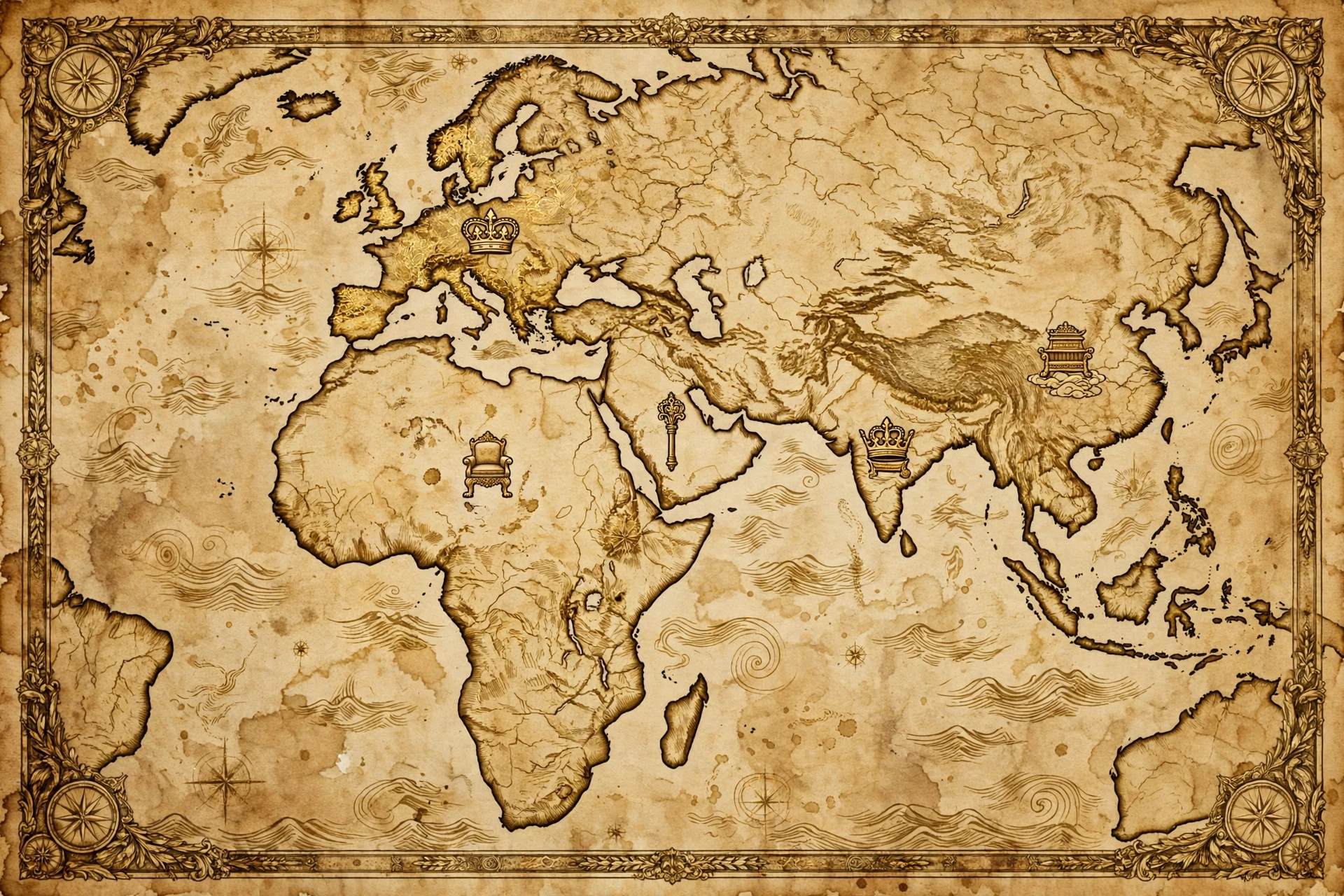
India has one of the deepest royal naming traditions on earth, built on raj (king), indra (lord) and bhupa (lord of the earth). These range from everyday names to imperial titles.
| Name | Origin | Meaning | Note |
|---|---|---|---|
| Rajan | Sanskrit | King | The classic Indian royal name |
| Raja | Sanskrit | King | Used across India and Southeast Asia |
| Samrat | Sanskrit | Emperor, universal ruler | The title of Ashoka-grade emperors |
| Rajendra | Sanskrit | King of kings | Raj (king) + Indra (lord) |
| Narendra | Sanskrit | King of men, lord of men | Borne by kings and a prime minister |
| Bhupendra | Sanskrit | Lord of the earth, king | Bhu (earth) + Indra (lord) |
| Maharaja | Sanskrit | Great king | The famous imperial title |
| Yuvraj | Sanskrit | Crown prince, young king | Heir apparent — and a cricket star’s name |
| Kumar | Sanskrit | Prince, son | One of India’s most common name elements |
| Naresh | Sanskrit | King, lord of men | Nara (man) + isha (lord) |
| Rajesh | Sanskrit | King of kings | Raj + isha (lord) |
| Bhupati | Sanskrit | Lord of the earth, king | A stately compound |
| Nripendra | Sanskrit | King of kings, lord of men | Nripa (king) + Indra (lord) |
| Mahendra | Sanskrit | Great lord | Also a name of Indra, king of the gods |
| Devendra | Sanskrit | Lord of the gods | Indra’s title — king of heaven |
| Siddhartha | Sanskrit | He who achieves his goal | The Buddha, born a prince of the Shakya clan |
| Vikramaditya | Sanskrit | Sun of valour | Title of the legendary ideal king |
| Prithviraj | Sanskrit / Hindi | King of the earth | The Chauhan king of Delhi |
| Rana | Sanskrit / Rajput | King | Title of Rajput rulers, as in Rana Pratap |
| Rao | Indian (Maratha) | King, prince (title) | A royal title now used as a surname |
| Thakur | Hindi | Lord, chief | A title of landholding nobility |
| Adhiraj | Sanskrit | Supreme king, first king | Adhi (supreme) + raj (king) |
| Chakravarti | Sanskrit | Universal emperor | The wheel-turning world ruler of Indian thought |
| Lokendra | Sanskrit | Lord of the world | Loka (world) + Indra (lord) |
Arabic, Persian and Turkish Royal Names
From the caliphs and sultans to the shahs of Persia and the Mughal emperors, this region produced royal names used from Spain to Indonesia.
| Name | Origin | Meaning | Note |
|---|---|---|---|
| Sultan | Arabic | Sovereign, ruler | The title of kings from Morocco to Brunei |
| Amir | Arabic | Prince, commander | Also spelled Emir in title form |
| Shah | Persian | King | The title of Persia’s kings for millennia |
| Shahzad | Persian | Prince, son of the king | A beloved name in Pakistan and Iran |
| Shahryar | Persian | King, sovereign | The king of the Thousand and One Nights |
| Jamshid | Persian | Mythical great king | Traditionally read as “twin shining” |
| Khosrow | Persian | Of good fame | Borne by Sassanian kings of Persia |
| Ardashir | Persian | Whose rule is righteous | Founder of the Sassanian Empire |
| Shapur | Persian | Son of the king | Several Sassanian kings bore it |
| Bahram | Persian | Victorious | Name of Sassanian kings and a prince of legend |
| Dara | Persian | Possessor, wealthy | Borne by Persian kings in epic tradition |
| Farouk | Arabic | One who distinguishes truth | King Farouk, the last king of Egypt |
| Saladin | Arabic | Righteousness of the faith | The sultan who retook Jerusalem |
| Harun | Arabic | Borne by the caliph Harun al-Rashid | Meaning debated — “messenger” is one reading |
| Orhan | Turkish | Supreme ruler, great khan | The second Ottoman sultan |
| Murad | Arabic / Turkish | Desired, wished-for | Borne by five Ottoman sultans |
| Osman | Turkish / Arabic | Founder of the Ottoman dynasty | Meaning traditionally linked to a bird |
| Selim | Arabic / Turkish | Safe, sound | Selim the Grim and two later sultans |
| Timur | Turkic | Iron | The conqueror known in the West as Tamerlane |
| Padishah | Persian | Master king, emperor | The grand title of Ottoman and Mughal rulers |
| Khalifa | Arabic | Caliph, successor | The title of Islam’s supreme rulers |
| Wali | Arabic | Governor, guardian, ruler | A provincial ruler’s title |
| Hakim | Arabic | Wise, judge | Also used historically of rulers |
| Atabek | Turkish | Father of a prince | Regents who often became kings themselves |
| Jahangir | Persian | Conqueror of the world | The Mughal emperor, son of Akbar |
| Shahjahan | Persian | King of the world | The Mughal emperor who built the Taj Mahal |
| Aurangzeb | Persian | Ornament of the throne | The last great Mughal emperor |
| Akbar | Arabic | Greatest | Akbar the Great, the Mughal emperor |
African and Asian King and Emperor Names
The section most royal-name lists skip entirely: genuine king, emperor and crown words from Africa’s great kingdoms and Asia’s imperial traditions, plus names borne by their rulers.
| Name | Origin | Meaning | Note |
|---|---|---|---|
| Ade | Yoruba | Crown, royalty | Starts hundreds of Yoruba royal names |
| Oba | Yoruba | King, ruler | The title of Yoruba kings |
| Eze | Igbo | King | The Igbo word for a king |
| Kgosi | Tswana | King, chief | The title of Botswana’s traditional kings |
| Negus | Amharic (Ethiopian) | King | The Ethiopian royal title |
| Mansa | Mandinka | King of kings, emperor | Mansa Musa, famed as history’s richest king |
| Askia | Songhai | Emperor (title) | Askia the Great of the Songhai Empire |
| Kabaka | Luganda | King of Buganda | The title of Uganda’s Baganda kings |
| Sarki | Hausa | King, emir | The Hausa royal title |
| Nana | Akan (Ghana) | King, chief, royal | An Ashanti honorific used as a name |
| Jaja | Igbo (Nigerian) | King Jaja of Opobo | The merchant-king who founded Opobo |
| Mfalme | Swahili | King | The everyday Swahili word |
| Shaka | Zulu | King Shaka of the Zulu | His name is tied to a famous beetle story |
| Cetshwayo | Zulu | King of the Zulu | Fought the British at Isandlwana |
| Moshoeshoe | Sotho | Founder-king of Lesotho | Nation-builder of the Basotho |
| Mswati | siSwati | Borne by Eswatini’s kings | Mswati III is the reigning king |
| Sobhuza | siSwati | King Sobhuza II of Eswatini | Reigned for over 60 years |
| Letsie | Sesotho | Borne by Lesotho’s kings | Letsie III is the reigning king |
| Wang | Chinese | King | One of China’s commonest surnames — literally “king” |
| Rama | Sanskrit / Thai | The legendary King of Ayodhya | Regnal name of every Thai king |
| Datu | Malay / Tagalog | Chief, prince | The pre-colonial royal title of the Philippines |
| Tengku | Malay | Prince | A royal title in Malaysia and Sumatra |
| Norodom | Khmer | Cambodia’s royal house | Traditionally read as “best of men” |
| Jigme | Tibetan / Bhutanese | Fearless | Borne by Bhutan’s Dragon Kings |
| Kublai | Mongolian | Kublai Khan | The khan who ruled China and founded the Yuan dynasty |
| Temujin | Mongolian | Of iron | Birth name of Genghis Khan, the Great Khan |
| Batu | Mongolian / Turkic | Firm, strong | Khan of the Golden Horde |
| Huang | Chinese | Emperor, sovereign | The character 皇 means a supreme sovereign |
Names of Real Kings from History
These names earn their place through the men who bore them — saints, lawgivers and nation-founders. The literal meanings vary, and the notes say so.
| Name | Origin | Meaning | Note |
|---|---|---|---|
| Louis | French / Germanic | Famous warrior | Eighteen kings of France |
| Albert | Germanic | Noble and bright | Prince Albert; two kings of Belgium |
| Magnus | Latin | Great | Kings of Norway and Sweden for centuries |
| Haakon | Old Norse | High son | Seven kings of Norway |
| Olaf | Old Norse | Ancestor’s descendant | Saint Olaf, the eternal king of Norway |
| Canute | Old Norse | Knot | Cnut the Great ruled England, Denmark and Norway |
| Harald | Old Norse | Army ruler | Harald Bluetooth and Harald Fairhair |
| Stephen | Greek | Crown, wreath | King Stephen of England; Saint Stephen of Hungary |
| Charles | Germanic | Free man | Kings and emperors across all Europe |
| Philip | Greek | Lover of horses | Kings of Macedon, France and Spain |
| Edward | English | Wealthy guardian | Eight English kings after the Conquest |
| George | Greek | Farmer | Six British King Georges — a meaning fit for no throne, a name fit for six |
| Arthur | Welsh / Celtic | The once and future king | Meaning debated — possibly “bear” |
| Alfred | English | Elf counsel | Alfred the Great of Wessex |
| Athelstan | English | Noble stone | The first true King of England |
| Edmund | English | Wealthy protector | Kings and martyred saints |
| Ashoka | Sanskrit | Without sorrow | The Mauryan emperor who spread Buddhism |
| Chandragupta | Sanskrit | Moon-protected | Founder of the Maurya Empire |
| Shivaji | Marathi | The great Maratha king | Named for the goddess Shivai |
| Sejong | Korean | Temple name of Joseon’s greatest king | Creator of the Korean alphabet |
| Akihito | Japanese | Bright and benevolent | Emperor emeritus of Japan |
| Naruhito | Japanese | Succeeding in benevolence | Japan’s reigning emperor |
| Brian | Irish | High, noble | Brian Boru, High King of Ireland |
| Kenneth | Scottish Gaelic | Born of fire / handsome | Kenneth MacAlpin, first king of Scots |
| Malcolm | Scottish Gaelic | Devotee of Saint Columba | Four kings of Scotland |
| Menelik | Ethiopian | Son of the wise | Menelik II, Emperor of Ethiopia |
| Ragnar | Old Norse | Counsel of the warriors | The legendary Viking king |
| Leonidas | Greek | Son of the lion | Sparta’s king at Thermopylae |
| Alfonso | Spanish / Gothic | Noble and ready | Thirteen kings of Castile and León |
Celtic and Norse Names of Kings and Chiefs
The kings of Ireland, Wales, Scotland and the Viking world had names that meant battle-rule, leadership and kingship — or were made royal by the men who carried them into legend.
| Name | Origin | Meaning | Note |
|---|---|---|---|
| Fergus | Irish | Man of vigour | A legendary king of Ulster |
| Niall | Irish | Champion | Niall of the Nine Hostages, High King of Ireland |
| Cormac | Irish | Cormac mac Airt | The legendary wise High King — meaning debated |
| Conchobar | Irish | Lover of hounds | The King of Ulster of the Táin |
| Ailill | Irish | King Ailill of Connacht | Queen Medb’s husband — meaning unknown |
| Cathal | Irish | Battle ruler | Cath (battle) + val (rule); kings of Munster |
| Duncan | Scottish Gaelic | Dark / brown warrior | The king of Macbeth fame |
| Llywelyn | Welsh | Leader | Llywelyn the Great, prince of Wales |
| Gruffydd | Welsh | Lord, prince | Borne by Welsh kings and princes |
| Owain | Welsh | Noble-born, youth | Owain Glyndŵr, last Prince of Wales |
| Rhodri | Welsh | Circle-king | Rhod (wheel) + rhi (king); Rhodri the Great |
| Hywel | Welsh | Prominent, eminent | Hywel the Good, lawgiver king |
| Madoc | Welsh | Fortunate | The legendary Prince Madoc |
| Cadwallader | Welsh | Battle leader | A king of Gwynedd, last “King of the Britons” |
| Bleddyn | Welsh | Wolf | Borne by kings of Powys |
| Caradog | Welsh | Beloved | Caratacus, the British king who defied Rome |
| Ivar | Old Norse | Bow warrior, archer | Ivar the Boneless, Viking king of Dublin |
| Rollo | Old Norse | Famous wolf | Founder of Normandy’s royal line |
| Guthrum | Old Norse | Battle serpent | Viking king of East Anglia |
| Sweyn | Old Norse | Young man, lad | Sweyn Forkbeard, king of Denmark and England |
| Sitric | Old Norse | Sigtryggr, Viking king of Dublin | The Hiberno-Norse king who minted Ireland’s first coins |
Slavic and Eastern European Royal Names
From the princes of Kyiv and Kraków to the tsars of Bulgaria and the voivodes of Wallachia — a royal tradition most English-language lists barely touch.
| Name | Origin | Meaning | Note |
|---|---|---|---|
| Vladislav | Slavic | Glorious ruler | Vlad (rule) + slav (glory) |
| Boleslav | Slavic | Greater glory | The first crowned kings of Poland |
| Casimir | Slavic | Proclaimer of peace | Casimir the Great of Poland |
| Wenceslaus | Slavic | Greater glory | Good King Wenceslaus of Bohemia |
| Stanislaus | Slavic | Attaining glory | Two kings of Poland |
| Mieszko | Polish | First ruler of Poland | Meaning debated — the dynasty-maker |
| Przemysl | Slavic | The legendary founder-king | Mythical first of the Přemyslid dynasty |
| Svatopluk | Slavic | Strong in armies | Ruler of Great Moravia |
| Boris | Bulgarian / Slavic | King Boris I of Bulgaria | Meaning debated — often read as “battle glory” |
| Simeon | Hebrew (via Bulgarian use) | He has heard | Tsar Simeon the Great of Bulgaria |
| Kaloyan | Bulgarian / Greek | Handsome John | The tsar who defeated the Crusaders |
| Asen | Bulgarian | The Asen dynasty | Ivan Asen II, Bulgaria’s great tsar — meaning debated |
| Dragomir | Slavic | Precious peace | Borne by Serbian and Wallachian princes |
| Zvonimir | Slavic | Sound of peace | The last native king of Croatia |
| Tomislav | Slavic | First King of Croatia | Crowned in 925 — meaning combines torment and glory roots |
| Decebalus | Dacian | The brave one | The last king of Dacia |
| Radu | Romanian | Glad, joyful | Borne by many princes of Wallachia |
| Basarab | Cuman / Romanian | Often read as “father ruler” | Founder of Wallachia and its dynasty |
Modern, Surname-Style and Fantasy Royal Names
Today’s royal names mix surname style, bold word names and the invented kings of modern fantasy — each fantasy name labelled as fiction.
| Name | Origin | Meaning | Note |
|---|---|---|---|
| Princeton | English | Princely town | A place and university name with a princely start |
| Royal | English | Royal | A rising word name |
| Royce | English | Often read as “king’s son” | A surname name from the Roy root |
| Reginald | Germanic / English | Ruler’s counsel | The king’s adviser, in name form |
| Ronald | Old Norse / Scottish | Ruler’s counsel | From Ragnvald, a Viking royal name |
| Gentry | English | Nobility, gentlefolk | A surname meaning the well-born class |
| Noble | English | Noble, high-born | A virtue-style word name |
| Heir | English | One who inherits | A word name with throne energy — label: literal |
| Majestic | English | Majestic, royal in bearing | A bold modern word name |
| Kingdom | English | A king’s realm | A maximalist word name |
| Crown | English | Crown | The ultimate royal symbol as a name |
| Constantine | Latin | Steadfast, constant | Eleven Byzantine emperors |
| Maximus | Latin | Greatest | Rome’s superlative, imperial in feel |
| Tiberius | Latin | Of the Tiber | Rome’s second emperor |
| Octavian | Latin | Eighth (born) | The birth name of Augustus |
| Hadrian | Latin | From Hadria | The emperor of Hadrian’s Wall |
| Uther | Welsh / British | Uther Pendragon | Arthur’s father, the king — name traditionally read as “terrible” |
| Oberyn | Literary (fiction) | Prince Oberyn Martell | Invented by George R.R. Martin |
| Rhaegar | Literary (fiction) | Prince Rhaegar Targaryen | Invented dragon-prince name |
| Aegon | Literary (fiction) | Aegon the Conqueror | Invented Targaryen king’s name |
| Viserys | Literary (fiction) | King Viserys Targaryen | Invented royal name |
| Aragorn | Literary (fiction) | Traditionally read as “kingly valour” | Tolkien’s returning king |
| Elessar | Literary (fiction) | Elf-stone | Aragorn’s throne name |
| Theoden | Literary (from Old English) | King, lord | From þeoden — Tolkien borrowed a real word for “king” |
| Eomer | Literary (fiction) | Horse-famous | Rohan’s royal marshal, later king |
| Eldarion | Literary (fiction) | Son of the Eldar | Aragorn’s heir in Tolkien’s legendarium |
How to Choose a Royal Name for Your Son
Start with the claim you actually want the name to make. A name that literally means king — Rex, Malik, Rajan, Basil — says it outright, while a prince or lord name (Mael, Brendan, Tierney) keeps the royalty quieter and often wears better at school and at work. Emperor names like Augustus, Kaiser and Sargon are the boldest of all; save them for when you genuinely want maximum grandeur.
Next, think about heritage. Royal names are at their best when they connect to your family’s own story: Yuvraj or Rajendra for an Indian family, Eze or Ade for a Nigerian one, Haakon or Magnus for a Scandinavian one, Vladislav or Casimir for a Slavic one. A royal name with real roots in your culture will always outrank an exotic borrowing.
Then test the practicalities. Say the full name aloud with your surname, check the initials, and consider nicknames — Alexander shortens to Alex or Xander, Kingston to King, Frederick to Freddie. Finally, weigh the famous bearer: some names come with one overwhelming association (Sultan, Prince, Kaiser), while others, like Henry, Louis and Edward, have been shared by so many kings that the name feels classic rather than themed. If you are still torn between regal and gentle, compare this list with our boy names that mean blessing — and for the complete opposite energy, browse names that mean nothing.
Frequently Asked Questions
What is the best boy name that means king?
Rex is the most direct — it is simply the Latin word for king. For something warmer and more international, Malik (Arabic), Rajan (Sanskrit) and Ryan (Irish, “little king”) are the most used king names in the world today.
What boy name means prince?
Prince itself is used as a name, from the Latin princeps, “first”. More traditional options include Brendan (Irish), Mael (Breton, “prince, chief”), Kunwar (Hindi) and Mirza (Persian).
What is a strong emperor name for a boy?
Augustus, the name of Rome’s first emperor, is the classic choice. Kaiser (German), Sargon (Akkadian, “legitimate king”), Samrat (Sanskrit, “universal emperor”) and Jahangir (Persian, “conqueror of the world”) are equally grand and much rarer.
Are royal names like King and Sultan actually used for babies?
Yes. King, Prince, Royal and Reign all appear in modern baby-name statistics, especially in the United States, and Sultan and Malik have been ordinary given names in Muslim-majority countries for centuries.
What is a royal name that doesn’t sound old-fashioned?
Kingston, Caspian, Elric, Oberon and Zayn-style modern picks all feel current — but from this list, Kingston, Caspian, Cyrus, Darius and Oberon balance royal meaning with a modern sound best.
Conclusion
From Rex to Rajan to Mansa, boy names that mean royalty span every continent and thirty centuries of kings. Whether you want the literal word for king in your own heritage language, the name of a real lawgiver or saint-king, or an emperor’s title turned into a first name, there is a crown here that fits. Choose the claim, check the roots, and your son starts life with a name that already knows how to wear a crown — or, if you prefer your irony strong, pair it with a middle name from our list of boy names that mean evil for a little royal menace.