Chipotle Allergen Menu: Every Ingredient Checked for Allergies
The Chipotle allergen menu identifies four allergen categories in the restaurant’s U.S. chart: dairy (milk), soy, wheat/gluten, and sulphites. The chart names the ingredients associated with each category, but it does not guarantee that food will remain separate during preparation. That distinction matters: an ingredient may not be listed as an allergen in a particular menu item, yet contact with another food can still occur in the restaurant.
This guide explains where Chipotle publishes its allergen information, which ingredients appear under each of the four declared categories, and what the company says about gluten, corn, cross-contact, limited-time items, and other allergens. It also separates allergen details from nutrition, prices, and store hours so those different questions are not confused.
What the Chipotle Allergen Menu Says
Chipotle publishes its U.S. allergen information through an online chart and tool on its official website. The chart declares four categories: dairy (milk), soy, wheat/gluten, and sulphites. The listed ingredients are specific rather than broad estimates: dairy is associated with four ingredients, soy with Sofritas only, wheat/gluten with flour tortillas only, and sulphites with three items.
For the wheat and gluten categories, Chipotle explains that they are combined because all of its gluten-containing items contain wheat. This is why the chart uses a combined category instead of presenting wheat and gluten as separate entries. The distinction is useful when reading the chart, but it does not remove the separate caution about possible trace gluten in certain corn ingredients.
The chart is an ingredient reference, not a promise that a meal will be free from every allergen. Chipotle says individual foods may come into contact during preparation and that this contact is not reflected on the chart. The company also warns that it cannot guarantee the complete absence of several allergens that are not used as ingredients.
Is Chipotle Safe for People with Allergies?
There is no single yes-or-no answer that applies to every allergy or every order. The allergen chart can help identify the ingredients Chipotle declares, but the company’s cross-contact warning is an important part of the same information. A chart entry tells readers which ingredients are flagged; it does not establish that a restaurant can prevent all contact between foods during preparation.
Chipotle specifically states that it does not use eggs, mustard, peanuts, tree nuts, sesame, shellfish, or fish as ingredients in its food. However, it also says it cannot guarantee the complete absence of those allergens in its restaurants. The company notes that individual foods may come into contact with one another during preparation, and that this is not reflected on the chart.
Chipotle adds another qualification: limited-time offerings and menu items being tested may include one or more allergens, including allergens that are not identified on its allergen page. That means the published chart should not be treated as a complete guarantee for every temporary or test item. The company’s own warning is the clearest way to understand the limits of the chart.
This article presents Chipotle’s published ingredient and preparation guidance. It does not determine whether a particular meal is medically safe for an individual, and it does not make a celiac-safety claim. Anyone relying on the restaurant’s information should read the current official chart and its full cross-contact statement rather than treating the absence of an ingredient from a row as a guarantee.
Chipotle Allergen Chart: Is There a PDF?
People searching for a chipotle allergen menu pdf should know that Chipotle publishes its U.S. allergen information as an online chart and tool on its official allergens page. A standalone U.S. Chipotle allergen menu PDF is not published. The official chart is therefore the place to consult for the company’s current declared allergen information.
Use the official Chipotle allergen page to view the chart and the accompanying explanations. The notes matter as much as the ingredient rows: they explain the combined wheat/gluten category, the source of sulphites, the possibility of cross-contact, and the limits of the information for limited-time and test items.
Chipotle Allergen Breakdown by Menu Item and Category
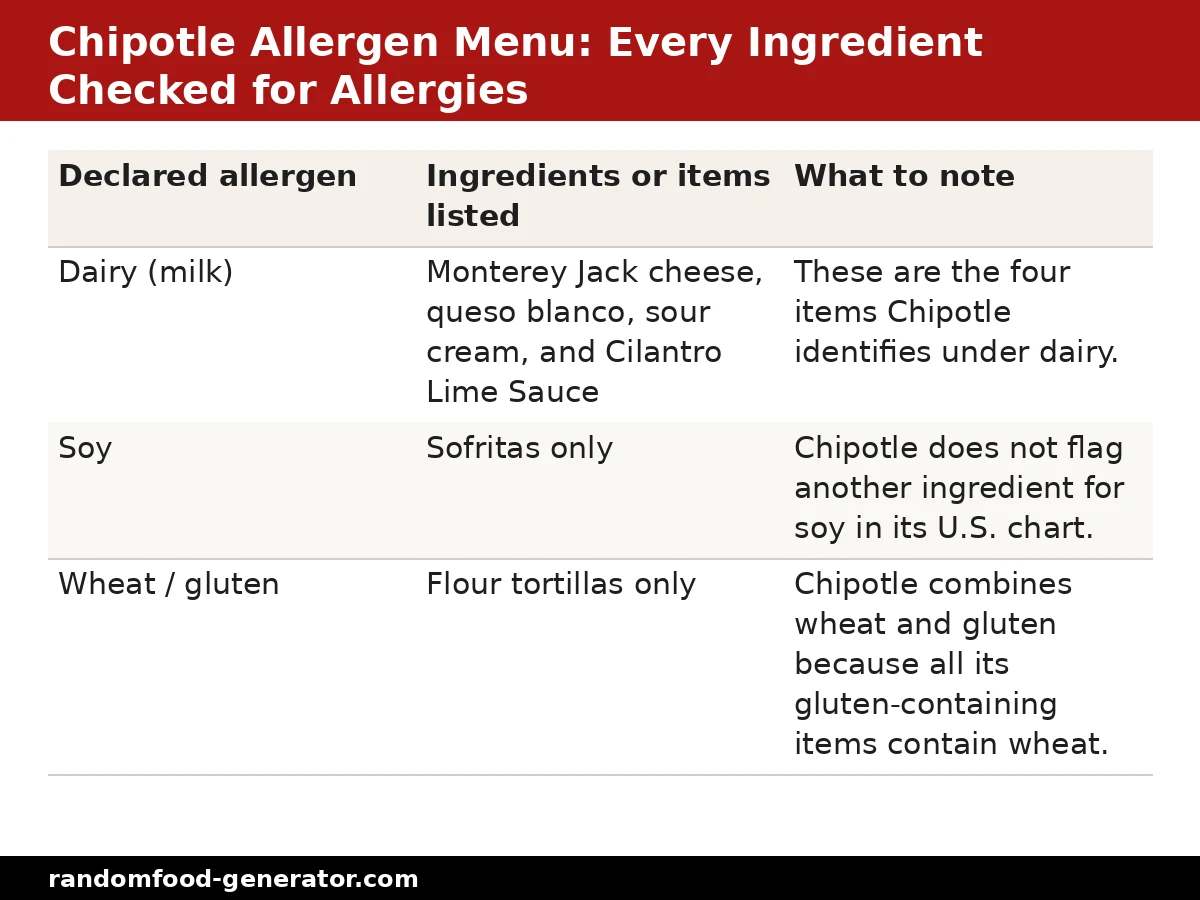
The table below organizes the four categories declared in the U.S. chart by the ingredients Chipotle names. It is a direct summary of those declarations, not a full ingredient list for every possible order combination.
| Declared allergen | Ingredients or items listed | What to note |
|---|---|---|
| Dairy (milk) | Monterey Jack cheese, queso blanco, sour cream, and Cilantro Lime Sauce | These are the four items Chipotle identifies under dairy. |
| Soy | Sofritas only | Chipotle does not flag another ingredient for soy in its U.S. chart. |
| Wheat / gluten | Flour tortillas only | Chipotle combines wheat and gluten because all its gluten-containing items contain wheat. |
| Sulphites | Flour tortillas, Sofritas, and chipotle-honey vinaigrette | Chipotle says the sulphites in its food items come exclusively from vinegar. |
Dairy: Milk in Cheese, Queso, Sour Cream, and Sauce
Chipotle’s dairy (milk) category names Monterey Jack cheese, queso blanco, sour cream, and Cilantro Lime Sauce. Those are the four ingredients to look for when reviewing the dairy row. The chart does not list every menu combination separately; it identifies the ingredients associated with the declared allergen.
Chipotle also explains that its shredded Monterey Jack cheese and queso are made with vegetable-based rennet, and that its sour cream is 100% cultured cream. The rennet detail describes how the cheese is made; it does not change the fact that Monterey Jack cheese and queso are listed in the dairy category. Sour cream is also explicitly listed as dairy.
Readers looking for chipotle dairy free options should pay attention to the named ingredients rather than relying on a menu label or the apparent simplicity of an order. Cilantro Lime Sauce is included in the dairy category alongside the cheese, queso, and sour cream. The restaurant’s cross-contact warning still applies to food preparation beyond the ingredient declarations.
Soy: Sofritas Is the Only Declared Item
For the question of chipotle soy allergy information, Chipotle’s U.S. chart identifies Sofritas only. No other Chipotle ingredient is flagged for soy in that chart. This is a specific declaration: it should not be expanded into a claim that every other item is guaranteed to be free from soy contact during preparation.
Chipotle’s soy entry is also relevant to searches for chipotle sofritas ingredients. The allergen chart identifies Sofritas as the item containing the declared soy allergen, while the company’s vegan and vegetarian guidance says Sofritas is vegan and vegetarian approved. Those statements describe different aspects of the item: one is an allergen declaration and the other is a dietary classification.
Chipotle lists Sofritas under sulphites as well as soy. The company explains that all sulphites present in its food items come exclusively from vinegar, where sulphites occur naturally below the concentration of 10 ppm required for an ingredient to be listed under federal law. Even so, Chipotle chooses to label menu items containing vinegar as possible allergen items. Sofritas therefore appears in two rows of the chart for two different declared categories.
Wheat and Gluten: Chipotle Flour Tortilla Gluten Rule
Chipotle’s clearest gluten instruction is direct: “If you avoid gluten, don’t eat our flour tortillas.” The U.S. allergen chart lists flour tortillas under wheat/gluten and explains that the two categories are combined because all Chipotle gluten-containing items contain wheat. For anyone asking is chipotle gluten free, that flour-tortilla warning is essential context.
The company also gives a separate caution about corn. Items containing corn—including corn tortillas used for chips and crispy corn tortillas, as well as corn salsa—may have trace amounts of gluten. Chipotle attributes this possibility to potentially co-mingling with gluten-containing grains in the field. This caution is distinct from the chart’s flour-tortilla entry: the chart identifies flour tortillas, while the corn statement describes a possible trace exposure.
Chipotle provides a glove-change instruction for customers who are highly sensitive to gluten. Its guidance says to ask for a glove change at the start of the order. The timing is part of the instruction, so the request should be made before the order is prepared rather than after food handling has begun.
These statements do not amount to a guarantee that a meal is free of gluten or cross-contact. Chipotle’s broader warning says individual foods may come into contact during preparation and that the chart does not show this contact. The company also says it cannot guarantee the complete absence of allergens in its restaurants. Its published guidance should be understood with both the flour-tortilla rule and the corn caution in view.
Sulphites: Why Vinegar-Based Items Are Flagged
Sulphites are the fourth category in Chipotle’s U.S. allergen chart. The company lists flour tortillas, Sofritas, and chipotle-honey vinaigrette. It explains that all sulphites present in Chipotle food items come exclusively from vinegar, where sulphites occur naturally below the 10 ppm concentration that would require them to be listed as an ingredient under federal law.
That explanation can seem surprising because the listed items are not all obviously associated with the same type of food. Chipotle’s explanation connects them through vinegar: the company says the sulphites come from vinegar, rather than from a separate sulphite ingredient added to each item. It nevertheless chooses to identify menu items containing vinegar as possible allergen items on its chart.
Chipotle Cross Contamination and the Unlisted-Allergen Warning
Chipotle’s cross-contact statement is important for every allergy category, not only the four shown in the chart. The company says: “Individual foods may come into contact with one another during preparation, which is not reflected on this chart. Although we do not use eggs, mustard, peanuts, tree nuts, sesame, shellfish, or fish as ingredients in our food, Chipotle cannot guarantee the complete absence of these allergens in its restaurants. Additionally, limited time offerings or menu items in test may include one or more allergens, including allergens not identified on this page.”
Chipotle Vegan Options, Vegetarian Notes, and the Carnitas Pork Warning
Chipotle says its Sofritas is vegan and vegetarian approved. Its guidance says vegans should avoid the restaurant’s meats, shredded Monterey Jack cheese, queso, sour cream, and chipotle-honey vinaigrette. The dairy ingredients remain listed in the dairy category, while Sofritas is listed for soy and sulphites. These details show why a dietary label and an allergen category should not be treated as interchangeable.
There is also a separate pork note for customers who avoid pork: “Our carnitas are made with pork.” Pork is not one of the four allergen categories declared in the chart, but the note is relevant to ingredient and dietary checks. It should not be confused with the milk, soy, wheat/gluten, or sulphites declarations.
What the Allergen Chart Does Not Cover
The Chipotle allergen menu is not a nutrition calculator, price list, or store-hours guide. Searches such as chipotle chicken bowl calories, chipotle quesadilla calories, and chipotle chips calories concern nutrition information, not the four allergen categories. Similarly, how much is a chipotle bowl and chipotle burrito price are cost questions. Those details should not be inferred from an allergen chart.
For separate menu research, see chipotle chicken bowl calories, chipotle quesadilla calories, and chipotle chips calories. For the cost question, visit the guide to how much is a chipotle bowl. These topics answer different questions and should not be used as substitutes for the restaurant’s allergen information.
Likewise, when does chipotle close and is chipotle open are operating-hours searches, not ingredient questions. Opening times do not change which ingredients Chipotle declares in its allergen chart. Keep the purpose of each resource clear: use the allergen page for ingredient declarations and its warnings, and use separate menu resources for nutrition, pricing, or hours.
FAQs
What allergens does Chipotle declare on its allergen menu?
Chipotle declares four allergen categories in its U.S. chart: dairy (milk), soy, wheat/gluten, and sulphites. Dairy is listed for Monterey Jack cheese, queso blanco, sour cream, and Cilantro Lime Sauce. Soy is listed for Sofritas only, wheat/gluten for flour tortillas only, and sulphites for flour tortillas, Sofritas, and chipotle-honey vinaigrette.
Is Chipotle gluten free?
Chipotle says to avoid its flour tortillas if you avoid gluten. The company also warns that corn items—including corn tortillas used for chips and crispy corn tortillas, plus corn salsa—may have trace amounts of gluten from possible field co-mingling with gluten-containing grains. Its cross-contact statement also says it cannot guarantee the complete absence of allergens in its restaurants.
Does Chipotle use peanuts, tree nuts, eggs, fish, shellfish, sesame or mustard?
Chipotle says those foods are not used as ingredients in its food. However, the company also states that it cannot guarantee their complete absence in its restaurants because individual foods may come into contact during preparation. The distinction is important: not used as ingredients does not mean guaranteed absent.
Which Chipotle items contain soy?
According to Chipotle’s official U.S. allergen chart, Sofritas is the only item flagged for soy. The chart does not flag another ingredient for soy. Sofritas is also listed under sulphites, which Chipotle says come from vinegar in its food items.
Is there a Chipotle allergen menu PDF?
No standalone U.S. Chipotle allergen menu PDF is published. Chipotle makes its allergen information available as an online chart and tool on its official allergens page. Read the chart together with the explanations and warnings shown on that page.
Can I ask Chipotle to change gloves for a gluten sensitivity?
Yes. Chipotle’s published gluten guidance says that customers who are highly sensitive to gluten and want the crew to change gloves should make the request at the start of the order. The company separately warns that cross-contact may occur during preparation, so the glove-change instruction is not a guarantee that food will be free of gluten.
How to Use Chipotle’s Allergen Information
Start with the four declared categories and the exact ingredients named in each row. Check the dairy list for Monterey Jack cheese, queso blanco, sour cream, and Cilantro Lime Sauce; the soy entry for Sofritas; the wheat/gluten entry for flour tortillas; and the sulphites entry for flour tortillas, Sofritas, and chipotle-honey vinaigrette. Keep the corn-related gluten caution separate from the chart’s flour-tortilla declaration.
Then read the explanatory notes rather than stopping at the table. Chipotle’s vinegar explanation accounts for the sulphites category, its glove-change instruction gives a specific step for highly gluten-sensitive customers, and its cross-contact statement explains why the chart cannot guarantee the absence of allergens. The warning about limited-time and test items is another reason to consult the current online information.
Most importantly, use the company’s wording accurately. An ingredient not appearing in a category is not a promise that cross-contact cannot happen. Chipotle says it cannot guarantee the complete absence of the listed un-used allergens in its restaurants, and it warns that temporary or test items may contain allergens not identified on the page. The online chart is a useful declaration of listed ingredients, but its own limitations are part of the information.