Korean Street Food: Tteokbokki, Hotteok, Gimbap and More
Korean street food ranges from quick market meals and grilled skewers to winter sweets and snacks eaten while exploring the city. In Seoul, try a bench stall at Gwangjang Market, an evening cart in Myeongdong or an orange-tent pojangmacha. The choices include fiery rice cakes, mild fish cakes, rice rolls and sweet pancakes.
This is a practical korean street food list, explaining the dishes, their flavours, where to find them and typical sampled prices. It is not a ranking: choose according to whether you want something spicy, filling, crisp, sweet or portable. Prices are not official; stalls set their own amounts, and tourist areas can cost more.
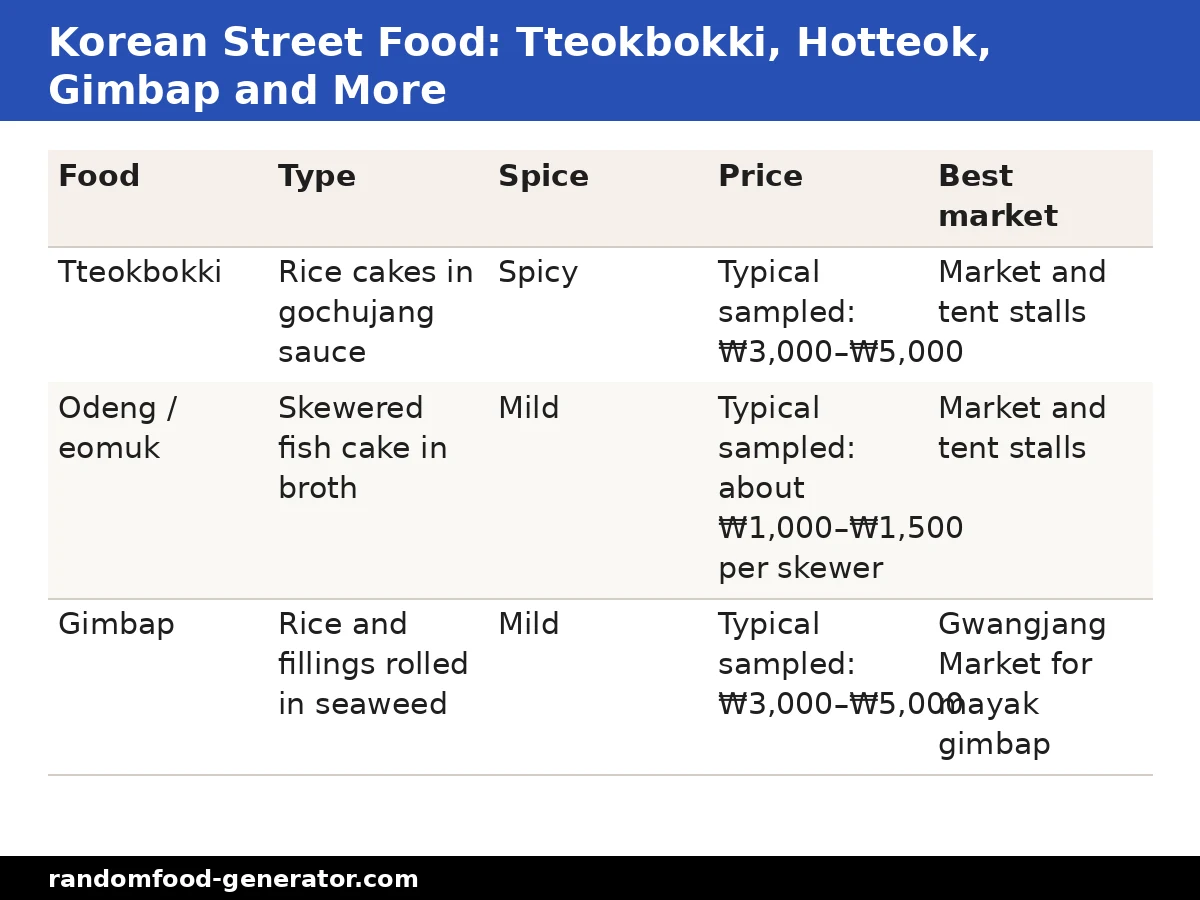
Korean street food at a glance
Compare familiar snacks by type, spice, typical sampled price and market setting. Heat can depend on sauce or preparation, so the notes distinguish spicy dishes from those without chili in their basic description.
| Food | Type | Spice | Price | Best market |
|---|---|---|---|---|
| Tteokbokki | Rice cakes in gochujang sauce | Spicy | Typical sampled: ₩3,000–₩5,000 | Market and tent stalls |
| Odeng / eomuk | Skewered fish cake in broth | Mild | Typical sampled: about ₩1,000–₩1,500 per skewer | Market and tent stalls |
| Gimbap | Rice and fillings rolled in seaweed | Mild | Typical sampled: ₩3,000–₩5,000 | Gwangjang Market for mayak gimbap |
| Hotteok | Filled griddled pancake | Mild | Typical sampled: ₩1,500–₩3,000 | Seasonal street carts |
| Bungeoppang | Fish-shaped filled pastry | Mild | Typical sampled: about ₩1,000 for 2–3 pieces | Seasonal street carts |
| Korean corn dog | Battered hot dog on a stick | No chili in the basic description | Typical sampled: ₩3,000–₩5,000 | Myeongdong |
| Dakkochi | Grilled chicken skewer | Varies with the glaze | Varies by stall | Pojangmacha and street stalls |
| Bindaetteok | Mung-bean pancake | No chili in the basic description | Typical sampled: ₩4,000–₩8,000 | Gwangjang Market |
| Sundae | Korean blood sausage | Not specified in the basic description | Varies by stall | Market stalls |
| Twigim | Battered fried snacks | Depends on the dip | Varies by stall | Market and tent stalls |
| Gyeranppang | Small egg bread | Mild | Typical sampled: ₩1,500–₩2,500 | Seasonal carts |
| Tornado potato | Spiral-cut potato on a skewer | No chili in the basic description | Varies by stall | Myeongdong carts |
| Yukhoe | Gwangjang Market specialty | Not specified in the basic description | Varies by stall | Gwangjang Market |
Where to eat Seoul street food
The seoul street food scene is spread across several market areas. Gwangjang is known for traditional dishes and a covered food corridor; Myeongdong has evening carts and modern snacks. Namdaemun is another market named in street-food guides. Choose according to whether you prefer a bench-stall meal or a walk among carts.
Gwangjang Market: traditional stalls and classic dishes
Established in 1905, Gwangjang Market is described as Korea’s first permanent market. Its covered food corridor has bench stalls, and the market is known for bindaetteok, mayak gimbap and yukhoe.
Bindaetteok is made from mung beans ground on a stone mill with pork and vegetables, then fried crisp. Mayak gimbap are thumb-sized seaweed rice rolls served with sweet-tangy mustard dip. “Mayak” jokingly means “narcotic,” referring to how addictive the little rolls seem. Both are recognizable gwangjang market food.
Myeongdong: evening carts and modern snacks
Myeongdong has rows of evening carts selling Korean corn dogs, tornado potatoes, skewers and sweets. It is the more tourist-oriented of Seoul’s two best-known street-food areas and a familiar place to find a korean corn dog.
Prices in Myeongdong run notably higher than at neighbourhood stalls. Published guides put them roughly 30–50% above neighbourhood prices, so treat that comparison as an approximate guide rather than a fixed surcharge. If you are planning a food walk focused on myeongdong street food, check the displayed price at each cart before ordering.
Gwangjang or Myeongdong: which should you choose?
Choose Gwangjang for its covered bench-stall corridor and traditional specialties such as bindaetteok and mayak gimbap. Choose Myeongdong for an evening walk among carts selling corn dogs, tornado potatoes, skewers and sweets. The two areas offer different styles of Seoul street food rather than competing versions of the same market.
Namdaemun and the pojangmacha experience
Namdaemun also appears in Seoul street-food roundups. Stalls and dishes can vary, so choose from what is being cooked and displayed during your visit.
A pojangmacha is an orange-tent street stall, often associated with evening food. These stalls are part of the everyday street-food atmosphere and serve many of the familiar quick dishes. Some have a compact counter or seating area; others are set up for a short stop. The tent-stall setting is as much a part of the experience as the food itself.
Korean street food you have to try
Tteokbokki: chewy rice cakes in a spicy sauce
Tteokbokki is the signature stall dish: chewy cylindrical rice cakes simmered in sweet-and-spicy gochujang, a red chili paste. It usually includes fish cake (eomuk) and a boiled egg. The combination is sold at markets and tent stalls across Korea.
Typical sampled Seoul prices are ₩3,000–₩5,000. If you are deciding what to order first, this is the dish most closely associated with the classic market-stall experience.
Odeng or eomuk: fish cake and warming broth
Odeng, or eomuk, is fish cake served on skewers with hot broth. It is a classic partner to tteokbokki and a mild option; the odeng broth is a familiar free extra at stalls.
A typical sampled price for an odeng skewer is about ₩1,000–₩1,500. It is a simple choice when you want something savoury and warm without the heat of tteokbokki.
Gimbap and mayak gimbap: portable rice rolls
Gimbap is rice and fillings rolled in seaweed and sliced. A picnic and lunchbox staple, it is also convenient market food. Mayak gimbap are mini, thumb-sized rolls made famous at Gwangjang Market and served with sweet-tangy mustard dip. Their name jokes about how moreish they are.
Typical sampled prices for gimbap or a mayak gimbap plate are ₩3,000–₩5,000. The rolls are generally mild in their basic form, making them a useful option alongside more strongly seasoned snacks.
Hotteok: a warm, syrup-filled pancake
Hotteok is a yeasted pancake griddled with a filling of brown sugar, cinnamon and crushed nuts or seeds that melt into hot syrup. Busan’s seed-filled ssiat hotteok is the famous variation. Busan’s seed-filled ssiat hotteok is the famous variation.
Hotteok is a winter street food, with carts typically operating roughly from November through March. Typical sampled prices are ₩1,500–₩3,000. Take care with the hot filling when you bite into a freshly cooked one.
Bungeoppang: fish-shaped pastry with a sweet centre
Bungeoppang is a fish-shaped waffle-batter pastry filled with sweet red bean paste; modern versions may use custard. It descended from Japanese taiyaki and is a familiar cold-weather cart snack.
Bungeoppang carts typically appear during the colder months, roughly November through March. A typical sampled price is about ₩1,000 for 2–3 pieces.
Korean corn dogs: crisp street snacks on sticks
Korean corn dogs are battered hot dogs on sticks, often coated in diced potato or breadcrumbs and dusted with sugar. They are a Myeongdong favourite; the basic description is not chili-led.
Typical sampled prices are ₩3,000–₩5,000. They are easy to carry while exploring the carts, although the coating makes them a more substantial snack than a simple skewer.
Dakkochi: grilled chicken skewers
Dakkochi is grilled chicken on a skewer, glazed sweet, salty or spicy. The glaze determines the heat; prices vary by stall.
Bindaetteok: Gwangjang’s crisp mung-bean pancake
Bindaetteok is a crisp mung-bean pancake with pork and vegetables, ground on a stone mill and fried on a griddle. It is Gwangjang Market’s signature pancake. Typical sampled prices are ₩4,000–₩8,000.
Sundae, twigim, gyeranppang and tornado potato
Sundae is Korean blood sausage; twigim means battered fried snacks. Both appear on stall menus and can accompany tteokbokki. Sundae’s spice level is not specified, while twigim’s heat depends on its dip.
Gyeranppang is a small loaf with a whole egg baked on top. This mild winter food has typical sampled prices of ₩1,500–₩2,500. Tornado potato is a spiral-cut potato on a skewer, familiar at Myeongdong carts; prices vary by stall.
How spicy is Korean street food?
Not every market snack is hot. Tteokbokki is the clearest spicy choice; dakkochi depends on its glaze, and twigim on its dip. Many other familiar dishes are mild or have no chili in their basic description.
| Dish | Spice guide |
|---|---|
| Tteokbokki | Spicy and sweet from gochujang sauce |
| Odeng / eomuk | Mild; served with hot broth |
| Gimbap and mayak gimbap | Mild in the basic description; mayak gimbap comes with a sweet-tangy mustard dip |
| Hotteok | Mild and sweet |
| Bungeoppang | Mild and sweet |
| Korean corn dog | No chili in the basic description |
| Dakkochi | Can be sweet, salty or spicy depending on the glaze |
| Bindaetteok | No chili in the basic description |
| Sundae | Spice level is not specified in the basic description |
| Twigim | Depends on the accompanying dip |
| Gyeranppang | Mild |
| Tornado potato | No chili in the basic description |
| Yukhoe | Spice level is not specified in the basic description |
| Tteok-twi-sun | Spice comes mainly from the tteokbokki; twigim depends on its dip |
If you prefer mild food, start with odeng, gimbap, hotteok, bungeoppang or gyeranppang. If you enjoy chili, tteokbokki is the obvious starting point. For dakkochi and twigim, ask about the glaze or dip before ordering because that is where the heat may come from.
Korean street food prices: typical sampled Seoul ranges
There is no official price list: stalls set their own prices, and tourist areas generally cost more. These are typical street prices sampled from 2026 Seoul food guides, not guaranteed rates at a particular cart.
| Food or budget | Typical sampled price |
|---|---|
| Most snacks overall | ₩1,000–₩6,000 per item |
| Tteokbokki | ₩3,000–₩5,000 |
| Odeng skewer | About ₩1,000–₩1,500 |
| Gimbap / mayak gimbap plate | ₩3,000–₩5,000 |
| Bindaetteok | ₩4,000–₩8,000 |
| Hotteok | ₩1,500–₩3,000 |
| Bungeoppang | About ₩1,000 for 2–3 pieces |
| Korean corn dog | ₩3,000–₩5,000 |
| Gyeranppang | ₩1,500–₩2,500 |
| Full evening of grazing | About ₩15,000–₩20,000 |
Use these korean street food prices as a planning reference and check the vendor’s price before ordering. Myeongdong carts are notably more expensive than neighbourhood stalls; guides put the difference at roughly 30–50%, an approximate comparison rather than a fixed rule. Other prices vary by stall.
Winter street food: when to look for hotteok and bungeoppang
Hotteok, bungeoppang and gyeranppang are winter foods. Their carts typically operate roughly from November through March, making them familiar cold-weather snacks.
Hotteok has a warm brown-sugar, cinnamon and nut filling; bungeoppang is a crisp fish-shaped pastry with red bean paste or custard; and gyeranppang is a small loaf topped with a whole egg. All are mild alternatives to spicy tteokbokki.
These carts are seasonal, so check what is available during your visit.
How to order at a pojangmacha or market stall
A pojangmacha is an orange-tent street stall, especially common in the evening. Check the food or menu, choose a snack or combination, and follow the ordering routine used by other customers. Some stalls have seating; others offer quick service.
Odeng is served on skewers with hot broth, which is a familiar free extra. It is a mild choice alongside stronger dishes. Tteokbokki, twigim and sundae can also be ordered together.
Payment methods differ between small stalls. Ask whether a vendor accepts card and keep cash as a backup. If you are unsure about heat, ask whether the sauce or glaze is spicy, especially for dakkochi and twigim.
What is tteok-twi-sun?
Tteok-twi-sun is the classic combination of tteokbokki, twigim and sundae on one tray: chewy rice cakes in spicy sauce, battered fried snacks and Korean blood sausage. Use the name when you want the mixed selection.
The trio combines spicy-sweet tteokbokki, crisp twigim and sundae. Ask about dips if you are sensitive to spice.
Choosing the best Korean street food for your visit
The best korean street food depends on your taste: choose tteokbokki for chili, or odeng, gimbap and hotteok for milder options. Gwangjang is associated with bindaetteok and mayak gimbap; Myeongdong is known for evening carts. Namdaemun is another market to consider.
For a wider regional perspective, the asian street food guide covers signature dishes across several countries. You can also explore thai food delivery for Thai dishes at home, or browse the best food in the world guide for a broader food overview. For another detailed look at Seoul’s stalls and market dishes, read Koreary’s korean street food guide.
FAQs
What is the most popular Korean street food?
Tteokbokki is the signature street-food dish. It consists of chewy cylindrical rice cakes simmered in a sweet-and-spicy gochujang sauce, usually with fish cake and a boiled egg. It is sold at almost every market and tent stall in Korea.
How much does Korean street food cost?
Most items cost about ₩1,000–₩6,000 at typical stalls, based on sampled 2026 guide prices. Myeongdong’s tourist carts cost more, and a full evening of grazing is about ₩15,000–₩20,000. Check each vendor’s price.
What is tteokbokki made of?
It is made from cylindrical rice cakes simmered in gochujang red chili sauce, usually with fish cake and a boiled egg.
Where is the best place to eat street food in Seoul?
Choose Gwangjang Market for bindaetteok and mayak gimbap, or Myeongdong for evening snacks such as corn dogs and tornado potatoes.
Is Korean street food spicy?
Tteokbokki is spicy, but odeng, gimbap, hotteok, bungeoppang and gyeranppang are mild. Dakkochi depends on its glaze, and twigim on its dip.
What is mayak gimbap?
They are mini seaweed rice rolls made famous at Gwangjang Market and served with sweet-tangy mustard dip. The name jokes about how moreish they are.