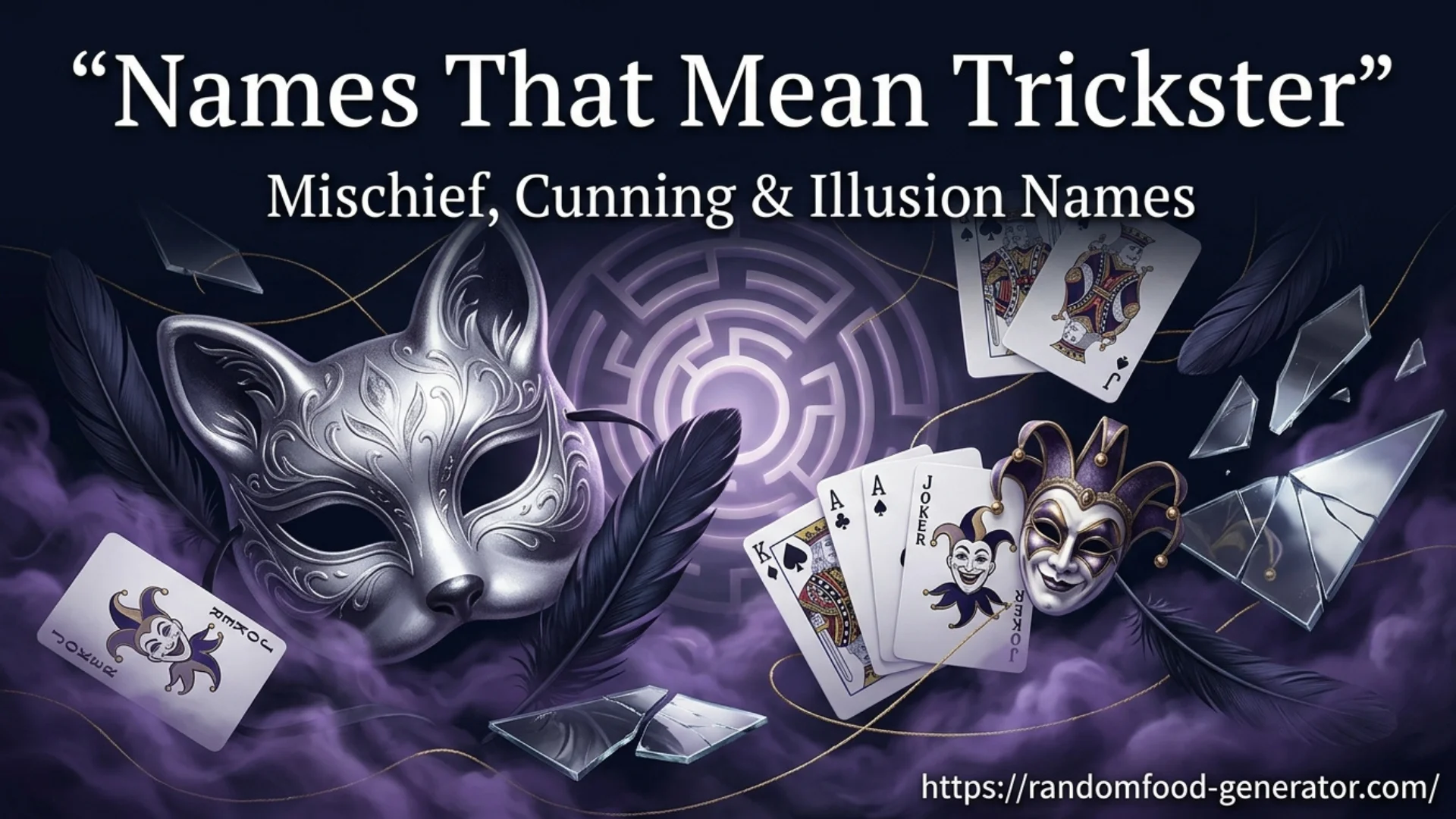
180+ Names That Mean Trickster, Mischief, Cunning, or Illusion
A trickster is not always a villain.
In mythology and folklore, tricksters can be thieves, pranksters, shape-shifters, messengers, clever underdogs, culture heroes, rebellious spirits, or teachers who expose foolishness by breaking ordinary rules.
Some use deception for selfish reasons. Others use wit to survive, challenge authority, help humanity, or reveal an uncomfortable truth.
That complexity makes trickster-inspired names useful for babies, pets, fictional characters, gaming profiles, fantasy worlds, pen names, and anyone whose personality contains a suspicious amount of clever chaos.
However, there is an important distinction:
- Some names literally mean deception, illusion, or cunning.
- Some belong to mythological or folkloric tricksters.
- Some merely create a mischievous or mysterious impression.
- Some are ordinary vocabulary words rather than traditional personal names.
- Some popular online “Japanese trickster names” are not Japanese names at all.
A trickster is generally understood as a clever boundary-breaking figure who uses tricks, secret knowledge, disguise, or rule-breaking to disrupt ordinary life. Famous examples appear across Greek, Norse, Akan, Yoruba, Polynesian, Japanese, Chinese, Indigenous American, and European storytelling traditions.
For wider background, see this guide to the trickster archetype in mythology and folklore.
Best Names That Mean Trickster or Deception
These are the strongest options with direct meanings or unusually close linguistic connections.
- Dolos — Ancient Greek; trickery, guile, or deception.
- Dolus — Latin form associated with deceit, guile, or fraud.
- Apate — Ancient Greek; deceit, deception, guile, or fraud.
- Fraus — Latin and Roman mythological personification of fraud.
- Ate — Greek mythological name connected with delusion, error, recklessness, and ruin.
- Maya — Sanskrit; illusion or magic.
- Māyā — Direct Sanskrit transliteration of Maya.
- Metis — Ancient Greek; wisdom, skill, or cunning.
- Mirage — A deceptive visual appearance.
- Jinx — A person or thing thought to bring misfortune.
- Rogue — A dishonest, unpredictable, or playfully independent person.
- Trick — Direct modern English word name.
- Trickster — Direct English archetype name.
- Mischief — Playful trouble or minor wrongdoing.
- Rascal — A mischievous person.
- Jester — A comic entertainer historically known for wit and mockery.
- Vex — To annoy, puzzle, or frustrate.
- Sly — Clever in a secretive or deceptive way.
- Clever — Direct English virtue-style word name.
- Cunning — Skill in achieving something through clever planning or deception.
- Guile — Sly or cunning intelligence.
- Riddle — A puzzling question or mysterious person.
- Fable — A short symbolic story, sometimes involving clever animal tricksters.
- Phantom — Something present only as an appearance or illusion.
- Shadow — A hidden or elusive image.
Apate was the Greek personification of deceit, while her male counterpart Dolos represented trickery. Ate personified delusion, recklessness, or ruin. Maya directly means “illusion” or “magic” in Sanskrit, and Metis means wisdom, skill, or cunning.
Also check: 160+ Names That Mean Grace
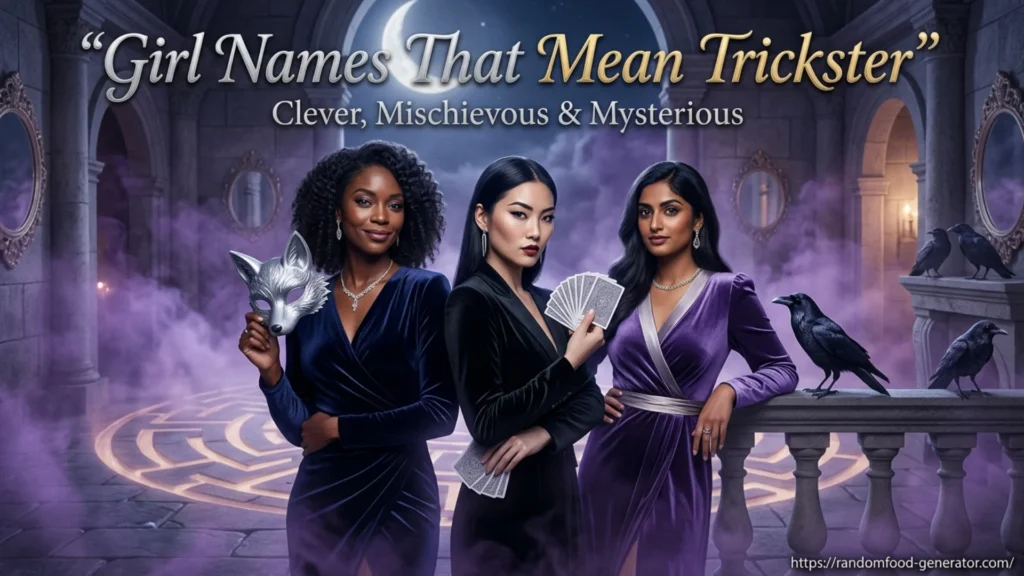
Girl Names That Mean Trickster, Deceiver, or Illusion
Girl Names With Direct Deceptive Meanings
- Apate — Greek personification of deceit.
- Fraus — Roman personification of fraud.
- Ate — Greek personification of delusion, error, and reckless ruin.
- Maya — Sanskrit; illusion or magic.
- Metis — Greek; wisdom, skill, cunning.
- Mirage — A deceptive visual appearance.
- Illusion — Direct English word choice.
- Guile — Cunning or deceitful intelligence.
- Fallacia — Latin-inspired word associated with deception or fallacy.
- Dolosa — Creative feminine form inspired by Latin vocabulary for deceit.
Only Apate, Fraus, Ate, Maya, and Metis have strong historical or linguistic foundations. Fallacia and Dolosa are better treated as literary or fantasy constructions rather than established traditional names.
Mythological and Legendary Trickster Girl Names
- Eris — Greek goddess of strife and discord.
- Circe — Greek enchantress known for transformation and magical deception.
- Calypso — Mythological figure who conceals and detains Odysseus.
- Laverna — Roman goddess associated with thieves and deception.
- Medea — Greek sorceress associated with clever schemes and magic.
- Morgan — Connected through Morgan le Fay with enchantment and manipulation.
- Morgana — Elaborated form associated with Morgan le Fay.
- Tamamo — Inspired by Tamamo-no-Mae, a legendary Japanese fox woman.
- Kuzunoha — Japanese legendary fox woman and shape-shifter.
- Daji — Chinese historical and legendary figure later associated with fox-spirit traditions.
- Aunt Nancy — Caribbean and African American development of the Anansi tradition.
- Kitsune — Japanese word for fox and a category of magical fox spirits.
- Vixen — A female fox, symbolically associated with slyness.
- Raven — Associated with clever trickster traditions in several Indigenous cultures.
- Fox — An animal name associated with cleverness and stealth.
These names are connected with trickery through stories or symbolism. Their literal etymologies do not necessarily mean trickster.
Playful and Mischievous Girl Names
- Jinx — A modern word name with playful-chaotic energy.
- Rogue — Independent and unpredictable.
- Mischief — Direct playful word choice.
- Trixie — A familiar diminutive of Beatrix.
- Pixie — A small fairy-like being often portrayed as playful.
- Puck — Mischievous spirit name usable across genders.
- Fable — Story-inspired and mysterious.
- Echo — Greek mythological name with an elusive quality.
- Riddle — Mysterious and clever.
- Vex — Short, sharp, and troublesome.
- Tease — Playful modern word name.
- Imp — A small mischievous spirit.
- Sprite — A fairy-like spirit.
- Fae — Fairy-inspired modern choice.
- Faye — Established name with fairy associations.
- Nixie — A Germanic water-spirit name.
- Pippa — Bright and playful in sound, though it does not mean mischief.
- Zelda — Strong magical or mischievous popular-culture association.
- Nyx — Greek name for night, not trickster.
- Vesper — Evening, with an elusive atmosphere.
Trixie is derived from Beatrix, not from the English word “trick.” Nyx means night, while Echo belongs to a very different Greek story. They fit the aesthetic category, not the literal-meaning category.
Boy Names That Mean Trickster or Mischief
Direct and Mythological Trickster Names
- Dolos — Trickery or deception.
- Dolus — Deceit or guile.
- Loki — Norse mythological trickster figure.
- Hermes — Greek messenger god who frequently acts as a trickster.
- Mercury — Roman counterpart of Hermes.
- Anansi — Akan spider trickster associated with wit and storytelling.
- Ananse — Alternate form of Anansi.
- Kwaku Ananse — Full Akan form associated with the spider trickster.
- Eshu — Yoruba divine figure associated with crossroads, communication, and trickery.
- Èṣù — Yoruba spelling of Eshu.
- Elegua — Afro-Caribbean form related to the Eshu tradition.
- Legba — West African and Caribbean crossroads figure.
- Maui — Polynesian culture hero and trickster.
- Puck — Mischievous supernatural figure from English folklore.
- Robin Goodfellow — Another name for Puck.
- Reynard — The fox trickster of medieval European tales.
- Renart — French form associated with the same fox tradition.
- Coyote — Major trickster figure in several Indigenous American traditions.
- Raven — Trickster and culture-hero figure in several northwestern Indigenous traditions.
- Iktomi — Spider trickster in Lakota tradition.
- Wisakedjak — Trickster and culture hero in Algonquian traditions.
- Kutkh — Raven trickster figure from northeastern Asian traditions.
- Azeban — Raccoon trickster in Abenaki storytelling.
- Saci — One-legged trickster from Brazilian folklore.
- Curupira — Brazilian forest figure who confuses hunters.
- Huehuecoyotl — Aztec “old coyote” figure associated with mischief.
- Sun Wukong — The Monkey King of Chinese literature.
- Wukong — Shortened form associated with the Monkey King.
- Nezha — Rebellious Chinese mythological figure with playful associations.
- Nasreddin — Wise fool and humorous trickster in Middle Eastern folklore.
- Juha — Arabic folk trickster and comic wise fool.
- Till — Inspired by Till Eulenspiegel.
- Eulenspiegel — German folk prankster.
- Autolycus — Greek mythological thief and master of deception.
- Odysseus — Greek hero famous for strategy, disguise, and cunning.
- Sisyphus — Greek figure known for repeatedly outwitting others.
- Sinon — Greek legendary deceiver in the Trojan Horse story.
- Prometheus — Greek culture hero who tricks Zeus in some myths.
- Jack — Folk hero of many clever “Jack tales.”
- Brer Rabbit — African American folk trickster.
- Rabbit — Animal trickster name.
- Fox — Symbol of cunning.
- Rascal — A mischievous boy.
- Jester — Clever entertainer and mocker.
- Rogue — Unpredictable or dishonest adventurer.
Hermes, Loki, Anansi, Eshu, Maui, Puck, Coyote, Raven, and Sun Wukong are associated with the trickster archetype through mythology and folklore. Their names do not all literally translate as trickster. Anansi, for example, literally refers to a spider, while his stories associate him with cunning, knowledge, mischief, and trickery.
Male Names That Mean Cunning or Cleverness
- Dolos — Trickery and guile.
- Metis — Wisdom, skill, and cunning; traditionally feminine.
- Satoshi — Can mean intelligent or clever with suitable Japanese kanji.
- Aqil — Intelligent, wise, and reasonable.
- Cato — Wise or shrewd.
- Sage — A wise person.
- Reynard — Strong fox-trickster association.
- Fox — Symbolic cleverness.
- Voss — German surname meaning fox.
- Renard — French word and surname meaning fox.
- Odysseus — Associated with strategic cunning.
- Autolycus — Associated with theft and deception.
- Hermes — Associated with cleverness and trickery.
- Anansi — Associated with wit and resourcefulness.
- Loki — Associated with schemes and shape-shifting.
- Puck — Mischievous and witty.
- Maui — Resourceful trickster and culture hero.
- Sun Wukong — Cunning, rebellious Monkey King.
- Nasreddin — Comic wisdom and clever reversals.
- Reynardine — Literary form inspired by Reynard the Fox.
The first six have direct intelligence or cunning associations. Most of the rest gained that meaning through stories rather than literal translation.
Names That Mean Mischief
Traditional personal names translating exactly as “mischief” are rare. The clearest options are modern English vocabulary names and mythological associations.
- Mischief
- Rascal
- Imp
- Prank
- Trick
- Jinx
- Vex
- Rogue
- Jester
- Puck
- Pixie
- Sprite
- Tease
- Chaos
- Mayhem
- Trouble
- Rebel
- Riot
- Frolic
- Whim
- Caprice
- Jape
- Antic
- Lark
- Monkey
These are creative modern word names. Several work far better for pets, game characters, usernames, or fictional troublemakers than for a birth certificate.
Names That Mean Deceiver
Direct Deception Names
- Apate — Deceit and fraud.
- Dolos — Trickery and deception.
- Dolus — Deceit or guile.
- Fraus — Fraud.
- Ate — Delusion or error.
- Maya — Illusion or magic.
- Mirage — Deceptive appearance.
- Guile — Sly deception.
- Fallacy — Misleading or faulty reasoning.
- Feint — A deceptive movement.
- Ruse — A trick intended to deceive.
- Decoy — Something used to mislead.
- Bluff — A false show intended to mislead.
- Veil — Something that conceals.
- Mask — A covering that hides identity.
- Facade — A misleading outward appearance.
- Phantom — An appearance without physical reality.
- Shadow — Hidden or obscured image.
- Sly — Secretively clever.
- Trickster — One who deceives or plays tricks.
Apate and Dolos are the strongest historical names for literal deceit. Most of the others are modern English concept names.
Names That Mean Illusion
Established or Historically Rooted Options
- Maya — Sanskrit; illusion or magic.
- Māyā — Sanskrit spelling.
- Phantasia — Greek-derived; imagination or appearance.
- Fantasia — Italian and literary form associated with imagination.
- Mirage — An optical illusion or misleading appearance.
- Kasumi — Japanese; can mean mist when written 霞.
- Yume — Japanese; dream when written 夢.
- Eidolon — Greek-derived; image, phantom, or idealized representation.
- Phantom — Apparition or false appearance.
- Phantasm — Apparition, illusion, or imagined image.
- Vision — Something seen in imagination or dream.
- Dream — Direct word name.
- Reverie — A dreamy state.
- Haze — Mist or obscurity.
- Mist — Fine water droplets obscuring vision.
- Veil — A concealing covering.
- Shadow — A dark image.
- Echo — Repeated sound that can create an elusive impression.
- Fata — Inspired by the optical phenomenon Fata Morgana.
- Morgana — Connected with Fata Morgana and Morgan le Fay.
- Chimera — An impossible fantasy or illusion.
- Delusion — A false belief or impression.
- Glamour — Historically connected with enchantment and magical illusion.
- Spell — Magical influence.
- Enigma — Something mysterious or difficult to explain.
Maya is the clearest established personal name meaning illusion or magic. Kasumi and Yume are genuine Japanese names or name readings, but they mean mist and dream rather than trickster.
Greek Names That Mean Trickster, Deception, or Cunning
- Dolos — Trickery, deceit, guile.
- Apate — Deceit or fraud.
- Ate — Delusion, recklessness, error, or ruin.
- Metis — Wisdom, skill, cunning.
- Hermes — Trickster-associated messenger god.
- Mercury — Roman counterpart of Hermes.
- Autolycus — Master thief in mythology.
- Odysseus — Hero associated with clever plans and disguise.
- Sisyphus — Mythological king associated with trickery.
- Sinon — Deceiver connected with the Trojan Horse.
- Prometheus — Culture hero who deceives Zeus.
- Eris — Discord.
- Circe — Enchantress and transformer.
- Calypso — Concealing mythological figure.
- Medea — Sorceress and strategist.
- Proteus — Shape-shifting sea god.
- Peitho — Persuasion and seduction.
- Pseudologos — A lie or falsehood personified.
- Aletheia — Truth; opposite symbolism to Apate.
- Phantasia — Imagination or appearance.
Dolos, Apate, Ate, and Metis have meanings directly related to trickery, delusion, or cunning. Hermes, Autolycus, Odysseus, Sisyphus, and Sinon belong to the mythological-association category.
Japanese Names That Mean Trickster
There is no large authentic class of standard Japanese baby names that literally means “trickster.”
Many online pages list ordinary Japanese nouns, adjectives, monsters, or phrases as though Japanese parents routinely use them as first names. They do not.
Japanese Trickster Words and Folklore Terms
- Kitsune — 狐 — Fox; magical fox spirits are often shape-shifters and tricksters.
- Tanuki — 狸 — Raccoon dog; associated with transformation and playful deception.
- Itazura — 悪戯 — Mischief or prank.
- Yako — 野狐 — Wild fox or a type of fox spirit.
- Nogitsune — 野狐 — Wild fox spirit.
- Kokkuri — Divination game and animal-spirit figure.
- Bakemono — 化け物 — Transforming supernatural creature.
- Maboroshi — 幻 — Phantom or illusion.
- Gen’ei — 幻影 — Phantom or illusion.
- Sagi — 詐欺 — Fraud or swindle.
- Kage — 影 — Shadow.
- Yami — 闇 — Darkness.
- Kurai — 暗い — Dark or gloomy.
- Akuma — 悪魔 — Demon.
- Ayakashi — 妖 — Supernatural apparition or mysterious being.
These are primarily words, folklore categories, or creature names, not conventional personal names. Kitsune literally means fox, and Japanese folklore attributes intelligence, shape-shifting, beguiling, and misleading behavior to fox spirits.
Usable Japanese Names With Clever or Illusive Meanings
- Satoshi — 聡 — Intelligent, perceptive, clever.
- Kei — 慧 — Wise or intelligent with this kanji.
- Akira — 明 — Bright or clear with this kanji.
- Kasumi — 霞 — Mist.
- Yume — 夢 — Dream.
- Maya — A legitimate Japanese name, though its Japanese meaning depends on the kanji.
- Rei — Meaning depends on kanji; can suggest spirit, elegance, or clarity.
- Shinobu — Meaning depends on kanji; can relate to endurance or concealment.
- Kiri — Can evoke mist depending on the written form.
- Ren — Meaning depends on kanji and does not inherently mean trickster.
Satoshi, Kei, Akira, Kasumi, and Yume can suit a clever or mysterious fictional character. They should not be translated as trickster.
Japanese Mythological Trickster-Inspired Names
- Tamamo — Tamamo-no-Mae, legendary fox woman.
- Kuzunoha — Legendary fox woman.
- Kitsune
- Tanuki
- Kokkuri
- Yako
- Osaki — Fox-spirit tradition.
- Izuna — Small fox- or weasel-like spirit.
- Kanko — Alternate name associated with tube fox traditions.
- Inugami — Dog-spirit possession tradition.
These work better for fiction, fantasy games, or pets than for babies.
Japanese Girl Names With a Trickster or Illusion Vibe
- Kasumi — Mist.
- Yume — Dream.
- Maya — Meaning varies by kanji.
- Rei — Meaning varies by kanji.
- Shinobu — Endurance or concealment, depending on kanji.
- Tamamo — Fox-spirit association.
- Kuzunoha — Legendary fox association.
- Kiri — Mist-inspired reading.
- Ayame — Iris flower; mysterious sound rather than trickster meaning.
- Rin — Meaning varies by kanji; crisp, clever sound.
Only Kasumi and Yume have straightforward mist or dream meanings in the listed forms. Tamamo and Kuzunoha are folklore associations.
Japanese Boy Names With a Clever or Trickster Vibe
- Satoshi — Intelligent or clever.
- Kei — Wise or intelligent.
- Akira — Bright or clear.
- Shinobu — Meaning depends on kanji.
- Ren — Meaning depends on kanji.
- Kaito — Meaning depends on kanji; popular adventurous sound.
- Riku — Land, depending on kanji.
- Gen — Meaning depends on kanji.
- Rei — Meaning depends on kanji.
- Kitsune — Fox-spirit word, not a conventional boy name.
Chinese Names and Figures Connected With Tricksters
As with Japanese, standard Chinese personal names rarely use characters that directly mean fraud, deception, or trickster because those meanings are negative.
Chinese Mythological and Literary Trickster Names
- Sun Wukong — Monkey King from Journey to the West.
- Wukong — Shortened form.
- Nezha — Rebellious mythological hero.
- Daji — Legendary woman associated in later tradition with a fox spirit.
- Huli Jing — 狐狸精 — Fox spirit; a category rather than a personal name.
- Red Boy — Mischievous figure from Journey to the West.
- Zhu Bajie — Comic and troublesome companion in Journey to the West.
- Ji Gong — Eccentric folk hero and “mad monk.”
- Monkey — Direct English adaptation of the Monkey King theme.
- Fox — Symbolic adaptation of huli-jing folklore.
Chinese Characters With Clever or Illusive Meanings
- Hui — 慧 — Intelligent or wise.
- Zhi — 智 — Wisdom or intellect.
- Min — 敏 — Quick, agile, or clever.
- Ling — 灵 — Spirit, cleverness, or supernatural quality depending on context.
- Huan — 幻 — Illusion or fantasy.
- Jiao — 狡 — Sly or cunning, but strongly negative and generally unsuitable for a personal name.
- Zha — 诈 — Fraud or deceit; not suitable as a normal name.
- Ying — 影 — Shadow.
- Meng — 梦 — Dream.
- Wu — 悟 — Enlightenment or understanding.
Hui, Zhi, Min, Ling, Meng, and Wu can appear naturally in Chinese names. Huan is more literary, while Jiao and Zha carry negative meanings and should not be casually recommended as baby-name characters.
Last Names That Mean Trickster or Suggest Cunning
Few hereditary surnames literally mean trickster. The strongest choices come from foxes, cleverness, performers, or occupational associations.
- Fox — English surname from the animal or a clever-person nickname.
- Voss — German and Dutch surname meaning fox.
- Fuchs — German surname meaning fox.
- Renard — French surname meaning fox.
- Reynard — English and literary fox association.
- Vos — Dutch surname meaning fox.
- Lis — Polish surname meaning fox.
- Zorro — Spanish word for fox; also strong fictional association.
- Sly — English surname or nickname suggesting secretive cleverness.
- Trick — Rare surname and direct English word.
- Tricker — English surname, though not necessarily derived from modern “trickster.”
- Trickett — English surname with uncertain or separate historical roots.
- Jester — Occupational-style modern surname.
- Fool — Historical nickname surname, though obviously risky.
- Wise — Wise-person nickname.
- Sharp — Nickname for a keen or clever person.
- Quick — Nickname or descriptive surname.
- Craft — Skill or clever technique.
- Crafty — Modern invented surname-style choice.
- Riddle — Established surname with mysterious associations.
- Mask — Concealment-inspired surname.
- Veil — Hidden-identity imagery.
- Shadow — Modern word surname.
- Mirage — Modern fantasy surname.
- Deceiver — Direct concept name, suitable mainly for characters.
Fox, Voss, Fuchs, Renard, Vos, and Lis are the most natural surname options for symbolic cunning. A fox meaning is not identical to trickster, but centuries of folklore have done most of the thematic work already.
Other Names for a Trickster
Useful synonyms, titles, and character labels include:
- Prankster
- Deceiver
- Schemer
- Rogue
- Rascal
- Jester
- Fool
- Con artist
- Swindler
- Charlatan
- Impostor
- Shape-shifter
- Illusionist
- Magician
- Mischief-maker
- Rule-breaker
- Boundary-crosser
- Fox
- Wise fool
- Culture hero
- Rebel
- Joker
- Hoaxer
- Huckster
- Trick player
Some words are playful, while others imply genuine fraud or criminal deception. Calling a fictional fox a rascal is charming. Naming a newborn “Swindler” may lead to awkward conversations at the bank.
Modern Trickster Names for Characters
- Jinx
- Rogue
- Vex
- Riddle
- Mirage
- Shadow
- Mask
- Veil
- Sly
- Trick
- Prank
- Mischief
- Chaos
- Mayhem
- Riot
- Rascal
- Jester
- Imp
- Sprite
- Fox
- Raven
- Coyote
- Phantom
- Fable
- Echo
- Decoy
- Ruse
- Bluff
- Feint
- Cipher
- Enigma
- Puzzle
- Secret
- Haze
- Smoke
- Glitch
- Switch
- Twist
- Gambit
- Sleight
Cute Mischievous Names for Pets
- Loki
- Puck
- Jinx
- Rascal
- Mischief
- Imp
- Pixie
- Trixie
- Monkey
- Foxy
- Coyote
- Raven
- Sly
- Rogue
- Bandit
- Sneaky
- Pickle
- Trouble
- Chaos
- Mayhem
- Wukong
- Anansi
- Kitsune
- Tanuki
- Saci
How to Choose a Trickster Name
Decide Whether You Want a Literal Meaning
For direct meanings, prioritize:
- Dolos
- Dolus
- Apate
- Fraus
- Ate
- Maya
- Metis
- Mirage
- Guile
- Ruse
Choose the Type of Trickster
Different figures express different qualities:
- Playful mischief: Puck, Pixie, Rascal
- Cunning intelligence: Metis, Anansi, Odysseus
- Deception: Dolos, Apate, Fraus
- Illusion: Maya, Mirage, Kasumi
- Shape-shifting: Loki, Kitsune, Proteus
- Rebellion: Sun Wukong, Nezha, Rogue
- Comic wisdom: Nasreddin, Juha, Till
- Animal cleverness: Fox, Raven, Coyote, Rabbit
- Chaos: Eris, Loki, Mayhem
- Magic: Circe, Morgan, Tamamo
Separate Meaning From Mythological Role
These statements are not interchangeable:
- Dolos directly represents trickery.
- Apate directly represents deceit.
- Maya means illusion or magic.
- Metis means wisdom, skill, or cunning.
- Loki is a trickster figure, but the name does not simply mean trickster.
- Hermes acts as a trickster, but the etymology of Hermes is uncertain.
- Anansi literally relates to a spider, while his folklore role is trickster.
- Kitsune literally means fox, not trickster.
- Puck names a mischievous spirit but has a more complicated etymology.
- Reynard became associated with foxes through literature.
Consider Cultural Context
Anansi, Eshu, Legba, Coyote, Raven, Iktomi, Wisakedjak, Maui, Sun Wukong, Kitsune, and other figures belong to living or historically important cultural traditions.
They are more than stylish labels for a fantasy mood board.
Research the stories, pronunciation, religious role, and cultural setting before using one as a baby name, business identity, or commercial character.
Treat Invented Names Honestly
There is nothing wrong with a fantasy name such as Illusia, Shadowlyn, Miravelle, or Trickara.
The problem begins when a newly assembled word is described as an ancient Japanese, Greek, Celtic, or Sanskrit name. Fiction does not become etymology merely because somebody added “origin: mystical” underneath it.
Frequently Asked Questions
What name is associated with mischief?
Loki is one of the most famous names associated with mischief because he plays a trickster role in Norse mythology.
Other strong choices include Puck, Anansi, Hermes, Eshu, Maui, Sun Wukong, Jinx, and Rascal. Loki’s mythological role is trickster-like, though the name itself does not literally translate as mischief.
What Greek god is a trickster?
Hermes is the best-known Greek trickster god.
He is associated with messengers, travelers, boundaries, trade, thieves, clever speech, and deception. Myths about his childhood include stealing Apollo’s cattle and disguising their tracks.
What male names mean mischief?
Very few traditional masculine names literally mean mischief.
The closest direct or symbolic options include Dolos, Loki, Puck, Anansi, Hermes, Eshu, Maui, Reynard, Rascal, Rogue, Jester, and Mischief.
Dolos is the strongest direct option because it represents trickery or deception.
What is a name for a trickster?
Strong names for a trickster include:
- Dolos
- Loki
- Hermes
- Anansi
- Eshu
- Puck
- Maui
- Reynard
- Coyote
- Raven
- Sun Wukong
- Nasreddin
For a female trickster, consider Apate, Maya, Metis, Eris, Circe, Laverna, Tamamo, or Jinx.
What is a mischievous name?
A mischievous name suggests playful trouble, cleverness, rebellion, or pranks.
Popular options include Loki, Puck, Jinx, Rascal, Rogue, Mischief, Pixie, Trixie, Imp, Monkey, and Trouble.
What name literally means trickster?
Dolos is one of the closest historical names because the Greek concept represents trickery, guile, and deception.
Apate means deceit, Maya means illusion or magic, and Metis means wisdom, skill, or cunning.
What girl name means deceiver?
Apate is the clearest mythological girl name connected directly with deceit.
Fraus represents fraud in Roman mythology, while Maya means illusion or magic rather than deceiver.
What boy name means deceiver?
Dolos, or its Latin form Dolus, is the strongest masculine choice linked directly with deception and trickery.
Loki, Hermes, Autolycus, Odysseus, and Sinon are associated with deception through mythology rather than literal name meanings.
What Japanese name means trickster?
There is no widely established Japanese personal name that directly means trickster.
Kitsune means fox and refers to fox spirits often associated with shape-shifting and deception. Itazura means mischief, but it is a vocabulary word rather than a conventional personal name.
Satoshi means intelligent or clever with suitable kanji, but it does not mean trickster.
What Japanese girl name means trickster?
There is no standard Japanese girl name with that exact literal meaning.
Kasumi, meaning mist with 霞, and Yume, meaning dream with 夢, provide an illusion-like theme. Tamamo and Kuzunoha have legendary fox-spirit associations.
What Chinese name means trickster?
There is no common Chinese personal name that directly translates as trickster.
Sun Wukong is the most famous Chinese trickster-associated name. Characters such as Hui, Zhi, and Min can express intelligence or quickness, while Huan means illusion. Characters meaning fraud or sly deception are generally unsuitable for normal personal names.
What names mean illusion?
The clearest established option is Maya, meaning illusion or magic in Sanskrit.
Other illusion-inspired choices include Mirage, Phantasia, Fantasia, Kasumi, Yume, Eidolon, Phantom, Phantasm, Haze, Veil, Shadow, and Chimera.
What last name means trickster?
Few surnames literally mean trickster.
Fox-related surnames such as Fox, Voss, Fuchs, Renard, Reynard, Vos, and Lis provide the strongest symbolic connection with cleverness and trickster folklore.
What name means cunning?
Metis means wisdom, skill, or cunning in Ancient Greek.
Satoshi can mean intelligent or clever with appropriate Japanese kanji. Cato is associated with wisdom or shrewdness, while Fox and Reynard symbolize cunning through folklore.
Final Thoughts
Names connected with tricksters can represent intelligence, adaptability, humor, rebellion, disguise, illusion, survival, or playful trouble.
For the most literal meanings, Dolos, Apate, Ate, Maya, and Metis are the strongest choices.
For famous mythological figures, consider Loki, Hermes, Anansi, Eshu, Maui, Puck, Sun Wukong, Coyote, Raven, Iktomi, or Reynard.
For modern names, Jinx, Rogue, Mischief, Rascal, Vex, Mirage, Shadow, Riddle, and Fox provide immediate mischievous energy.
The best choice depends on whether you want a genuine historical meaning, a mythological association, or a creative fantasy name.
Just label it honestly. A random noun copied from a Japanese dictionary is not automatically an ancient baby name, even when somebody places a cherry-blossom emoji beside it.