Asian Street Food: Iconic Dishes From Thailand to Taiwan
Asian street food is a collection of local food traditions, not one shared menu or a contest between countries. Bangkok, Taipei, Hanoi, Osaka and George Town each bring different ingredients, cooking methods and eating customs to their stalls, markets and food streets.
This country-by-country guide follows those local signatures, from pad Thai and som tam in Thailand to stinky tofu in Taiwan, pho in Vietnam, takoyaki in Japan and char kway teow in Malaysia. It is not a ranking. Instead, it explains what the dishes are, where to look for them and how to approach markets and shared tables. If you are exploring street food in asia for the first time, use the glossary and the sweet-and-savoury guide to choose a starting point.
What makes Asian street food distinctive?
There is no single style of asian street food: dishes may be stir-fried, simmered, grilled, fried or assembled as sandwiches. The phrase best asian street food is not a ranking; it can describe dishes that express a place, from Bangkok noodles and Taipei night-market snacks to Hanoi pho, Osaka takoyaki and Penang’s wok-fried noodles. These are among the famous street food in asia, each with its own local context.
Thailand: pad Thai, som tam and Bangkok street food
Thailand’s street-food scene is especially associated with Bangkok and Chiang Mai. In Bangkok, pad Thai is the best-known street noodle dish: rice noodles are stir-fried with tamarind, egg, bean sprouts, chives and peanuts. Thipsamai in the Old Town is the best-known specialist stall for the dish. It is a familiar starting point for anyone exploring bangkok street food.
Som tam offers a very different combination. This spicy green papaya salad is pounded with chili, lime, fish sauce and peanuts, bringing heat, acidity and crunch into one dish. Pad kra pao is a savoury rice meal made with minced pork or chicken stir-fried with holy basil, garlic and Thai chilies, then served over rice. These dishes show how varied a Thai street-food meal can be, even before dessert.
Chiang Mai has its own signature flavours. Khao soi is a northern Thai coconut curry noodle soup topped with crispy noodles, while sai ua is a northern herb sausage. Both are closely associated with the region. For something sweet, mango sticky rice pairs ripe mango with sweet coconut sticky rice and is sold at stalls across the country.
For a classic evening food walk in Bangkok, Yaowarat Road in Chinatown is the familiar night-time street-food strip. The city and the north offer different experiences, so a single meal should not be treated as a complete picture of Thai cooking. Readers who want to explore these dishes beyond the market can also look at thai food delivery.
Taiwan: Taipei night markets and Tainan specialties
Night markets are central to Taiwan’s street-food identity. In Taipei, Shilin is the largest and best-known market, while Raohe is famous for pepper buns baked against the walls of clay ovens. The range of taiwan night market food includes crisp, savoury snacks, dumplings, drinks and dishes with bold aromas.
Stinky tofu is fermented tofu that is deep-fried until the outside is crisp and the inside remains soft. It is served with pickled cabbage. Its smell is powerful, but its taste is mild by comparison. An oyster omelette combines small oysters with an egg-and-starch omelette and a sweet-spicy sauce. Pepper buns, also called hujiao bing, are juicy pork buns seasoned with black pepper and baked against the wall of a clay oven.
Xiao long bao are soup dumplings. Taiwan’s Din Tai Fung helped make them famous around the world. They are a useful reminder that a food guide can include dishes closely associated with a destination even when visitors may encounter them in restaurants as well as market settings. Bubble tea was invented in Taiwan and grew from the island’s tea-shop culture into a global drink.
Tainan is regarded as Taiwan’s food capital. Its local specialties include dan zai noodles, milkfish dishes and coffin toast. Together, Taipei’s night markets and Tainan’s food traditions show why Taiwan’s food culture cannot be reduced to one snack or one market.
Vietnam: pho, bun cha and vietnam street food
Vietnam street food has strong regional signatures, especially in Hanoi and Ho Chi Minh City. Pho, the famous beef or chicken noodle soup, is traditionally a breakfast dish. The best-known Hanoi shops often sell out by mid-morning, so it is a dish associated with an early start rather than only an evening food walk.
Bun cha is a Hanoi lunch classic. It brings grilled pork patties and slices together with a light broth, rice vermicelli and herbs. Banh mi takes a different form: a crisp baguette sandwich filled with meats, pâté, pickled vegetables and herbs. The baguette reflects a French colonial-era legacy, and banh mi has its strongest association with southern Vietnam.
Banh xeo is a crisp, turmeric-tinted crepe folded around pork, shrimp and bean sprouts. Com tam, or broken rice served with grilled pork, is a Ho Chi Minh City staple. These dishes make a useful contrast between the soup-and-herb combinations associated with Hanoi and the southern city’s sandwich and rice traditions.
Japan: Osaka takoyaki and Fukuoka yatai
Osaka is nicknamed “Japan’s Kitchen,” and Dotonbori and Kuromon Market are central street-food areas. The city’s signature snack is takoyaki: batter balls containing octopus, crisp on the outside and gooey inside, usually topped with sauce, mayonnaise and bonito flakes. It is one of the best-known examples of japanese street food.
Okonomiyaki is a savoury cabbage pancake grilled on a teppan. Yakitori is skewered grilled chicken, sold at stalls and festival stands. These dishes offer different ways to eat while walking through a busy food district: a hot snack, a filling savoury pancake or a grilled skewer.
Fukuoka is known for its yatai, small open-air food stalls that set up at night. They serve ramen and grilled skewers. The yatai experience gives the city a different street-food atmosphere from Osaka’s market and shopping-district centres, while keeping the focus on food prepared and served in a compact stall setting.
Malaysia: Penang, Kuala Lumpur and malaysian street food
George Town in Penang is a UNESCO World Heritage old town where Malay, Chinese, Indian and Peranakan food traditions meet. It is widely described as Malaysia’s street-food capital. Hawker centres and kopitiams are important places to eat: hawker centres bring small food stalls together around shared seating, while a kopitiam is the traditional coffee-shop version of that arrangement.
Char kway teow is made from flat rice noodles stir-fried over fierce heat with prawns, egg, Chinese sausage, bean sprouts and cockles. Asam laksa is a sour, tamarind-based fish noodle soup. Nasi kandar is rice served with a choice of curries. Hokkien mee features noodles in a spicy prawn broth, while cendol is a sweet bowl of shaved ice with coconut milk, palm sugar and green rice-flour jelly.
Penang and Kuala Lumpur are both useful names to know when planning a Malaysian food-focused visit, but George Town is the place specifically identified with the country’s street-food reputation in this guide. The dishes above show the range of malaysian street food, from wok-fried noodles and curry rice to sour soup and a cold dessert.
Korea and the Philippines: two more street-food signatures
Korea’s tteokbokki—rice cakes coated in gochujang sauce—is a familiar sight at Seoul market stalls, including Gwangjang Market and Myeongdong. This is a short introduction rather than a full country guide; see the dedicated korean street food guide for broader coverage of Korea’s market dishes.
In the Philippines, halo-halo is an emblematic street sweet. It combines shaved ice with sweet beans, jellies, leche flan and ube. Its mixture of textures and ingredients makes it a natural stop for anyone following the dessert side of the region’s food traditions.
Asian street food dish glossary
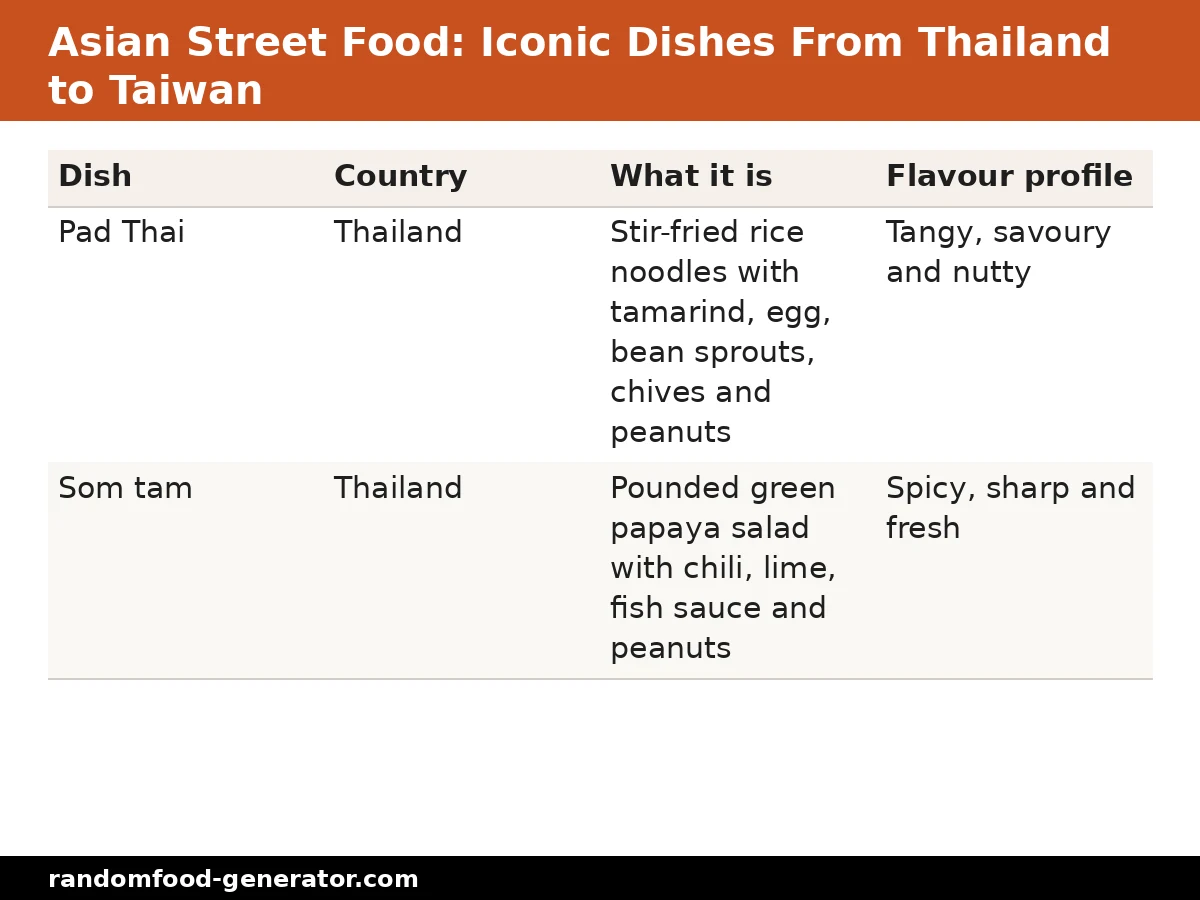
Use this quick glossary to connect a dish name with its country, preparation and general flavour. It is a practical way to scan asian street food dishes before deciding what to order.
| Dish | Country | What it is | Flavour profile |
|---|---|---|---|
| Pad Thai | Thailand | Stir-fried rice noodles with tamarind, egg, bean sprouts, chives and peanuts | Tangy, savoury and nutty |
| Som tam | Thailand | Pounded green papaya salad with chili, lime, fish sauce and peanuts | Spicy, sharp and fresh |
| Pad kra pao | Thailand | Minced pork or chicken with holy basil, garlic and Thai chilies over rice | Savoury, aromatic and spicy |
| Khao soi | Thailand | Northern coconut curry noodle soup topped with crispy noodles | Creamy, savoury and gently spiced |
| Sai ua | Thailand | Northern Thai herb sausage | Herb-forward and savoury |
| Mango sticky rice | Thailand | Coconut sticky rice served with ripe mango | Sweet, creamy and fruity |
| Stinky tofu | Taiwan | Fermented tofu, deep-fried and served with pickled cabbage | Crisp outside, soft inside; mild taste |
| Oyster omelette | Taiwan | Small oysters in an egg-and-starch omelette | Savoury with sweet-spicy sauce |
| Pepper bun | Taiwan | Juicy pork bun seasoned with black pepper and baked in a clay oven | Peppery and savoury |
| Xiao long bao | Taiwan | Soup dumplings | Savoury and broth-filled |
| Bubble tea | Taiwan | A tea-shop drink that originated in Taiwan | Tea-based and often sweet |
| Pho | Vietnam | Beef or chicken noodle soup | Savoury and broth-led |
| Bun cha | Vietnam | Grilled pork with light broth, rice vermicelli and herbs | Grilled, savoury and fresh |
| Banh mi | Vietnam | Crisp baguette sandwich with meats, pâté, pickled vegetables and herbs | Savoury, crisp and tangy |
| Banh xeo | Vietnam | Crisp turmeric-tinted crepe with pork, shrimp and bean sprouts | Savoury and crisp |
| Com tam | Vietnam | Broken rice with grilled pork | Savoury and smoky |
| Takoyaki | Japan | Batter balls filled with octopus | Savoury, sauced and soft-centred |
| Okonomiyaki | Japan | Savoury cabbage pancake grilled on a teppan | Savoury and hearty |
| Yakitori | Japan | Skewered grilled chicken | Grilled and savoury |
| Char kway teow | Malaysia | Flat rice noodles stir-fried with prawns, egg, Chinese sausage, bean sprouts and cockles | Rich, savoury and wok-fried |
| Asam laksa | Malaysia | Fish noodle soup with a tamarind-based broth | Sour and savoury |
| Nasi kandar | Malaysia | Rice served with a choice of curries | Spiced and savoury |
| Hokkien mee | Malaysia | Noodles in a spicy prawn broth | Spicy and savoury |
| Cendol | Malaysia | Shaved ice with coconut milk, palm sugar and green rice-flour jelly | Sweet, cool and coconut-rich |
| Tteokbokki | Korea | Rice cakes in gochujang sauce | Spicy and savoury |
| Halo-halo | Philippines | Shaved ice with sweet beans, jellies, leche flan and ube | Sweet, creamy and varied in texture |
Choose a sweet or savoury path through the guide
For a savoury path, try pad Thai or pad kra pao in Thailand, an oyster omelette or pepper bun in Taiwan, pho or banh mi in Vietnam, and takoyaki or yakitori in Japan. Malaysia offers char kway teow, asam laksa and nasi kandar. For sweets, look to Thai mango sticky rice, Taiwanese bubble tea, Malaysian cendol or Filipino halo-halo. Moving between the two paths gives a meal more variety.
Street food words to know
- Hawker centre: A collection of small food stalls sharing one seating area. The format is common in Malaysia and Singapore.
- Kopitiam: A traditional coffee shop where several vendors share tables, similar in spirit to a hawker-centre arrangement.
- Yatai: Small open-air food stalls that set up at night in Fukuoka, serving ramen and grilled skewers.
- Night market: An outdoor evening market made up of food and other stalls. Taiwan’s Shilin and Raohe markets are familiar examples.
- Pojangmacha: A Korean term for a tent-style street-food stall, useful vocabulary when exploring Korean street-food culture.
Singapore is also part of the hawker-centre conversation: the shared-stall format is common there as well as in Malaysia. The words matter because they describe different eating settings. A night market is an evening market to wander through, while a hawker centre is a shared seating area serving food from multiple small vendors.
How to eat at street stalls and shared tables
Pause to see how a stall works before ordering. Some vendors focus on one specialty, while a market may have many counters. Check the displayed menu and watch how customers order; if you are unsure, pointing to a dish being prepared can help communicate your choice.
At a hawker centre or kopitiam, vendors share a seating area. Follow the venue’s ordering and payment routine, then use an available shared table if that is the local arrangement. A busy stall can be a useful clue because a steady queue may indicate local interest and frequent preparation, but it is not a guarantee. Street food is generally inexpensive and often cash-based; costs vary by vendor and location, with no standard published price across these countries or dishes.
Planning a country-by-country food walk
Plan around a neighbourhood and the time of day: explore Yaowarat Road in Bangkok at night, seek khao soi or sai ua in Chiang Mai, and visit Shilin or Raohe in Taipei. In Hanoi, pho is traditionally a breakfast dish and well-known shops may sell out by mid-morning; bun cha is a lunch classic. Osaka’s Dotonbori and Kuromon Market are street-food centres, while Fukuoka’s yatai stalls set up at night. George Town in Penang is closely associated with Malaysia’s hawker and kopitiam culture. For food beyond Asia, explore the best food in the world guide and food in Colombia. For a broader destination overview, see Triptuitive’s Asia street food destinations guide.
FAQs
What is the most famous Asian street food?
There is no official ranking of the region’s street dishes. Pad Thai, pho, banh mi, takoyaki and xiao long bao are among the best-known internationally, but their importance comes from different local food traditions rather than from a shared ranking.
Which country is best known for street food?
Several countries are strongly associated with street food, including Thailand, Taiwan, Malaysia, Vietnam, Japan and Korea. Bangkok’s stalls, Taiwan’s night markets, Penang’s hawker culture and the signature dishes of Vietnam, Japan and Korea each offer a distinct experience.
What is a hawker centre?
A hawker centre is a group of small food stalls arranged around a shared seating area. It is common in Malaysia and Singapore. A kopitiam is the traditional coffee-shop version of a similar shared-vendor setup.
Is Asian street food always spicy?
No. Some Thai and Korean dishes bring noticeable chili heat, but many familiar choices are mild or sweet. Xiao long bao, pepper buns, takoyaki, banh mi and mango sticky rice offer different flavours without making chili the defining feature.
What should a first-timer try first?
Begin with a signature that matches the place you are visiting: pad Thai in Bangkok, stinky tofu or pepper buns in Taipei, pho or banh mi in Vietnam, takoyaki in Osaka, or char kway teow in Penang. These choices provide a clear introduction to the local food traditions.
What is the difference between a night market and a hawker centre?
A night market is an outdoor market of stalls that operates in the evening, as seen in Taiwan. A hawker centre is a permanent, usually covered group of food stalls with shared tables, a format common in Malaysia and Singapore.