280 Japanese Last Names Related to Death: Dark and Powerful Surnames
Introduction
Here is the secret most lists of “Japanese surnames meaning death” will not tell you: almost no real Japanese surname is written with the kanji for death itself. Death is kegare — ritual impurity — and for centuries Japanese families avoided 死 (death), 屍 (corpse), 墓 (grave), 喪 (mourning), 葬 (funeral), 血 (blood) and 殺 (kill) in their names entirely. Any list that offers you hundreds of surnames built on those characters is inventing them.
So this list is built the honest way, and it is bigger for it. Instead of fake death kanji, it gathers the real surnames that genuinely carry death’s shadow in Japanese culture: burial-mound names written with 塚, the mound of an ancient tomb; demon surnames written with 鬼; black surnames of the 黒 family; white surnames — white being Japan’s colour of mourning and the funeral shroud; decay and desolation names; night, moon and star names; shrine and spirit names; the surnames of samurai houses that Japanese history remembers for curses, massacres and spectacular falls; and, clearly labelled at the end, the famous fictional surnames of shinigami and demons from manga and anime.
Every surname below appears exactly once. Real surnames are presented as real; fictional ones are flagged as fiction. If you want the given-name side of the theme, start with our list of Japanese girl names that mean death, and for the wider darkness see names that mean death and destruction.
Quick Picks: The 15 Most Striking Death-Linked Surnames
| Name | Origin | Meaning | Note |
|---|---|---|---|
| Kuchiki | Japanese (朽木) | Decayed tree | A real surname — and Bleach’s most aristocratic shinigami house |
| Kurosaki | Japanese (黒崎) | Black cape | A real surname; Ichigo’s family in Bleach |
| Onizuka | Japanese (鬼塚) | Demon burial mound | A real surname joining the demon and tomb kanji |
| Taira | Japanese (平) | Level; peaceful | The fallen clan whose drowned ghosts haunt Dan-no-ura |
| Minamoto | Japanese (源) | Source; origin | The Genji — the warrior house that destroyed the Taira |
| Fushiguro | Japanese (伏黒) | Crouching black | A real surname, carried by Jujutsu Kaisen’s Megumi |
| Zen’in | Japanese (禪院) | Zen temple | A real surname; Jujutsu Kaisen’s cursed clan |
| Hozuki | Japanese (鬼灯) | Demon lantern | A real surname written with the ground-cherry ‘demon lantern’ |
| Kamado | Japanese (竈門) | Hearth gate | A rare real surname, famed by Demon Slayer’s hero |
| Sakurazuka | Japanese (桜塚) | Cherry-blossom burial mound | A real surname; Tokyo Babylon’s assassin bears it |
| Kageyama | Japanese (影山) | Shadow mountain | A real surname — the mountain where the shadow falls |
| Ochiai | Japanese (落合) | Meeting of the fallen | A common real surname built on the kanji for ‘fall’ |
| Kurogane | Japanese (黒金) | Black metal; iron | A real surname — ‘black gold’ is iron in old Japanese |
| Yagami | Japanese (夜神) | Night god | FICTION — Death Note’s Light Yagami; not a real family name |
| Shigaraki | Japanese (死柄木) | Death-grip tree | FICTION — a My Hero Academia surname actually written with 死, death |
The surnames that best show what this list is about — real tomb, demon and darkness names, two houses remembered for death, and the two most famous fictional death surnames in anime, labelled as fiction.
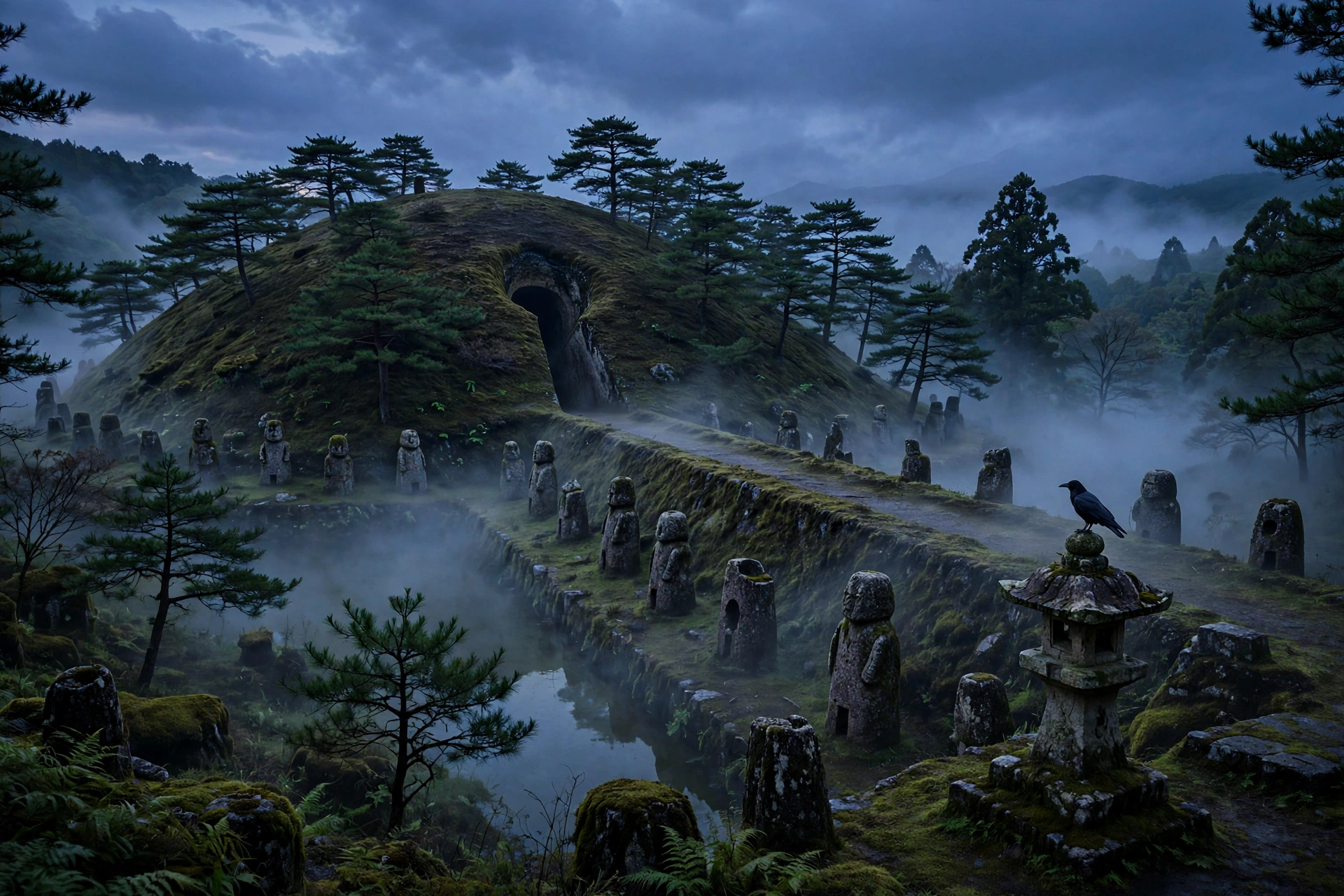
Burial-Mound Surnames: The 塚 (Tsuka) Family
The character 塚 means a burial mound — the great keyhole-shaped kofun tombs of ancient Japan. Hundreds of real Japanese families carry a tomb in their name, and most never think of it. These are the most established tsuka surnames, from the very common to the rare.
| Name | Origin | Meaning | Note |
|---|---|---|---|
| Otsuka | Japanese (大塚) | Great burial mound | One of Japan’s commonest surnames |
| Tezuka | Japanese (手塚) | Hand burial mound | Osamu Tezuka, the ‘god of manga’, bore it |
| Iizuka | Japanese (飯塚) | Rice burial mound | A common surname, also a city in Fukuoka |
| Ishizuka | Japanese (石塚) | Stone burial mound | A common surname across Japan |
| Tsukamoto | Japanese (塚本) | Foot of the burial mound | A common, well-established surname |
| Tsukahara | Japanese (塚原) | Burial-mound plain | Borne by a famous gymnastics family |
| Tsukada | Japanese (塚田) | Burial-mound field | A common surname in the Kanto region |
| Tsukagoshi | Japanese (塚越) | Beyond the burial mound | A real surname of the old provinces |
| Tsukano | Japanese (塚野) | Burial-mound moor | A real, moderately common surname |
| Tsukaguchi | Japanese (塚口) | Mouth of the burial mound | A real surname, also an Osaka place name |
| Tsukazaki | Japanese (塚崎) | Burial-mound cape | A real surname of the coastal provinces |
| Kozuka | Japanese (小塚) | Small burial mound | Also the word for a small knife’s handle |
| Miyazuka | Japanese (宮塚) | Shrine burial mound | A shrine and a tomb in one name |
| Nishizuka | Japanese (西塚) | West burial mound | A real surname of western Japan |
| Yamazuka | Japanese (山塚) | Mountain burial mound | A real, uncommon surname |
| Kizuka | Japanese (木塚) | Tree burial mound | A real surname of the old Musashi province |
| Kanazuka | Japanese (金塚) | Gold burial mound | A real, rare surname |
| Mizuka | Japanese (水塚) | Water burial mound | A real surname tied to flood-refuge mounds |
| Tsukashima | Japanese (塚島) | Burial-mound island | A real, uncommon surname |
| Kaizuka | Japanese (貝塚) | Shell mound | Shell middens were ancient burial sites; also a city in Osaka |
| Inuzuka | Japanese (犬塚) | Dog burial mound | Immortalised by Inuzuka Shino of the Hakkenden epic |
| Niizuka | Japanese (新塚) | New burial mound | A real surname, commonest in Niigata |
| Tsukahori | Japanese (塚堀) | Burial-mound moat | A rare real surname |
| Nakazuka | Japanese (中塚) | Middle burial mound | A real surname of central Japan |
Demon Surnames: The 鬼 (Oni) Family
鬼 — the oni, Japan’s horned ogre-demons — is one of the very few genuinely frightening kanji that real families carry. Demon surnames cluster in northern Japan, and several combine the demon with graves, capes and willows. Every name here is a real, attested surname.
| Name | Origin | Meaning | Note |
|---|---|---|---|
| Onizaki | Japanese (鬼崎) | Demon cape | A real surname of the northern coasts |
| Onishi | Japanese (鬼石) | Demon stone | A real surname, also a Gunma town of legend-haunted hills |
| Oniyanagi | Japanese (鬼柳) | Demon willow | A real surname from Iwate, land of oni folklore |
| Onizawa | Japanese (鬼沢) | Demon marsh | A real, uncommon surname |
| Onimaru | Japanese (鬼丸) | Demon circle | Also a famous tachi blade, the ‘demon-slayer’ Onimaru Kunitsuna |
| Onikubo | Japanese (鬼久保) | Eternal demon hollow | A real surname of the Tohoku region |
| Kijima | Japanese (鬼島) | Demon island | Evokes Onigashima, the demons’ island in the Momotaro tale |
| Kito | Japanese (鬼頭) | Demon head | A real surname, written with ‘demon’ and ‘head’ |
| Onihara | Japanese (鬼原) | Demon plain | A rare real surname |
Black Surnames: The 黒 (Kuro) Family
Black is the colour of night, ink and the unlit grave-side of Japanese folklore, and the 黒 family is the largest dark surname clan in Japan — thousands of families, dozens of compound forms. These are the established black surnames.
| Name | Origin | Meaning | Note |
|---|---|---|---|
| Kurosawa | Japanese (黒沢) | Black marsh | Borne by film master Akira Kurosawa |
| Kuroda | Japanese (黒田) | Black field | A great daimyo house of the Sengoku age |
| Kuroki | Japanese (黒木) | Black tree | A common surname, especially in Kyushu |
| Kurokawa | Japanese (黒川) | Black river | A common surname; black rivers run through many ghost tales |
| Kuroishi | Japanese (黒石) | Black stone | A real surname, also an Aomori city |
| Kuroshima | Japanese (黒島) | Black island | A real surname of the southern islands |
| Kurobe | Japanese (黒部) | Black quarter | Named for the famously dark, sheer Kurobe gorge |
| Kuroiwa | Japanese (黒岩) | Black rock | A common surname across Japan |
| Kurose | Japanese (黒瀬) | Black shallows | A real surname of western Japan |
| Kurosu | Japanese (黒須) | Black necessity | A real, uncommon surname |
| Kuroyanagi | Japanese (黒柳) | Black willow | Borne by TV legend Tetsuko Kuroyanagi |
| Kuromaru | Japanese (黒丸) | Black circle | A real surname; a black circle marked condemned ships |
| Kurono | Japanese (黒野) | Black moor | A real surname of the northern plain |
| Kurozumi | Japanese (黒住) | Black dwelling | Founder of the Kurozumi-kyo faith bore this name |
| Kuronuma | Japanese (黒沼) | Black swamp | Known to manga readers from Kimi ni Todoke |
| Kurotsuchi | Japanese (黒土) | Black earth | A real surname; grave-earth in two kanji |
| Kurotani | Japanese (黒谷) | Black valley | A real surname of the mountain provinces |
| Kurotaki | Japanese (黒滝) | Black waterfall | A real, uncommon surname |
| Kuroeda | Japanese (黒枝) | Black branch | A real, rare surname |
| Kuromi | Japanese (黒海) | Black sea | A rare real surname; Sanrio’s dark imp shares the name |
| Kurosaka | Japanese (黒坂) | Black slope | A real surname of the old roads |
| Kuroha | Japanese (黒羽) | Black feather | A real surname — the crow’s feather |
| Kuromiya | Japanese (黒宮) | Black shrine | A rare real surname |
| Kuromori | Japanese (黒森) | Black forest | A real surname evoking the deep, unlit woods |
| Kuromatsu | Japanese (黒松) | Black pine | A real surname; the black pine guards many temple graves |
White Surnames: The Colour of Mourning
Western readers think of white as purity, but in Japan white is first the colour of death: the white burial kimono, the white shroud of the yurei ghost, the white bones (hakkotsu) that remain after cremation. The 白 family is one of the largest surname groups in the country — and every one of these is a mourning-white name.
| Name | Origin | Meaning | Note |
|---|---|---|---|
| Shiraishi | Japanese (白石) | White stone | One of Japan’s commonest surnames |
| Shirakawa | Japanese (白川) | White river | A common surname, also a famed Gifu village |
| Shiratori | Japanese (白鳥) | White bird; swan | A real surname — the swan is a soul-bird in Japanese lore |
| Shiraiwa | Japanese (白岩) | White rock | A real, moderately common surname |
| Shirahata | Japanese (白幡) | White banner | White banners flew for the Genji dead |
| Shiraki | Japanese (白木) | White wood; plain wood | Plain unlacquered wood is the wood of coffins and shrines |
| Shirane | Japanese (白根) | White root; white peak | A real surname of the snow-peak provinces |
| Shirasawa | Japanese (白沢) | White marsh | Also the hakutaku, the white beast that wards off spirits |
| Shirao | Japanese (白尾) | White tail | A real, uncommon surname |
| Shirato | Japanese (白戸) | White door | A real surname, commonest in Aichi |
| Shiramizu | Japanese (白水) | White water | A real surname of Kyushu |
| Shiraume | Japanese (白梅) | White plum blossom | Plum blooms on bare winter branches, a funeral flower |
| Shirakami | Japanese (白神) | White god | Named for the sacred Shirakami mountains |
| Shirasu | Japanese (白須) | White shoal | A real surname, also the name of a famed Edo judge |
| Shirota | Japanese (白田) | White field | A real surname of western Japan |
| Shiroyama | Japanese (白山) | White mountain | Named for sacred Hakusan, a mountain of the dead |
| Shirakura | Japanese (白倉) | White storehouse | A real surname of Niigata |
| Shirai | Japanese (白井) | White well | A common surname across Japan |
| Shirahama | Japanese (白浜) | White beach | A real surname, also Wakayama’s white-sand shore |
| Shirasaka | Japanese (白坂) | White slope | A real, uncommon surname |
| Shirakata | Japanese (白方) | White side | A real, rare surname |
| Shirako | Japanese (白子) | White child | A real surname of Chiba and the east |
| Shirase | Japanese (白瀬) | White rapids | Borne by Nobu Shirase, Japan’s Antarctic pioneer |
| Shirataki | Japanese (白滝) | White waterfall | A real surname; waterfalls are spirit thresholds |
| Shirasaki | Japanese (白崎) | White cape | A real surname of the Pacific coasts |
Decay and Desolation: 朽, 荒 and Ash
A smaller, grimmer shelf: surnames of rotting wood, ruined fields and hearth-ash. The 荒 (ara) family carries the character for ‘desolate, laid waste’ — the look of a battlefield or an abandoned village — while 灰 is ash itself, what the crematorium leaves behind.
| Name | Origin | Meaning | Note |
|---|---|---|---|
| Saraki | Japanese (更木) | Fresh-cut timber | Bleach reads this same real surname ‘Zaraki’ for its death-loving captain |
| Araki | Japanese (荒木) | Desolate tree | A common surname across Japan |
| Arakawa | Japanese (荒川) | Desolate river | A common surname; also Tokyo’s great eastern river |
| Arai | Japanese (荒井) | Desolate well | A common surname, not to be confused with 洗井 |
| Aratani | Japanese (荒谷) | Desolate valley | A real surname of the mountain provinces |
| Arahata | Japanese (荒畑) | Desolate field | A real, uncommon surname |
| Aramaki | Japanese (荒牧) | Desolate pasture | A real surname, commonest in Kyushu |
| Arase | Japanese (荒瀬) | Desolate shallows | A real, uncommon surname |
| Arakaki | Japanese (荒垣) | Desolate fence | A characteristically Okinawan surname |
| Aramata | Japanese (荒俣) | Desolate fork | Borne by occult scholar Hiroshi Aramata |
| Arakida | Japanese (荒木田) | Desolate tree field | A rare real surname |
| Kojin | Japanese (荒神) | Fierce god | Kojin is the terrifying hearth god who brings both fire and plague |
| Haibara | Japanese (灰原) | Ash plain | A real surname; Detective Conan’s Ai Haibara made it famous |
| Haitani | Japanese (灰谷) | Ash valley | A rare real surname |
Night, Moon and Mountains of the Dead
Death in Japan keeps night hours: ghosts walk at the hour of the ox, Obon lanterns burn after dark, and the Dewa mountains — Gassan, Haguro and Yudono — are climbed as a rehearsal for death and rebirth. These real surnames belong to the night sky, the moon’s calendar, and the sacred mountains where the dead are gathered.
| Name | Origin | Meaning | Note |
|---|---|---|---|
| Yaku | Japanese (夜久) | Long night | A rare real surname from Kagoshima |
| Yuzuki | Japanese (夕月) | Evening moon | A rare real surname — the moon at dusk |
| Mikazuki | Japanese (三日月) | Crescent moon | A real surname; also a legendary sword, Mikazuki Munechika |
| Tsukiyama | Japanese (月山) | Moon mountain | Gassan, ‘moon mountain’, is a Dewa peak where the dead gather |
| Tsukioka | Japanese (月岡) | Moon hill | Borne by ghost-painter Tsukioka Yoshitoshi |
| Tsukimori | Japanese (月森) | Moon forest | A real, uncommon surname |
| Tsukino | Japanese (月野) | Moon moor | A real surname, famed by Sailor Moon’s heroine |
| Tsukida | Japanese (月田) | Moon field | A real surname of eastern Japan |
| Tsukizaki | Japanese (月崎) | Moon cape | A real, uncommon surname |
| Tsukishiro | Japanese (月城) | Moon castle | A real, rare surname |
| Tsukishima | Japanese (月島) | Moon island | A real surname, also Tokyo’s island district |
| Tsukihashi | Japanese (月橋) | Moon bridge | A rare real surname |
| Tsukigata | Japanese (月形) | Moon shape | A real surname, also a Hokkaido town |
| Mochizuki | Japanese (望月) | Full moon | A common surname — the full moon of the Obon sky |
| Hazuki | Japanese (葉月) | Leaf month | The old name for August, the month of Obon |
| Kisaragi | Japanese (如月) | Second month | The old name for February in the lunar calendar |
| Yayoi | Japanese (弥生) | March; new life | The old name for the third month |
| Mutsuki | Japanese (睦月) | Month of harmony | The old name for January |
| Minazuki | Japanese (水無月) | Month of water | The old name for June |
| Fumizuki | Japanese (文月) | Letter month | The old name for July, when Tanabata letters are written to the dead lovers |
| Kannazuki | Japanese (神無月) | Month without gods | October, when the gods leave home — a spirit-haunted month |
| Shimotsuki | Japanese (霜月) | Frost month | The old name for November, when frost kills the fields |
| Nagatsuki | Japanese (長月) | Long month | The old name for September, month of lengthening nights |
| Akatsuki | Japanese (暁) | Dawn | A real surname — the hour when ghosts must depart |
| Ariake | Japanese (有明) | Dawn moon | The moon still hanging in the morning sky |
| Hangetsu | Japanese (半月) | Half moon | A rare real surname |
| Hoshino | Japanese (星野) | Star moor | A common surname of the night sky |
| Hoshiyama | Japanese (星山) | Star mountain | A real surname of the hill country |
| Hoshizaki | Japanese (星崎) | Star cape | A real surname of the coasts |
| Hoshida | Japanese (星田) | Star field | A real, moderately common surname |
| Hoshi | Japanese (星) | Star | A short, real single-kanji surname |
| Hoshikawa | Japanese (星川) | Star river | The Milky Way is Japan’s river of stars and souls |
| Hoshina | Japanese (星名) | Star name | A real, uncommon surname |
| Hoshihara | Japanese (星原) | Star plain | A real surname of the high plains |
| Hoshijima | Japanese (星島) | Star island | A real, uncommon surname |
| Hoshide | Japanese (星出) | Star rising | Borne by astronaut Akihiko Hoshide |
| Hoshizawa | Japanese (星沢) | Star marsh | A real, uncommon surname |
| Hoshimoto | Japanese (星本) | Star origin | A real, rare surname |
| Karasuma | Japanese (烏丸) | Crow circle | Crows are death omens and carrion birds of the battlefield |
| Karasuyama | Japanese (烏山) | Crow mountain | A real surname, also a Tochigi city |
| Chono | Japanese (蝶野) | Butterfly moor | Butterflies are the souls of the dead in Japanese folk belief |
| Haguro | Japanese (羽黒) | Black feather | Mount Haguro, ‘black feather’, is a Dewa mountain of the dead |
| Tateyama | Japanese (立山) | Standing mountain | Sacred Tateyama, with its ‘hell valley’, was a mountain of the afterlife |
Shrine and Spirit Surnames: The 神 (Kami) Family
The kami are Japan’s gods and spirits, and surnames written with 神 mark families who served shrines — the places where the living negotiate with the dead. These are the established kami surnames, from the common to the rare.
| Name | Origin | Meaning | Note |
|---|---|---|---|
| Kagura | Japanese (神楽) | Sacred music | Kagura dance summons and entertains the spirits of gods and ancestors |
| Jinguji | Japanese (神宮寺) | Shrine temple | A real surname born where shrine and temple stood as one |
| Kamiya | Japanese (神谷) | God valley | A common surname across Japan |
| Kanzaki | Japanese (神崎) | God cape | A common surname of the coasts |
| Kambe | Japanese (神戸) | God door | An older reading of the name behind the city of Kobe |
| Kamisato | Japanese (神里) | God village | A real surname, characteristically Okinawan |
| Kamio | Japanese (神尾) | God ridge | A real, uncommon surname |
| Jimbo | Japanese (神保) | Divine protection | A real surname; Tokyo’s book district shares it |
| Kambayashi | Japanese (神林) | God forest | Sacred groves are where kami descend |
| Kanbara | Japanese (神原) | God plain | A real surname of Shizuoka and beyond |
| Kamiki | Japanese (神木) | Sacred tree | The rope-bound sacred trees of shrines share this name |
| Kamiyama | Japanese (神山) | God mountain | A real surname of the sacred peaks |
| Kandori | Japanese (神取) | God taking | A real, uncommon surname |
| Kaminaga | Japanese (神永) | Eternal god | A real, rare surname |
| Kamisawa | Japanese (神沢) | God marsh | A real surname of the north |
| Kamishiro | Japanese (神代) | Age of the gods | The mythic age before human history |
| Kanagawa | Japanese (神奈川) | Kana river of the gods | A rare surname borrowed from the famous prefecture |
| Kamino | Japanese (神野) | God moor | A real, uncommon surname |
| Kaniwa | Japanese (神庭) | Sacred garden | The gravel court where shrine rites are performed |
| Kamimori | Japanese (神森) | God forest grove | A real, rare surname |
Priests of the Dead: Onmyoji and Ritual Clans
Some surnames belonged to the professionals of the spirit world: the onmyoji diviners who read omens, exorcised demons and pacified vengeful ghosts, and the hereditary ritual clans of the imperial court who managed mourning taboo itself.
| Name | Origin | Meaning | Note |
|---|---|---|---|
| Abe | Japanese (安倍) | Peaceful folds | Abe no Seimei, the most famous onmyoji in history, bore it |
| Kamo | Japanese (賀茂) | Joyful increase | The Kamo were the rival house of hereditary onmyoji |
| Ashiya | Japanese (芦屋) | Reed hut | Ashiya no Doman, Seimei’s legendary dark rival, shares this real surname |
| Tsuchimikado | Japanese (土御門) | Imperial earth gate | The Tsuchimikado were the hereditary masters of onmyodo |
| Inbe | Japanese (忌部) | Abstinence guild | The Inbe managed ritual purity and mourning taboo at court |
| Nakatomi | Japanese (中臣) | Inner retainers | The Nakatomi recited the great purifications for the dead and defiled |
| Urabe | Japanese (卜部) | Divination guild | Hereditary court diviners who read cracks in scorched bone |
Samurai Clans Remembered for Death and Curses
Japanese history remembers certain houses not for their glory but for their endings: clans drowned to the last child, houses extinguished in a single night, and lords whose vengeful ghosts (onryo) Japan still appeases at shrines today. These are real clan surnames, each with its death story.
| Name | Origin | Meaning | Note |
|---|---|---|---|
| Fujiwara | Japanese (藤原) | Wisteria plain | The great court house, undone by the warrior age it spawned |
| Tachibana | Japanese (橘) | Wild mandarin | An imperial offshoot house that faded with the court |
| Oda | Japanese (織田) | Woven field | Oda Nobunaga died in the flames of Honno-ji, betrayed by his own retainer |
| Takeda | Japanese (武田) | Warrior field | The Takeda were annihilated at Nagashino and died out within a decade |
| Uesugi | Japanese (上杉) | Upper cedar | The house of Kenshin, the war god of Echigo |
| Date | Japanese (伊達) | Showy; gallant | Date Masamune, the One-Eyed Dragon of the war-torn north |
| Tokugawa | Japanese (徳川) | Virtue river | The shogun house that closed Japan and executed its rivals |
| Sanada | Japanese (真田) | True field | Sanada Yukimura died charging the Tokugawa at Osaka Castle |
| Mori | Japanese (毛利) | Feather profit | The Mori of Choshu, brought to the brink at Sekigahara |
| Chosokabe | Japanese (長宗我部) | Long clan division | Shikoku’s unifiers, extinguished as a great house after one generation |
| Shimazu | Japanese (島津) | Island ford | The Shimazu of Satsuma, famed for sacrificial rearguard charges |
| Hojo | Japanese (北条) | Northern strip | The Later Hojo died to a man in Odawara’s fall; the earlier Hojo fell at Kamakura in flames |
| Ashikaga | Japanese (足利) | Reed moor | The shogun house that rotted through a century of civil war |
| Imagawa | Japanese (今川) | Now river | Imagawa Yoshimoto died in the rain at Okehazama, ambushed by Nobunaga |
| Akechi | Japanese (明智) | Bright wisdom | Akechi Mitsuhide, the betrayer of Honno-ji, died a fugitive days later |
| Azai | Japanese (浅井) | Shallow well | Azai Nagamasa died by his own hand in Odani Castle’s fall |
| Asakura | Japanese (朝倉) | Morning storehouse | Allies of the Azai, destroyed in the same campaign |
| Hosokawa | Japanese (細川) | Narrow river | A house that survived by serving every winner of the wars |
| Miyoshi | Japanese (三好) | Three goods | The Miyoshi briefly ruled Kyoto before collapsing in fratricide |
| Saito | Japanese (斎藤) | Purification wisteria | Saito Dosan, the ‘Viper of Mino’, was cut down by his own son |
| Shibata | Japanese (柴田) | Brushwood field | Shibata Katsuie died with his wife in his burning castle |
| Maeda | Japanese (前田) | Front field | The Maeda of Kaga, richest of the daimyo houses |
| Yuki | Japanese (結城) | Binding castle | A warrior house of Shimosa, repeatedly ruined and revived |
| Satomi | Japanese (里見) | Village sight | Immortalised by the eight dog warriors of the Nanso Satomi Hakkenden |
More Warrior Houses of the Warring States
Beyond the famous names, the Sengoku centuries are a graveyard of houses: extinguished lines, attainted names, and families remembered chiefly for how they ended.
| Name | Origin | Meaning | Note |
|---|---|---|---|
| Nitta | Japanese (新田) | New field | Nitta Yoshisada died in battle carrying the imperial cause |
| Kusunoki | Japanese (楠木) | Camphor tree | Kusunoki Masashige, the loyalist who rode knowingly to his death at Minatogawa |
| Chiba | Japanese (千葉) | Thousand leaves | An ancient eastern house that dwindled through the wars |
| Kyogoku | Japanese (京極) | Capital’s edge | A courtier-warrior house of Omi |
| Otomo | Japanese (大友) | Great companion | Kyushu’s Christian daimyo house, ruined by the Shimazu wars |
| Ouchi | Japanese (大内) | Great inner | The Ouchi were destroyed by their own retainer’s coup |
| Amago | Japanese (尼子) | Nun child | The Amago of Izumo, extinguished by the Mori after decades of war |
| Rokkaku | Japanese (六角) | Six corners | The Rokkaku of southern Omi, broken by Nobunaga |
| Matsunaga | Japanese (松永) | Pine eternity | Matsunaga Hisahide died blowing himself up with his beloved tea kettle |
| Tsutsui | Japanese (筒井) | Tube well | A warrior-monk house of Yamato |
| Kono | Japanese (河野) | River moor | The sea-lords of Iyo, famed for shrine and pirate wars |
| So | Japanese (宗) | Ancestral shrine | The So of Tsushima, mediators in every Korean war |
| Ryuzoji | Japanese (龍造寺) | Dragon-making temple | Ryuzoji Takanobu, the ‘Bear of Hizen’, died at Okitanawate |
| Arima | Japanese (有馬) | Having horses | The Arima of Hizen, patrons and persecutors of Christians in turn |
| Nabeshima | Japanese (鍋島) | Cauldron island | The Nabeshima of Saga — the Hagakure, scripture of samurai death, was written for this house |
| Satake | Japanese (佐竹) | Help bamboo | An ancient Minamoto-descended house of Hitachi |
| Ii | Japanese (井伊) | Well clan | Ii Naomasa, the ‘Red Demon’ of the Tokugawa vanguard |
| Matsudaira | Japanese (松平) | Pine level | The Tokugawa’s original name, from their Mikawa village |
| Toyotomi | Japanese (豊臣) | Bountiful retainer | Hideyoshi’s bestowed imperial surname; his house was exterminated at Osaka in 1615 |
| Kobayakawa | Japanese (小早川) | Small swift river | Kobayakawa Hideaki’s betrayal decided Sekigahara — he died mad within two years |
| Ukita | Japanese (宇喜多) | Roof joy field | The Ukita were attainted and exiled to Hachijo Island after Sekigahara |
| Hatakeyama | Japanese (畠山) | Field mountain | A shugo house torn apart by its own succession wars |
| Shiba | Japanese (斯波) | This wave | Once among the mightiest shugo houses, faded to nothing in the wars |
| Yamana | Japanese (山名) | Mountain name | The Yamana’s feud with the Hosokawa ignited the Onin War |
Death-Dealers: Ninja, Vendetta and Punishment Houses
A final shelf of warrior surnames tied to killing itself: the ninja clans of Iga and Koga, the house of the 47 ronin’s vendetta, and the ministry of punishments whose name is written with the kanji for a criminal sentence.
| Name | Origin | Meaning | Note |
|---|---|---|---|
| Akamatsu | Japanese (赤松) | Red pine | Akamatsu Mitsusuke assassinated a shogun and died for it |
| Isshiki | Japanese (一色) | One colour | A shugo house ground down in the civil wars |
| Mogami | Japanese (最上) | Uppermost | The Mogami of Dewa, rivals of the Date, were attainted and erased |
| Kakisaki | Japanese (蠣崎) | Oyster cape | The Kakisaki ruled Ezo’s frontier through war and trade |
| Toki | Japanese (土岐) | Earth flag | The Toki of Mino, overthrown by the Viper Saito Dosan |
| Takenaka | Japanese (竹中) | Within bamboo | Takenaka Shigeharu, the strategist who died young serving Hideyoshi |
| Hachisuka | Japanese (蜂須賀) | Bee necessity inlet | A house raised from river bandits to daimyo |
| Asano | Japanese (浅野) | Shallow moor | Asano Naganori’s death sentence launched the 47 ronin’s famous vendetta |
| Hattori | Japanese (服部) | Garment guild | Hattori Hanzo’s house led the ninja of Iga |
| Fuma | Japanese (風魔) | Wind demon | The Fuma ninja clan — a surname that literally reads ‘wind demon’ |
| Momochi | Japanese (百地) | Hundred lands | Momochi Sandayu, the elusive grandmaster of Iga-ryu ninjutsu |
| Sarutobi | Japanese (猿飛) | Monkey flight | Sarutobi Sasuke is the archetypal ninja of legend |
| Osakabe | Japanese (刑部) | Punishment ministry | Written with 刑, ‘punishment’ — the old ministry judged criminal cases |
Surnames of Ending: The 末 (Sue) Family
末 means ‘end, last, final’ — the end of the line, the end of the year, the end of a life. Families across Japan carry this quiet, terminal kanji, and their surnames read like a roll of endings.
| Name | Origin | Meaning | Note |
|---|---|---|---|
| Suetsugu | Japanese (末次) | Next after the end | A common surname in Kyushu |
| Sueoka | Japanese (末岡) | End hill | A real surname of western Japan |
| Suehiro | Japanese (末広) | End spreading | Also the word for an auspicious folding fan — a rare hopeful sue |
| Suematsu | Japanese (末松) | End pine | A common surname across Japan |
| Suenaga | Japanese (末永) | End eternal | A real surname — the end that lasts forever |
| Sueyoshi | Japanese (末吉) | End fortune | Also the lowest grade of fortune slip at shrines |
| Suemitsu | Japanese (末光) | End light | A real, uncommon surname |
| Sueda | Japanese (末田) | End field | A real surname of the south |
| Suei | Japanese (末井) | End well | A real, uncommon surname |
| Suenobu | Japanese (末延) | End prolonged | A real surname of Yamaguchi |
| Suehara | Japanese (末原) | End plain | A real, rare surname |
| Suemura | Japanese (末村) | End village | A real, rare surname |
| Suezaki | Japanese (末崎) | End cape | A real, uncommon surname |
| Suezawa | Japanese (末沢) | End marsh | A real, rare surname |
Fictional Death Surnames: Shinigami, Demons and Dark Heroes
None of the following are real family names — and that is exactly why they are listed separately. Manga and anime have invented some magnificent death surnames, several written with kanji no real family would ever use. Use these for characters, never assume a real person bears one.
| Name | Origin | Meaning | Note |
|---|---|---|---|
| Hitsugaya | Japanese (日番谷) | Sun-watch valley | FICTION — Bleach’s ice-wielding captain Toshiro Hitsugaya |
| Shihoin | Japanese (四楓院) | Four-maple temple | FICTION — Bleach’s noble assassin house |
| Unohana | Japanese (卯ノ花) | Deutzia flower | FICTION — Bleach’s gentle healer who was the first Kenpachi |
| Tosen | Japanese (東仙) | Eastern hermit | FICTION — Bleach’s blind captain Kaname Tosen |
| Ukitake | Japanese (浮竹) | Floating bamboo | FICTION — Bleach’s frail, kind-hearted captain |
| Kibutsuji | Japanese (鬼舞辻) | Demon-dance crossroads | FICTION — Demon Slayer’s progenitor demon, Muzan Kibutsuji |
| Shinazugawa | Japanese (不死川) | Undying river | FICTION — Demon Slayer’s wind hashira; ‘undying’ is in the name |
| Himejima | Japanese (悲鳴嶼) | Screaming isle | FICTION — Demon Slayer’s stone hashira, written with ‘scream’ |
| Rengoku | Japanese (煉獄) | Purgatory | FICTION — Demon Slayer’s flame hashira; the surname is literally purgatory |
| Ubuyashiki | Japanese (産屋敷) | Birth mansion | FICTION — the cursed, short-lived master house of Demon Slayer |
| Kocho | Japanese (胡蝶) | Butterfly | FICTION — Demon Slayer’s insect hashira Shinobu Kocho |
| Tokito | Japanese (時透) | Time transparent | FICTION — Demon Slayer’s mist hashira |
| Uzui | Japanese (宇髄) | Universe marrow | FICTION — Demon Slayer’s sound hashira |
| Hashibira | Japanese (嘴平) | Beak level | FICTION — Demon Slayer’s boar-headed Inosuke Hashibira |
| Tsuyuri | Japanese (栗花落) | Chestnut-flower fall | FICTION — Demon Slayer’s Kanao Tsuyuri, with an impossible literary reading |
| Uchiha | Japanese (宇智波) | Cosmos wisdom wave | FICTION — Naruto’s doomed, massacred sharingan clan |
| Otsutsuki | Japanese (大筒木) | Great bamboo tree | FICTION — Naruto’s celestial progenitor clan |
| Yozakura | Japanese (夜桜) | Night cherry blossom | FICTION — the spy family of Mission: Yozakura Family |
| Ryogi | Japanese (両儀) | Both rites | FICTION — Kara no Kyoukai’s demon-hunter house |
| Nanaya | Japanese (七夜) | Seven nights | FICTION — Tsukihime’s extinct clan of demon assassins |
| Emiya | Japanese (衛宮) | Guard palace | FICTION — the Fate series’ mage family |
| Mato | Japanese (間桐) | Between paulownia | FICTION — Fate’s worm-ridden, dying mage house |
| Kotomine | Japanese (言峰) | Word peak | FICTION — Fate’s hollow priest Kirei Kotomine |
| Tohsaka | Japanese (遠坂) | Distant slope | FICTION — Fate’s jewel-mage house |
| Urameshi | Japanese (浦飯) | Shore rice | FICTION — Yu Yu Hakusho’s spirit detective Yusuke Urameshi |
| Hatake | Japanese (はたけ) | Field (hiragana) | FICTION — Naruto’s Kakashi Hatake, written in hiragana |
| Uzumaki | Japanese (うずまき) | Whirlpool (hiragana) | FICTION — Naruto’s own clan name, a spiral of sealing lore |
| Kurogiri | Japanese (黒霧) | Black fog | FICTION — My Hero Academia’s warp-gate villain |
| Sesshoin | Japanese (殺生院) | Killing temple | FICTION — Fate’s Kiara Sesshoin; the surname contains 殺生, ‘killing’ |
| Araya | Japanese (荒耶) | Desolate what | FICTION — Kara no Kyoukai’s still, death-seeking mage Souren Araya |
| Aozaki | Japanese (蒼崎) | Blue cape | FICTION — the magician family of Mahoyo and Tsukihime |
How to Choose a Japanese Death Surname
Start by deciding whether you need a real surname or a fictional one. Every surname on this page before the fiction section is a genuine Japanese family name you could meet at a train station — safe for a pen name, a character you want grounded, or a story set in the real world. The fiction section is for fantasy and horror characters, where an impossible surname is a feature, not an error.
Next, choose your register of darkness. The burial-mound and white surnames are subtle: almost nobody outside Japan will hear the tomb or the mourning shroud in them, which makes them wearable anywhere. The demon and black surnames are overt and dramatic. The clan surnames carry specific historical stories — read the note before you borrow one, because a house remembered for a curse is a heavy gift to give a hero. If death at sea and in battle is your theme, pair this list with our guide to names that mean death bringer.
Finally, respect the reality behind the list. Japan’s avoidance of death kanji in surnames is not a gap in the language — it is a thousand-year-old courtesy to the living. The other great traditions on this theme take the same indirect road; compare the Greek names that mean death, where the death words became given names instead. And for the meaning of the shinigami themselves, the reapers who made half these fictional names famous, see the Wikipedia article on shinigami.
Frequently Asked Questions
Is there a Japanese surname that literally means death?
Essentially, no. The kanji 死 (death) is almost never used in real Japanese surnames, because death is a source of ritual impurity (kegare) that families historically kept out of their names. The two famous “death-kanji” surnames — Yagami from Death Note and Shigaraki from My Hero Academia — are fictional spellings invented for manga. Real surnames approach death sideways: burial mounds, demons, black, mourning white and decay, as this list shows.
What Japanese surname means demon?
The 鬼 (oni) family: Onizuka (demon burial mound), Onizaki, Onishi, Oniyanagi, Onizawa and Onimaru are all real, attested surnames written with the demon kanji. The single most dramatic is Onizuka, which combines the demon with a tomb mound.
What is the darkest real Japanese surname?
By imagery, Kurotsuchi — “black earth”, the earth of the grave — and Kuchiki, “decayed tree”, are the darkest everyday surnames. By story, Taira is darker still: the clan’s drowned dead, including the child emperor Antoku, are among Japan’s most feared vengeful ghosts, and Taira no Masakado’s severed head is still enshrined in Tokyo to keep his curse quiet.
Are Bleach and Demon Slayer surnames real?
Some are, some are not. Kuchiki, Kurosaki, Kamado, Zen’in, Fushiguro and Hozuki are real surnames that the authors borrowed. Rengoku (purgatory), Kibutsuji, Shinazugawa (undying river) and Himejima (screaming isle) from Demon Slayer, and Shihouin and Unohana from Bleach, are inventions — magnificent, but invented. Section by section, this list labels which is which.
Why do so many Japanese surnames contain a burial mound?
Because Japan is covered in them. The kofun — enormous keyhole-shaped tomb mounds of the 3rd to 6th centuries — gave their names to the villages and fields around them, and families took the place name as a surname. A 塚 in a surname is no darker, to most Japanese ears, than “Hill” or “Barrow” in English; Barrow, in fact, means exactly the same thing.
Conclusion
Japan never wrote death into its surnames directly — it wrote around it, and the result is richer than any invented list: tomb mounds and demon capes, mourning white and grave-black earth, decayed trees and desolate rivers, the surnames of onmyoji who bargained with ghosts and of clans whose ghosts Japan still fears. Choose a real surname when you want the darkness to be believable, a fictional one when you want it to be theatrical — and if the theme pulls you further, the blood-red side of the family is waiting in our list of Japanese names that mean blood.