300 Japanese Names That Mean Blood: Crimson, Life-Force and Scarlet Names
Introduction
Blood is the most charged colour a name can carry. In Japanese it is life itself — the word for a blood vessel, kechimyaku (血脈), doubles as a word for lineage, and a family line is quite literally a line of blood. A name built on blood, crimson or scarlet is therefore not only a dark name; it is a name about ancestry, vitality and the red thread that binds generations. That double meaning — gothic edge on the surface, life-force underneath — is exactly why Japanese names that mean blood keep rising in baby-name lists and character rosters alike.
This list is built differently from most. Every name below appears exactly once, and every entry carries its real kanji, so you can see precisely which shade of red you are choosing: 血 (chi/ketsu), the blood kanji itself; 紅 (kurenai/beni/kou), deep crimson; 朱 (shu), vermilion; 緋 (hi), scarlet; 茜 (akane), madder red; and 赤 (aka), pure red. If you are collecting Japanese dark names more broadly, pair this list with our Japanese girl names that mean death and our guide to names that mean cold-blooded. For the science and symbolism of blood itself, see Wikipedia’s article on blood.
A word of honesty before the tables: names written with 血 are rare in everyday Japan — they live mostly in fiction, games and bold modern naming — while the crimson families (Akane, Kurenai, Beni, Shu) are perfectly ordinary given names. Each section is labelled so you know which shelf you are browsing, and the anime and lore sections are kept separate from the baby-name sections. However you use it, every name here is a genuine Japanese name form with checkable kanji.
Quick Picks: The 15 Best Japanese Names That Mean Blood
The fifteen strongest Japanese blood and crimson names — the ones we would shortlist first for a baby, a character or a pen name.
| Name | Origin | Meaning |
|---|---|---|
| Akane | Japanese | Madder red; deep crimson |
| Kurenai | Japanese | Crimson; deep red |
| Suzaku | Japanese | The Vermilion Bird of the south |
| Benimaru | Japanese | Crimson circle; crimson round |
| Guren | Japanese | Crimson lotus |
| Akatsuki | Japanese | Dawn; the red first light |
| Zakuro | Japanese | Pomegranate, with blood-red seeds |
| Beni | Japanese | Crimson; rouge red |
| Akira | Japanese | Vermilion (written with the shu kanji) |
| Hiiro | Japanese | Scarlet colour |
| Chishio | Japanese | Blood surge; a rush of blood |
| Momiji | Japanese | Red maple leaves |
| Sango | Japanese | Coral, the sea’s red jewel |
| Ruby | Japanese (katakana) | The blood-red gemstone |
| Inochi | Japanese | Life itself — blood as the life-force |
Girl Names Written with the Blood Kanji 血
These are the purest entries on the list: girl names whose first kanji is 血, read chi. They are striking, unmistakably blood names, and today they appear mostly in fiction and daring modern naming — each one pairs the blood kanji with a soft, classic second kanji.
| Name | Origin | Meaning | Note |
|---|---|---|---|
| Chika | Japanese | Blood flower | 血花 — blood + flower; the gentlest blood-kanji girl name |
| Chihana | Japanese | Blood blossom | 血華 — blood + splendid blossom |
| Chiyo | Japanese | Blood night | 血夜 — blood + night; a moonlit, gothic choice |
| Chisaki | Japanese | Blood bloom | 血咲 — blood + to bloom |
| Chiemi | Japanese | Blood smile | 血笑 — blood + smile (笑 reads emi in names) |
| Chihime | Japanese | Blood princess | 血姫 — blood + princess |
| Chizuru | Japanese | Blood crane | 血鶴 — blood + crane, symbol of long life |
| Chiyuki | Japanese | Blood snow | 血雪 — red on white; a stark, poetic image |
| Chiharu | Japanese | Blood spring | 血春 — blood + spring season |
| Chisato | Japanese | Blood village | 血里 — blood + home village |
| Chimaki | Japanese | Blood chronicle | 血真紀 — blood + truth + record |
| Chikana | Japanese | Blood grace | 血佳奈 — blood + excellent + grace |
| Chieri | Japanese | Blood blessing | 血恵里 — blood + blessing + village |
| Chinami | Japanese | Blood wave | 血波 — blood + wave |
| Chimari | Japanese | Blood ball | 血鞠 — blood + the silk temari ball |
| Chisaya | Japanese | Blood gauze night | 血紗夜 — a spelling made famous by vampire fiction |
| Chikari | Japanese | Blood fragrance | 血香里 — blood + fragrance + village |
| Chinatsu | Japanese | Blood summer | 血夏 — blood + summer |
| Ketsue | Japanese | Blood blessing | 血恵 — uses the on’yomi reading ketsu |
Boy Names Written with the Blood Kanji 血
For boys, 血 is read both chi and, in the more formal on’yomi style, ketsu. These names lean warrior-like — blood hawks, blood shadows, blood stars — and are at home on samurai-era heroes and modern manga leads alike.
| Name | Origin | Meaning | Note |
|---|---|---|---|
| Chikage | Japanese | Blood shadow | 血影 — blood + shadow |
| Chitaka | Japanese | Blood hawk | 血鷹 — blood + hawk |
| Chikatsu | Japanese | Blood victory | 血勝 — blood + victory |
| Chihiko | Japanese | Blood prince | 血彦 — blood + accomplished young man |
| Chitoki | Japanese | Blood time | 血時 — blood + time |
| Chikato | Japanese | Blood man | 血人 — blood + person, read with to |
| Chihito | Japanese | Blood man | 血人 — the same kanji read with hito |
| Chisei | Japanese | Blood star | 血星 — blood + star |
| Chitake | Japanese | Blood warrior | 血武 — blood + martial |
| Chishin | Japanese | Blood heart | 血心 — blood + heart/mind |
| Ketsu | Japanese | Blood (single kanji) | 血 — the blood kanji alone, on’yomi reading |
| Ketsuei | Japanese | Blood excellence | 血英 — blood + excellent |
| Ketsuki | Japanese | Blood radiance | 血輝 — blood + radiance |
| Ketsugo | Japanese | Blood self | 血吾 — blood + self |
| Ketsuya | Japanese | Blood indeed | 血也 — blood + classical copula |
| Ketsuto | Japanese | Blood flight | 血翔 — blood + to soar |
| Ketsuhiko | Japanese | Blood prince | 血彦 — the on’yomi twin of Chihiko |
| Ketsuji | Japanese | Blood order | 血治 — blood + to govern/heal |
| Ketsuma | Japanese | Blood truth | 血真 — blood + truth |
| Kekki | Japanese | Vigour; hot blood | 血気 — the word for youthful vigour and hot-bloodedness |
Blood Moon Names
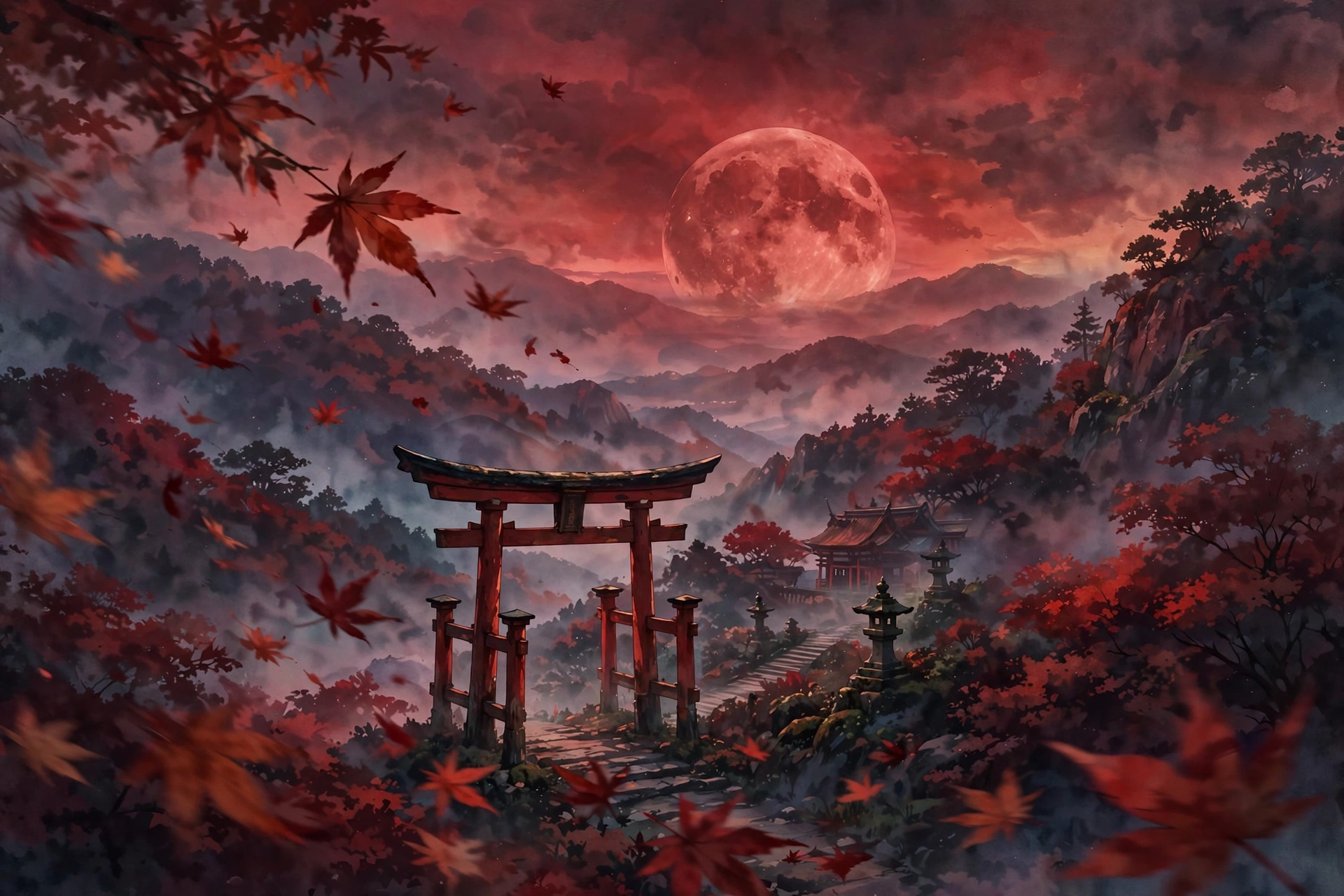
A blood moon — a total lunar eclipse glowing copper-red — is one of the most searched Japanese naming images. These names write the red moon directly, with 血月, 紅月, 朱月 and 緋月, plus the wider red-moon sky.
| Name | Origin | Meaning | Note |
|---|---|---|---|
| Ketsuzuki | Japanese | Blood moon | 血月 — the literal blood moon, on’yomi ketsu |
| Chizuki | Japanese | Blood moon | 血月 — the same kanji read with chi |
| Akazuki | Japanese | Red moon | 赤月 — pure red + moon |
| Hizuki | Japanese | Scarlet moon | 緋月 — scarlet + moon |
| Shuzuki | Japanese | Vermilion moon | 朱月 — vermilion + moon |
| Benizuki | Japanese | Crimson moon | 紅月 — crimson + moon, kun’yomi style |
| Kougetsu | Japanese | Crimson moon | 紅月 — the same kanji in on’yomi style |
| Yuuzuki | Japanese | Evening moon | 夕月 — the dusk moon that rises red |
| Akezuki | Japanese | Dawn moon | 曙月 — the moon fading into red dawn |
| Tsukiyo | Japanese | Moonlit night | 月夜 — a classic girl name for a red-moon night |
| Getsurin | Japanese | Moon ring | 月輪 — the full disc of the moon |
| Mangetsu | Japanese | Full moon | 満月 — the full moon that eclipses turn red |
Akane 茜 — Madder Crimson Names
茜 (akane) is the madder plant, source of Japan’s classic red dye, and Akane is one of the most beloved crimson girl names in the country. The whole family below keeps the madder kanji and varies the second character.
| Name | Origin | Meaning | Note |
|---|---|---|---|
| Akari | Japanese | Madder village | 茜里 — also the heroine spelling in many anime |
| Akana | Japanese | Madder greens | 茜菜 — madder + leafy greens |
| Akanemi | Japanese | Madder beauty | 茜美 — madder + beauty |
| Akani | Japanese | Madder cinnabar | 茜丹 — madder + cinnabar red |
| Akami | Japanese | Madder fruit | 茜実 — madder + fruit |
| Akayo | Japanese | Madder generation | 茜代 — madder + generation |
| Akae | Japanese | Madder picture | 茜絵 — madder + picture |
| Akaena | Japanese | Madder grace | 茜那 — madder + grace |
| Akarin | Japanese | Madder bell | 茜鈴 — madder + small bell |
| Akanori | Japanese | Madder record | 茜紀 — madder + chronicle |
| Akanami | Japanese | Madder wave | 茜波 — madder + wave |
| Akaomi | Japanese | Madder retainer | 茜臣 — a rare masculine form of the family |
Kurenai and Beni 紅 — Crimson Names for Girls
紅 is Japan’s deep-crimson kanji, read kurenai for the colour itself, beni in girl-name compounds and kou in on’yomi forms. It is the red of rouge, of maple leaves and of the famous ninja Kurenai Yuhi in Naruto.
| Name | Origin | Meaning | Note |
|---|---|---|---|
| Beniko | Japanese | Crimson child | 紅子 — crimson + child |
| Benio | Japanese | Crimson cord | 紅緒 — crimson + cord/thread |
| Benika | Japanese | Crimson fragrance | 紅香 — crimson + fragrance |
| Benihime | Japanese | Crimson princess | 紅姫 — also Urahara’s zanpakuto in Bleach |
| Benibana | Japanese | Crimson flower (safflower) | 紅花 — the safflower of Ghibli’s Only Yesterday |
| Benina | Japanese | Crimson grace | 紅奈 — crimson + grace |
| Benimi | Japanese | Crimson beauty | 紅美 — crimson + beauty |
| Benie | Japanese | Crimson picture | 紅絵 — crimson + picture |
| Beniri | Japanese | Crimson jasmine | 紅莉 — crimson + jasmine |
| Kouko | Japanese | Crimson child | 紅子 — the on’yomi twin of Beniko |
| Kurena | Japanese | Crimson grace | 紅那 — a short form of Kurenai |
| Kuren | Japanese | Crimson lotus | 紅蓮 — an alternate reading of Guren’s kanji |
| Benisa | Japanese | Crimson gauze | 紅紗 — crimson + silk gauze |
| Beniyuki | Japanese | Crimson snow | 紅雪 — crimson + snow |
| Beniha | Japanese | Crimson leaf | 紅葉 — crimson + leaf, read beniha |
Kou 紅 — Crimson Names for Boys
Read kou, 紅 gives boys a whole regiment of crimson names — crimson star, crimson flight, crimson heart — with a formal, martial ring quite different from the softer beni girl forms.
| Name | Origin | Meaning | Note |
|---|---|---|---|
| Kouya | Japanese | Crimson indeed | 紅也 — crimson + classical copula |
| Kousei | Japanese | Crimson star | 紅星 — crimson + star |
| Kouta | Japanese | Crimson stout | 紅太 — crimson + plump/great |
| Kougo | Japanese | Crimson self | 紅吾 — crimson + self |
| Kouhiko | Japanese | Crimson prince | 紅彦 — crimson + accomplished young man |
| Kouto | Japanese | Crimson flight | 紅翔 — crimson + to soar |
| Kouen | Japanese | Crimson flame | 紅炎 — crimson + flame |
| Kouji | Japanese | Crimson order | 紅治 — crimson + to govern |
| Kouhaku | Japanese | Red and white | 紅白 — Japan’s lucky red-and-white pairing |
| Koutarou | Japanese | Crimson eldest son | 紅太郎 — crimson + eldest son |
| Kouichi | Japanese | Crimson one | 紅一 — crimson + one |
| Koushin | Japanese | Crimson heart | 紅心 — crimson + heart |
| Kousuke | Japanese | Crimson aid | 紅介 — crimson + to assist |
| Kouhei | Japanese | Crimson peace | 紅平 — crimson + peace |
Shu 朱 — Vermilion Names
朱 (shu) is vermilion, the sacred red of shrine gates and the ink used for temple seals. It also gives Japanese its most famous red guardian, Suzaku the Vermilion Bird. This is the largest and most versatile red family on the list.
| Name | Origin | Meaning | Note |
|---|---|---|---|
| Shu | Japanese | Vermilion (single kanji) | 朱 — the vermilion kanji alone |
| Shuu | Japanese | Vermilion feather | 朱羽 — vermilion + feather |
| Shuka | Japanese | Vermilion flower | 朱花 — vermilion + flower |
| Shuri | Japanese | Vermilion village | 朱里 — also the name of Okinawa’s vermilion castle |
| Shuna | Japanese | Vermilion grace | 朱奈 — vermilion + grace |
| Shuei | Japanese | Vermilion excellence | 朱英 — vermilion + excellent |
| Shuko | Japanese | Vermilion child | 朱子 — vermilion + child |
| Shuki | Japanese | Vermilion record | 朱紀 — vermilion + chronicle |
| Shumei | Japanese | Vermilion bright | 朱明 — vermilion + bright |
| Shuran | Japanese | Vermilion orchid | 朱蘭 — vermilion + orchid |
| Shusei | Japanese | Vermilion star | 朱星 — vermilion + star |
| Shuto | Japanese | Vermilion flight | 朱翔 — vermilion + to soar |
| Shuya | Japanese | Vermilion night | 朱夜 — vermilion + night |
| Shuyo | Japanese | Vermilion leaf | 朱葉 — vermilion + leaf |
| Shuichi | Japanese | Vermilion one | 朱一 — vermilion + one |
| Shugo | Japanese | Vermilion enlightenment | 朱悟 — vermilion + awakening |
| Shuji | Japanese | Vermilion order | 朱治 — vermilion + to govern |
| Shusuke | Japanese | Vermilion aid | 朱介 — vermilion + to assist |
| Shuta | Japanese | Vermilion stout | 朱太 — vermilion + great |
| Shue | Japanese | Vermilion blessing | 朱恵 — vermilion + blessing |
| Shuho | Japanese | Vermilion step | 朱歩 — vermilion + step |
| Shumiko | Japanese | Vermilion beauty child | 朱美子 — vermilion + beauty + child |
| Shuemi | Japanese | Vermilion blessed beauty | 朱恵美 — vermilion + blessing + beauty |
| Shukichi | Japanese | Vermilion luck | 朱吉 — vermilion + good fortune |
Crimson Warriors and Demons
Red is the colour of Japanese battle banners and demon skin alike. These names come from war chronicles, demon lore and the crimson armour of the Sengoku age — bold, theatrical choices for characters.
| Name | Origin | Meaning | Note |
|---|---|---|---|
| Akamaru | Japanese | Red circle | 赤丸 — Kishimoto’s ninja dog in Naruto |
| Akatora | Japanese | Red tiger | 赤虎 — a fierce red-tiger name from fiction |
| Akazukin | Japanese | Red hood | 赤ずきん — Japan’s Little Red Riding Hood |
| Akahime | Japanese | Red princess | 赤姫 — the red princess of folktale retellings |
| Yukimura | Japanese | Fortunate village | 幸村 — Sanada Yukimura, who fought in crimson armour |
| Sanada | Japanese (surname) | True rice field | 真田 — the crimson-armoured clan of Osaka Castle |
| Shuten | Japanese | Sake drinker | 酒呑 — Shuten-doji, the blood-drenched demon chief of Mt Oe |
| Ibaraki | Japanese | Thorn tree | 茨木 — Ibaraki-doji, Shuten-doji’s demon lieutenant |
| Akaoni | Japanese | Red demon | 赤鬼 — the red oni of Setsubun and a hundred games |
| Akuma | Japanese | Demon | 悪魔 — Street Fighter’s red-aura demon warrior |
Hi 緋 — Scarlet Names
緋 (hi) is scarlet, the brightest red on this list — the colour of scarlet carp, scarlet sakura and the holly berries of winter shrines. A small, jewel-like family of girl names.
| Name | Origin | Meaning | Note |
|---|---|---|---|
| Hiori | Japanese | Scarlet weave | 緋織 — scarlet + weave |
| Hiiragi | Japanese | Holly | 柊 — the holly whose red berries mark winter shrines |
| Hinaka | Japanese | Scarlet fragrant grace | 緋奈香 — scarlet + grace + fragrance |
| Hizakura | Japanese | Scarlet sakura | 緋桜 — scarlet + cherry blossom |
| Higoi | Japanese | Scarlet carp | 緋鯉 — the prized all-red koi |
| Hiyu | Japanese | Scarlet excellence | 緋優 — scarlet + excellence |
| Hina | Japanese | Scarlet greens | 緋菜 — the beloved Hina written with scarlet |
| Hika | Japanese | Scarlet flower | 緋花 — scarlet + flower |
| Himi | Japanese | Scarlet beauty | 緋美 — scarlet + beauty |
| Hii | Japanese | Scarlet (single kanji) | 緋 — the scarlet kanji alone |
| Hisaki | Japanese | Scarlet bloom | 緋咲 — scarlet + to bloom |
Blood Flowers — Spider Lilies and Red Blooms
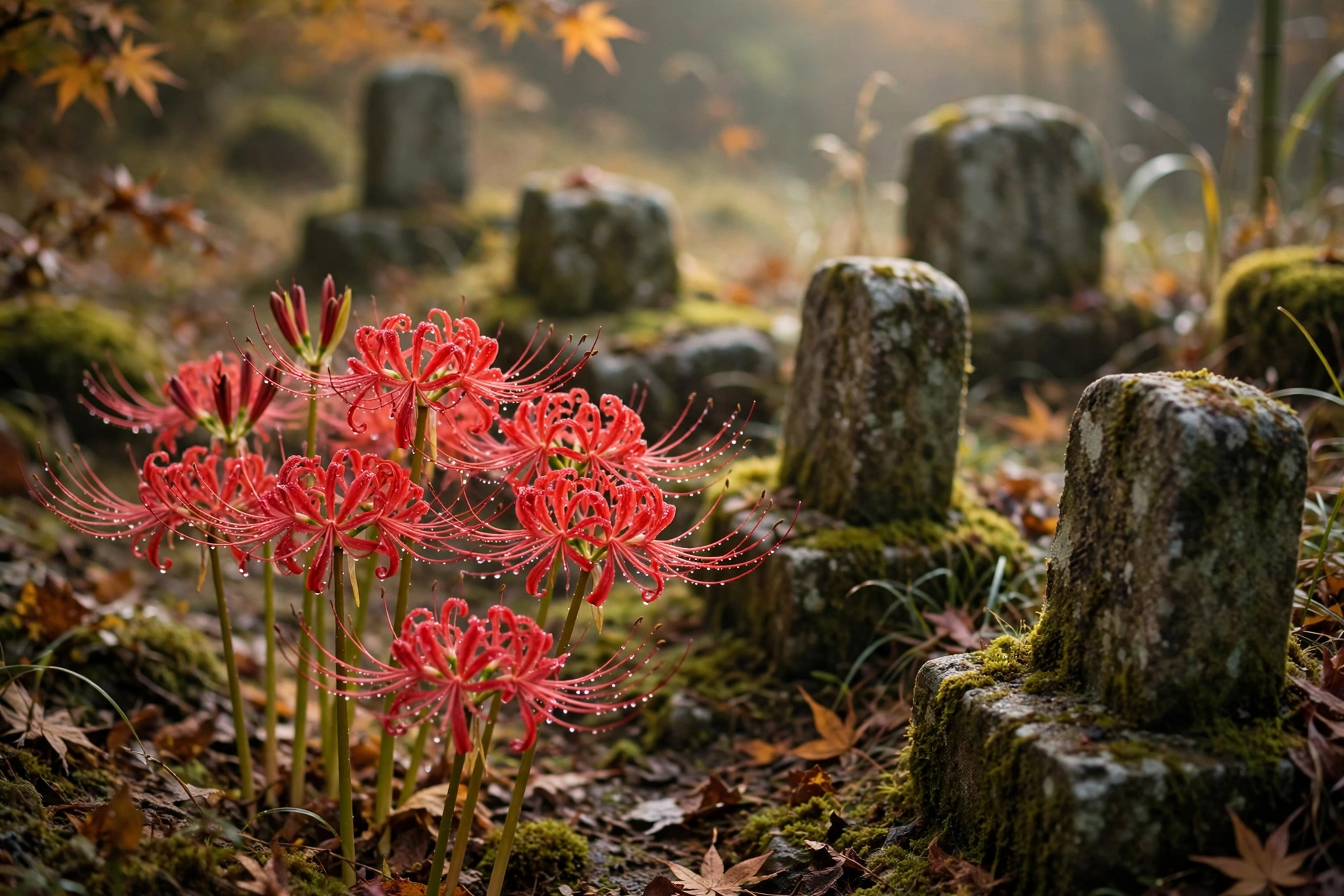
No flower says blood like the higanbana, the red spider lily that blooms on graves at the autumn equinox and is said to grow where blood was spilled. Around it gathers a whole garden of red blooms used as names.
| Name | Origin | Meaning | Note |
|---|---|---|---|
| Higan | Japanese | The far shore; equinox | 彼岸 — the Buddhist shore the spider lily is named for |
| Higanbana | Japanese | Red spider lily | 彼岸花 — the blood-red grave flower itself |
| Manju | Japanese | Manjusha blossom | 曼珠 — from manjushage, the spider lily’s Sanskrit name |
| Manjushage | Japanese | Red spider lily | 曼珠沙華 — the full poetic name of the flower |
| Shakuyaku | Japanese | Chinese peony | 芍薬 — the deep-red medicinal peony |
| Botan | Japanese | Peony | 牡丹 — the king of red flowers |
| Tsubaki | Japanese | Camellia | 椿 — red camellias that fall whole, like a severed head, in samurai lore |
| Satsuki | Japanese | Fifth month; azalea | 皐月 — the blood-red azalea month |
| Tsutsuji | Japanese | Azalea | 躑躅 — azalea bushes that blaze red in May |
| Anemone | Japanese (katakana) | Anemone | アネモネ — the red windflower of Greek blood myth |
| Hibana | Japanese | Spark | 火花 — a flower of fire, glowing ember-red |
| Benihagi | Japanese | Crimson bush clover | 紅萩 — crimson + bush clover |
| Benizakura | Japanese | Crimson cherry | 紅桜 — the deep-red cherry blossom |
| Benibara | Japanese | Crimson rose | 紅薔薇 — crimson + rose |
| Benishibori | Japanese | Crimson tie-dye bloom | 紅絞り — a famous red camellia pattern |
Life-Force Names — Blood as Life
In Japanese thought blood is not only red, it is life in motion: the pulse (脈), the life in the body (命), vigour (血気). These names take the life-force side of blood — strong, warm choices with no gothic edge.
| Name | Origin | Meaning | Note |
|---|---|---|---|
| Seimei | Japanese | Life; clear and bright | 生命 — ‘life’ itself; also the onmyoji Abe no Seimei |
| Genki | Japanese | Vigour; good spirits | 元気 — the everyday word for healthy energy |
| Chikara | Japanese | Power; strength | 力 — the force that moves through the blood |
| Ikue | Japanese | Living blessing | 生恵 — to live + blessing |
| Ikumi | Japanese | Living beauty | 生美 — to live + beauty |
| Ikuya | Japanese | Living indeed | 生也 — to live + classical copula |
| Seiko | Japanese | Living child | 生子 — to live + child |
| Myaku | Japanese | Pulse; vein | 脈 — the pulse where blood is felt |
| Ikioi | Japanese | Momentum; vigour | 勢 — force and drive |
| Yuuki | Japanese | Courage | 勇気 — the hot-blooded virtue itself |
Vampire Anime Names
Japanese vampire anime has produced a generation of blood-lore names. These are the given names of the leads and legends of Blood+, Vampire Knight, Seraph of the End and their kin — labelled honestly as character names.
| Name | Origin | Meaning | Note |
|---|---|---|---|
| Saya | Japanese (anime) | Swift arrow; small night | 小夜 — Saya Otonashi of Blood+ and Saya Kisaragi of Blood-C |
| Diva | Japanese (anime) | Songstress | Blood+’s chiropteran queen and Saya’s twin |
| Haji | Japanese (anime) | Beginning | ハジ — Saya’s immortal chevalier in Blood+ |
| Fuyumi | Japanese (anime) | Winter beauty | 冬美 — Fuyumi Yanagi, the ghost girl of Blood Lad |
| Kaname | Japanese (anime) | Pivot; key point | 要 — Kaname Kuran, the pureblood ancestor of Vampire Knight |
| Yuki | Japanese (anime) | Gentle princess | 優姫 — Yuki Cross, Vampire Knight’s pureblood heroine |
| Zero | Japanese (anime) | Zero | 零 — Zero Kiryu, the vampire hunter of Vampire Knight |
| Hanabusa | Japanese (anime) | Flower shrine | 英 — Hanabusa Aido, Vampire Knight’s ‘idol’ vampire |
| Mikaela | Japanese (anime) | Who is like God | ミカエラ — Mikaela Hyakuya of Seraph of the End |
| Shiki | Japanese (anime) | Ceremony; four seasons | 式 — the name of the vampire-haunted village in Shiki |
| Natsuno | Japanese (anime) | Summer field | 夏野 — Natsuno Yuuki, Shiki’s defiant hero |
| Anju | Japanese (anime) | Apricot tree | 杏樹 — Anju Maaka, the doll-like vampire sister of Chibi Vampire |
| Karin | Japanese (anime) | Fruit bell | 果鈴 — Karin Maaka, the blood-making vampire of Chibi Vampire |
Demon Slayer and Dark Blood Lore
Demon Slayer runs on blood — demon blood arts, the demon king’s blood that makes monsters, the doctor who turned blood into medicine. Its cast, plus Japan’s great blood-soaked ghost tales, fills this darker shelf.
| Name | Origin | Meaning | Note |
|---|---|---|---|
| Tamayo | Japanese (fiction) | Jewel generation | 珠世 — Lady Tamayo, the demon doctor who weaponised blood into cures |
| Nezuko | Japanese (fiction) | Red bean child | 禰豆子 — Nezuko Kamado, whose blood art sets her own blood ablaze |
| Yushiro | Japanese (fiction) | Healing history lad | 愈史郎 — Tamayo’s devoted demon assistant |
| Muzan | Japanese (fiction) | Cruel; heartless | 無惨 — Muzan Kibutsuji, the demon king whose blood creates demons |
| Akaza | Japanese (fiction) | Lingering seat | 猗窩座 — Upper Moon Three of Demon Slayer |
| Daki | Japanese (fiction) | Fallen princess | 堕姫 — Upper Moon Six, the oiran demon |
| Gyutaro | Japanese (fiction) | Eldest son | 妓夫太郎 — Daki’s brother, master of blood sickles |
| Oiwa | Japanese (folklore) | Rock | お岩 — the poisoned, blood-weeping ghost of Yotsuya Kaidan |
| Okiku | Japanese (folklore) | Chrysanthemum | お菊 — the plate-counting ghost of Bancho Sarayashiki |
| Otsuyu | Japanese (folklore) | Dew | お露 — the ghost lover of the peony-lantern tale Botan Doro |
Tan and Ni 丹 — Cinnabar Red Names
丹 (tan/ni) is cinnabar, the red mineral pigment of shrine paint and alchemy’s elixir of life. It survives in old place names, surnames and Demon Slayer’s kind-hearted father, Kamado Tanjuro.
| Name | Origin | Meaning | Note |
|---|---|---|---|
| Tanjuro | Japanese | Cinnabar eldest son | 丹十郎 — Tanjuro Kamado, father of Demon Slayer’s hero |
| Tango | Japanese | Cinnabar back | 丹後 — the old province north of Kyoto |
| Tanba | Japanese | Cinnabar wave | 丹波 — the old province and a proud surname |
| Niwa | Japanese | Cinnabar feather | 丹羽 — the surname of Nagashide Niwa, Oda’s general |
| Tanji | Japanese | Cinnabar order | 丹治 — cinnabar + to govern |
| Nio | Japanese | Cinnabar birth | 丹生 — a shrine name of the mercury-red goddess Niutsuhime |
| Niu | Japanese | Cinnabar birth | 丹生 — the same shrine kanji read niu |
| Tanna | Japanese | Cinnabar plain | 丹那 — an old Izu place and family name |
Crimson Sky — Dawn and Sunset Names
Twice a day the sky itself bleeds red. These names belong to dawn (暁, 曙, 東雲) and to the red west (夕日, 夕焼) — and to the sun goddess whose light starts it all.
| Name | Origin | Meaning | Note |
|---|---|---|---|
| Akebono | Japanese | Dawn; daybreak | 曙 — the red first light; also a great sumo champion |
| Yuuhi | Japanese | Evening sun | 夕日 — the setting sun sinking red |
| Yuuyake | Japanese | Sunset glow | 夕焼 — the whole sky burning at dusk |
| Asahi | Japanese | Morning sun | 朝日 — the rising sun, Japan’s most classic dawn name |
| Sekiyo | Japanese | Evening sun | 夕陽 — a literary form of the setting sun |
| Yuugure | Japanese | Dusk | 夕暮 — the red-dark hour when demons were said to walk |
| Shinonome | Japanese | Dawn sky | 東雲 — the pink-red eastern clouds of first light |
| Amaterasu | Japanese | Shining over heaven | 天照 — the sun goddess, sovereign of the dawn |
Japanese Surnames That Mean Red
Japan’s red surnames cluster around 赤 (aka) — red wells, red pines, red islands — with a single crimson valley from 紅. All are living family names, several of them famous from anime detectives and generals.
| Name | Origin | Meaning | Note |
|---|---|---|---|
| Akagi | Japanese (surname) | Red tree | 赤木 — red tree; a famous battleship and sake region |
| Akahoshi | Japanese (surname) | Red star | 赤星 — red star |
| Akaishi | Japanese (surname) | Red stone | 赤石 — red stone; a Southern Alps range |
| Akao | Japanese (surname) | Red tail | 赤尾 — red tail/ridge end |
| Akamine | Japanese (surname) | Red peak | 赤嶺 — an Okinawan red-peak surname |
| Akaike | Japanese (surname) | Red pond | 赤池 — red pond |
| Akabori | Japanese (surname) | Red digging | 赤掘 — red earth digging |
| Akabane | Japanese (surname) | Red feather | 赤羽 — red feather; a Tokyo district |
| Akasaka | Japanese (surname) | Red slope | 赤坂 — red slope; Tokyo’s palace district |
| Akatsuka | Japanese (surname) | Red mound | 赤塚 — red burial mound |
| Akamatsu | Japanese (surname) | Red pine | 赤松 — the red pine of temple gardens |
| Akatsuchi | Japanese (surname) | Red earth | 赤土 — red soil |
| Akakura | Japanese (surname) | Red storehouse | 赤倉 — red storehouse; a Niigata ski town |
| Akaoka | Japanese (surname) | Red hill | 赤岡 — red hill |
| Akano | Japanese (surname) | Red field | 赤野 — red field |
| Akahori | Japanese (surname) | Red moat | 赤堀 — red moat, a variant carving of Akabori |
| Akashima | Japanese (surname) | Red island | 赤島 — red island |
| Akanishi | Japanese (surname) | Red west | 赤西 — red west; singer Jin Akanishi |
| Akai | Japanese (surname) | Red well | 赤井 — Shuichi Akai, the FBI sniper of Detective Conan |
| Beniya | Japanese (surname) | Crimson valley | 紅谷 — the list’s one crimson 紅 surname |
Kou 紅 — Crimson Names for Girls
The on’yomi reading kou works for girls too, giving crimson names a polished, modern ring — crimson flower, crimson hope, crimson sea — distinct from both the beni and kurenai forms above.
| Name | Origin | Meaning | Note |
|---|---|---|---|
| Kouka | Japanese | Crimson flower | 紅花 — the safflower read in on’yomi |
| Kouki | Japanese | Crimson hope | 紅希 — crimson + hope |
| Kouna | Japanese | Crimson grace | 紅奈 — crimson + grace |
| Kourei | Japanese | Crimson lovely | 紅麗 — crimson + lovely |
| Koumi | Japanese | Crimson beauty | 紅美 — crimson + beauty |
| Kouyo | Japanese | Crimson generation | 紅代 — crimson + generation |
| Kouhi | Japanese | Crimson princess | 紅姫 — Benihime’s on’yomi twin |
| Kousa | Japanese | Crimson gauze | 紅紗 — crimson + silk gauze |
Crimson Blossom and Autumn Names
Beyond the spider lily, Japan’s red year is written in blossom and leaf: sakura season’s deep-red cherries, winter camellias, apricot and plum, and the maple mountains that turn the colour of blood each autumn.
| Name | Origin | Meaning | Note |
|---|---|---|---|
| Sakura | Japanese | Cherry blossom | 桜 — deepest in its crimson double forms |
| Momo | Japanese | Peach | 桃 — the blush-red fruit of longevity |
| Sazanka | Japanese | Sasanqua camellia | 山茶花 — the red winter camellia |
| Kantsubaki | Japanese | Winter camellia | 寒椿 — camellias blooming red in the snow |
| Ume | Japanese | Plum blossom | 梅 — the red plum that opens the year |
| Anzu | Japanese | Apricot | 杏 — the apricot and its red-gold fruit |
| Ichigo | Japanese | Strawberry | 苺 — the blood-red berry |
| Yaezakura | Japanese | Double cherry blossom | 八重桜 — the layered, deepest-pink cherries |
| Kanzakura | Japanese | Winter cherry | 寒桜 — cherries that bloom red-pink in midwinter |
| Kouyou | Japanese | Crimson leaves | 紅葉 — the on’yomi word for autumn’s red maples |
| Kaede | Japanese | Maple | 楓 — the maple leaf itself, red every autumn |
Tokyo Ghoul and Dark Anime Names
Modern dark anime runs redder than ever. Tokyo Ghoul’s cast of ghouls and investigators, the vampires of Monogatari, the red-eyed Akame and the haunted village of Shiki supply this contemporary shelf.
| Name | Origin | Meaning | Note |
|---|---|---|---|
| Ken | Japanese (anime) | Research; study | 研 — Ken Kaneki, Tokyo Ghoul’s one-eyed king |
| Touka | Japanese (anime) | Winter flower | 董花 — Touka Kirishima, the Rabbit of Tokyo Ghoul |
| Rize | Japanese (anime) | Sound reason | 利世 — Rize Kamishiro, the binge-eating ghoul |
| Hinami | Japanese (anime) | Young fruit | 雛実 — Hinami Fueguchi of Tokyo Ghoul |
| Ayato | Japanese (anime) | Design person | 絢都 — Ayato Kirishima, the Black Rabbit |
| Eto | Japanese (anime) | Star and rabbit (playful reading) | エト — Eto Yoshimura, the One-Eyed Owl |
| Juuzou | Japanese (anime) | Thirteen three | 什造 — Juuzou Suzuya, the stitched investigator |
| Uta | Japanese (anime) | Song | ウタ — Uta, Tokyo Ghoul’s masked clown |
| Nishiki | Japanese (anime) | Brocade | 錦 — Nishiki Nishio, the Serpent of Tokyo Ghoul |
| Amon | Japanese (anime) | Gate of Asia (name lore) | 亜門 — Koutarou Amon, the ghoul investigator |
| Shinobu | Japanese (anime) | Endurance | 忍 — Shinobu Oshino, Monogatari’s diminished vampire queen |
| Koyomi | Japanese (anime) | Calendar | 暦 — Koyomi Araragi, bitten hero of Monogatari |
| Tsubasa | Japanese (anime) | Wing | 翼 — Tsubasa Hanekawa of Monogatari |
| Hitagi | Japanese (anime) | Hiragana name | ひたぎ — Hitagi Senjougahara of Monogatari |
| Akame | Japanese (anime) | Red eye | アカメ — Akame of Akame ga Kill!, named for her red eyes |
| Megumi | Japanese (anime) | Blessing | 恵 — Megumi Shimizu, Shiki’s first vampire victim |
| Tohru | Japanese (anime) | Clear; penetrate | 徹 — Tohru Mutou of Shiki |
| Sunako | Japanese (anime) | Sand child | 沙子 — Sunako Kirishiki, Shiki’s ancient child vampire |
| Seishin | Japanese (anime) | Quiet trust | 静信 — Seishin Muroi, Shiki’s novelist priest |
| Toshio | Japanese (anime) | Alert man | 敏夫 — Dr Toshio Ozaki of Shiki |
More Vampire Anime Names
The supporting casts of the great vampire series are a name goldmine: Vampire Knight’s Night Class, the Hiragi house of Seraph of the End, Blood+’s Okinawan family, and the vampires of Rosario + Vampire.
| Name | Origin | Meaning | Note |
|---|---|---|---|
| Takuma | Japanese (anime) | Polish truth | 琢磨 — Takuma Ichijo, Vampire Knight’s vice-president |
| Senri | Japanese (anime) | Thousand leagues | 千里 — Senri Shiki of Vampire Knight |
| Rima | Japanese (anime) | Jasmine polish | 莉磨 — Rima Toya of Vampire Knight |
| Ichiru | Japanese (anime) | One silk | 壱縷 — Ichiru Kiryu, Zero’s twin in Vampire Knight |
| Maria | Japanese (anime) | Maria (katakana-era spelling) | まりあ — Maria Kurenai — her surname is literally Crimson |
| Sayori | Japanese (anime) | Small trust | さより — Sayori Wakaba, Yuki’s friend in Vampire Knight |
| Seiren | Japanese (anime) | Siren (katakana) | セイレン — Seiren, Kaname’s silent attendant |
| Yuichiro | Japanese (anime) | Gentle first son | 優一郎 — Yuichiro Hyakuya, hero of Seraph of the End |
| Shinoa | Japanese (anime) | Shinoa (katakana) | シノア — Shinoa Hiragi, Seraph of the End’s squad leader |
| Mitsuba | Japanese (anime) | Three leaves | 三葉 — Mitsuba Sangu of Seraph of the End |
| Shinya | Japanese (anime) | Deep night | 深夜 — Shinya Hiragi of Seraph of the End |
| Kureto | Japanese (anime) | Dusk person | 暮人 — Kureto Hiragi, heir of the Hiragi house |
| Mahiru | Japanese (anime) | True noon | 真昼 — Mahiru Hiragi, who became a demon’s sword |
| Fumito | Japanese (anime) | Sentence person | 文人 — Fumito Nanahara, Blood-C’s smiling villain |
| Kai | Japanese (anime) | Kai (katakana) | カイ — Kai Miyagusuku, Saya’s brother in Blood+ |
| Riku | Japanese (anime) | Riku (katakana) | リク — Riku Miyagusuku of Blood+ |
| Mao | Japanese (anime) | Mao (katakana) | マオ — Mao Jahana, Blood+’s fiery Okinawan friend |
| Yumie | Japanese (anime) | Reason beauty river | 由美江 — Sister Yumie Takagi of Hellsing |
| Moka | Japanese (anime) | Bud fragrance | 萌香 — Moka Akashiya of Rosario + Vampire — her surname means ‘red night’ |
| Kokoa | Japanese (anime) | Small Asia (name reading) | 小亜 — Kokoa Shuzen, Moka’s little sister |
| Tsukune | Japanese (anime) | Moon sound | 月音 — Tsukune Aono, Rosario + Vampire’s human hero |
| Ren | Japanese (anime) | Ren (katakana) | レン — Ren Maaka, Karin’s vampire brother in Chibi Vampire |
Historical Crimson Boy Names — Maru, Taro and Nosuke Forms
Old Japanese boy names were built like armour: a strong first element plus a suffix of rank — -maru (circle), -taro (eldest son), -nosuke (aid), -hiko (prince). Give the first element a red kanji and the whole Sengoku-era pattern turns crimson.
| Name | Origin | Meaning | Note |
|---|---|---|---|
| Shumaru | Japanese | Vermilion circle | 朱丸 — vermilion + circle |
| Koumaru | Japanese | Crimson circle | 紅丸 — crimson + circle |
| Himaru | Japanese | Scarlet circle | 緋丸 — scarlet + circle |
| Chimaru | Japanese | Blood circle | 血丸 — blood + circle, read with chi |
| Ketsumaru | Japanese | Blood circle | 血丸 — the same kanji in on’yomi |
| Akataro | Japanese | Red eldest son | 赤太郎 — red + eldest son |
| Shutaro | Japanese | Vermilion eldest son | 朱太郎 — vermilion + eldest son |
| Hitaro | Japanese | Scarlet eldest son | 緋太郎 — scarlet + eldest son |
| Ketsutaro | Japanese | Blood eldest son | 血太郎 — blood + eldest son |
| Shunosuke | Japanese | Vermilion aid | 朱之介 — vermilion + aid |
| Kounosuke | Japanese | Crimson aid | 紅之介 — crimson + aid |
| Akahiko | Japanese | Red prince | 赤彦 — red + accomplished young man |
How to Choose a Japanese Blood or Crimson Name
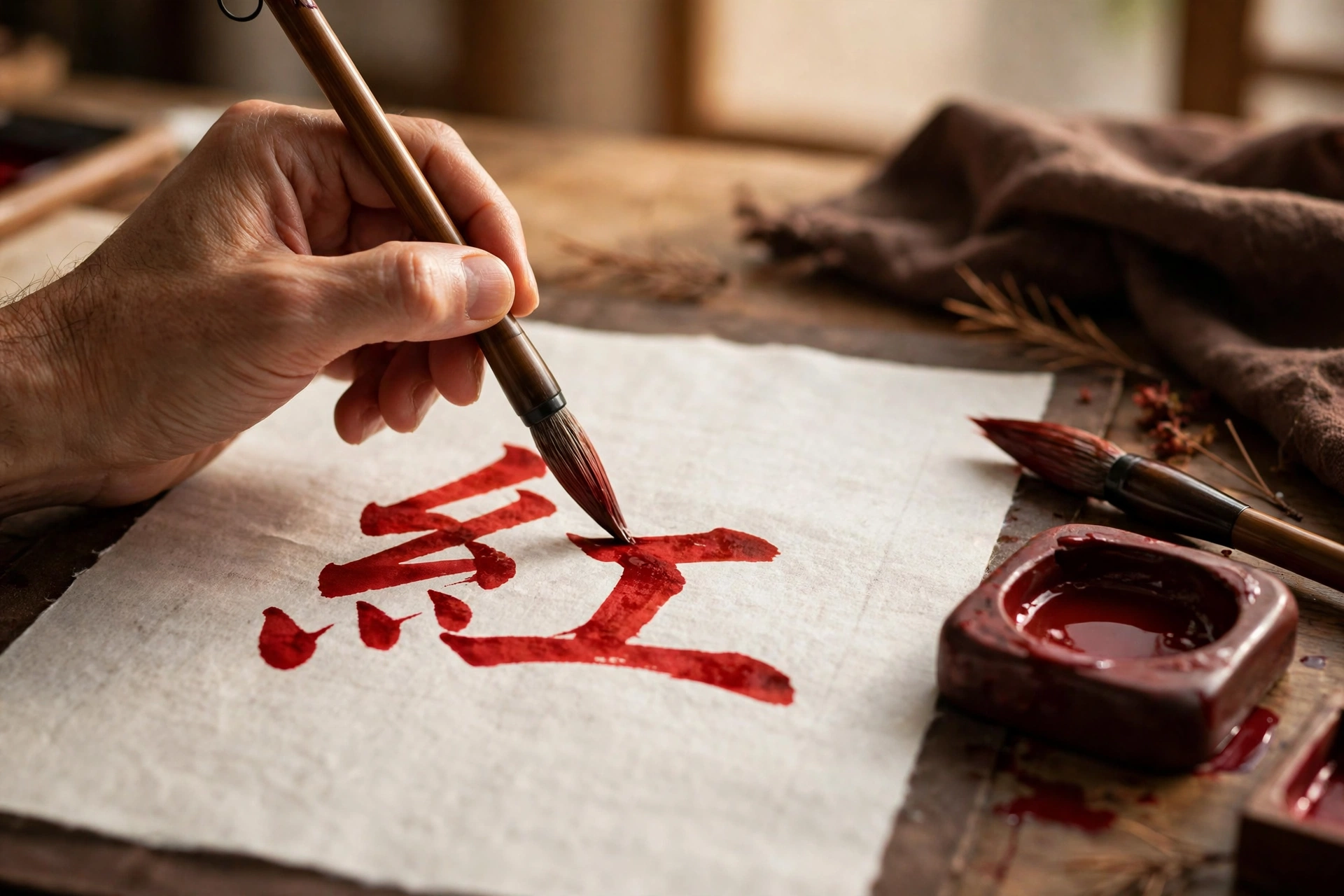
Start with the shade, because Japanese reds are not interchangeable. 血 (chi/ketsu) is literal blood — dramatic, gothic, mostly fictional. 紅 (kurenai/beni/kou) is deep crimson, the classic and most usable family. 朱 (shu) is vermilion, sacred and formal. 緋 (hi) is scarlet, bright and jewel-like. 茜 (akane) is madder, warm and earthy. 赤 (aka) is plain red, boldest in surnames. Pick the shade first and the right table chooses itself.
Then be honest about the setting. For a real baby in or outside Japan, the everyday-safe choices are the crimson families — Akane, Kurenai, Beni, Shuka, Hiiro, Sango — plus dawn names like Akatsuki and Asahi. Names built on 血 are best kept for characters, stage names and pen names, where their shock value is the point; the anime sections above show how naturally they live in fiction.
Check the kanji reading out loud. Japanese names live in their kanji: the same sound can be written a dozen ways, and the same kanji (like 紅月 or 血月) can carry two readings. If a name matters to you, confirm the exact spelling with a name dictionary, and test the full name — given name plus surname — for awkward sound collisions.
Finally, remember the meaning has two faces. In Japan blood also means lineage, warmth and life — a crimson name can honour family as easily as it can thrill a horror fan. For the darker end of the spectrum, continue with our Japanese names that mean angel for the opposite pole, our names that mean flame for red’s fiery cousins, and our names that mean bat for the vampire’s familiar.
Frequently Asked Questions
What is the most common Japanese name that means blood or red?
Akane (茜) is by far the most common — a top-tier girl name meaning madder red. Kurenai (紅, crimson) and Beni (紅) follow, while names written with the literal blood kanji 血 are rare outside fiction.
How do you write ‘blood’ in a Japanese name?
Blood is 血, read chi in kun’yomi compounds (Chika, Chihana) and ketsu in on’yomi compounds (Ketsuki, Ketsuzuki). Both readings are used in the tables above, and each entry shows its kanji.
Are Japanese blood names suitable for babies?
The crimson families — Akane, Kurenai, Beni, Shu, Hiiro — are normal, well-loved baby names. Names written with 血 itself are dramatic and mostly fictional, so most families reserve them for characters; the sections above are labelled so you can tell the difference.
What is the difference between kurenai, beni and kou?
All three read the same kanji 紅 (crimson). Kurenai is the colour word itself, beni is the reading used in softer girl-name compounds (Beniko, Benihime), and kou is the formal on’yomi reading used for both boys (Kousei) and girls (Kouka).
Which Japanese name means blood moon?
The literal blood moon is 血月 — read Ketsuzuki or Chizuki. Crimson and scarlet moons are written 紅月 (Benizuki/Kougetsu), 朱月 (Shuzuki) and 緋月 (Hizuki); all five appear in the Blood Moon table above.
Conclusion
Three hundred names deep, the pattern is clear: Japanese red is never just a colour. It is blood and lineage, vermilion shrine gates and temple seals, spider lilies on autumn graves, maple mountains, pomegranate seeds and the first and last light of the sun. Whether you came for a gothic character name written in 血, a classic baby name like Akane or Kurenai, or a blood-moon name for a story, the exact shade of red you need is in these tables — with its kanji attached, so the meaning can never drift.