230 Names That Mean Destiny: Fated, Meant-to-Be and Chosen Names
Introduction
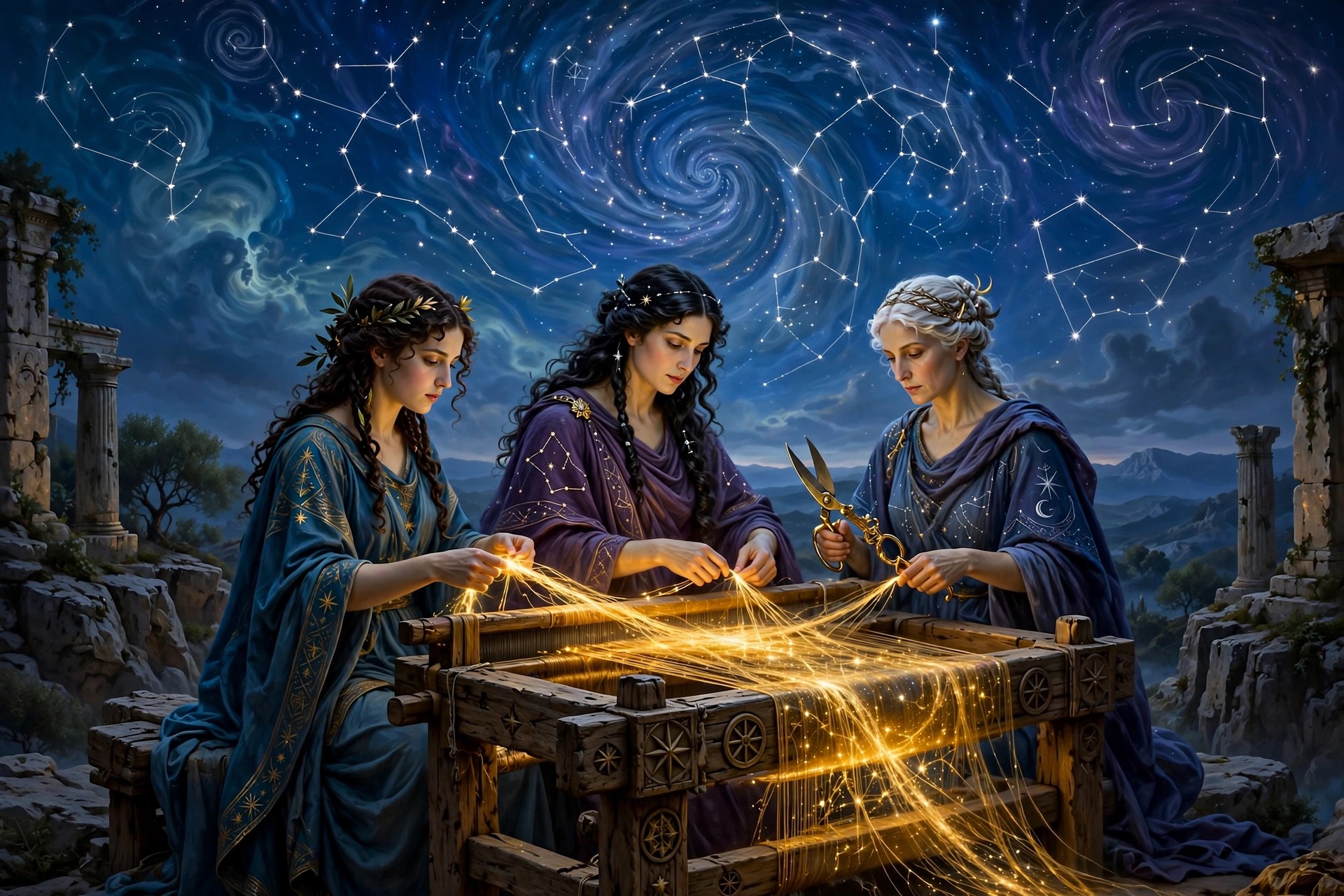
Some names wish a child luck; destiny names do something stronger – they declare that the child was meant to be. Every culture has a word for the script written before birth, and a family of names built on it: the Greek Moirai spinning the thread, the Norse Norns at the well, the Arabic qadar decreed by heaven, the red thread of Chinese and Japanese legend.
A note on honesty, because this theme invites exaggeration. Fate and destiny are cousins, not twins: fate is what is fixed, destiny is where you are headed. Our companion list of names that mean fate covers the fixed thread; this list centres on destiny – the destination, the calling, the chosen path. Where a name means something adjacent – fortune, wonder, a happy lot – the tables say so plainly instead of relabelling it. And every name appears exactly once: no list below is a reshuffle of another, and the idea that a name is ‘written in the stars’ is explored fully in our star-name pages, including names that mean surprise for the unexpected blessings that arrive looking like destiny.
The word itself is worth a pause: English ‘destiny’ comes from Latin destinare, to make firm, to bind fast – the same root explored at Wikipedia’s destiny article. What follows is the whole wardrobe of that idea: literal destiny words in thirty languages, the fate powers of every mythology, prophets and seers, star names, chosen-one names and the vocabulary of the path.
Quick Picks: The 15 Best Names That Mean Destiny
Short on time? These fifteen carry the theme best: the Greek Fates and their Norse sisters, the great destiny words of Arabic, Turkish and English, and the goddess no one escapes.
| Name | Origin | Meaning |
|---|---|---|
| Moira | Greek | One of the Fates; one’s allotted portion |
| Kismet | Turkish / Arabic | Destiny; the lot decreed for you |
| Destiny | English / Latin | That which is bound to happen |
| Fate | English / Latin | The fixed thread of a life |
| Clotho | Greek | The Fate who spins the thread of life |
| Lachesis | Greek | The Fate who measures the thread |
| Atropos | Greek | The Fate who cuts the thread, ‘the unturnable’ |
| Urd | Norse | ‘That which has become’ – the Norn of the past |
| Verdandi | Norse | ‘Becoming’ – the Norn of the present |
| Skuld | Norse | ‘What must be’ – the Norn of the future |
| Wyrd | Old English | Fate; the web of destiny |
| Ananke | Greek | Necessity, the mother of the Fates |
| Moros | Greek | Doom; the end appointed for every life |
| Tyche | Greek | Fortune; the luck written over a life |
| Fortuna | Roman | The goddess of fortune and fate |
Names That Literally Mean Destiny
Start with the real thing: the actual word for destiny, fate or divine decree in the world’s languages, worn as a name. This is the table most destiny lists never build – and the reason this one exists.
| Name | Origin | Meaning | Note |
|---|---|---|---|
| Destino | Spanish / Portuguese | Destiny | The direct word, used as a bold name |
| Sors | Latin | Fate; a lot cast; an oracle | Rome drew the sortes to read destiny |
| Fatum | Latin | That which has been spoken; fate | The root of the word ‘fate’ itself |
| Ming | Chinese | Destiny; the mandate; also life | Heaven’s mandate is tianming |
| Qadar | Arabic | The divine decree; destiny | One of Islam’s six articles of faith |
| Muqaddar | Arabic / Urdu | That which is decreed; destiny | A solemn, traditional name |
| Taqdir | Arabic | Destiny; the divine measuring-out | Used from Arabia to Indonesia |
| Yazgi | Turkish | Destiny; that which is written | From yazmak, to write – fate as handwriting |
| Kader | Turkish | Destiny; fate | The Turkish form of Arabic qadar |
| Schicksal | German | Destiny; fate | A rare German word name, honestly labelled |
| Providence | English / Latin | Divine foresight; heaven’s plan | A Puritan-era virtue name |
| Serendipity | English | The happy accident that feels destined | Coined from the tale of the Princes of Serendip |
| Serendip | Persian / Literary | The old name of Sri Lanka | The homeland of serendipity’s princes |
| Heimarmene | Greek | Cosmic fate; the destiny of the world | The Stoics’ word for universal fate |
| Aisa | Greek | One’s portion; fate | The share of life allotted to each person |
| Pepromene | Greek | That which is fated to be | A rare, grand Greek fate word |
| Unmei | Japanese | Destiny; fate | The word in a thousand anime titles |
| Shukumei | Japanese | Predestined fate; a karmic destiny | The heavier, fated sense of destiny |
| Sadame | Japanese | Fate; a fixed rule of heaven | A poetic, old-fashioned destiny word |
| Unmyeong | Korean | Destiny; fate | Korea’s word for the destined path |
| Palja | Korean | One’s fate; the fortune of a life | Read by Korean fortune tellers |
| Daiva | Sanskrit | Fate; that which comes from the gods | The unseen force behind events |
| Niyati | Sanskrit | Destiny; the fixed order of things | A graceful, philosophical name |
| Vidhi | Sanskrit | Destiny; fate; also the Ordainer | Brahma as Vidhi writes fate on foreheads |
| Bhagya | Sanskrit | Fortune; destiny; one’s lot | The root of Bhagiratha’s lucky name |
| Bhagyam | Malayalam / Sanskrit | Destiny; good fortune | The South Indian form of bhagya |
| Karma | Sanskrit | Action and its destined fruit | The law that links deed to destiny |
| Goral | Hebrew | A lot; one’s destined portion | Lots were cast before God in the Temple |
| Mazal | Hebrew | Fortune; the star decreed for you | As in mazel tov – ‘good stars’ |
| Bakht | Persian | Fortune; destiny | A name element across Persia and India |
| Taleh | Persian / Arabic | Fortune; one’s rising star | The luck that rises with you |
| Hatima | Swahili | Destiny; the end appointed | East Africa’s word for fate |
| Naseeb | Arabic / Urdu | One’s destined share; fate | Millions sing of naseeb in love songs |
| Qismat | Urdu / Hindi | Destiny; one’s portion | The everyday South Asian word for kismet |
| Tynged | Welsh | Fate; destiny | Wales’ solemn word, a rare word name |
| Dán | Irish | Fate; a gift; a poem | In Irish myth, destiny and art are one word |
Greek and Roman Powers of Destiny
Beyond the three Fates of the Quick Picks stands a whole Greek machinery of destiny: necessity, doom, inescapable justice, and Rome’s own Parcae, who renamed the sisters for the stages of a life.
| Name | Origin | Meaning | Note |
|---|---|---|---|
| Nemesis | Greek | The dispenser of what is due | No destiny escapes her measure |
| Adrasteia | Greek | ‘The inescapable one’ | An epithet of Nemesis – fate you cannot flee |
| Ker | Greek | Doom; the death appointed in battle | The dark spirit who claims the fated slain |
| Thanatos | Greek | Death, the final destiny | Brother of Sleep in Greek myth |
| Dike | Greek | Justice; the order destiny keeps | Daughter of Zeus and Themis |
| Eunomia | Greek | Good order; right law | One of the Horae who guard heaven’s order |
| Themis | Greek | Divine law; the order beneath fate | The Titaness whose oracle spoke destiny |
| Chronos | Greek | Time, within which all destiny unfolds | Not to be confused with the Titan Kronos |
| Kairos | Greek | The opportune moment; destiny’s opening | The god of the fleeting right moment |
| Aion | Greek | Eternity; the age of a life | The god of cyclical, unending time |
| Elpis | Greek | Hope, left in Pandora’s jar | Destiny’s kindest companion |
| Plutus | Greek | Wealth, fortune’s blind gift | Aristophanes made him a god of destiny’s unfairness |
| Rhamnusia | Greek | Nemesis of Rhamnous, the fateful one | Her temple overlooked Marathon bay |
| Praxidice | Greek | The exacter of justice | A fate-adjacent goddess of due outcomes |
| Nona | Roman | ‘The ninth’ – the Parca who spins | The Roman Clotho, named for the ninth month |
| Decima | Roman | ‘The tenth’ – the Parca who measures | The Roman Lachesis |
| Morta | Roman | The Parca who cuts; death itself | The Roman Atropos |
| Parca | Roman | A Fate; one who spares – or does not | The Romans’ collective name for destiny’s sisters |
| Fata | Latin | A fate-being; origin of the word ‘fairy’ | Medieval fata became the fairy godmothers |
| Nortia | Etruscan | The goddess of fate and fortune | Her temple’s nails marked the years of destiny |
Norse and Northern Destiny Names
The Norse knew destiny best of all: the Norns of the Quick Picks rule a world where even gods have an appointed end, attended by follower-spirits, luck-spirits and the Valkyries who choose the fated slain.
| Name | Origin | Meaning | Note |
|---|---|---|---|
| Norn | Norse | A goddess of destiny | The name of the fate-weavers themselves |
| Odin | Norse | The All-Father who learns every fate | He traded an eye for knowledge of destinies |
| Frigg | Norse | The goddess who knows all fates and tells none | Odin’s queen, keeper of destinies’ secrets |
| Saga | Norse | The seeress goddess; a story | Every destiny, retold, becomes a saga |
| Mimir | Norse | The wise head who knows what is to come | Odin carries his counsel to the world’s end |
| Dis | Norse | A female fate-spirit; a guardian goddess | The disir watch over families and their lots |
| Fylgja | Norse | The follower-spirit bound to a person’s fate | She appears when destiny is near |
| Hamingja | Norse | The luck-spirit who is a family’s fortune | A destiny that can be inherited and lost |
| Rota | Norse | A Valkyrie who chooses the slain | Her name is tied to turmoil and fate in battle |
| Gondul | Norse | A Valkyrie, ‘wand-wielder’ | She incites the battles where fates are decided |
| Skogul | Norse | A Valkyrie, ‘shaker’ of battle | Named in the valkyrie lists of the sagas |
| Hrist | Norse | A Valkyrie, ‘the shaker’ | A chooser of the fated dead |
| Mist | Norse | A Valkyrie, ‘cloud’ | The shortest valkyrie name of all |
| Hildr | Norse | A Valkyrie whose battle never ends | She resurrects the slain nightly to fight again |
| Brynhildr | Norse | The Valkyrie bound by a fated love | The great tragic heroine of the Volsung saga |
| Sigrun | Norse | A Valkyrie, ‘victory rune’ | She chose her own destiny against her father’s will |
| Kara | Norse | A Valkyrie of the Helgi lays | A swan-maiden of Norse legend |
Celtic, Slavic and Baltic Fate Names
Eastern and western Europe kept their own destiny goddesses: Poland’s Dola, Lithuania’s beloved Laima, the Slavic fate-mothers, and Ireland’s battle queens who deal out the lots of war.
| Name | Origin | Meaning | Note |
|---|---|---|---|
| Rod | Slavic | The god of fate, family and birth | Slavs honoured him before all other gods |
| Sud | South Slavic | Fate itself; the destined one | Serbian sudbina, destiny, shares his root |
| Sudenitsa | Slavic | A female fate who attends every birth | The fate-mothers visit on the third night |
| Dola | Polish | Fate; one’s allotted portion | Poland’s everyday word for destiny |
| Niedola | Polish | Bad fate; misfortune | Dola’s dark sister |
| Dolya | Ukrainian | Fate; one’s share of life | The Ukrainian form of Dola |
| Srecha | Serbian | Luck; fortune personified | From sreća, happiness and fate in one |
| Usud | Serbian | Fate; the destined end | A figure of Balkan folk belief |
| Makosh | Slavic | The goddess of fate and women’s work | She spins the thread of destiny like the Moirai |
| Laima | Lithuanian | The goddess of fate and childbirth | Baltic mothers still invoke her blessing |
| Laime | Latvian | The fate goddess; luck itself | Latvia’s word for happiness is her name |
| Dalia | Lithuanian | The fate goddess; destiny | Now a popular Lithuanian girl’s name |
| Matrona | Celtic / Roman | One of the Mother goddesses who govern lots | The Matronae were worshipped across Celtic Europe |
| Morrigan | Irish | The great queen who deals fate in battle | Ireland’s phantom queen of war and destiny |
| Badb | Irish | The crow goddess who foretells the slain | One of the Morrigan’s three forms |
| Macha | Irish | The goddess who cursed Ulster’s warriors | Another face of the great queen |
| Nemain | Irish | The frenzy that decides a battle’s fate | The fourth of the war goddesses |
Egyptian and Mesopotamian Destiny Names
The oldest destiny names on earth come from the Nile and Mesopotamia, where gods of fate stood at every birth and a scribe god wrote each life on tablets or foreheads.
| Name | Origin | Meaning | Note |
|---|---|---|---|
| Shai | Egyptian | The god of fate and destiny | He stood beside every Egyptian from birth |
| Renenutet | Egyptian | The goddess of fate and nourishment | She decreed each newborn’s lot and lifespan |
| Meskhenet | Egyptian | The birth goddess who proclaims destinies | She spoke the fate of kings at their birth |
| Seshat | Egyptian | The goddess who writes destinies | She recorded the years of every king |
| Thoth | Egyptian | The scribe of the gods, recorder of fates | His pen kept the book of destinies |
| Hathor | Egyptian | The goddess whose seven forms decree a child’s fate | The Seven Hathors prophesy at every birth |
| Hemsut | Egyptian | The fate goddesses of ancient Egypt | Female counterparts of Shai |
| Tayt | Egyptian | The weaving goddess | Egypt’s weaver, kin to fate-weavers everywhere |
| Namtar | Mesopotamian | Destiny and fate personified | The vizier of the underworld, whose name means fate |
| Mamitu | Mesopotamian | The goddess of fate, oaths and decisions | She decrees the lots of gods and men |
| Nabu | Mesopotamian | The scribe god who writes destinies | He held the Tablet of Destinies each new year |
| Ishtar | Mesopotamian | The goddess who holds the destinies of battle | Queen of heaven, dealer of lots in war |
| Zurvan | Persian | Time itself, father of fate’s twins | In Zurvanism he fathers good and evil alike |
| Grokh | Armenian | The scribe who writes destinies on foreheads | He records each life in the Book of Life |
Asian Destiny Names and the Red Thread
Asia imagines destiny as connection: China’s Yue Lao ties the red thread between destined lovers, India’s Vidhata writes fate on the forehead, and heaven issues a Mandate that even emperors must keep.
| Name | Origin | Meaning | Note |
|---|---|---|---|
| Yuanfen | Chinese | Fated affinity; the destiny that binds two people | The force that brings destined people together |
| Yuan | Chinese | The fated bond; affinity | The short form of yuanfen, also a classic name |
| Yuelao | Chinese | The Old Man Under the Moon, god of destined love | He ties the red thread on destined couples |
| Hongniang | Chinese | ‘The Red Matchmaker’ | The beloved go-between of the Romance of the Western Chamber |
| Siming | Chinese | The Director of Allotted Lifespans | The star god who holds the register of lives |
| Tianming | Chinese | The Mandate of Heaven | Heaven’s destiny that legitimises rulers |
| Mingli | Chinese | The workings of fate; destiny’s reason | A thoughtful, modern Chinese name |
| Zhinu | Chinese | The Weaver Girl of the Qixi legend | Her fated love crosses the Milky Way once a year |
| Enmusubi | Japanese | The god of fated bonds and matchmaking | Worshipped at Izumo, Japan’s destiny shrine |
| Takamimusubi | Japanese | The high creator god of binding and becoming | One of the first gods of Shinto myth |
| Samshin | Korean | The goddess of birth and allotted fate | Korean grandmothers pray to her for children |
| Brahma | Sanskrit | The creator who ordains every destiny | As Vidhata he writes fate on each forehead |
| Vidhata | Sanskrit | The Dispenser of destiny | An epithet of Brahma, the Ordainer |
| Chitragupta | Sanskrit | The scribe who records every deed and fate | His ledger decides each soul’s next life |
| Yama | Sanskrit | The first mortal, now judge of destinies | Son of the sun god, lord of the dead |
| Dhata | Sanskrit | The Ordainer; the settler of lots | A Vedic god who arranges each life |
| Kala | Sanskrit | Time, the destiny no one escapes | Also a title of Yama and of Shiva |
Prophets, Seers and Oracles
Destiny needs a voice. These are the seers who announced it – Greek prophets who could not escape their own foresight, the Sibyls, Israel’s prophets, and the doomed truth-teller of Troy.
| Name | Origin | Meaning | Note |
|---|---|---|---|
| Cassandra | Greek | The prophetess fated never to be believed | Troy’s seer, cursed by Apollo |
| Tiresias | Greek | The blind prophet of Thebes | He kept his foresight even among the dead |
| Calchas | Greek | The seer of the Greek fleet at Troy | He read the war’s destiny in a bird sign |
| Melampus | Greek | The first mortal seer | He understood the speech of animals |
| Mopsus | Greek | The seer who out-prophesied Calchas | Their contest is a legend of fate itself |
| Amphiaraus | Greek | The seer who foresaw his own death | He hid from a war he knew would kill him |
| Idmon | Greek | The Argonauts’ seer, ‘the knowing one’ | He sailed knowing he would not return |
| Helenos | Greek | The Trojan prince who read the gods’ will | Priam’s prophetic son |
| Sibyl | Greek | A prophetess of the ancient world | Her leaves held Rome’s destinies |
| Herophile | Greek | The Erythraean Sibyl | She prophesied the fall of Troy |
| Phemonoe | Greek | The first priestess of Delphi | Said to have invented hexameter verse |
| Deiphobe | Greek | The Cumaean Sibyl | She guided Aeneas through the underworld |
| Amalthea | Greek | A name of the Sibyl of Cumae | Also the goat who nursed Zeus |
| Pythia | Greek | The oracle priestess of Delphi | Her utterances moved the Greek world |
| Vegoia | Etruscan | The prophetess who taught the Etruscans fate’s laws | Her books governed land and destiny |
| Isaiah | Hebrew | The great prophet of Israel | ‘Salvation of the Lord’ |
| Jeremiah | Hebrew | The weeping prophet | He announced a destiny his people refused |
| Ezekiel | Hebrew | The prophet of the exile | His visions map heaven’s design |
| Daniel | Hebrew | The interpreter of dreams and destinies | ‘God is my judge’ |
| Micah | Hebrew | The prophet who foresaw Bethlehem | A country voice among the prophets |
| Amos | Hebrew | The shepherd prophet | The first of Israel’s writing prophets |
| Jonah | Hebrew | The prophet who fled his destiny – and met a whale | ‘Dove’ in Hebrew |
| Samuel | Hebrew | The seer who anointed kings | He chose Saul and David by heaven’s word |
| Deborah | Hebrew | The prophetess and judge of Israel | She decreed the battle that freed her people |
| Huldah | Hebrew | The prophetess consulted by King Josiah | She authenticated the lost Book of the Law |
| Miriam | Hebrew | The prophetess of the Exodus | Moses’ sister, who sang at the sea |
| Volva | Norse | A seeress | Odin raised one from the dead to tell the world’s fate |
Written in the Stars: Astrology and Star Names
For most of history, destiny was read in the sky – so star names are destiny names. These are the real stars, the star-maiden of justice, and the ‘star child’ names of several nations; our last names that mean star list carries the surname side of the same sky.
| Name | Origin | Meaning | Note |
|---|---|---|---|
| Astraea | Greek | The star maiden, goddess of justice | She was the last immortal to leave the earth |
| Esther | Persian | ‘Star’ | The queen whose hidden destiny saved her people |
| Aries | Latin | The ram; first sign of the zodiac | The constellation of the golden fleece |
| Leo | Latin | The lion; a zodiac sign | Also simply ‘lion’, a royal name |
| Lyra | Greek | The lyre constellation | Orpheus’ lyre, set among the stars |
| Orion | Greek | The hunter constellation | His belt is the sky’s most famous asterism |
| Vega | Arabic | The brightest star of Lyra | ‘The swooping eagle’ in Arabic |
| Altair | Arabic | The eagle star of Aquila | ‘The flying one’ |
| Rigel | Arabic | The foot of Orion | A blue supergiant, seventh-brightest star |
| Sirius | Greek | The Dog Star, brightest in the sky | ‘The scorcher’ |
| Castor | Greek | One of the Gemini twins | A mortal twin, given half of heaven |
| Pollux | Greek | The immortal Gemini twin | He shared his destiny with Castor |
| Regulus | Latin | ‘Little king’, the heart of Leo | A princely star name |
| Antares | Greek | The red heart of Scorpius | ‘Rival of Mars’ |
| Aster | Greek | Star | The root of astronomy, astrology and Esther’s kin |
| Estelle | French | Star | The elegant French form of Stella |
| Stella | Latin | Star | As in Stella Maris, star of the sea |
| Seren | Welsh | Star | One of Wales’ most popular girls’ names |
| Csilla | Hungarian | Star | Coined for a novel, now a Hungarian classic |
| Hoshi | Japanese | Star | A bright, simple Japanese name |
| Hoshiko | Japanese | Star child | A classic Japanese girl’s name |
| Yildiz | Turkish | Star | Turkey’s everyday star name |
| Izaro | Basque | Star | A rare, lyrical Basque name |
| Tarak | Sanskrit | Star; also a protector | A short Indian star name |
| Nahid | Persian | The planet Venus; the bright star | Persia’s name for the morning star |
Fortune and the Happy Lot: Boy Names
Honestly labelled: these names mean fortune, luck or blessedness – destiny’s smiling side, and the names parents actually mean when they say ‘destined for good things’.
| Name | Origin | Meaning | Note |
|---|---|---|---|
| Maktub | Arabic | ‘It is written’ | The phrase at the heart of The Alchemist |
| Bakhtiyar | Persian | Fortunate; destiny’s friend | A classic name from Bukhara to Delhi |
| Iqbal | Arabic | Fortune; prosperity | The name of Pakistan’s poet-philosopher |
| Daulat | Arabic / Persian | Fortune; wealth of destiny | An old royal name element |
| Kamran | Persian | Fortunate; successful | A prince’s name in Persian romance |
| Chance | English | Fortune; the luck of the draw | A modern American favourite |
| Prosper | Latin / French | Fortunate; to succeed | Shakespeare’s magician is Prospero |
| Fortunato | Italian | The fortunate one | Italy’s direct fortune name |
| Felix | Latin | Lucky; fortunate; happy | Rome’s luckiest name |
| Faust | Latin / German | Fortunate; auspicious | Before Goethe, simply a lucky name |
| Beatus | Latin | Blessed; happy | A Roman name of good fortune |
| Asher | Hebrew | Fortunate; blessed; happy | A son of Jacob, blessed with abundance |
| Zelig | Yiddish | Blessed; fortunate | The Yiddish form of a German luck name |
| Gad | Hebrew | Fortune; a troop coming | Jacob named him for the fortune that arrived |
| Onni | Finnish | Luck; happiness | Finland’s beloved good-fortune name |
| Bonaventure | Italian / Latin | Good fortune | A saint’s name meaning destined goodness |
| Ventura | Spanish | Fortune; good luck | A Spanish surname-name of happy lots |
| Fortune | English | Luck itself | A bold unisex word name |
Chosen, Meant-to-Be and Path Names
Destiny’s gentlest face: the chosen ones of several faiths, the Yiddish word for a destined soulmate, and the path names – because a destiny, in the end, is a road. These pair naturally with names that mean eternal for a timeless sibling set.
| Name | Origin | Meaning | Note |
|---|---|---|---|
| Chosen | English | The one who was picked out | A rising modern virtue name |
| Electa | Latin | ‘The chosen one’ | Addressed in the Second Letter of John |
| Mukhtar | Arabic | The chosen one | A respected name across the Muslim world |
| Mustafa | Arabic | The Chosen One | The Prophet Muhammad’s title, and a beloved name |
| Messiah | Hebrew | The Anointed One | Now genuinely used as a first name in America |
| Christos | Greek | The Anointed One | A standard Greek boy’s name |
| Mahdi | Arabic | The rightly guided one to come | The awaited one of Islamic tradition |
| Bashert | Yiddish | Destined; one’s fated soulmate | The word for a match made in heaven |
| En | Japanese | The fated bond between people | The thread of destiny in one syllable |
| Michi | Japanese | The path; the way | A name for the road destiny walks |
| Michiko | Japanese | Child of the path; child of wisdom | Borne by an empress of Japan |
| Dao | Chinese | The Way; the path all things follow | The heart-word of Daoism |
| Marga | Sanskrit | The path; the way of seeking | India’s word for the spiritual road |
| Pantha | Sanskrit | A path; a way of life | A rare, thoughtful Indian name |
| Tariq | Arabic | The one who knocks at destiny’s door; the morning star | Also the pathfinder of the Quran’s chapter At-Tariq |
| Sabeel | Arabic | A path; a way | As in ‘the way of God’ |
| Waylon | English | ‘Land beside the road’ | The country singer Waylon Jennings made it sing |
| Destan | Turkish | An epic tale; a heroic destiny | Turkey’s word for a fate-filled saga |
Surname-Style and Modern Destiny Names
Finally, the modern shelf: star surnames, and the honest word names of story and omen that today’s parents choose to mark a child as fated. If your ‘destiny’ baby was also a joyful shock, see names that mean miracle or blessing for the other half of the story.
| Name | Origin | Meaning | Note |
|---|---|---|---|
| Stern | German | Star | A German-Jewish surname of the destined sky |
| Starr | English | Star | A spelling with rock-and-roll history |
| Starling | English | The little star; also the bird | A nature-surname with a celestial root |
| Astor | German / Literary | Linked by lore to the stars and the hawk | The great hotel family’s name |
| Fable | English | A story with a moral | A modern word name for a storied child |
| Legend | English | A story destined to be retold | A bold, rising American name |
| Story | English | The tale of a life | A gentle modern word name |
| Epic | Greek / English | A grand heroic tale | The boldest of the story names |
| Omen | Latin | A sign of what is to come | A dark, dramatic word name |
| Augury | Latin | Reading destiny in signs | Rome’s priests were augurs |
| Prophecy | Greek | A foretelling | A striking modern word name |
| Oracle | Latin | The voice that speaks destiny | From Delphi to the modern nursery |
| Mystic | Greek | One who knows the hidden things | A modern spiritual word name |
| Rune | Norse | A secret; the letters that carry fate | The Norns’ alphabet was runes |

How to Choose a Destiny Name
Decide how literal you want to be. True destiny words – Kismet, Qadar, Niyati, Yazgi – carry the exact meaning and a beautiful travel-ready story. Mythology names carry characters: the Fates and Norns are powerful and unmistakably fateful, while the seers and prophets suit a thoughtful, bookish hope for a child. Star names are the softest option, destiny read in the sky rather than decreed.
Check the weight of the story. Atropos, Moros and Nemesis are magnificent names with heavy endings; Skuld and Morta likewise belong to children whose parents love the dark grandeur. For everyday wear, the fortune names and chosen names – Felix, Asher, Mustafa, Electa – promise destiny without doom.
Finally, say it with the surname, check the spelling your country will make of it (Qismat and Kismet are the same word in two dresses), and learn the story well enough to tell it. A destiny name is a promise you make at the very start of the story – choose one you will enjoy keeping.
Frequently Asked Questions
What name literally means destiny?
Destino in Spanish and Portuguese, Schicksal in German, Unmei in Japanese, Unmyeong in Korean, Tynged in Welsh and Yazgi in Turkish all literally mean destiny. Kismet and its Urdu form Qismat come from the Arabic word for one’s allotted portion.
What is the difference between fate and destiny names?
Fate names stress what is fixed – the thread spun, measured and cut. Destiny names stress the destination: where a life is headed, and the calling it carries. In practice the two shelves overlap, which is why this list labels adjacent meanings – fortune, blessing, chance – honestly in its tables.
Who are the three Fates?
In Greek myth they are Clotho, who spins the thread of life, Lachesis, who measures it, and Atropos, who cuts it. Rome renamed them Nona, Decima and Morta; the Norse Norns Urd, Verdandi and Skuld rule the past, present and future at the well beneath the world tree.
What name means ‘it was meant to be’?
Maktub – Arabic for ‘it is written’ – is the closest single name, made famous worldwide by Paulo Coelho’s The Alchemist. Bashert is the Yiddish equivalent for a destined match, and Yuanfen is the Chinese word for the fated affinity that brings two people together.
Are destiny names suitable for real babies?
The everyday ones certainly are: Destiny, Felix, Asher, Mustafa, Moira, Laima and Dalia are ordinary names somewhere in the world. Save the darkest powers – Atropos, Moros, Morta – for characters, or choose them knowingly for their grandeur.
Conclusion
Thread and tablet, red string and star chart: humanity has never stopped believing that a life can be meant. These 230 names hold every version of that belief, from the Greek sisters at their loom to a Turkish word that means fate because it means handwriting. Choose the destiny you would wish on a child – written gently, and in full – and the name will do the rest.