400 Names That Mean Vengeance: Revenge, Retribution and Justice Names
Introduction
Vengeance is one of the oldest stories human beings tell. Before there were courts, there was the blood debt: a wrong answered by a wrong, a family’s honour restored by a family’s hand. The Greeks built a goddess out of it, the Norse built their greatest sagas out of it, and parents in Armenia and Kurdistan still give its word, unsoftened, to their sons. A name that means vengeance is not really about cruelty – it is about memory, loyalty and the refusal to let a wrong stand unanswered.
This list is built differently from most. Every name below appears exactly once, and every name is real: a genuine given name, a deity, a saga or epic figure, a documented historical avenger, a great literary revenger, or a language’s actual word for vengeance used as a name and flagged as such. There are no gaming team names, no office team names and no coined sci-fi compounds padding the count, and the softer neighbouring territory – justice, truth and righteousness – is covered in its own full section below, honestly labelled as its own thing.
The Greeks gave vengeance a face in Nemesis, and she opens the Quick Picks. From there the list travels through the Furies, the blood feuds of Iceland, the forty-seven ronin, Draupadi’s unbound hair and the revenge tragedies of Shakespeare’s stage, ending with the last names that carry the score-settling meaning. If you want the heat without the debt, the companion lists of names that mean wrath and names that mean anger burn just as bright, and girl names that mean chaos and names that mean fierce cover the wilder edge of the same energy.
Quick Picks: The 15 Best Names That Mean Vengeance
The fifteen names that carry the theme best: gods of retribution, the most famous avengers ever named, and a few that a bold parent could genuinely use.
| Name | Origin | Meaning | Note |
|---|---|---|---|
| Nemesis | Greek | Divine retribution | The goddess who balances fortune and punishes hubris; the ultimate vengeance name |
| Alastor | Greek | The avenger; he who does not forget | A spirit of family blood-feuds in Greek tragedy, later a poetic name for an avenging genius |
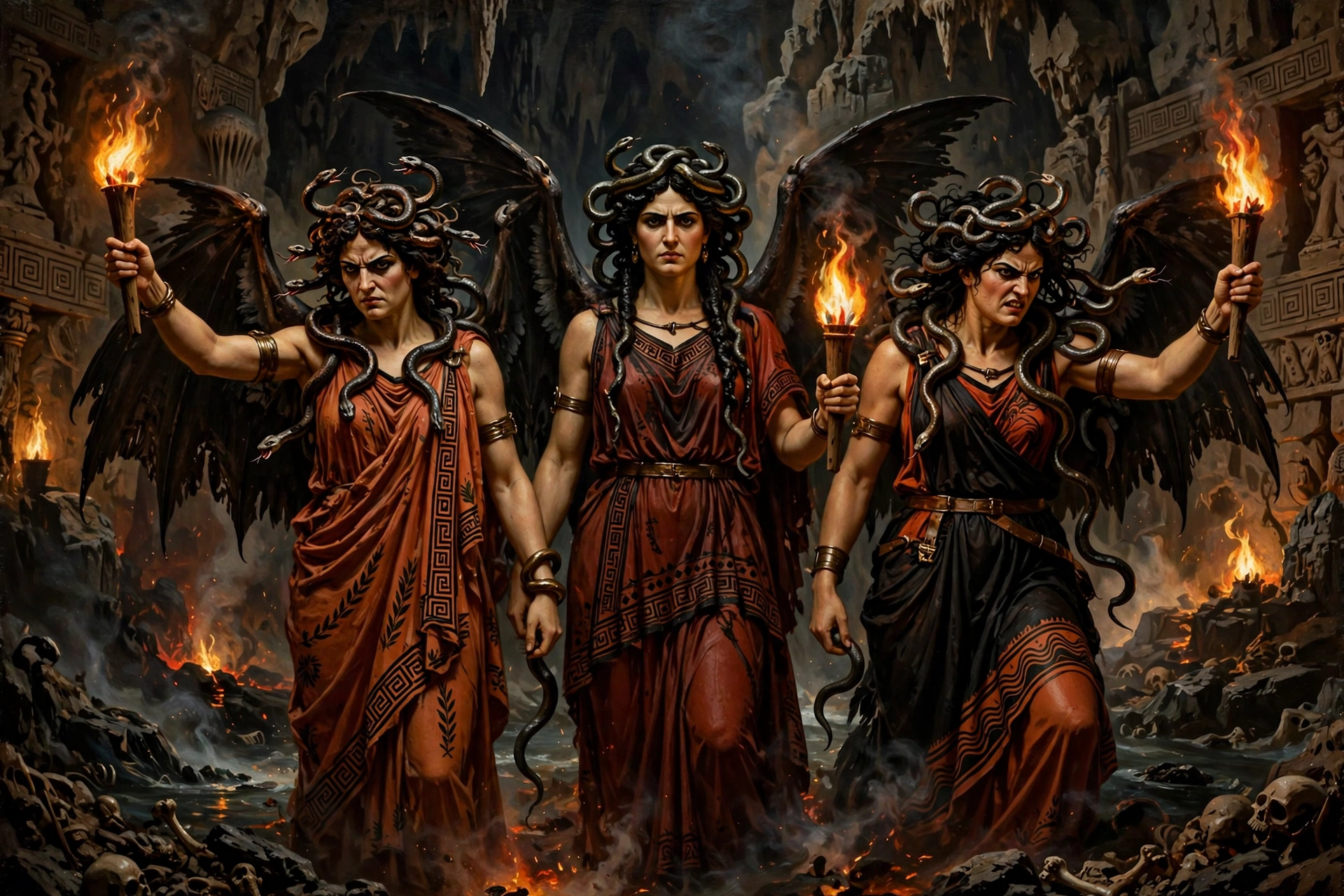
| Tisiphone | Greek | Avenger of murder | The Fury who punishes killers, whip and snakes in hand |
| Medea | Greek | Cunning; plots | The sorceress whose revenge on Jason became mythology’s most terrible payback |
| Orestes | Greek | Of the mountain | He avenged his father Agamemnon by killing his mother, then stood trial before the gods |
| Electra | Greek | Amber; shining | The daughter whose grief drove the vengeance for her murdered father |
| Vali | Norse | The slain one’s avenger | Born for one purpose: to kill Hodr and avenge Baldr – and he did it a day after birth |
| Vidar | Norse | The silent avenger | Odin’s son who will tear apart the wolf Fenrir to avenge his father at Ragnarok |
| Samson | Hebrew | Sun | The judge who, blinded, prayed for strength to be avenged on the Philistines |
| Esther | Persian / Hebrew | Star | The queen whose courage turned Haman’s plot back on himself |
| Draupadi | Sanskrit | Daughter of Drupada | The Mahabharata queen who kept her hair unbound until it was washed in her wrongdoers’ blood |
| Olga | Norse / Slavic | Holy; blessed | Saint Olga of Kiev, who avenged her murdered husband in four escalating acts of revenge |
| Boudica | Celtic | Victory | The Iceni queen who burned Roman cities in vengeance for her flogging and her daughters |
| Hamlet | Germanic / Literary | Little home | Shakespeare’s prince, commanded by a ghost to revenge a foul and most unnatural murder |
| Edmond | English / Literary | Fortunate protector | Edmond Dantes, the Count of Monte Cristo – literature’s most patient avenger |
Names That Literally Mean Vengeance in Languages Around the World
Some languages do not hide the meaning behind a myth – the word for vengeance itself is the name. These are the most direct entries on the list, from real Armenian and Kurdish given names to honest word names flagged as such.
| Name | Origin | Meaning | Note |
|---|---|---|---|
| Vrezh | Armenian | Vengeance | A genuine Armenian boy’s name built directly on the word for revenge |
| Intiqam | Arabic / Azerbaijani | Revenge; retribution | Borne as a real given name in Azerbaijan and across the Middle East |
| Thar | Arabic | Blood revenge | Tha’r, the old tribal duty of avenging kin – the engine of a thousand feuds |
| Badal | Pashto | Revenge; exchange | A pillar of Pashtunwali, the Pashtun code of honour; also a given name |
| Tolhildan | Kurdish | Revenge; avenging | A Kurdish name given so a loss is remembered and answered |
| Nakam | Hebrew | Vengeance | The biblical word, as in ‘vengeance is mine, I will repay’ |
| Nokem | Hebrew | Avenger | The avenger of blood recognised in ancient Israelite law |
| Goel | Hebrew | Redeemer; avenger | The kinsman-redeemer whose duty was to avenge and restore the family |
| Poine | Greek | Blood-price; vengeance | Personified in Greek myth as the spirit who collects the debt for murder |
| Tisis | Greek | Retribution | The abstract Greek force of paying back, wrong for wrong |
| Ultio | Latin | Vengeance | Rome personified her; Augustus raised an altar to Ultio in the Forum |
| Ultor | Latin | The Avenger | The title of Mars Ultor, the Mars who avenges – vowed by Augustus for Caesar’s murder |
| Vindex | Latin | Avenger; defender | A real Roman cognomen, borne by Gaius Julius Vindex who rose against Nero |
| Dial | Welsh | Avenge; vengeance | The blunt Welsh word at the heart of the old revenge tales |
| Kosto | Finnish | Revenge | An old Finnish name drawn straight from the word kosto |
| Utu | Maori | Reciprocity; revenge | The Maori principle that every gift – and every injury – must be repaid |
| Kisasi | Swahili | Revenge | The East African word for settling a score; a rare word name |
| Kataki | Japanese | The enemy to be avenged | In katakiuchi, the sanctioned vendetta, the kataki is the target of the quest |
| Fukushu | Japanese | Revenge | The modern Japanese word; a bold word name rather than a classic given name |
| Adauchi | Japanese | Vendetta; revenge attack | The classical Japanese term for a revenge killing undertaken as a duty |
| Onryo | Japanese | Vengeful spirit | The wronged ghost who returns from death to settle the account herself |
| Vendetta | Italian | Blood feud | An edgy word name – more at home in fiction than on a birth certificate |
| Karma | Sanskrit | Action; consequence | The universe’s own system of payback, now a popular modern name |
| Qisas | Arabic | Retribution in kind | The law of equal retaliation; an honest word name |
| Badla | Urdu / Hindi | Revenge; exchange | The everyday South Asian word for payback; a rare word name |
Greek Gods, Furies and Heroes of Vengeance
Greek myth is where vengeance becomes literature. The Furies hunt killers, queens murder kings for sacrificed daughters, and one blinded king of Ithaca comes home in disguise to settle a houseful of scores.
| Name | Origin | Meaning | Note |
|---|---|---|---|
| Alecto | Greek | Unceasing anger | The Fury who never rests until the debt is paid |
| Megaera | Greek | Jealous rage | The Fury who punishes broken oaths and infidelity |
| Erinys | Greek | A Fury | The singular form of the Erinyes, the avenging goddesses born from blood |
| Adrasteia | Greek | She who cannot be escaped | An epithet of Nemesis herself – retribution you cannot outrun |
| Arae | Greek | The Curses | Spirits invoked by the wronged, whose curses hunt the guilty |
| Ate | Greek | Ruin; blind folly | The goddess of the reckless act that brings its own punishment down |
| Lyssa | Greek | Rage; madness | The spirit sent to drive Heracles mad – fury as a weapon of the gods |
| Keres | Greek | Doom spirits | The female death-spirits who feast on violent ends |
| Dike | Greek | Justice | Daughter of Zeus who reports human injustice to her father |
| Agamemnon | Greek | Very steadfast | The murdered king whose death set the great revenge chain of the Oresteia in motion |
| Clytemnestra | Greek | Famed wooing | She killed Agamemnon in his bath, avenging her sacrificed daughter Iphigenia |
| Aegisthus | Greek | Goat strength | Clytemnestra’s accomplice, himself avenging his father Thyestes’ horrific wrongs |
| Thyestes | Greek | To feast (darkly) | His feud with his brother Atreus seeded two generations of vengeance |
| Atreus | Greek | Fearless | He fed Thyestes his own children – the crime the house never escaped |
| Iphigenia | Greek | Strong-born | The sacrificed daughter whose death her mother never forgave |
| Chrysothemis | Greek | Golden law | Electra’s sister, who refused to join the revenge – the road not taken |
| Pylades | Greek | Gate-keeper | Orestes’ cousin and companion, who stood beside him in the killing |
| Menelaus | Greek | Wrath of the people | The wronged husband whose stolen wife launched the Trojan War |
| Helen | Greek | Torch; bright | The face over which a decade of vengeance and war was fought |
| Achilles | Greek | Grief of the people | He re-entered the war for one reason: to kill Hector and avenge Patroclus |
| Patroclus | Greek | Glory of the father | Achilles’ beloved companion, whose death demanded vengeance |
| Hector | Greek | Holding fast | Troy’s champion, killed by Achilles in single combat before the walls |
| Paris | Greek | (Trojan prince) | He shot Achilles in the heel, avenging Hector and Troy |
| Priam | Greek | Ransomed | The old king who ransomed Hector’s body and was cut down by Achilles’ son |
| Neoptolemus | Greek | New war | Called Pyrrhus; he killed Priam on the altar, closing his father’s account |
| Hecuba | Greek | (Trojan queen) | Enslaved and broken, she still avenged her murdered son Polydorus by blinding his killer |
| Polydorus | Greek | Many gifts | Priam’s youngest son, murdered for his gold by his host |
| Polymestor | Greek | Much counsel | The Thracian king blinded by Hecuba in her revenge |
| Odysseus | Greek | The wrathful one (folk meaning) | He came home in disguise and slaughtered the suitors consuming his house |
| Telemachus | Greek | Far fighter | Odysseus’ son, who fought beside his father in the hall |
| Penelope | Greek | Weaver | The wife whose honour and household the suitors’ deaths restored |
| Antinous | Greek | Opposing mind | The chief suitor, and the first to fall to Odysseus’ bow |
| Jason | Greek | Healer | The husband Medea’s revenge methodically destroyed, child by child and bride by bride |
| Pelias | Greek | (King of Iolcus) | The usurper Medea tricked his own daughters into killing – Jason’s family debt collected |
| Creusa | Greek | Princess; ruler | Jason’s new bride, killed by Medea’s poisoned robe and crown |
| Ajax | Greek | Eagle (or earth) | The great warrior who killed himself in shame; his brother paid for failing him |
| Teucer | Greek | Archer | Ajax’s half-brother, exiled by their father for returning without his brother’s body |
| Philoctetes | Greek | Lover of gain (ironic) | The abandoned archer whose poisoned arrows finally killed Paris |
| Heracles | Greek | Glory of Hera | Killed from beyond the grave by the centaur Nessus’ patient revenge |
| Nessus | Greek | (Centaur) | Dying, he gave Deianira his poisoned blood as a ‘love charm’ – revenge on a delay |
| Deianira | Greek | Destroyer of men | Her name proved true: she sent the shirt that killed Heracles, believing it would restore his love |
| Andromache | Greek | Battle of men | Hector’s widow, carried off by the son of the man who killed her husband |
| Perseus | Greek | Destroyer | He turned Polydectes to stone with Medusa’s head, avenging years of harassment of his mother |
| Polydectes | Greek | Receiver of many | The king whose lust for Danae Perseus answered with a stone statue |
Norse Sagas: Blood Feuds and Avenger Gods
No culture wrote vengeance like the Norse. In the Icelandic sagas a killing is a debt on a ledger, carried across decades and oceans until someone with an axe settles it.
| Name | Origin | Meaning | Note |
|---|---|---|---|
| Baldr | Norse | Lord; prince | The bright god whose killing Vali was born to avenge |
| Hodr | Norse | Warrior | The blind god Loki tricked into throwing the fatal mistletoe |
| Loki | Norse | The knot; the tangler | Engineer of Baldr’s death, bound in a cave until Ragnarok for it |
| Fenrir | Norse | Fen-dweller | The wolf chained by the gods, who will kill Odin – and be avenged by Vidar |
| Odin | Norse | Frenzy; inspiration | The All-Father, swallowed by Fenrir and avenged by his silent son |
| Frigg | Norse | Beloved | The mother who extracted oaths from all things to protect Baldr – and missed the mistletoe |
| Hel | Norse | Hidden | Queen of the dead, who set the impossible condition for Baldr’s return |
| Sigurd | Norse / Germanic | Victory guard | The dragon-slayer drawn into a cursed gold’s long chain of revenge |
| Sigmund | Norse | Victory protection | Sigurd’s father, whose broken sword his son reforged |
| Regin | Norse | The mighty one (smith) | The smith who raised Sigurd to kill Fafnir, and plotted to kill him after |
| Fafnir | Norse | The embracer | The dwarf turned dragon, killed by Sigurd over the cursed hoard |
| Hreidmar | Norse | (Dwarf king) | Murdered by his own sons for the cursed gold – the feud’s first corpse |
| Gudrun | Norse | Battle rune | She avenged her brothers by killing her husband Atli and feeding him his sons |
| Atli | Norse | Little father (Attila) | The Hunnish king Gudrun destroyed from inside his own hall |
| Gunnar | Norse | War warrior | Gudrun’s brother, thrown into the snake pit by Atli |
| Hogni | Norse | Protector | Gunnar’s brother, who laughed while his heart was cut out |
| Brynhildr | Norse | Armoured battle | The valkyrie who engineered Sigurd’s death after being deceived into the wrong marriage |
| Svanhildr | Norse | Swan battle | Gudrun’s daughter, trampled by horses on a false accusation – and avenged by her brothers |
| Hamdir | Norse | (Gjuki kin) | He and Sorli stoned the king who killed their sister, and died for it |
| Sorli | Norse | Armoured | Hamdir’s brother in the last, hopeless revenge ride |
| Erp | Norse | Brown | The half-brother Hamdir and Sorli killed on the road – the mistake that doomed their revenge |
| Jormunrek | Norse | Great king (Ermanaric) | The Gothic king who had Svanhildr trampled and was maimed in his own hall |
| Randver | Norse | Shield wolf | Jormunrek’s son, hanged on a slander that also doomed Svanhildr |
| Bikki | Norse | (Courtier) | The slanderer whose lies set the whole Svanhildr tragedy running |
| Hervor | Norse | Army guard | The shieldmaiden who woke her dead father to demand his cursed sword |
| Angantyr | Norse | (Berserker king) | Hervor’s father, who rose from his grave-mound to warn her about the sword |
| Amleth | Norse / Danish | (Prince of Jutland) | Saxo Grammaticus’ original Hamlet, who feigned madness and avenged his father |
| Egil | Norse | Edge; terror | Egill Skallagrimsson, the poet-warrior whose life was a chain of feuds and paybacks |
| Skallagrim | Norse | Bald Grim | Egil’s father, who answered his son’s killing with killings of his own |
| Kari | Norse | Curly; gust | Kari Solmundarson, who hunted the burners of Njal’s house across years and seas |
| Flosi | Norse | (Chieftain of Svinfell) | He led the burning of Njal and his sons – the act Kari spent a saga avenging |
| Njal | Norse | (Sage of Bergthorshvoll) | The law-wise patriarch burned in his house; his death demanded a famous vengeance |
| Gisli | Norse | Ray; hostage | The outlaw hero of Gisla saga, who avenged his sworn brother and was hunted for it |
| Vestein | Norse | Holy stone | Gisli’s sworn brother, murdered in the night – the death Gisli answered |
| Thordis | Norse | Thor’s goddess | Gisli’s sister, who swung a sword at his betrayer even in her own hall |
Roman Names of Revenge and Honour
Rome turned vengeance into law, but its legends remember the older way: a ravished woman avenged by a revolution, a father who killed his own daughter rather than surrender her, a general who came back to Rome at the head of an enemy army.
| Name | Origin | Meaning | Note |
|---|---|---|---|
| Aeneas | Roman / Greek | Praised | In the Aeneid’s last line he kills Turnus in a blaze of vengeance for young Pallas |
| Pallas | Roman / Greek | Youth | Evander’s son, cut down by Turnus – his belt on Turnus’ shoulder seals Turnus’ fate |
| Turnus | Roman | (Rutulian king) | Aeneas’ rival, killed over Pallas’ sword-belt |
| Evander | Roman / Greek | Good man | The old king who sent his only son to war and received his body |
| Mezentius | Roman / Etruscan | (Exiled tyrant) | The contemptuous killer Aeneas brings down in Pallas’ war |
| Brutus | Roman | Heavy; dull (ironic) | Lucius Junius Brutus avenged Lucretia by expelling the Tarquin kings and founding the Republic |
| Lucretia | Roman | Wealth (ironic) | Her violation and suicide were the wrong Rome avenged with a revolution |
| Collatinus | Roman | (Nobleman) | Lucretia’s husband, who carried her story into the Forum |
| Tarquin | Roman / Etruscan | (Royal house) | Sextus Tarquinius, the prince whose crime cost his family the throne |
| Verginia | Roman | Virgin | Killed by her own father to keep her from the corrupt Appius – Rome rose over her body |
| Appius | Roman | (Decemvir) | Appius Claudius, whose lust for Verginia destroyed him and the Decemvirate |
| Icilius | Roman | (Tribune) | Verginia’s betrothed, who turned her death into an uprising |
| Camillus | Roman | Attendant | Marcus Furius Camillus, who avenged sacked Rome on the Gauls and refused to let honour be ransomed |
| Brennus | Gallic / Roman | King; raven | The Gallic chief who sacked Rome and threw his sword on the scales: ‘Woe to the conquered’ |
| Coriolanus | Roman | Of Corioli | The exiled general who marched on Rome itself in vengeance – and was turned back by his mother |
| Volumnia | Roman | (Matron) | Coriolanus’ mother, the only avenger Rome could send against its avenger |
| Horatius | Roman | (Roman house) | Horatius Cocles held the bridge; another Horatius killed his own sister for mourning Rome’s enemy |
Biblical Avengers and Settled Scores
The Hebrew Bible runs on the lex talionis – eye for eye – and its pages are full of brothers avenging sisters, generals settling battlefield debts, and one queen who turned a genocidal plot back on the plotter.
| Name | Origin | Meaning | Note |
|---|---|---|---|
| Joab | Hebrew | Yahweh is father | David’s ruthless general, who killed Abner to avenge his brother Asahel |
| Abner | Hebrew | Father of light | Saul’s commander, who killed Asahel in battle and was murdered by Joab at the gate |
| Asahel | Hebrew | God has made | The swift-footed brother whose death Joab carried as a debt for years |
| Amasa | Hebrew | Burden | Joab’s cousin, kissed and stabbed by Joab – a purge dressed as politics |
| Absalom | Hebrew | Father of peace (ironic) | He waited two full years, then had his brother Amnon killed for their sister Tamar |
| Amnon | Hebrew | Faithful (ironic) | David’s eldest son, whose crime against Tamar Absalom answered |
| Tamar | Hebrew | Palm tree | The wronged princess whose honour her brother avenged in blood |
| Simeon | Hebrew | Heard | With Levi, he massacred the city of Shechem for their sister Dinah |
| Levi | Hebrew | Joined | Simeon’s partner in the Dinah vengeance – his violence remembered in Jacob’s deathbed words |
| Dinah | Hebrew | Judged; justice | Jacob’s daughter, whose wronging her brothers avenged on a whole city |
| Shechem | Hebrew | Shoulder; ridge | The prince who wronged Dinah and died with all his city’s men |
| Jael | Hebrew | Mountain goat | She gave the fleeing general Sisera milk – then drove a tent peg through his temple |
| Sisera | Canaanite | (General) | Jabin’s commander, killed by Jael while he slept |
| Deborah | Hebrew | Bee | The prophetess who ordered the war and sang the victory song over Sisera |
| Barak | Hebrew | Lightning | The commander who would only go to battle beside Deborah |
| Ehud | Hebrew | United | The left-handed judge who assassinated King Eglon with a hidden blade |
| Eglon | Hebrew | Calf-like | The Moabite king whose court Ehud escaped by locking the doors |
| Phinehas | Hebrew | Dark-skinned; oracle | The priest whose spear stopped a plague – zeal counted as atonement |
| Elijah | Hebrew | My God is Yahweh | On Mount Carmel he ordered the prophets of Baal seized and slaughtered |
| Elisha | Hebrew | God is salvation | Elijah’s successor, who cursed the mocking youths in the Lord’s name – a darker miracle |
| Jehu | Hebrew | Yahweh is he | Anointed for one task: to wipe out the house of Ahab and avenge Naboth and the prophets |
| Ahab | Hebrew | Father’s brother | The king whose dynasty Jehu exterminated to the last heir |
| Jezebel | Phoenician | Not exalted | The queen thrown from her window and trampled in Jehu’s purge |
| Naboth | Hebrew | Fruits; words | The vineyard owner murdered on Jezebel’s forged orders; his blood, Elijah promised, would be answered |
| Athaliah | Hebrew | Yahweh is exalted | The queen who seized Judah’s throne by killing the royal children – and was executed when one survived |
| Joash | Hebrew | Yahweh has given | The baby king hidden six years in the Temple, crowned in the coup that destroyed Athaliah |
| Jehoiada | Hebrew | Yahweh knows | The priest who raised Joash in secret and engineered Athaliah’s fall |
| Judith | Hebrew | Jewish woman | The widow who charmed her way into Holofernes’ tent and beheaded him, avenging her besieged city |
| Holofernes | Assyrian (name in Greek form) | (General) | Nebuchadnezzar’s commander, killed by Judith with his own sword |
| Mordecai | Hebrew / Babylonian | Of Marduk | Esther’s cousin, whose refusal to bow lit Haman’s plot – and who rose in Haman’s place |
| Haman | Persian | Magnificent (ironic) | The vizier hanged on the gallows he built for Mordecai |
| Vashti | Persian | Beautiful | The deposed queen whose fall opened the door for Esther |
| Moses | Hebrew / Egyptian | To draw out | His first recorded act: killing an Egyptian overseer who was beating a Hebrew slave |
| Gideon | Hebrew | Hewer; feller | He executed the Midianite kings Zebah and Zalmunna for the brothers they had killed at Tabor |
| David | Hebrew | Beloved | On his deathbed he named the accounts still open – Joab’s murders and Shimei’s curse – for Solomon to settle |
| Shimei | Hebrew | Famous | He cursed David in his flight and was executed for it under Solomon |
| Solomon | Hebrew | Peace (ironic) | The wise king who opened his reign by settling his father’s unfinished scores |
Names That Mean Justice, Truth and Righteousness
Vengeance’s respectable twin. The same instinct – that wrongs must be answered – built the law, and the world’s languages keep the proof in their names. If you love the theme but want it court-ready, start here.
| Name | Origin | Meaning | Note |
|---|---|---|---|
| Justus | Latin | Just; upright | A Roman name carried by early saints – justice as a given name |
| Justin | Latin | Just; righteous | The gentler, classic form of the justice family |
| Justina | Latin | Just; righteous | The feminine form, borne by a martyr of Padua |
| Justinian | Latin | Of Justinus | The emperor who codified Roman law itself – justice systematised |
| Justo | Spanish / Portuguese | Just | The direct Iberian form |
| Giusto | Italian | Just; right | The Italian form, with a warm, old-world feel |
| Juste | French | Just | The spare French form of the name |
| Justine | French / Latin | Just; righteous | The French feminine form, literary since de Sade and Gide |
| Justice | English | Fairness; the law | The virtue itself, used as a modern given name in English |
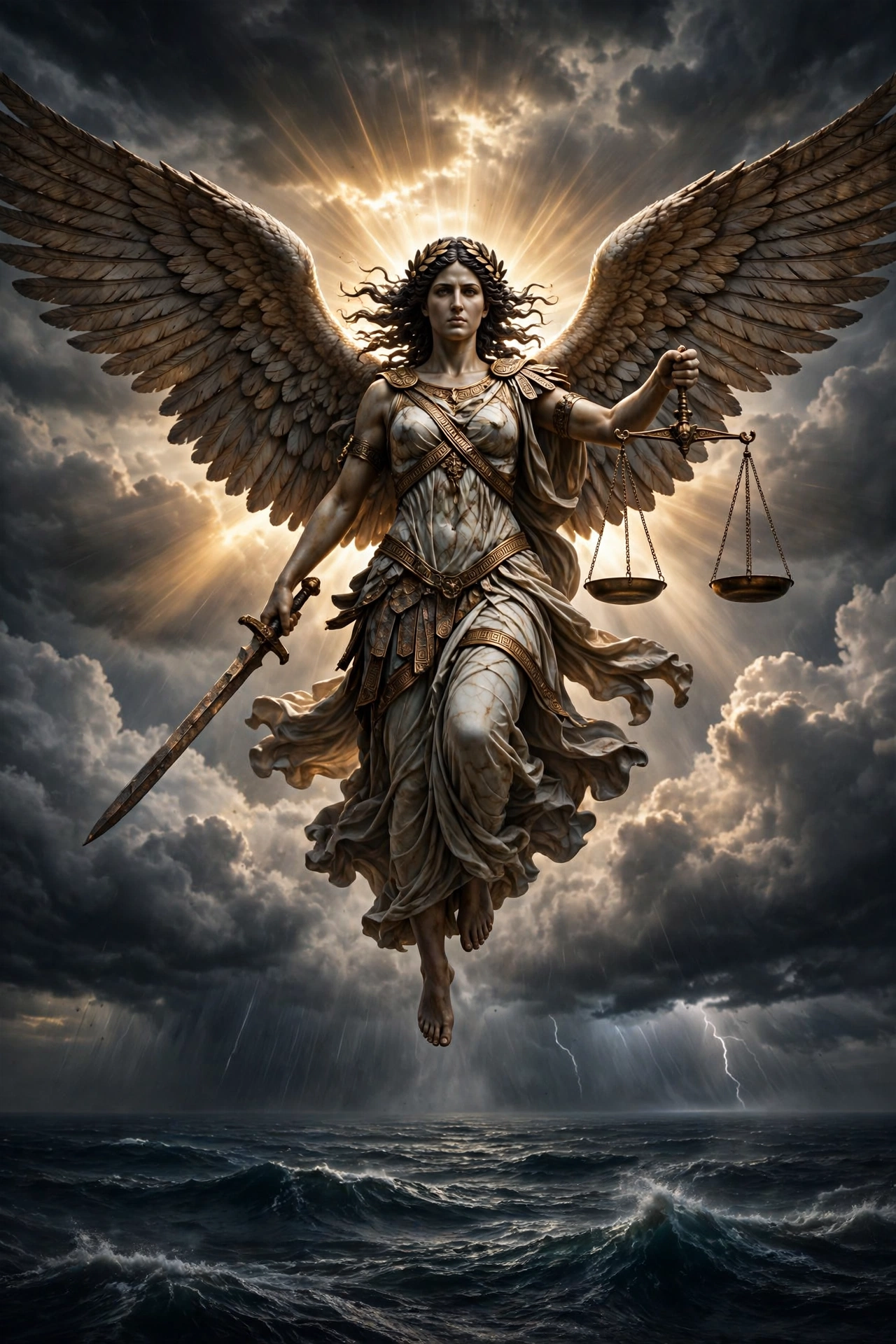
| Astraea | Greek | Star-maiden | The last goddess to leave earth, who became the constellation Virgo holding the scales |
| Themis | Greek | Divine law; custom | Titaness of divine order, mother of the Fates and the Seasons |
| Eunomia | Greek | Good order | Themis’ daughter, goddess of lawfulness and good governance |
| Aristides | Greek | Best son | Aristides ‘the Just’ of Athens, so trusted with fairness that citizens wrote his own exile vote for him |
| Tzadik | Hebrew | Righteous one | The title of a perfectly righteous person in Jewish tradition; an honest word name |
| Sadiq | Arabic | Truthful | A widely used Arabic name for a man whose word holds |
| Siddiq | Arabic | The veracious | The title given to Abu Bakr, first caliph, for his truthfulness |
| Adil | Arabic | Just; fair | One of the most direct justice names in the world, used across the Muslim world |
| Adila | Arabic | Just; fair | The feminine form of Adil |
| Adalet | Turkish | Justice | The Turkish word itself, used as a classic Turkish girl’s name |
| Insaf | Arabic | Fairness; equity | The quality every avenger claims to serve |
| Hakki | Turkish | Rightful; truthful | A traditional Turkish boy’s name built on hak, truth and right |
| Tzedek | Hebrew | Righteousness; justice | Also the Hebrew name of the planet Jupiter, king of planets; an honest word name |
| Emet | Hebrew | Truth | A modern Hebrew name meaning truth itself |
| Nyaya | Sanskrit | Justice; logic | Both the system of logic and the concept of justice in Indian philosophy; a word name |
| Dharma | Sanskrit | Law; duty; cosmic order | The law that holds the world; what every epic avenger claims to defend |
| Satya | Sanskrit | Truth | A beloved Indian name; Gandhi called his whole method satyagraha, truth-force |
| Satyam | Sanskrit | Truth (form of) | From the mantra ‘Satyam Shivam Sundaram’ – truth, goodness, beauty |
| Seigi | Japanese | Justice; righteousness | A genuine Japanese given name built on the word for justice |
| Masayoshi | Japanese | Just and righteous | A traditional samurai-era name meaning exactly what it says |
| Tadashi | Japanese | Correct; loyal | A classic Japanese boy’s name meaning righteous and true |
| Naoki | Japanese | Straight and honest | Literally a straight, honest tree |
| Seiji | Japanese | Law and governance | A name of lawful order, borne by conductors and politicians |
| Kosei | Japanese | Fairness; impartiality | Built from the characters for fairness and public good |
| Zheng | Chinese | Upright; correct | A Chinese name meaning straight and just |
| Zhengyi | Chinese | Justice | The Chinese word for justice, used as a given name |
| Ping | Chinese | Level; fair; peaceful | The level scales in a single syllable |
| Haki | Swahili | Justice; rights | The Swahili word at the heart of East African courts and protests; a word name |
| Iestyn | Welsh | Just | The Welsh form of Justin, borne by Welsh princes |
| Verity | Latin / English | Truth | The Puritan virtue name for truth itself |
| Verus | Latin | True | A Roman cognomen meaning genuinely true |
| Alethea | Greek | Truth | Truth personified, unconcealed – the Greek aletheia |
| Emmet | Germanic / Hebrew-linked | Truth; whole | Linked in Hebrew to emet, truth; also an old Germanic name |
| Honor | Latin / English | Honour | The virtue whose wound starts most revenge stories – here, the name itself |
| Solon | Greek | (Lawgiver) | Athens’ great lawgiver, who tried to replace blood-feud with courts |
| Lycurgus | Greek | Wolf-work | Sparta’s legendary lawgiver, who bound a warrior city in law |
| Draco | Greek | Dragon; serpent | The Athenian whose laws were so harsh we still call severe laws draconian |
Japanese Vengeance Names: Ronin, Samurai and Onryo
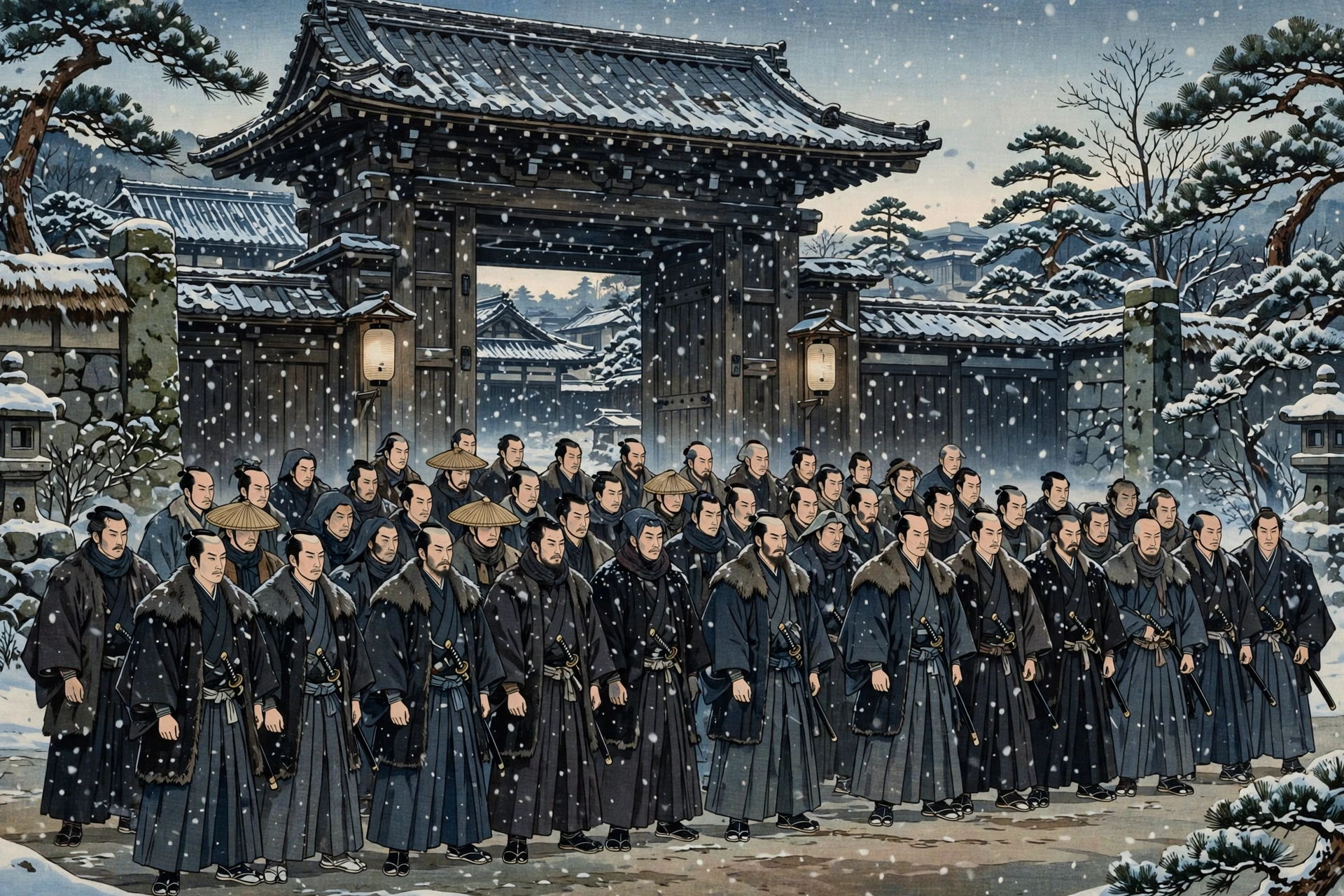
Japan made vengeance a ceremony. The forty-seven ronin waited two years to avenge their lord, then surrendered to the law; the Soga brothers trained ten years for one night; and the wronged dead – the onryo – are still feared at shrines built to calm them.
| Name | Origin | Meaning | Note |
|---|---|---|---|
| Asano | Japanese | Shallow field (surname) | Lord Asano Naganori, whose forced suicide the forty-seven ronin avenged |
| Kira | Japanese | Glimmer (surname) | Kira Yoshinaka, the court official whose conduct doomed Asano – the ronin’s target |
| Yoshio | Japanese | Righteous life | Oishi Yoshio, called Kuranosuke, the chamberlain who led the forty-seven ronin |
| Chikara | Japanese | Strength; power | Oishi Chikara, Yoshio’s son and the youngest ronin, who died with his father at seventeen |
| Yuranosuke | Japanese | (Stage name) | Oboshi Yuranosuke, the fictionalised name of the ronin leader in the Kabuki classic Chushingura |
| Sukenari | Japanese | (Samurai name) | Soga Juro Sukenari, elder of the two Soga brothers of the famous night revenge |
| Tokimune | Japanese | (Samurai name) | Soga Goro Tokimune, the younger brother, who cut down ten men in the vendetta |
| Suketsune | Japanese | (Samurai name) | Kudo Suketsune, the brothers’ target, whose retainer had killed their father |
| Masakado | Japanese | (Warrior name) | Taira no Masakado, the rebel whose severed head legend said flew home – and whose spirit Tokyo still placates |
| Michizane | Japanese | True path | Sugawara no Michizane, the exiled scholar who became one of Japan’s great vengeful spirits, later deified to calm him |
| Sutoku | Japanese | (Imperial name) | The retired emperor Sutoku, whose curse after defeat made him one of the three great onryo |
| Okiku | Japanese | Chrysanthemum | The servant girl of the Banchō Sarayashiki tale, murdered over a plate and heard counting them forever |
| Oiwa | Japanese | (Woman of the Yotsuya tale) | Betrayed and disfigured by her husband, she became Japanese theatre’s most famous female onryo |
| Iemon | Japanese | (Samurai name) | Tamiya Iemon, Oiwa’s treacherous husband, haunted to madness |
| Tamamo | Japanese | Jewel algae (fox name) | Tamamo-no-Mae, the nine-tailed fox spirit blamed for an emperor’s sickness and hunted down for it |
| Enma | Japanese / Buddhist | Judge of the dead | King Enma weighs every soul’s sins – vengeance administered by heaven |
| Yurei | Japanese | Faint spirit; ghost | The Japanese ghost, most powerful when it has a score to settle; an honest word name |
Chinese Names of Revenge and Endurance
Chinese history frames vengeance as endurance: a king sleeping on brushwood for twenty years, a defector whipping a corpse, and an orphan hidden in a basket so that one day the family account can be closed.
| Name | Origin | Meaning | Note |
|---|---|---|---|
| Goujian | Chinese | (King of Yue) | He slept on brushwood and tasted gall daily for years, until he destroyed the kingdom that had humbled him |
| Fuchai | Chinese | (King of Wu) | Goujian’s nemesis, who showed mercy once – and paid for it with his state |
| Zixu | Chinese | (Minister of Wu) | Wu Zixu fled to Wu, raised its army against his own homeland, and whipped the corpse of the king who killed his father and brother |
| Jing Ke | Chinese | (Assassin of Yan) | The swordsman sent to kill the King of Qin – the most famous failed assassination of ancient China |
| Dan | Chinese | Red; cinnabar | Crown Prince Dan of Yan, who staked everything on Jing Ke’s dagger |
| Wu Song | Chinese | (Water Margin hero) | He killed a tiger bare-handed, then killed his brother’s murderers and wrote his confession in their blood on the wall |
| Dalang | Chinese | The elder | Wu Dalang, the humble baker poisoned by his wife – the wrong Wu Song avenged |
| Jinlian | Chinese | Golden lotus | Pan Jinlian, the wife whose affair and poison set Wu Song’s revenge in motion |
| Ximen | Chinese | West gate (surname) | Ximen Qing, the rich lover Wu Song killed after a formal complaint failed |
| Lin Chong | Chinese | Forest; charge | The ‘Panther Head’, an arms instructor framed and hunted until he killed his persecutors in a burning temple |
| Cheng Ying | Chinese | (Loyal retainer) | In The Orphan of Zhao, he gave up his own infant son’s life to save the last child of a massacred clan |
| Gongsun | Chinese | (Surname) | Gongsun Chujiu, who died in the orphan’s place in the same plot |
| Zhao Wu | Chinese | (The Orphan of Zhao) | The hidden child grown up, who finally brought down the murderer of his entire family |
| Tu’an Gu | Chinese | (Minister of Jin) | The villain of the Zhao story, who engineered the massacre of three hundred kin |
| Bao Zheng | Chinese | Upright; evidence | Judge Bao, the incorruptible magistrate whose name still means justice in China |
| Qin Hui | Chinese | (Song chancellor) | The minister blamed for the hero Yue Fei’s judicial murder; his iron statue still kneels in disgrace at Yue Fei’s tomb |
| Zhuan Zhu | Chinese | (Assassin of Wu) | He hid a dagger in a fish’s belly to kill King Liao for his patron – loyalty as assassination |
| Nie Zheng | Chinese | (Assassin of Han) | He killed a minister for the patron who had honoured his mother, then flayed his own face so his family would not pay for it |
Indian Epic Names Born of Vows and Revenge
The Mahabharata is, at bottom, a revenge engine: a queen’s unbound hair, a boy killed by seven warriors, a charioteer’s lifelong insult – every oath made in it is eventually collected, with interest.
| Name | Origin | Meaning | Note |
|---|---|---|---|
| Bhima | Sanskrit | The terrible | He swore to drink Dushasana’s blood and break Duryodhana’s thigh – and kept both oaths |
| Dushasana | Sanskrit | Hard to rule | He dragged Draupadi by her hair into the hall; Bhima’s blood-oath named him personally |
| Kichaka | Sanskrit | (Commander of Matsya) | He kicked Draupadi in open court; Bhima, disguised as a cook, crushed him that same night |
| Amba | Sanskrit | Mother | The princess Bhishma ruined by abduction and refusal; she immolated herself praying to be reborn as his killer |
| Shikhandi | Sanskrit | Peacock-crested | Amba reborn – the one warrior Bhishma would not fight, and the shield behind which Arjuna shot him |
| Bhishma | Sanskrit | The terrible (vow) | The grandsire whose own terrible vow set Amba’s tragedy, and his fall, in motion |
| Arjuna | Sanskrit | Bright; silver | He vowed to kill Jayadratha before sunset for his son’s death – or enter the fire himself |
| Jayadratha | Sanskrit | Victorious chariot | The Sindhu king who held back four armies while Abhimanyu was surrounded and killed |
| Abhimanyu | Sanskrit | Self-pride; wrathful | The sixteen-year-old who broke the discus formation and died in it – the war’s most avenged death |
| Ashvatthama | Sanskrit | Horse-voiced | Learning of his father’s death by a trick, he slaughtered the enemy camp by night – and was cursed to wander immortal |
| Drona | Sanskrit | Vessel; bucket | The royal guru, killed after he laid down his arms at false news of his son’s death |
| Drupada | Sanskrit | Pillar | Humiliated by Drona, he performed a sacrifice for children destined to destroy him – Draupadi and Dhrishtadyumna |
| Dhrishtadyumna | Sanskrit | Bold and shining | Born full-grown from the sacrificial fire for one purpose: to kill Drona |
| Karna | Sanskrit | Ear; cutter | Mocked all his life as a charioteer’s son, his wounded honour bound him fatally to Duryodhana |
| Duryodhana | Sanskrit | Hard to conquer | The eldest Kaurava whose envy of his cousins engineered the dice game and the war |
| Shakuni | Sanskrit | Bird; omen | The dice-player uncle; later tradition says he destroyed the Kuru house to avenge his own Gandhara family |
| Gandhari | Sanskrit | Of Gandhara | Mother of the hundred Kauravas, who cursed Krishna himself for letting them die |
| Krishna | Sanskrit | Dark; all-attractive | The strategist and charioteer who ensured that every vow sworn in the epic was, in the end, kept |
| Parashurama | Sanskrit | Rama with the axe | The Brahmin warrior who avenged his murdered father by exterminating corrupt Kshatriya kings twenty-one times over |
| Jamadagni | Sanskrit | (Sage) | Parashurama’s father, shot by a king’s sons over the wish-granting cow Kamadhenu |
| Kartavirya | Sanskrit | (Haiheya king) | The thousand-armed king whose theft of the cow began the feud that killed Jamadagni |
| Rama | Sanskrit | Pleasing; dark | His war on Lanka answered the abduction of Sita – and a sister’s dishonour on the other side |
| Lakshmana | Sanskrit | Marked with luck | Rama’s brother, who cut off Surpanakha’s nose – the spark that lit Lanka’s fall |
| Surpanakha | Sanskrit | Sharp nails | Ravana’s sister, whose mutilation her brother crossed an ocean to answer |
| Ravana | Sanskrit | He of the roar | The ten-headed king who abducted Sita as a matter of family honour and pride |
| Jatayu | Sanskrit | (Vulture king) | The old vulture who fought Ravana in mid-air for Sita and died naming her kidnapper |
| Bali | Sanskrit | Offering; the strong one | Also called Vali: the vanara king shot from hiding by Rama; his death is the Ramayana’s great debate about justice |
| Sugriva | Sanskrit | Beautiful neck | Vali’s exiled brother, who twice lost his kingdom and regained it through Rama |
| Khara | Sanskrit | Harsh; donkey | The rakshasa commander Rama slew in Janasthana – one more debt Ravana counted |
| Virabhadra | Sanskrit | Distinguished hero | Shiva’s wrath given form, created from a lock of his hair to destroy Daksha’s sacrifice |
| Sati | Sanskrit | Truth; the true one | Shiva’s wife, who burned herself at her father’s insult – the wrong Virabhadra answered |
| Daksha | Sanskrit | Able; ritual skill | The proud father-in-law whose sacrifice Virabhadra turned into a battlefield |
| Chanakya | Sanskrit | Son of Chanaka | Insulted by the Nanda king, he untied his topknot and swore not to bind it until the Nandas fell – then raised Chandragupta to do it |
| Chandragupta | Sanskrit | Moon-protected | Chanakya’s protege, founder of the Mauryan Empire, built as an instrument of his guru’s vow |
Persian Shahnameh Names of Vengeance
Ferdowsi’s Shahnameh, the Persian Book of Kings, turns on two great accounts: an innocent prince murdered abroad, and the grandson raised in hiding to come back for the king who ordered it.
| Name | Origin | Meaning | Note |
|---|---|---|---|
| Kay Khosrow | Persian | Good fame; royal | The hidden grandson who returned at the head of an army to avenge his father Siyavash on Afrasiab |
| Siyavash | Persian | Owner of the black stallion | The innocent prince, exiled by a false accusation and murdered in a foreign land |
| Afrasiab | Persian | (King of Turan) | The Turanian king who ordered Siyavash’s execution and paid for it with his life and throne |
| Sudabeh | Persian | (Queen) | The stepmother whose rejected desire became the accusation that destroyed Siyavash |
| Farangis | Persian | (Princess of Turan) | Siyavash’s widow, who carried his unborn son – the future avenger – to safety |
| Garsivaz | Persian | (Prince of Turan) | Afrasiab’s brother, whose slanders worked Siyavash to death |
| Piran | Persian | The elder; vizier | Turan’s great vizier, who sheltered Siyavash and Kay Khosrow yet served the king who killed them |
| Rostam | Persian | I grew strong | Persia’s mightiest champion, trapped all his life between other men’s feuds |
| Sohrab | Persian | Red water; hero | Rostam’s unknown son, killed by his own father – the tragedy no vengeance could undo |
| Shaghad | Persian | (Prince) | Rostam’s half-brother, whose spiked pit killed the hero – and who died by Rostam’s last arrow |
| Esfandiyar | Persian | Holy creation | The invulnerable prince Rostam was forced by kings and fate to kill |
| Manuchehr | Persian | Of heavenly face | The early king who marched on his great-uncles to avenge the murder of Iraj |
| Iraj | Persian | (Prince of Persia) | The youngest and gentlest son, murdered by his own brothers over the division of the world |
| Tur | Persian | (Prince) | Iraj’s brother and co-murderer – the ancestor of Persia’s enemies, the Turanians |
| Salm | Persian | (Prince) | The eldest brother, who joined Tur in Iraj’s murder and died under Manuchehr’s vengeance |
Celtic Goddesses and Heroes of Revenge
Ireland’s goddesses of war do not merely watch battles – they cause them, often to settle a personal account. Wales adds a princess whose mistreatment set two kingdoms burning, and a goddess invoked by Boudica herself.
| Name | Origin | Meaning | Note |
|---|---|---|---|
| Morrigan | Irish | Phantom queen | The great goddess of battle, fate and sovereignty, who could make or break kings |
| Macha | Irish | Plain; field | Forced to race the king’s horses while pregnant, she cursed Ulster’s men with birth-pangs in their hour of need |
| Badb | Irish | Crow; fury | The crow goddess who shrieked over battlefields and maddened armies |
| Nemain | Irish | Venomous; frenzy | The spirit of battle-panic, whose cry could kill a hundred men with terror |
| Fea | Irish | Harsh | One of the war goddesses of the Tuatha De Danann, grouped with Badb and Nemain |
| Anann | Irish | (Goddess) | An aspect of the Morrigan triad, mother of gods and patroness of the Munster kings |
| Medb | Irish | Intoxicating | Connacht’s queen, whose pride and counting of wealth against her husband launched the Cattle Raid of Cooley |
| Fergus | Irish | Man of strength | The exiled Ulster king who fought against his own people after Conchobar’s treachery |
| Conchobar | Irish | Lover of hounds | The Ulster king whose broken safe-conduct murdered Deirdre’s lover and drove his best warriors into exile |
| Deirdre | Irish | Sorrow; raging | Prophesied to bring ruin, she lost her lover to Conchobar’s treachery and dashed her head rather than be taken |
| Naoise | Irish | (Warrior) | Deirdre’s lover, murdered under a flag of truce |
| Lugh | Irish | Light; shining | The many-skilled god who demanded an impossible eric-fine from his father’s killers, then slew Balor |
| Cian | Irish | Ancient; enduring | Lugh’s father, beaten to death by the sons of Tuireann – the crime Lugh answered with tasks that destroyed them |
| Brian | Irish | Noble; strong | Eldest of Tuireann’s sons, broken at last by the final task Lugh imposed |
| Tuireann | Irish | (Father) | Father of Cian’s killers, who watched the eric consume his sons |
| Balor | Irish | Flashing; deadly | The Fomorian king with the destroying eye, killed by his own grandson Lugh |
| Branwen | Welsh | White raven | The Welsh princess starved and struck in Ireland’s kitchen; her letter home brought Britain to avenge her |
| Matholwch | Welsh | (King of Ireland) | Branwen’s husband, whose court mistreated her and whose horses paid first |
| Efnisien | Welsh | (Prince) | Branwen’s half-brother, who mutilated the horses, threw her child into the fire, and finally died breaking the enemy’s cauldron |
| Bran | Welsh | Raven | Bendigeidfran, the giant king who waded the sea to Ireland to answer his sister’s wrongs |
| Gwern | Welsh | Alder; swamp | Branwen’s little son, burned by Efnisien at the feast meant to make peace |
| Gwenllian | Welsh | White pool; blessed | The Welsh warrior princess who led revenge raids after her husband’s capture in 1136 and died fighting |
| Andraste | British Celtic | The invincible | The war goddess to whom Boudica sacrificed and prayed before her revolt |
Real Avengers of History
History’s avengers did not stop at feelings. A widowed princess burned the tax-collectors who killed her husband; a steppe queen dipped a skull-cup in a king’s blood; two Frankish queens fought a forty-year war that began with a murdered sister.
| Name | Origin | Meaning | Note |
|---|---|---|---|
| Hannibal | Punic | Grace of Baal | At nine years old he swore at his father’s altar never to befriend Rome – and spent his life collecting on it at Cannae and beyond |
| Hamilcar | Punic | Servant of Melqart | Hannibal’s father, who carried Carthage’s defeat to Spain and raised his sons as Rome’s answer |
| Hasdrubal | Punic | Baal is my help | Hannibal’s brother, who died holding Spain against Rome |
| Scipio | Roman | Staff; rod | Scipio Africanus volunteered for Spain to avenge his father and uncle, both killed there – and ended by breaking Carthage |
| Tomyris | Scythian / Persian sources | (Queen of the Massagetae) | She warned Cyrus to return her son; when he came back dead, she defeated Persia and plunged Cyrus’ head into a skin of blood |
| Cyrus | Persian | Sun; far-sighted | Cyrus the Great, whose capture of Tomyris’ son brought the one defeat his empire could not answer |
| Spargapises | Scythian | (Prince) | Tomyris’ son, tricked into capture and dead by his own hand – the wrong his mother avenged on an empire |
| Genghis | Mongolian | Universal; fierce | Temujin avenged his father Yesugei’s poisoning, united the steppe, and later emptied Khwarezm for murdered envoys |
| Yesugei | Mongolian | (Khan) | Genghis Khan’s father, poisoned by the Tatars – the first debt his son collected |
| Hind | Arabic | India (name) | Hind bint Utbah, who lost her father, uncle and brother at Badr and swore vengeance on Hamza |
| Hamza | Arabic | Lion; strong | The Prophet’s uncle and Islam’s early champion, killed at Uhud by an assassin in Hind’s pay |
| Wahshi | Arabic | Wild; untamed | The Abyssinian spearman who killed Hamza at Uhud to buy his own freedom |
| Charlotte | French / Germanic | Free woman | Charlotte Corday stabbed the revolutionary demagogue Marat in his bath, saying she had killed one man to save a hundred thousand |
| Marat | French | (Journalist) | Jean-Paul Marat, whose newspaper demanded heads by the hundred thousand – until Corday answered |
| Cassius | Roman | Empty; vain (ironic) | Gaius Cassius Longinus, the lean and hungry organiser of Caesar’s assassination |
| Octavian | Roman | Eighth | Caesar’s heir, who hunted his adoptive father’s assassins to Philippi and built an empire on the duty of vengeance |
| Antony | Roman | Priceless (folk meaning) | Mark Antony, Octavian’s partner in the proscriptions that answered Caesar’s murder – beginning with Cicero |
| Viriathus | Lusitanian | (Shepherd-general) | After Rome massacred his surrendered people, he waged eight years of guerrilla war Rome could only end by bribery and assassination |
| Spartacus | Thracian / Latin | From Sparta (folk link) | The gladiator whose slave army answered Rome’s cruelty across Italy for two years |
| Wallace | Scottish | Foreigner; Welshman | William Wallace; legend holds he first rose after the English sheriff murdered his wife Marion |
| Alaric | Gothic | Ruler of all | The Visigoth king who sacked Rome in 410 after Rome massacred the families of Gothic soldiers in its own service |
| Stilicho | Vandal / Roman | (General) | The half-Vandal general whose execution unleashed the massacre that sent Alaric to Rome |
| Vlad | Romanian / Slavic | Rule; glory | Vlad the Impaler, whose father and elder brother were murdered by boyars and Ottomans – he spent a reign answering |
| Mircea | Romanian | Peace | Mircea the Elder’s namesake grandson-line: Vlad’s elder brother Mircea, blinded and buried alive by the boyars |
| Brunhilda | Frankish / Germanic | Armour battle | The Visigothic queen of Austrasia whose sister’s murder by her brother-in-law began a forty-year war of assassinations |
| Fredegund | Frankish / Germanic | Peace battle | Brunhilda’s rival queen, a former servant who answered murder with murder for four decades |
Literary Avengers and Revenge Tragedies
Before the novel existed, the revenge tragedy did: Seneca’s ghosts, Shakespeare’s stage runs with it, Dumas gave it a thousand pages to ripen in, and a gypsy in Verdi avenges her mother with the wrong child. These are the great fictional score-settlers.
| Name | Origin | Meaning | Note |
|---|---|---|---|
| Mercedes | Spanish | Mercies | Edmond Dantes’ fiancee, who married his betrayer while he rotted in the Chateau d’If |
| Fernand | Germanic / French | Bold journey | Fernand Mondego, the friend whose jealous report put Dantes in prison for fourteen years |
| Danglars | French | (Clerk’s surname) | The ship’s clerk whose hand wrote the denunciation – Monte Cristo ruined him last and slowest |
| Villefort | French | (Prosecutor’s name) | The crown prosecutor who buried Dantes to protect his own career, and was destroyed through his family |
| Haydee | Greek / Literary | Modest; caressed | The enslaved princess who testified against Fernand, avenging her father Ali Pasha whom he betrayed |
| Claudius | Latin / Literary | Lame | Hamlet’s uncle, who took a crown, a queen and a brother’s life – the ghost’s whole case |
| Gertrude | Germanic / Literary | Spear strength | Hamlet’s mother, whose hasty remarriage her son could neither forgive nor avenge cleanly |
| Ophelia | Greek / Literary | Help; advantage | The collateral ruin of Hamlet’s revenge, mad and drowned between two families’ debts |
| Laertes | Greek / Literary | (Lord of Argos’ kin) | He came home breathing fire for his father Polonius and sister Ophelia, and dueled Hamlet in a poisoned bout |
| Polonius | Latin / Literary | Of Poland (courtier) | The spying counsellor Hamlet stabbed through the arras – the death Laertes returned to answer |
| Fortinbras | Literary (invented by Shakespeare) | Strong in arm | The Norwegian prince whose own father’s death shadowed the play, and who inherits the emptied stage |
| Heathcliff | English / Literary | Heath cliff | The foundling brutalised by Hindley Earnshaw, who came back rich and dismantled two families house by house |
| Catherine | Greek / Literary | Pure | Catherine Earnshaw, the love at the centre of Heathcliff’s war – ‘I am Heathcliff’ |
| Hindley | English / Literary | Doe meadow (surname as name) | The brother who degraded Heathcliff from family to servant, and was repaid in property, health and heir |
| Havisham | English / Literary | (Surname) | Miss Havisham, jilted at the altar in Dickens, who stopped her clocks and raised Estella as a weapon against all men |
| Estella | Latin / Literary | Star | Havisham’s beautiful adopted daughter, educated to break hearts on commission |
| Compeyson | English / Literary | (Surname) | The gentleman conman who jilted Havisham and later fought Magwitch to the death in the Thames |
| Captain Ahab | Hebrew / Literary | Father’s brother | The Pequod’s captain, who re-crewed a whaling ship as an instrument of revenge against the white whale |
| Moby | Literary | (The whale) | Moby Dick himself – ‘the whale’ as a name carries the whole obsession |
| Ishmael | Hebrew / Literary | God hears | The narrator, sole survivor of Ahab’s vengeance – ‘Call me Ishmael’ |
| Titus | Latin / Literary | Honoured | Titus Andronicus, Shakespeare’s Roman general, who served the queen her sons in a pie |
| Tamora | Literary | (Queen of the Goths) | Shakespeare’s Tamora, who lost a son to Titus’ rite and answered atrocity with atrocity |
| Lavinia | Latin / Literary | Of Lavinium | Titus’ daughter, whose mutilation her father answered in the bloodiest banquet in literature |
| Vindice | Literary | Avenger (from Latin vindicta) | The disguised hero of The Revenger’s Tragedy, who carries his murdered love’s skull to the murderer |
| Hieronimo | Spanish / Literary | Sacred name | The Knight Marshal of The Spanish Tragedy, who founds the whole revenge genre staging a play-within-a-play to kill his son’s murderers |
| Sweeney | Irish / Literary | Well-going; pleasant (ironic) | Sweeney Todd, the demon barber of Fleet Street, avenging his stolen wife and years in Botany Bay |
| Milady | French / Literary | My lady | Lady de Winter, the musketeers’ deadliest enemy, formally tried and executed by her victims at the novel’s close |
| Athos | Greek / Literary | (Mount Athos) | The musketeer who was Milady’s husband, and who pronounced her sentence as her judge |
| Tosca | Italian / Literary | Tuscan | Floria Tosca, who stabbed the police chief Scarpia at his own desk to save her lover |
| Scarpia | Italian / Literary | (Baron) | Verdi and Puccini’s Baron Scarpia, whose lust and cruelty Tosca answered with his own dinner knife |
| Azucena | Arabic / Spanish (lilies) | Madonna lily | The Romani woman of Il Trovatore, who swore at her mother’s burning stake to avenge her – and threw, by fateful error, her own child into the flames |
| Rigoletto | Italian / Literary | Little ruled line (stage name) | The jester who hired an assassin for his master’s sins and received his own daughter’s body in the sack |
| Monterone | Italian / Literary | (Count) | The old count whose public curse on Rigoletto’s master opens the opera’s machinery of revenge |
| Sparafucile | Italian / Literary | Shoot-rifle | The professional assassin of Rigoletto, businesslike about murder by contract |
| Javert | French / Literary | (Inspector) | Victor Hugo’s inspector in Les Miserables – law itself as an obsession, the respectable face of the talion |
Pop Culture Avengers
Modern storytelling still runs on the blood debt: a retired hitman’s dog, a bride’s list, a boy with a list of his own, and a Roman general promising vengeance ‘in this life or the next’.
| Name | Origin | Meaning | Note |
|---|---|---|---|
| Beatrix | Latin / Pop culture | Voyager; blessed | Beatrix Kiddo, the Bride of Kill Bill, who worked through her list of five |
| Bill | Germanic / Pop culture | Will; helmet | The Snake Charmer, last name on the Bride’s list and father of her child |
| O-Ren | Japanese / Pop culture | Lotus | O-Ren Ishii, who avenged her parents at eleven and ruled Tokyo’s underworld before the Bride arrived |
| Elle | French / Pop culture | She | Elle Driver, the one-eyed assassin of the Deadly Viper squad |
| Vernita | Latin / Pop culture | Spring-like | Vernita Green, first name on the Bride’s list – ‘one day, when she’s a grown woman, she will seek revenge’ |
| Inigo | Spanish / Pop culture | My strength (Basque link) | Inigo Montoya of The Princess Bride: ‘You killed my father. Prepare to die.’ |
| Arya | Sanskrit / Pop culture | Noble | Arya Stark, who recited her kill-list as a nightly prayer and crossed the sea to learn the craft |
| Oberyn | Pop culture (invented) | (Prince of Dorne) | The Red Viper, who came to King’s Landing demanding justice for his sister Elia |
| Elia | Hebrew / Pop culture | My God is Yahweh | Elia Martell, whose murder in the sack of King’s Landing her family never forgot |
| Sandor | Greek / Hungarian form | Defender of men | Sandor Clegane, the Hound, whose whole life circled his brother’s cruelty |
| Gregor | Greek / Pop culture | Watchful | Gregor Clegane, the Mountain – the act of cruelty his brother carried in his burned face |
| Cersei | Greek-linked / Pop culture | (Queen of Westeros) | Cersei Lannister, who answered a shaming walk through the streets with wildfire under the Sept |
| Sasuke | Japanese / Pop culture | Help; assistance | Sasuke Uchiha of Naruto, who defined his entire youth as becoming an avenger for his clan |
| Itachi | Japanese / Pop culture | Weasel | The brother Sasuke hunted for years – whose massacre of the clan hid a bargain that inverted the whole revenge |
| Thorfinn | Norse / Pop culture | Thor’s finder | Vinland Saga’s hero, who spent his youth hunting his father’s killer and his maturity renouncing the sword |
| Thors | Norse / Pop culture | Thor’s (warrior) | Thorfinn’s father, the Troll of Jom, murdered by Askeladd’s treachery |
| Askeladd | Norse / Pop culture | Ash lad | The mercenary who killed Thors under a flag of truce – and carried his own revenge against a king |
| Guts | English / Pop culture | Innards; grit | The Black Swordsman of Berserk, who hunted his betraying friend Griffith across a demon-haunted world |
| Griffith | Welsh / Pop culture | Strong lord | The friend whose sacrifice of his own army made Guts an avenger |
| Casca | Spanish / Pop culture | Helmet; husk | The Band of the Hawk’s commander, caught between Guts’ love and Griffith’s betrayal |
| Kratos | Greek / Pop culture | Strength; power | The Ghost of Sparta, who took his vengeance from Ares all the way up Olympus |
| Ezio | Italian / Pop culture | Eagle (folk link) | Ezio Auditore of Assassin’s Creed, who watched his father and brothers hang and answered the Pazzi and Borgia for it |
| Corvo | Italian / Pop culture | Raven | Corvo Attano, the framed lord protector of Dishonored, who unmade a coup one conspirator at a time |
| Ellie | Greek-linked / Pop culture | Light | Ellie Williams of The Last of Us Part II, whose grief for Joel drove her into the cycle Abby began |
| Abby | Hebrew / Pop culture | Father’s joy (ironic) | Abby Anderson avenged her father’s murder by the Fireflies’ surgeon – and was hunted in her turn |
| Maximus | Latin / Pop culture | Greatest | Maximus Decimus Meridius: ‘Father to a murdered son, husband to a murdered wife – and I will have my vengeance, in this life or the next’ |
| Commodus | Latin / Pop culture | Convenient (ironic) | The emperor of Gladiator, whose murders of a father and a family Maximus answered in the arena |
| Django | Romani / Pop culture | I awake | Django Freeman, who rode back in a blue suit to free his wife and settle accounts with Candyland |
| Shosanna | Hebrew-linked / Pop culture | Lily; rose | Shosanna Dreyfus of Inglourious Basterds, who avenged her family from behind a cinema screen of nitrate film |
| Boba | Pop culture | (Bounty hunter) | Boba Fett, who cloned-son grew up in the shadow of his father Jango’s death at a Jedi’s hand |
| Jango | Pop culture | (Bounty hunter) | Jango Fett, template of the clone army, beheaded before his son’s eyes |
| Lelouch | Pop culture | (Prince) | Lelouch vi Britannia of Code Geass, who built a world revolution as revenge for his murdered mother and exiled childhood |
| Kurapika | Pop culture (invented) | (Hunter) | Last of the Kurta clan in Hunter x Hunter, who chained his heart to hunt the Phantom Troupe that slaughtered his people |
| Scar | English / Pop culture | Rock; scar | The nameless Ishvalan of Fullmetal Alchemist, killing state alchemists for his annihilated people – his brother’s arm his weapon |
| Furiosa | Latin / Pop culture | Furious (feminine) | Imperator Furiosa of Mad Max: Fury Road, who stole the Citadel’s most precious cargo out from under Immortan Joe |
| Ikari | Japanese / Pop culture | Anger; anchor | The surname of Evangelion’s Shinji Ikari – in Japanese it means both anger and anchor |
Last Names That Mean Revenge, Justice or the Avenger
The competitor lists ‘last names that mean revenge’ and mostly invents them. Real surnames in this space are occupational – judge, law, scales – or borrowed from the famous avengers below, several of which fans genuinely give as first names.
| Name | Origin | Meaning | Note |
|---|---|---|---|
| Judge | English | Occupational: a judge | A genuine English surname for the man who sat in judgment |
| Richter | German | Judge | The everyday German surname for a judge – the law as a family name |
| Law | Scottish / English | Law; hill | A border surname that doubles, conveniently, as the word for law itself |
| Deem | English / Manx | To judge | From the deemsters, the judges of the Isle of Man |
| Scales | English | The scales (emblem) | A real English surname sharing Lady Justice’s own emblem |
| Recht | German | Right; law | A German surname built on the word for right and law |
| Just | German / English | Just | A surname descended from Justus – justice worn as a family name |
| Qiu | Chinese | Enemy; grudge | The Chinese surname Qiu (the character for enemy and old grudges) – a real name carrying real history |
| Wick | English / Norse | Village; dwelling | John Wick’s surname – the most famous fictional avenger of the last decade rides under it |
| Dantes | French | (Literary surname) | The wronged sailor Edmond’s surname, now inseparable from patient revenge |
| Montoya | Spanish | (Surname) | Inigo’s surname, spoken in cinema’s most quoted introduction |
| Stark | Germanic | Strong; unyielding | Arya’s house name – stark by name and by bookkeeping |
| Uchiha | Japanese | Fan (clan name) | Sasuke’s slaughtered clan, whose name became a byword for the avenger’s path |
| Martell | Spanish-linked | Hammer | Oberyn’s house, whose words are ‘Unbowed, Unbent, Unbroken’ |
| Clegane | Pop culture (invented) | (House name) | The brothers’ house – hound and mountain both |
| Auditore | Italian | Listener; auditor | Ezio’s Florentine family, hanged by a corrupt gonfaloniere’s plot |
| Fett | Pop culture | (Bounty hunter name) | Jango and Boba’s name, passed down with the armour |
| Castle | English | Castle; fortress | Frank Castle, the Punisher – the skull-wearing endpoint of the revenge road |
| Soga | Japanese | (Surname) | The Soga brothers’ family name, attached to Japan’s most celebrated vendetta since 1193 |
How to Choose a Name That Means Vengeance
Start by deciding how much of the debt you want on display. A name like Nemesis, Tisiphone or Vrezh announces the theme to everyone in the room; a name like Adil, Justin or Satya carries the same moral root – wrongs must be answered – in the respectable language of justice. Many parents who love this theme choose the middle shelf: names like Vidar, Medea, Esther or Thorfinn, famous avengers whose stories reward a quick search but whose meanings are not written on the surface.
Second, read the story before you borrow the name. Some avengers are cautionary tales: Medea’s revenge consumed her own children, Azucena’s consumed her own child, and Heathcliff’s consumed himself. Others are figures of loyalty and patience – the forty-seven ronin, Cheng Ying, Olga of Kiev, Kari of the sagas – whose vengeance the telling cultures celebrate as honour kept. The story is part of the name; make sure it is one you want told at the christening.
Third, mind the ending of the cycle. The Oresteia is the rare revenge story that finishes somewhere better: Orestes is acquitted, the Furies are renamed the Kindly Ones, and blood-feud becomes law. Pairing a vengeance name with a peaceable middle name – or choosing from the justice section – quietly points the name at that ending. Names drawn from names that mean destroyer lean the other way; this list deliberately ends with justice and surnames, not destruction.
Finally, check the practicalities: spelling for a lifetime of forms (Intiqam and Tolhildan will be spelled out often), sound with your surname, and the difference between a deity name, a historical person’s name and a word name – all three are flagged in the tables above.
Frequently Asked Questions
What is the most famous name that means vengeance?
Nemesis. The Greek goddess of retribution gave English the word itself, and she still heads most lists on the theme – she is the first of the Quick Picks above. For a name in actual modern use, the Armenian Vrezh and the Arabic-Azerbaijani Intiqam both literally mean vengeance and are genuinely given to boys.
Are there real baby names that literally mean revenge?
Yes. Vrezh (Armenian), Intiqam (Arabic, used in Azerbaijan), Badal (Pashto, the honour-code duty of revenge) and Tolhildan (Kurdish) are all attested given names whose dictionary meaning is vengeance. Sanskrit Karma is the softer, globally popular version of the same idea: the universe keeping its own accounts.
What name means avenger in Japanese?
The forty-seven ronin of Ako are Japan’s defining avengers: their leader Oishi Yoshio (Kuranosuke), his son Chikara, and their lord Asano are all real, usable names. The concept words are katakiuchi (vendetta) and adauchi (revenge attack), while onryo names the vengeful spirit itself – Michizane and Sutoku are the famous historical onryo, and both are genuine Japanese names.
Is it strange to give a baby a vengeance name?
Less than it sounds. Across cultures these names usually honour memory and loyalty rather than violence: Olga is a canonised saint, Esther a heroine of her people’s survival, Kay Khosrow a model king, and the justice names – Adil, Justin, Satya, Seigi – are mainstream in their home countries. The honest approach is to choose an avenger whose story you admire, which is why every entry above carries its story in the Note column.
What is the difference between vengeance names and justice names?
Vengeance is personal: a specific wrong answered by the wronged party or their kin – Nemesis, Bhima, Gudrun, Wu Song. Justice is the same debt handed to a system: Adil (‘just’), Seigi (‘justice’), Themis and Astraea, Bao Zheng. This article keeps the two in separate sections so you can pick exactly how sharp an edge the name carries.
Conclusion
Four hundred names later, the pattern is clear: every culture on earth has kept its score-settlers by name, because every culture has believed that some debts must not be allowed to lapse. The Greeks gave the debt a goddess, the Norse gave it a ledger, Japan gave it a ceremony, Persia gave it an epic, and the law courts eventually gave it a robe – but the names survive from all five.
Choose the goddess if you want the theme undiluted, the ronin or the saga avenger if you want loyalty with the edge, and the justice names if you want the same moral steel in a form that walks into a courtroom. Whatever shelf you pick from, you are naming a child for the oldest conviction in storytelling: that what is done is remembered, and what is remembered is, one way or another, answered.