300 Names That Mean Wrath: Fierce, Fury and Anger Names
Introduction
Anger is the oldest named emotion in literature. The first word of the Iliad is rage. The first murder in the Bible is an act of jealous wrath. And across every culture that has told stories, the anger of gods and heroes has needed names – not soft ones, but names with teeth.
This list of names that mean wrath takes the theme seriously. Instead of padding, it gathers the real thing: names that literally translate as anger, rage or fury in Japanese, Sanskrit, Latin and Persian; the Furies, demons and wrathful deities of a dozen religions; storm gods and fire names, because anger is the emotion we describe as weather and heat; and the great vengeance figures of epic, whose long memories reshaped the maps of myth. Every name appears exactly once, in a proper table with origin and meaning, so the number in the title is a number you can count.
Wrath sits in a family of fierce themes on this site. Our companion list of names that mean anger covers the everyday anger names in more depth, while names that mean vengeance follows the cold, patient form of rage. For the storm-hearted girls’ side of the theme, see girl names that mean chaos, and for the scholarly backbone of the Greek section, the Erinyes article traces the Furies from Aeschylus to modern scholarship.
Quick Picks: The 15 Best Names That Mean Wrath
| Name | Origin | Meaning | Note |
|---|---|---|---|
| Alecto | Greek | The unceasing one | First of the Furies – the anger that never rests and never forgives |
| Kali | Sanskrit | The black one, time | The Hindu goddess whose battlefield rage destroys evil itself |
| Odin | Old Norse | Lord of frenzy | From odr, fury and ecstatic inspiration – the All-Father is named for rage itself |
| Morrigan | Irish | Phantom queen | The Celtic goddess of war-fury who shrieks over battlefields in crow form |
| Susanoo | Japanese | The raging storm god | The storm god whose temper tantrums shook heaven and earth |
| Sekhmet | Egyptian | The powerful one | The lioness goddess whose wrath nearly wiped out humanity before beer stopped her |
| Nemesis | Greek | Retribution | The goddess of vengeance who measures out wrath to the proud |
| Rudra | Sanskrit | The howler | The Vedic storm god whose roaring wrath Shiva inherited |
| Pele | Hawaiian | Lava, the volcano goddess | The fire goddess whose rages build and bury islands |
| Lyssa | Greek | Mad rage | The spirit of rabid fury who drove heroes mad |
| Ikari | Japanese | Anger | The Japanese word for anger itself, used as a name |
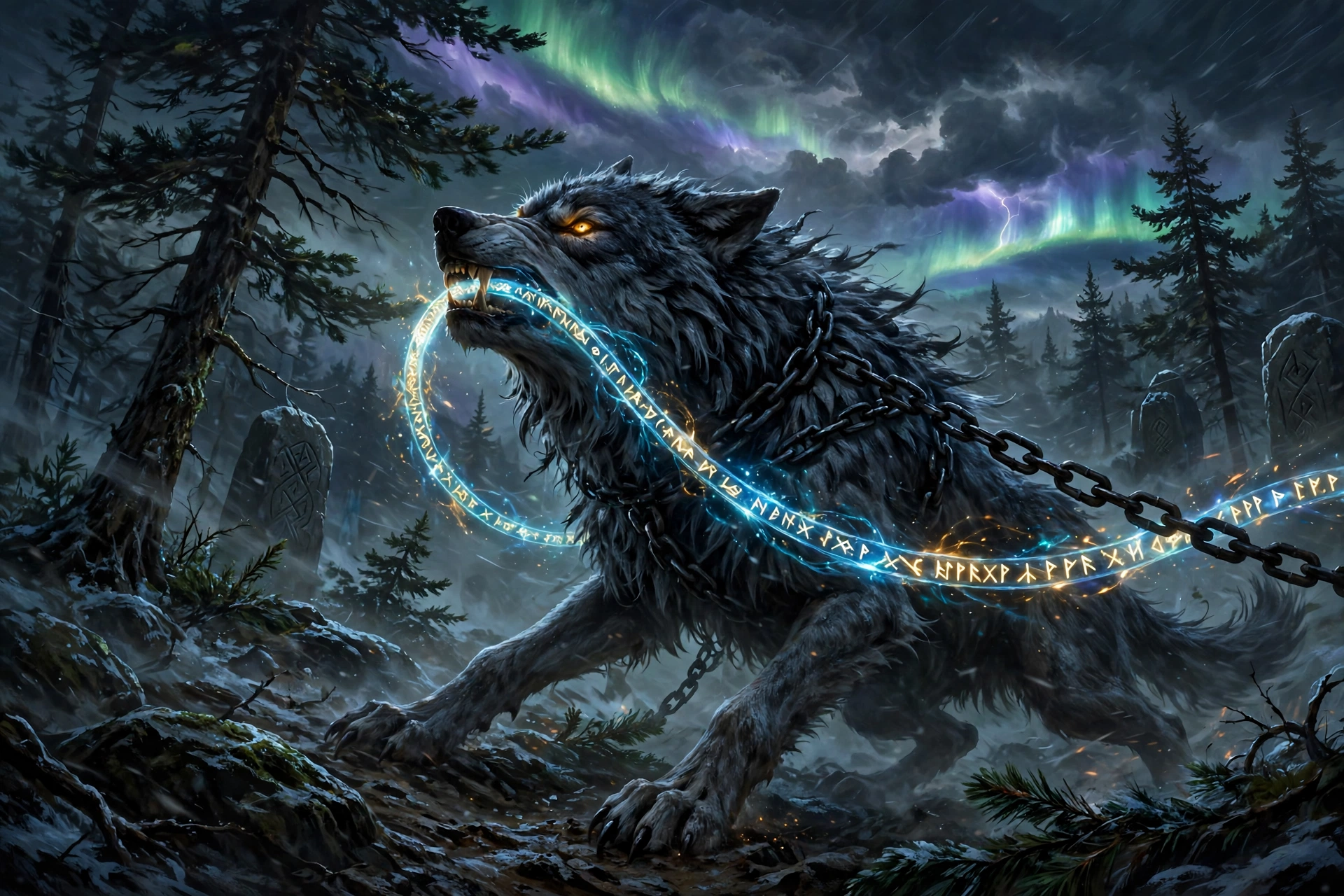
| Fenrir | Old Norse | The fen-dweller wolf | The monstrous wolf whose fury the gods could only bind, never tame |
| Ares | Greek | The bane, the curse | The god of war in its bloodiest form – slaughter and rage |
| Cain | Hebrew | Possession, spear | The first murderer, whose jealous wrath opens the Bible story of anger |
| Tempest | English | The storm | A modern word name – wrath as weather |
Names That Literally Mean Anger, Wrath or Fury
Start with the words themselves. Several languages have turned their word for anger into a given name or a mythic person – Sanskrit gave wrath a god of its own, Old Persian gave it a demon, and Greek gave Latin the little word ira that still smoulders inside irate.
| Name | Origin | Meaning | Note |
|---|---|---|---|
| Gekido | Japanese | Rage, fury | The Japanese word for violent rage – gekido, fury at full pitch |
| Krodha | Sanskrit | Anger, wrath | Wrath personified in Hindu myth, a son of Brahma who fathers more anger |
| Kopa | Sanskrit | Anger, wrath | The Sanskrit word for wrath, kopa – the anger that clouds judgement |
| Amarsha | Sanskrit | Impatience, wrath | The Sanskrit word for burning impatience and indignation |
| Manyu | Sanskrit | Wrath | The Rigvedic god of wrath and battle-fury, invoked like a weapon |
| Ira | Latin | Wrath | The Latin word for wrath itself – short, elegant and dangerous |
| Aeshma | Old Persian | Wrath | The Zoroastrian demon of wrath – the original from which Asmodeus descends |
| Funnu | Japanese | Wrath, indignation | The formal Japanese word for burning indignation, funnu |
| Kishin | Japanese | Fierce deity | The wrathful gods of Buddhism, who wear rage as armour to fight evil |
| Rage | English | Violent anger | A modern word name at maximum volume |
| Fury | English / Latin | Wild anger | From the Latin Furiae – a word name with the Furies inside it |
| Wrath | English | Anger, vengeance | Rare and uncompromising – the deadliest of the seven sins as a name |
Greek Furies, Spirits and Monsters of Wrath
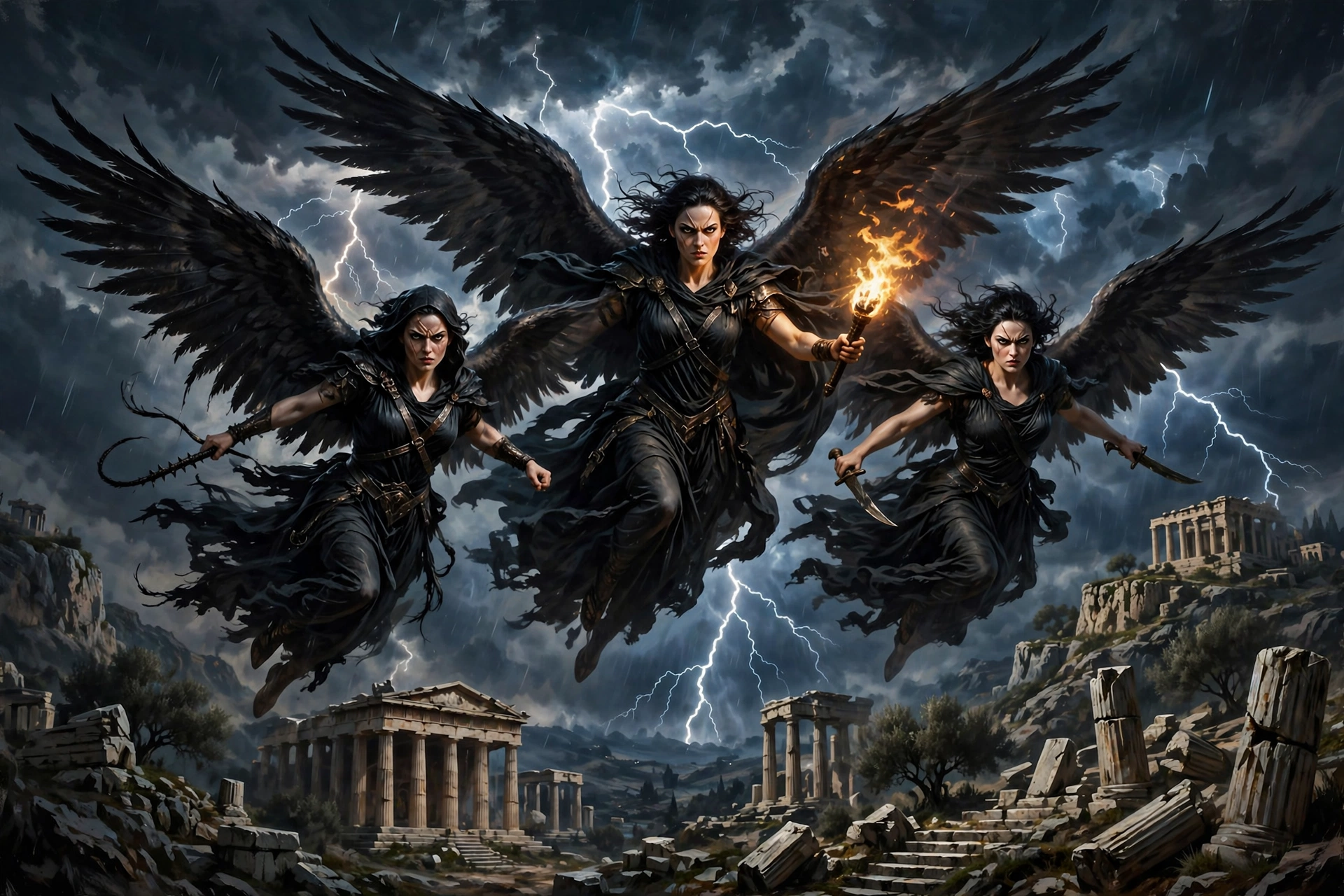
Greek imagination did not leave anger abstract – it gave wrath faces, wings and snake hair. The Furies hunted the guilty, personified spirits carried madness and ruin from house to house, and the monsters of the sea and sky were anger with teeth.
| Name | Origin | Meaning | Note |
|---|---|---|---|
| Megaera | Greek | The jealous one | Second of the Furies – grudging, jealous rage |
| Tisiphone | Greek | Avenger of murder | Third of the Furies – the voice of vengeance for blood |
| Erinys | Greek | The Fury | A single Fury named as one being – the curse that hunts |
| Mania | Greek | Madness | The spirit of madness and frenzy who unhinges minds |
| Ate | Greek | Ruin, delusion | The spirit of blind folly who leads men to their destruction |
| Ker | Greek | Doom | The death-spirit who haunts battlefields, thirsty for blood |
| Achlys | Greek | Mist of death | The gloom of misery and sorrow at the edge of the underworld |
| Lamia | Greek | The devourer | The child-eating spirit mothers invoked to frighten – rage turned monstrous |
| Empusa | Greek | The shape-shifter | Hecate shape-changing spirit of terror |
| Mormo | Greek | The terror | A bogey spirit of Corinth, the frightener of children |
| Aello | Greek | Storm-swift | A Harpy – the snatching wind of punishment |
| Ocypete | Greek | Swift-flying | A Harpy, sister to Aello, swift as a storm gust |
| Celaeno | Greek | The dark one | A Harpy of the Strophades, dark as a thunderhead |
| Scylla | Greek | The tearer | The six-headed sea monster who snatched sailors from passing ships |
| Charybdis | Greek | The whirlpool | The roaring maelstrom opposite Scylla – the sea wrath incarnate |
| Eris | Greek | Strife | The goddess whose golden apple of discord started the Trojan War |
| Deimos | Greek | Terror, dread | The son of Ares who rides with war, panic twin brother |
| Phobos | Greek | Fear, panic | The other twin – battlefield panic personified |
| Enyo | Greek | The waster of cities | The war goddess who revels in destruction beside Ares |
Greek Gods and Heroes of Wrath
The Olympians were magnificent and thin-skinned: a slighted god could empty a city, and the Iliad – the West first epic – is quite literally a poem about one hero anger, sung from its first word: rage.
| Name | Origin | Meaning | Note |
|---|---|---|---|
| Zeus | Greek | The sky father | King of gods, whose thunderbolt is wrath made visible |
| Apollo | Greek | The far-shooter | Whose plague arrows opened the Iliad, fired in anger at a dishonoured priest |
| Artemis | Greek | The huntress | Whose wrath fell on Actaeon, Niobe and every hunter who boasted |
| Athena | Greek | The city goddess | Cold fury behind the eyes – she petrified Medusa and ruined boastful weavers |
| Dionysus | Greek | The twice-born | The god whose gift is madness, and whose denied worshippers tear kings apart |
| Hephaestus | Greek | The forge god | Whose golden net trapped his unfaithful wife and her lover for the gods to mock |
| Achilles | Greek | Champion of the host | The hero whose all-consuming wrath at Agamemnon is the subject of the Iliad |
| Herakles | Greek | Glory of Hera | Whose fits of god-sent madness were as famous as his labours |
| Ajax | Greek | The great shield | Driven mad by wounded honour, he turned his sword on himself |
| Diomedes | Greek | Cunning of Zeus | Who raged so fiercely in one day of battle that he wounded two gods |
| Agamemnon | Greek | The very steadfast | The king whose insulting pride lit the fuse of Achilles wrath |
| Lycurgus | Greek | Wolf-worker | The Thracian king driven mad for attacking the god of wine |
| Athamas | Greek | Name of a maddened king | The king whom god-sent frenzy drove to hunt his own son |
Roman Wrath and Punishment
Rome took Greek anger and gave it uniforms and law courts: war gods with temples on the Campus Martius, and cold personifications – Punishment, Vengeance – that read like charges on an indictment.
| Name | Origin | Meaning | Note |
|---|---|---|---|
| Mars | Roman | The war god | Father of Romulus, god of war in its savage spring campaigns |
| Bellona | Roman | The war goddess | Mars consort, whose priests gashed their own arms in frenzy |
| Nerio | Roman | Valour | The Sabine war goddess, Mars earliest consort – strength in battle |
| Discordia | Roman | Discord | The Roman Eris, sower of strife |
| Furius | Roman | The furious one | A great Roman family name that literally proclaims fury |
| Poena | Roman / Greek | Punishment | The spirit of punishment and penalty who attends the Furies |
| Ultio | Roman | Vengeance | Vengeance personified, with an altar in the Forum of Augustus |
| Turnus | Roman / Latin | Name of a furious king | The Rutulian king whose rage drives the second half of the Aeneid |
Norse Rage: Wolves, Berserkers and the End of the World
Norse anger is eschatological – it builds until the world breaks. At its centre are the berserkers, warriors who fought in a trance of fury, and the chained wolf whose rage grows stronger every year until Ragnarok.
| Name | Origin | Meaning | Note |
|---|---|---|---|
| Modi | Old Norse | The wrathful, the brave | Modi, courage and wrath in one word – the son of Thor who survives Ragnarok |
| Jormungandr | Old Norse | The huge monster | The world serpent whose thrashing will flood the earth at the end |
| Angrboda | Old Norse | Bringer of grief | The giantess mother of monsters, whose children end the world |
| Skoll | Old Norse | The mocker, the treachery | The wolf who chases the sun, hate in pursuit of light |
| Hati | Old Norse | Hatred, the enemy | The wolf who chases the moon – his name simply means hatred |
| Garm | Old Norse | The howler | The bloody hound of Hel who breaks free at Ragnarok, barking wrath |
| Nidhogg | Old Norse | Malice striker | The dragon who gnaws the world-tree root and curses the dead |
| Surtr | Old Norse | The black one | The fire giant whose sword will set the whole world burning |
| Thrym | Old Norse | Uproar, noise | The frost giant king whose theft of the hammer starts a wedding-day massacre |
| Loki | Old Norse | The knot, the tangler | The trickster whose monstrous children and final betrayal unleash the end |
| Egill | Old Norse | Awe, edge of a sword | Egill Skallagrimsson, the berserker-poet whose rages were as famous as his verses |
| Kveldulf | Old Norse | Evening wolf | The berserker grandfather of Egill, a shape-shifting night wolf of rage |
| Starkad | Old Norse | The strong one | The legendary berserker hero, blessed and cursed by gods in turn |
| Hildr | Old Norse | Battle | A valkyrie whose name is simply battle – she revives the slain to fight forever |
| Gondul | Old Norse | Wand-wielder | A valkyrie who stirs kings to war with her spear |
| Sigrun | Old Norse | Victory rune | A valkyrie who defied fate for love of a hero |
| Thrud | Old Norse | Strength | Thor daughter, a valkyrie name of pure power |
| Grim | Old Norse / English | Fierce, severe | Masked and fierce – one of the wandering god bynames, and a name of stern temper |
| Grendel | Old English | The grinder (debated) | The raging monster who emptied Heorot hall for twelve winters |
Celtic War Goddesses and Battle Frenzy
The Celts deified battle-rage as a goddess – in fact as three of them, crow-winged and shrieking. Behind the goddesses stand the great frenzied champions and the queens who launched wars over pride, cattle and insult.
| Name | Origin | Meaning | Note |
|---|---|---|---|
| Badb | Irish | Battle crow, fury | The crow goddess whose shriek routs armies – her name carries rage itself |
| Macha | Irish | Name of a war goddess | The war goddess who cursed Ulster heroes with weakness for nine generations |
| Nemain | Irish | Frenzy, havoc | The war goddess whose very name means battle-frenzy and panic |
| Fea | Irish | The hateful | A war goddess of the Tuatha De Danann, named the hateful one |
| Anann | Irish | Name of a war goddess | A mother goddess of Munster, counted among the war goddesses |
| Cathubodua | Gaulish | Battle raven | The Gaulish war goddess, the Badb of ancient France |
| Agrona | Brittonic | Slaughter, battle | The ancient British goddess of strife and slaughter |
| Aeron | Welsh | Battle | A Welsh name drawn from the battle goddess Agrona – now used for boys and girls |
| Andraste | British | The invincible one | The war goddess to whom Boudica prayed before burning Roman cities |
| Boudica | British | Victory | The queen whose wrath at Rome burned three cities to the ground |
| Cailleach | Scottish / Irish | The veiled hag | The winter storm goddess who remakes the land with her hammer |
| Medb | Irish | The intoxicating one | Queen Medb, whose pride launched the great Cattle Raid of Cooley |
| Scathach | Irish | The shadowy one | The warrior woman of Skye who trained the greatest heroes – for a price |
| Aife | Irish | The radiant warrior | Scathach great rival, a warrior queen in her own right |
Hindu Wrath: Goddesses of Rage, Furious Forms and Angry Sages
Hindu tradition refuses to call wrath simply bad. The gods combined anger literally creates the goddess who saves the world; the fierce forms of Shiva burn away evil; and the short-tempered sages of the epics hand out curses the way other men hand out blessings.
| Name | Origin | Meaning | Note |
|---|---|---|---|
| Durga | Sanskrit | The invincible one | Born from the combined wrath of all the gods, blazing, to kill what none of them could |
| Chamunda | Sanskrit | Slayer of Chanda and Munda | The emaciated, terrifying goddess of the battlefield charnel grounds |
| Bhadrakali | Sanskrit | The auspicious Kali | The mighty form of Kali invoked for protection and victory |
| Chinnamasta | Sanskrit | The self-decapitated one | The goddess who holds her own severed head – fury and sacrifice in one image |
| Dhumavati | Sanskrit | The smoky one | The widow goddess of wrath, misfortune and the void |
| Bagalamukhi | Sanskrit | The paralyser | The goddess who seizes enemies tongues and stops their malice mid-word |
| Bhairavi | Sanskrit | The fierce goddess | The terrifying consort-form, goddess of wrath and decay |
| Bhairava | Sanskrit | The frightful one | Shiva as the howling guardian-destroyer, lord of the cremation grounds |
| Virabhadra | Sanskrit | The distinguished hero | Born from a lock of Shiva wrath-torn hair to wreck the sacrifice of Daksha |
| Sharabha | Sanskrit | The beast form | Shiva lion-bird form, taken to subdue a raging avatar |
| Mahakala | Sanskrit | Great time, great death | Shiva as time itself, the devourer of all things |
| Durvasa | Sanskrit | Hard to dwell with | The sage whose temper and curses drive half the plots of the epics |
| Vishvamitra | Sanskrit | Friend of all | The king turned sage whose burning rivalry with Vasishtha forged him anew |
| Parashurama | Sanskrit | Rama with the axe | The avatar who took up an axe in vengeance for his father – twenty-one times over |
| Kapila | Sanskrit | The tawny one | The sage whose angry glance burned sixty thousand princes to ash |
| Agastya | Sanskrit | The mountain-mover | The sage who drank the ocean and humbled the Vindhya mountains |
| Jamadagni | Sanskrit | The consuming fire | The fire-sage whose murder lit his son axe-vengeance |
| Shani | Sanskrit | The slow-moving one | Saturn god whose dreaded gaze brings hardship and humbling |
| Yama | Sanskrit | The twin, the restrainer | God of death and inflexible justice |
| Shumbha | Sanskrit | Name of a demon king | The asura king slain by the goddess in her cosmic fury |
| Nishumbha | Sanskrit | Name of a demon general | Shumbha brother, whose death preceded the great battle |
| Raktabija | Sanskrit | Blood-seed | The demon whose every drop of blood became another demon – rage multiplying |
Wrathful Deities of Buddhism
Buddhism did something remarkable with anger: it armoured compassion in it. The wrathful deities – bulging-eyed, flame-haired, trampling demons – are protectors whose fury is aimed entirely at ignorance and evil.
| Name | Origin | Meaning | Note |
|---|---|---|---|
| Yamantaka | Sanskrit / Tibetan | Conqueror of death | The buffalo-headed wrathful deity who defeats the lord of death himself |
| Hayagriva | Sanskrit | The horse-necked one | The wrathful horse god whose neigh shatters delusion |
| Acala | Sanskrit | The immovable one | The sword-and-lasso guardian whose glare never wavers |
| Vajrapani | Sanskrit | Holder of the thunderbolt | The wrathful bodhisattva of power, guardian of all the Buddhas secrets |
| Palden Lhamo | Tibetan | The glorious goddess | The fierce protectress of Tibet, riding a mule across a sea of blood |
| Fudo | Japanese | The immovable one | Fudo Myoo, Acala in Japan – the scowling guardian of temples and waterfalls |
Japanese Rage: Storm Gods, Oni and Vengeful Ghosts
Japan gives wrath two faces: the storm god in heaven whose tantrums flatten rice fields, and the onryo below – the vengeful ghost, wronged in life, whose grudge outlives death and bends the world until it is answered.
| Name | Origin | Meaning | Note |
|---|---|---|---|
| Shura | Japanese | Battle fury | From the Asura realm – beings who live for battle and rage |
| Asura | Sanskrit / Japanese | The anti-god | The wrathful demigods of Hindu and Buddhist myth, forever at war with heaven |
| Fujin | Japanese | Wind god | The snarling green demon who carries the bag of winds |
| Raijin | Japanese | Thunder god | The drum-beating thunder demon, Fujin eternal rival |
| Enma | Japanese | King of hell | Enma-o, the scowling judge of the dead, Yama in Japan |
| Shuten | Japanese | The sake-drinking demon | Shuten Doji, the ogre king of Mount Oe, terror of Kyoto |
| Ibaraki | Japanese | Name of an ogre | Ibaraki Doji, the demon of Rashomon gate whose arm was cut off |
| Kamaitachi | Japanese | Sickle weasel | The whirlwind yokai that slashes travellers with sickle claws |
| Masakado | Japanese | Name of a vengeful spirit | Taira no Masakado, the rebel whose severed head refused to rest |
| Michizane | Japanese | Name of a wrathful ghost | Sugawara no Michizane, the exiled scholar whose ghost struck the palace with lightning |
| Sutoku | Japanese | Name of an emperor | Emperor Sutoku, counted among Japan great vengeful spirits |
| Oiwa | Japanese | Name of a famous ghost | The betrayed wife of Yotsuya, Japan most famous onryo |
| Okiku | Japanese | Name of a well ghost | The servant girl who counts plates from the well she was thrown into |
Chinese Gods and Monsters of Fury
Chinese myth stores its wrath in the deep past: a water god who cracked the sky in a rage, a headless god who refused to stop fighting, and the Four Perils – beasts whose names became the language byword for chaos.
| Name | Origin | Meaning | Note |
|---|---|---|---|
| Nezha | Chinese | The fiery third prince | The rebellious child god who fought the Dragon King of the seas |
| Erlang | Chinese | The second son god | Erlang Shen, the three-eyed warrior god who subdues demons |
| Leigong | Chinese | Lord of thunder | The thunder god who punishes hidden crimes with his chisel |
| Dianmu | Chinese | Mother of lightning | The goddess whose mirrors flash the lightning for Leigong aim |
| Fengbo | Chinese | Earl of wind | The storm earl who rides a tiger through typhoons |
| Xiangliu | Chinese | The nine-headed serpent | The flood minister whose blood poisoned the earth itself |
| Gonggong | Chinese | The flood god | Whose rage at losing heaven throne made him butt a mountain and tilt the sky |
| Chiyou | Chinese | The war god | The horned inventor of weapons who battled the Yellow Emperor in the fog |
| Xingtian | Chinese | The punished heaven | The headless god who fights on, eyes in his chest, wrath undying |
| Taotie | Chinese | The gluttonous beast | The bronze-masked monster of appetite without end |
| Qiongqi | Chinese | The chaos tiger | The winged tiger of the Four Perils, who rewards the wicked |
| Hundun | Chinese | Chaos | Primordial chaos itself, the faceless emperor of the centre |
| Zhong Kui | Chinese | The demon queller | The scowling, bearded ghost-king who hunts evil spirits |
Biblical Wrath: Kings, Rebels and Avenging Hands
The Bible is frank about anger: it fills palaces and battlefields, moves prophets to poetry about the day of wrath, and gives us some of literature most unforgettable furious men and women.
| Name | Origin | Meaning | Note |
|---|---|---|---|
| Haman | Persian / Hebrew | Name of a proud minister | The vizier whose wounded pride plotted a genocide – and built his own gallows |
| Esau | Hebrew | Hairy | The brother whose rage at a stolen blessing echoed for generations |
| Korah | Hebrew | Bald, ice | The rebel swallowed by the earth for defying Moses |
| Absalom | Hebrew | Father of peace | David son, whose vengeance for his sister grew into rebellion |
| Saul | Hebrew | The asked-for one | The first king of Israel, eaten alive by jealous wrath |
| Ahab | Hebrew | Father brother | The king who sulked for a vineyard and unleashed Jezebel |
| Jezebel | Hebrew / Phoenician | Name of a fierce queen | The queen whose threats sent Elijah running to the desert |
| Herod | Greek | Heroic ruler | The king whose rage at the Magi fell on Bethlehem |
| Simeon | Hebrew | He has heard | The brother whose wrath with Levi at Shechem was cursed by their dying father |
| Levi | Hebrew | Joined, attached | Simeon partner in the Shechem vengeance – ancestor of priests |
| Phinehas | Hebrew | Name of a zealous priest | Whose spear-thrust zeal stopped a plague and won a covenant |
| Jael | Hebrew | Mountain goat | Who drove a tent peg through the sleeping enemy general head |
| Joab | Hebrew | God is father | David ruthless commander, who avenged his brother against orders |
| Nebuchadnezzar | Babylonian | Nebo, protect the crown | The emperor of the fiery furnace, humbled to eat grass |
| Shimei | Hebrew | Name of a cursing man | Who pelted the fleeing King David with stones and curses |
| Zephaniah | Hebrew | God has treasured | The prophet of the great day of wrath – dies irae |
| Nahum | Hebrew | Comfort, consolation | The prophet who sang vengeance over Nineveh fall |
Wrath of God: Angels, Demons and Divine Punishment
Where human anger ends, the theology of wrath begins. Demonologists assigned each deadly sin a prince, and wrath went to a Persian fire-demon reborn in Hebrew legend – while scripture own pages gave us destroyer angels and the chained adversary.
| Name | Origin | Meaning | Note |
|---|---|---|---|
| Asmodeus | Hebrew / Persian | The wrath demon | The demon of wrath in Binsfeld classification, from Aeshma, the Persian wrath-daeva |
| Azazel | Hebrew | The scapegoat demon | The desert demon who receives the sins of the people – and in Enoch, a fallen watcher |
| Belial | Hebrew | Worthlessness | The demon of lies and lawlessness in the Dead Sea Scrolls war |
| Abaddon | Hebrew | Destruction | The angel of the abyss in Revelation, king of the locust plague |
| Apollyon | Greek | The destroyer | The Greek name of Abaddon – the destroyer angel |
| Samael | Hebrew | Venom of God | The accusing angel of death in Jewish lore, fierce and feared |
| Mastema | Hebrew / Ethiopian | Hostility | The angel of hostility in the Book of Jubilees, who tests and punishes |
| Moloch | Canaanite | The king (god) | The god to whom children were burned – wrath worshipped as horror |
| Lilith | Akkadian / Hebrew | Night spirit | The storm-demoness of the night, in folklore the mother of demons |
Mesopotamian and Persian Wrath
The oldest written anger in the world is Mesopotamian: a god of plague who nearly talked the universe into ending, a goddess who threatened to raise the dead, and a sea-dragon whose vengeance made the cosmos.
| Name | Origin | Meaning | Note |
|---|---|---|---|
| Nergal | Akkadian | Lord of the great city | God of plague, war and the scorched noonday sun |
| Erra | Akkadian | The scorcher | The plague god whose epic rage nearly destroys Babylon and the world order |
| Ereshkigal | Sumerian | Queen of the great below | The dread queen of the dead, who stripped Ishtar at seven gates |
| Ishtar | Akkadian | The goddess of love and war | Who threatened to smash the underworld gates and raise the dead |
| Tiamat | Akkadian | The sea | The salt-water dragon whose vengeance-war against the young gods made the world from her body |
| Lamashtu | Akkadian | The child-snatching demoness | The lion-headed demoness mothers warded off with amulets |
| Pazuzu | Assyrian | King of the wind demons | The fever-and-storm demon, invoked even against worse evils |
| Enlil | Sumerian | Lord wind | The storm god whose sleepless rage at human noise sent the great flood |
| Ahriman | Persian | The destructive spirit | Angra Mainyu, the adversary of all good in Zoroastrian faith |
| Zahhak | Persian | The serpent king | The tyrant with serpents growing from his shoulders, fed on brains |
| Afrasiab | Persian / Turkic | The dread king | Turan great king, the Shahnameh eternal enemy of Iran |
Egyptian Wrath: The Eye of Ra
Egyptian wrath had a colour – red – and a goddess. When humanity plotted against the sun god, he sent his Eye against them as a lioness, and only a flood of red-dyed beer, mistaken for blood, could stop the slaughter.
| Name | Origin | Meaning | Note |
|---|---|---|---|
| Set | Egyptian | The pillar of strength (debated) | The red god of storms, deserts and chaos who murdered his brother Osiris |
| Apep | Egyptian | The serpent of chaos | Apophis, the great serpent who attacks the sun boat every night |
| Ammit | Egyptian | Devourer of the dead | The crocodile-lion devourer who eats the hearts of the guilty |
| Maahes | Egyptian | He who is true beside her | The lion-headed war god, executioner of the sun god enemies |
| Pakhet | Egyptian | She who scratches | The lioness huntress goddess of the desert wadis |
| Menhit | Egyptian | She who massacres | The lioness war goddess who goes before the king in battle |
Slavic, Baltic and Finnish Spirits of Wrath
Northern and eastern Europe kept older, colder angers: a black god, a winter goddess who must be drowned each spring, a witch in a chicken-legged hut, and the plague-daughters of the Finnish land of the dead.
| Name | Origin | Meaning | Note |
|---|---|---|---|
| Chernobog | Slavic | The black god | The black god of misfortune and darkness in Slavic lore |
| Morana | Slavic | Death, nightmare | Marzanna, the winter death goddess ritually drowned each spring |
| Baba Yaga | Slavic | The grandmother witch | The fierce witch of the deep forest, in the hut on chicken legs |
| Koschei | Slavic | The deathless one | The skeletal villain who hides his death in a needle, an egg, a duck, a hare |
| Rusalka | Slavic | The water spirit | The drowned maiden whose song lures men into the river |
| Lempo | Finnish | The evil one | The Finnish god of evil and malice in the Kalevala world |
| Loviatar | Finnish | Mother of plagues | The blind daughter of Death who mothered the nine diseases |
| Tuoni | Finnish | Death | The god of Tuonela, the Finnish land of the dead |
| Velnias | Lithuanian | The devil-trickster | The Baltic devil of storms, souls and trickery |
| Giltine | Lithuanian | The death goddess | The skeleton goddess of death and plague, with her poisonous tongue |
| Bangputys | Lithuanian | The wave-blower | The stormy sea god who stirs the waves in anger |
Wrath Gods of Africa, the Americas and the Pacific
Thunder is the world commonest language of divine anger. The Yoruba thunder king hurls his axe-stones, the Aztec rain god weeps storms, and in the Pacific the volcano goddess argues with the sea – with lava.
| Name | Origin | Meaning | Note |
|---|---|---|---|
| Shango | Yoruba | The thunder king | The deified king whose thunder-axe strikes the proud – emblem of sacred rage |
| Ogun | Yoruba | God of iron and war | The iron god whose rage clears the road – and turns on his own in legend |
| Oya | Yoruba | The storm goddess | The whirlwind orisha of storms and transformation, Shango fierce wife |
| Mami Wata | West African | Mother water | The beautiful, dangerous water spirit of wealth and vengeance |
| Huitzilopochtli | Aztec / Nahuatl | Hummingbird of the south | The Mexica war and sun god who demanded hearts to keep the sun moving |
| Tezcatlipoca | Aztec / Nahuatl | Smoking mirror | The strife-and-tempest god, patron of sorcery and discord |
| Tlaloc | Aztec / Nahuatl | The earth lord | The rain god whose storms and lightning were placated with tears |
| Itzpapalotl | Aztec / Nahuatl | Obsidian butterfly | The skeletal warrior goddess of the paradise of the fallen |
| Mictlantecuhtli | Aztec / Nahuatl | Lord of the dead | The grinning skeleton king of the Aztec underworld |
| Huracan | Maya | The one-legged storm | The storm god whose name gave the world the word hurricane |
| Buluc Chabtan | Maya | God of war and sacrifice | The blackened war god of sudden death |
| Ah Puch | Maya | The death god | The rotting god of death in Maya lore |
| Supay | Quechua / Inca | The death god | Lord of the Inca underworld, feared and appeased |
| Illapa | Quechua / Inca | Thunder and weather | The Inca thunder god who draws storm water from the Milky Way |
| Ku | Hawaiian | The upright one | Kuka ilimoku, the snatcher of islands – the Hawaiian war god |
| Namaka | Hawaiian | The sea goddess | The sea goddess whose battles with her sister Pele shaped the islands |
| Tu | Maori | Of furious visage | Tumatauenga, god of war and mankind, the angry-faced one |
| Whiro | Maori | The evil one | God of darkness and evil, lord of the underworld |
| Tawhirimatea | Maori | The storm god | Who attacked his own brothers in rage and still fights them as wind and weather |
Jealous Rage and Envy
Envy is wrath turned inward and green. The Greeks gave it its own spirit, the Romans its own goddess, and demonology its own prince of hell – and behind them stands the queen of heaven whose jealous rages drive half of Greek myth.
| Name | Origin | Meaning | Note |
|---|---|---|---|
| Phthonus | Greek | Envy, jealousy | The Greek personification of envy and jealous ill-will |
| Invidia | Roman | Envy | Envy personified, with snakes for hair and a gaze that withers |
| Zelus | Greek | Zeal, jealous rivalry | The personification of burning zeal and rivalry, brother of Victory |
| Hera | Greek | Queen of heaven | Whose jealous wrath pursued her husband lovers and their children across all myth |
| Leviathan | Hebrew | The coiling serpent | The sea monster assigned to envy in demonology lists of the seven princes |
| Aglauros | Greek | The dew-bright princess | The Athenian princess whose envy opened forbidden casket – and turned to stone |
Vengeance and Retribution: Names of the Long Memory
Wrath that waits becomes vengeance, and world literature is its archive. These names belong to the avengers: mothers, brothers, reborn princesses and wronged wives whose revenge reshaped epics – several of them still beautiful names, with a warning label attached.
| Name | Origin | Meaning | Note |
|---|---|---|---|
| Alastor | Greek | The avenger | The spirit of blood-feud vengeance who never lets a debt die |
| Vali | Old Norse | The avenger child | Born and grown in a single day for one purpose: to avenge Baldr |
| Signy | Old Norse | New victory | Who burned her own hall down to avenge her father and brothers |
| Gudrun | Old Norse | Battle rune | The heroine whose vengeance cycle closes the great Germanic sagas |
| Kriemhild | German | Battle mask | Whose revenge for her murdered husband destroyed a kingdom in the Nibelungenlied |
| Medea | Greek | The cunning one | The sorceress whose vengeance on Jason became the byword for a wronged woman fury |
| Clytemnestra | Greek | The famed plotter | Who waited ten years with an axe for the husband who sacrificed her daughter |
| Atreus | Greek | The fearless one | Who served his brother the brother own children at a feast – vengeance as horror |
| Procne | Greek | Name of a vengeful mother | Who avenged her sister in the most terrible way Greek myth knows |
| Philomela | Greek | Lover of song | Turned nightingale after the vengeance of Procne – her song is the complaint itself |
| Orestes | Greek | Of the mountain | Hunted by the Furies for avenging his father on his mother |
| Electra | Greek | The shining one | Who kept her father memory burning until vengeance came home |
| Hamlet | Danish / Norse | Village, home (from Amleth) | The prince whose name means a revenge delayed until it destroys everything |
| Amleth | Old Norse | Name of a legendary avenger | The Danish prince behind Hamlet, who feigned madness for years |
| Judith | Hebrew | The Jewish woman | Who saved her city by beheading the besieging general in his own tent |
| Draupadi | Sanskrit | Daughter of Drupada | Whose humiliation in the dice hall lit the fuse of the Kurukshetra war |
| Amba | Sanskrit | Mother | The princess who renounced heaven itself to be reborn as her wronger destroyer |
| Shikhandi | Sanskrit | Peacock-crested | Amba reborn – the warrior fated to bring down the grandsire Bhishma |
| Ashvatthama | Sanskrit | The horse-voiced | Who avenged his father with a forbidden night raid and was cursed with immortality |
| Ravana | Sanskrit | The roarer | The demon king whose abduction of Sita began the Ramayana war |
| Shurpanakha | Sanskrit | Sharp nails | The demoness whose insult and maiming sparked the road to Lanka war |
| Hannibal | Phoenician | Grace of Baal | Who swore at nine years old to be Rome enemy forever – and nearly ended it |
| Kaveh | Persian | The blacksmith | Whose leather apron became the banner of revolt against the serpent tyrant |
| Jebat | Malay | Name of a rebel avenger | Hang Jebat, who rose to avenge his wronged friend against the sultan |
| Goujian | Chinese | Name of a king | The king of Yue who slept on brushwood and tasted gall daily to keep his vengeance alive |
Fire and Burning Anger Names
Anger is the emotion we describe as heat – burning, blazing, seeing red. Fire names therefore double as wrath names across dozens of languages: gods of the forge and flame, serpents of the fire river, and everyday names in Serbia, Turkey and Finland that simply mean flame and ember.
| Name | Origin | Meaning | Note |
|---|---|---|---|
| Agni | Sanskrit | Fire | The god of fire himself, mouth of the gods and witness of oaths |
| Anala | Sanskrit | Fire | A name of the fire god – fire in its hungry form |
| Pavak | Sanskrit | Fire, the pure one | Fire as purifier – a name used across India |
| Tejas | Sanskrit | Sharpness, brilliance | The cutting edge of flame – brilliance with a bite |
| Jwala | Sanskrit | Flame | The flame itself, jwala – a name of fire rising |
| Uri | Hebrew | My flame, my light | Uri, my fire – a short biblical name |
| Lapid | Hebrew | Torch | The torch – borne in the Bible by the husband of Deborah |
| Shihab | Arabic | Flame, shooting star | A flame or meteor streaking the night – a classic Arabic name |
| Alev | Turkish | Flame | The Turkish word for flame, a beloved name |
| Ognjen | Serbian | Fiery | From oganj, fire – the fiery one of the Balkans |
| Zarko | Serbian | Burning, ardent | From zar, ember and heat – a name that glows |
| Plamen | Bulgarian | Flame | Flame itself as a name in Bulgaria |
| Tanwen | Welsh | White fire | tan, fire, plus gwyn, white – holy white fire |
| Nina | Quechua | Fire | The Quechua word for fire – also an ancient fire goddess name in Mesopotamia |
| Atar | Persian / Zoroastrian | Fire | The sacred fire itself, son of Ahura Mazda in Zoroastrian faith |
| Azar | Persian | Fire | Fire as a name – also the ninth month, when fire festivals fall |
| Hrach | Armenian | Fiery eyes | Fire in the eyes – an Armenian name of blazing spirit |
| Homura | Japanese | Flame, blaze | The Japanese word for a raging blaze, used as a name |
| Yandi | Chinese | The Flame Emperor | The legendary Flame Emperor, culture hero of fire and farming |
| Aithon | Greek | Burning, blazing | Blazing – the name of war god horses and of Odysseus false identity |
| Phlegethon | Greek | The flaming river | The river of fire that circles the Greek underworld |
| Styx | Greek | Hatred, the hateful | The underworld river named for hatred itself – gods swear their binding oaths on it |
| Pyrrhus | Greek | Flame-coloured, red | The red-haired son of Achilles, feared for his cruelty at Troy fall |
| Seraphim | Hebrew | The burning ones | The highest angels, burning with fire and love – Seraph as a rare name form |
| Ignatius | Latin | Fiery | From ignis, fire – the fiery saint of Loyola |
| Ignacio | Spanish | Fiery | The Spanish form of Ignatius |
| Fintan | Irish | White fire | The ancient seer who survived the flood in salmon shape |
| Aidan | Irish | Little fire | From Aodh, fire – little fire, and a beloved saint name |
| Aodh | Irish | Fire | The old Irish fire name behind Aidan and Keegan |
| Egan | Irish | Little fiery one | From Aodhagan, descendant of the little fire |
| Keegan | Irish | Little fiery one | Son of the fiery one – a surname name full of spark |
| Tyson | French / English | Firebrand | From tison, a firebrand – and a goad, one who stirs things up |
| Brand | Germanic | Firebrand, sword blade | Both a burning torch and a sword – fire you can hold |
| Brando | Italian | Firebrand, sword | The Italian form of Brand, famous from the screen |
| Ember | English | Glowing coal | A modern word name – the fire that survives the night |
| Blaze | English / Latin | Flame | From Blaise, refashioned by folk ear into pure flame |
| Flint | English | The sparking stone | The stone that strikes fire – hard, sharp, unyielding |
Storm Wrath Names
Weather is the other great metaphor for anger – we speak of stormy moods, thunderous looks and tempers like hurricanes. These names come from storm gods, violent winds and the words for tempest in a dozen languages.
| Name | Origin | Meaning | Note |
|---|---|---|---|
| Poseidon | Greek | Lord of the sea | The earth-shaker, whose decade-long wrath at one sailor became the Odyssey |
| Typhon | Greek | The whirlwind | The storm monster, father of the destructive winds, who tore at Zeus himself |
| Boreas | Greek | The north wind | The violent, icy north wind who snatches what he loves |
| Notus | Greek | The south wind | The wet, stormy south wind of late summer tempests |
| Eurus | Greek | The east wind | The unlucky east wind of storms |
| Astrape | Greek | Lightning | Lightning personified, attendant of Zeus |
| Bronte | Greek | Thunder | Thunder itself – the name the famous sisters carried into literature |
| Storm | English / Germanic | The tempest | A word name of pure weather fury |
| Gale | English | The fierce wind | A strong wind – and a name with a bite |
| Bora | Turkish / Slavic | Storm wind | The freezing katabatic storm wind of the Adriatic – a name in Turkey and Albania |
| Tayfun | Turkish | Typhoon | The typhoon in Turkish, used as a bold boy name |
| Vihor | Serbian / Croatian | Whirlwind | The whirlwind, spinning wrath as a name |
| Taranis | Gaulish / Celtic | The thunderer | The Celtic thunder god, Jupiter of the Gauls |
| Ran | Old Norse | Robbery, plunder | The sea goddess whose net drags sailors down to drown |
| Raiden | Japanese | Thunder and lightning | From the thunder god Raijin – thunder and lightning in one name |
| Arashi | Japanese | Storm | The storm – a dramatic Japanese word name |
Fierce Warriors and Mad Rulers: Rage in History
Finally, the historical ragers – conquerors whose names became synonyms for terror, champions whose berserk fury was their fame, and rulers remembered by a single adjective of dread. Handle these names as you would a loaded heirloom.
| Name | Origin | Meaning | Note |
|---|---|---|---|
| Attila | Gothic / Hunnic | Little father | The Scourge of God, whose empire ran on fear |
| Alaric | Gothic | Ruler of all | The Visigoth king who sacked Rome in 410 |
| Genghis | Mongolian | Universal, fierce | Chinggis Khan, whose wrath reorganised the map of the world |
| Timur | Turkic | Iron | Tamerlane, the iron conqueror whose pyramids of skulls marked his road |
| Spartacus | Thracian / Latin | Name of a rebel gladiator | Whose slave revolt shook Rome for two years |
| Arminius | Germanic | Name of a liberator | Who annihilated three legions in the Teutoburg Forest |
| Vercingetorix | Gaulish | King of warriors | The Gallic chieftain who united Gaul against Caesar |
| Shaka | Zulu | Name of a king | Shaka kaSenzangakhona, whose military revolution and rages reshaped southern Africa |
| Tydeus | Greek | Name of a furious hero | Whose dying act of rage horrified even Athena |
| Capaneus | Greek | Name of a boastful giant | Who scaled Thebes wall defying Zeus – and took the thunderbolt for it |
| Ivar | Old Norse | Bow warrior | Ivar the Boneless, the most feared Viking of the Great Heathen Army |
| Ivan | Russian / Hebrew | God is gracious | Ivan the Terrible, whose name carries both the faith and the fear |
| Vlad | Romanian / Slavic | The ruler | Vlad the Impaler, the original Dracula |
| Xerxes | Persian | Ruler of heroes | Who ordered the sea whipped with chains for destroying his bridge |
| Cambyses | Persian | Name of a mad king | The conqueror of Egypt remembered for madness and cruelty |
| Caligula | Latin | Little boot | The boyhood nickname of the emperor whose madness became proverbial |
How to Choose the Right Wrath Name
Decide which heat you want. Wrath names run on a dial. At the gentle end sit the fire and storm word names – warm, bold, but wearable anywhere. In the middle are the god and hero names, dramatic but anchored in beloved stories. At the far end are the demons, curses and mad rulers: magnificent, but a real conversation starter at every school gate.
Borrow from your own tradition. Nearly every culture in this list has wrath of its own – Greek furies, Norse wolves, Japanese storm gods, Hindu furious goddesses, West African thunder kings. A name from your family own mythology carries its anger with context and pride rather than shock value.
Read the story before you sign the certificate. Some of these figures are righteous – goddesses born from the gods combined anger to save the world, avengers of genuine wrongs. Others are warnings. The notes in each table tell you which is which; if you love the broader fierce spectrum, our lists of names that mean fierce and names that mean destroyer continue the tour.
Say it as a grown-up name. A wrath name will be heard in job interviews and wedding vows, not just storybooks. The strongest choices are the ones that sound dignified first and dangerous second – the thunder is there when you know, and merely handsome when you do not.
FAQs
What name means wrath itself?
Several names carry the meaning word for word. Ikari and Gekido are the Japanese words for anger and rage, Krodha is Sanskrit for wrath, Ira is the Latin word for wrath, and Aeshma is the Old Persian demon whose entire being is wrath. In English, Wrath, Rage and Fury exist as rare, bold word names.
What are the names of the three Furies?
The Greek Furies – the Erinyes – are Alecto, the unceasing one; Megaera, the jealous one; and Tisiphone, avenger of murder. Between them they cover wrath in its three classic forms: anger that will not rest, anger born of envy, and anger that answers blood with blood.
Is there a god of wrath in mythology?
Almost every pantheon has several. Odin is named from the Old Norse word for fury, the Hindu goddess Durga was created out of the combined wrath of the gods, Sekhmet is the Egyptian lioness of divine rage, Erra is the Mesopotamian plague god of world-ending anger, and Buddhism wrathful deities like Yamantaka wear fury as sacred armour.
What boy name means anger or rage?
For boys, the strongest literal choices are Ikari and Gekido from Japanese, Krodha from Sanskrit, and Modi, the Old Norse name that means the wrathful one and belongs to a son of Thor. Fire and storm names such as Ognjen, meaning fiery, Raiden, thunder and lightning, and Tyson, firebrand, give the same energy in a more wearable form.
What girl name means wrath or fury?
The great wrathful goddess names lead the list: Kali, Durga, Sekhmet, Nemain – whose name means battle-frenzy – and the Furies Alecto, Megaera and Tisiphone. Fire names like Alev, Jwala and Tanwen, meaning flame and white fire, carry the heat more gently.
Conclusion
Wrath has a bad press and a long pedigree. It built the Iliad, armed the goddesses who save the world in Hindu myth, gave the Norse their word for the chief of gods, and still waits inside a dozen ordinary names for fire, storm and thunder. Choose one of these names and you are not wishing anger on a child – you are giving them the old, honoured vocabulary of standing up, burning bright and refusing to be trifled with.