T-Bone Steak: What It Is, vs Porterhouse, Temps & Nutrition
A t bone steak combines two familiar cuts on one bone: strip loin on one side and a smaller piece of tenderloin on the other. Cut from the short loin, it has a distinctive T-shaped lumbar vertebra through the center. The larger side is the strip, while the smaller side is the same muscle sold as filet mignon.
The cut is often compared with a porterhouse because both contain strip loin and tenderloin. The USDA distinction comes down to the tenderloin’s width: a porterhouse measures at least 1.25 inches at its widest point, while a T-bone measures at least 0.5 inch but less than 1.25 inches. This guide covers the cut, the exact naming rule, cooking, nutrition, and buying tips.
What Is a t bone steak?
A T-bone is a bone-in steak cut crosswise from the beef short loin. A T-shaped lumbar vertebra runs through its center, separating two muscles:
The larger side is the strip loin, also sold boneless as a New York strip or strip steak.
The smaller side is the tenderloin, the muscle sold as filet mignon.
That combination gives one steak two distinct portions. The strip is larger; the tenderloin is smaller and leaner. If you are asking what is a t bone steak, that two-muscle layout and central bone are its defining features. The tenderloin width also determines whether the cut is called a T-bone, a porterhouse, or a bone-in strip steak.
T-bone steak vs porterhouse: what is the difference?
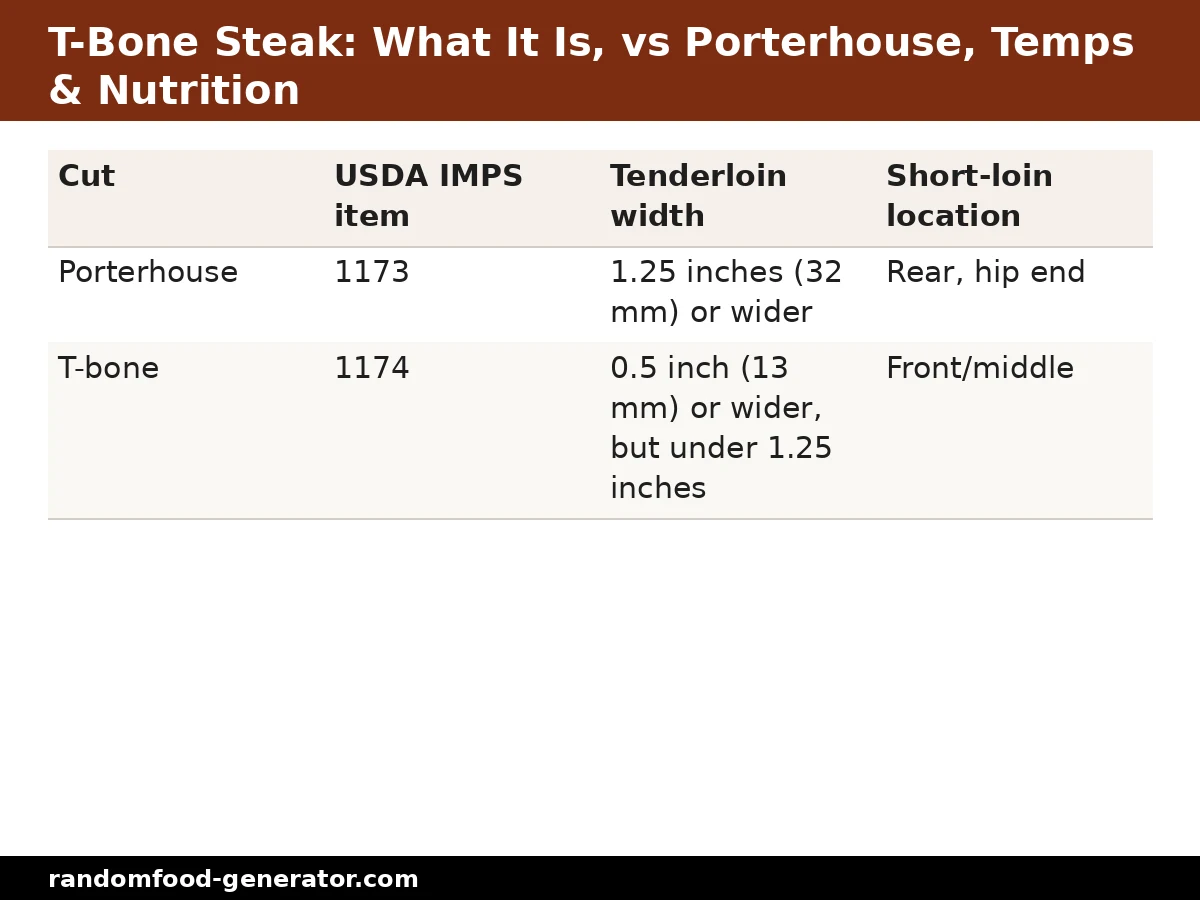
T-bone and porterhouse steaks come from the same cut family. Under the USDA Institutional Meat Purchase Specifications (IMPS), the deciding measurement is the tenderloin’s widest point, measured parallel to the backbone.
| Cut | USDA IMPS item | Tenderloin width | Short-loin location |
|---|---|---|---|
| Porterhouse | 1173 | 1.25 inches (32 mm) or wider | Rear, hip end |
| T-bone | 1174 | 0.5 inch (13 mm) or wider, but under 1.25 inches | Front/middle |
A porterhouse has the wider tenderloin section and comes from the rear, or hip end, of the short loin, where that muscle is widest. T-bones come from the front or middle, where the tenderloin is narrower. The t bone steak vs porterhouse distinction is therefore based on tenderloin width, not simply the steak’s overall size.
When comparing porterhouse vs t bone, check the tenderloin rather than judging by the steak’s overall size. At least 1.25 inches qualifies as porterhouse under IMPS item 1173. At least 0.5 inch but under 1.25 inches qualifies as T-bone under item 1174. A tenderloin under 0.5 inch falls into the bone-in strip steak category.
Where the T-bone steak cut comes from on the loin
The t bone steak cut comes from the short loin along the animal’s back. It is sliced crosswise through the section, leaving the lumbar vertebra in the middle and part of the strip loin and tenderloin on either side.
The tenderloin changes width along the short loin. It is narrower toward the front and middle and widest toward the rear near the hip. That is why steaks from different positions can have the same general shape but different names under the USDA width rule.
There is no single fixed number of T-bones from every short loin. The count depends on how the loin is portioned and the thickness of each steak. Thicker portions produce fewer steaks from a given length of loin.
How to cook t bone steak on the grill
For anyone wondering how to cook t bone steak, grilling works well, but the two muscles need slightly different heat management. The tenderloin is smaller and leaner, so it can overcook before the larger strip side. Use a grill setup that gives you a hotter area and a less intense area, allowing you to adjust the steak’s position as it cooks.
Prepare the steak and grill
Choose a steak with substantial, even thickness. Pat the surface dry before grilling and season according to preference. Set up the grill with more than one heat zone so you can move the steak away from the hottest area when needed.
Protect the tenderloin side
Keep the tenderloin side away from the hottest part of the grill. It is leaner and smaller, which means it can finish first. The larger strip side may need more time. The goal is to brown the outside while avoiding overcooking the smaller portion.
Check the temperature and rest
Use a food thermometer rather than relying on color or appearance. For the USDA safe minimum, beef steaks should reach 145°F (63°C), measured in the thickest part away from the bone, followed by a rest of at least 3 minutes.
T bone steak temperature: the USDA safe minimum
The key t bone steak temperature for food safety is 145°F (63°C), the USDA Food Safety and Inspection Service safe minimum for beef steaks, followed by a rest of at least 3 minutes. Insert the thermometer into the thickest part of the meat and keep it away from the bone. On a T-bone, make sure the probe measures the meat rather than touching the central bone.
Rare, medium-rare, medium, and well-done are doneness preferences. The USDA safe minimum remains 145°F plus the rest period; a preference below that temperature should not be described as meeting the USDA safe minimum.
How long does t bone steak grill time take?
There is no single grill-time figure for every T-bone. Cooking time depends on thickness, grill heat, and how the steak is positioned. The tenderloin side may finish before the larger strip side, so a fixed number of minutes cannot confirm doneness.
Use time only as a rough guide. Check the thickest part away from the bone with a food thermometer, and follow the USDA safe minimum of 145°F (63°C) plus at least 3 minutes of rest. Keep the tenderloin side away from the hottest grill area as it cooks.
T-bone steak nutrition: calories, protein and fat
T bone steak calories and nutrition vary with the entry, cooking method, and trim. These USDA FoodData Central figures are separate entries per 100 grams; do not blend the raw, cooked, and lean-only numbers.
| USDA FoodData Central entry | State and trim | Calories per 100 g | Protein per 100 g | Fat per 100 g |
|---|---|---|---|---|
| Beef, loin, T-bone steak — separable lean and fat, all grades | Cooked, broiled; 1/8-inch trim | 280 kcal | 24.3 g | 19.5 g |
| Beef, loin, T-bone steak — separable lean and fat, all grades | Raw; 1/8-inch trim | 223 kcal | 20.1 g | Not listed for this entry |
| Beef, loin, T-bone steak — separable lean only | Cooked, broiled; 1/4-inch trim | 202 kcal | 27.0 g | Not listed for this entry |
For t bone steak calories, the cooked, broiled entry with separable lean and fat has 280 kcal, 24.3 grams of protein, and 19.5 grams of fat per 100 grams. The raw entry has 223 kcal and 20.1 grams of protein. The cooked, broiled lean-only entry has 202 kcal and 27.0 grams of protein.
The lean-only entry has fewer calories and more protein per 100 grams than the cooked entry that includes separable fat. These figures are not per whole steak: the total depends on the steak’s weight and the amount of separable fat eaten. For t bone steak nutrition, use the entry that matches whether the portion is raw, cooked, or lean only.
T-bone steak price: what affects the cost?
There is no national retail price for T-bone steak, so a single price per pound should not be treated as universal. Retail prices vary by location and seller; check the current label where you shop.
USDA beef quality grades include Prime, Choice, and Select, in that order of marbling. T-bones are most commonly sold as Choice. Prime has the most marbling and the highest price. When comparing t bone steak price, consider the grade and thickness as well as the amount of meat on either side of the bone.
T-bone steak thickness and buying guide
For t bone steak thickness, look for a cut at least 1 inch thick; about 1.5 inches is the ideal guidance. A thicker cut gives the outside time to form a seared crust before the interior overcooks. This matters because the smaller tenderloin side can finish before the larger strip side. Porterhouses are commonly cut 1.5 to 2 inches thick.
Know the beef grades
Prime, Choice, and Select are the USDA quality grades to recognize. They are ordered by marbling, with Prime highest, followed by Choice and Select. T-bones are most commonly sold as Choice, while Prime has the most marbling and the highest price.
Check thickness and shape
Look for the larger strip portion and the smaller, rounder tenderloin portion on opposite sides of the T-shaped bone. If the tenderloin is at least 1.25 inches wide at its widest point, the cut meets the porterhouse rule. If it is under 0.5 inch, it is a bone-in strip steak rather than a T-bone.
Choose at least 1 inch of thickness, with about 1.5 inches as the ideal guidance.
Check the grade label: Prime, Choice, or Select.
Look at the tenderloin width as well as the steak’s overall size.
Bone in strip steak vs t bone: the under-0.5-inch rule
The phrase bone in strip steak vs t bone describes a difference in tenderloin width. If the tenderloin measures under 0.5 inch at its widest point, the cut is sold as a bone-in strip steak, also called a club steak, not a T-bone.
| Tenderloin width | Cut name |
|---|---|
| Under 0.5 inch | Bone-in strip steak (club steak) |
| 0.5 inch (13 mm) or wider, but under 1.25 inches | T-bone |
| 1.25 inches (32 mm) or wider | Porterhouse |
This lower threshold completes the USDA naming rule: under 0.5 inch is bone-in strip, from 0.5 inch to under 1.25 inches is T-bone, and 1.25 inches or wider is porterhouse. The measurement is taken at the tenderloin’s widest point, parallel to the backbone.
Why the two muscles need different heat management
A T-bone is not one uniform muscle. The tenderloin is smaller and leaner than the strip, so it can overcook first. Keep that side away from the hottest part of the grill. The bone also makes thermometer placement important: measure in the thickest part of the meat, away from the bone, rather than touching the bone with the probe.
These steps work together: choose a substantial thickness, manage the tenderloin side with less direct heat, and check the internal temperature. The USDA safe minimum is 145°F (63°C), followed by at least 3 minutes of rest.
What to serve with a T-bone steak
A T-bone can be the centerpiece of a meal, with sides chosen to balance the richness of the beef. Potatoes, cooked vegetables, and a fresh salad are flexible options. A hearty plate might pair the steak with potatoes and a vegetable, while a lighter meal could include salad or simply prepared vegetables.
For another beef preparation, steak tartare offers a different style. For barbecue menu inspiration, browse the City BBQ menu.
FAQs
What is a T-bone steak?
A T-bone is a bone-in steak from the short loin. A T-shaped lumbar vertebra separates the strip loin, the New York strip muscle, from a smaller section of tenderloin, the same muscle used for filet mignon.
What is the difference between a T-bone and a porterhouse?
The USDA distinction is the tenderloin width at its widest point, measured parallel to the backbone. A porterhouse (IMPS 1173) has a tenderloin at least 1.25 inches wide. A T-bone (IMPS 1174) has one at least 0.5 inch wide but under 1.25 inches. Porterhouses come from the rear of the short loin; T-bones come from the front or middle.
What temperature should a T-bone steak be cooked to?
The USDA FSIS safe minimum is 145°F (63°C), followed by a rest of at least 3 minutes. Measure the thickest part with a food thermometer, away from the bone.
How many calories are in a T-bone steak?
Per 100 grams, the USDA FoodData Central cooked, broiled entry with separable lean and fat and 1/8-inch trim has 280 kcal and 24.3 grams of protein. The cooked, broiled lean-only entry with 1/4-inch trim has 202 kcal and 27.0 grams of protein. The raw entry has 223 kcal and 20.1 grams of protein.
How thick should a T-bone steak be?
Choose a T-bone at least 1 inch thick, with about 1.5 inches as the ideal guidance. That thickness gives the outside time to sear before the smaller tenderloin side overcooks.
Which side of a T-bone is the filet?
The smaller, rounder piece beside the T-shaped bone is the tenderloin, the same muscle sold as filet mignon. The larger piece on the other side is the strip loin.
The bottom line on T-bone steak
A T-bone brings strip loin and tenderloin together on one short-loin steak. The USDA naming rule is based on tenderloin width: 0.5 inch to under 1.25 inches for a T-bone, at least 1.25 inches for a porterhouse, and under 0.5 inch for a bone-in strip steak.
For buying, look for at least 1 inch of thickness and consider about 1.5 inches ideal. When grilling, keep the smaller tenderloin side away from the hottest area and measure the thickest part away from the bone. The USDA safe minimum is 145°F (63°C) with a rest of at least 3 minutes. Compare nutrition figures only when the raw, cooked, and trim descriptions match.
For the nutrition entries, visit USDA FoodData Central.