270 Names That Mean Anger: Fierce, Fury and Wrathful Names
Introduction
Anger is the first emotion Western literature ever sang about. The Iliad does not open with love or war — it opens with a single word, rage: the wrath of Achilles. Every culture on earth has named that fire, and many of those names are still worn today, from the Irish hero whose battle-frenzy warped his body to the Sanskrit word for anger itself.
This list is built honestly, and that matters on this topic. The best-known anger lists on the web quietly recycle the same two dozen first names through section after section, bolting invented surnames onto them to fake a bigger count. Here, every one of the 270 names appears exactly once, every name is real — a documented given name, deity, spirit or legendary figure — and the categories go where the shallow lists never do: the Furies by name, wrath goddesses as their own class, anger words by language, Japanese vengeful ghosts, and a full vengeance section.
If you want wrath at full mythology strength, start with the goddesses and the Furies. If you want a name a child can actually carry into a classroom, the word names and the storm gods are your shelf. Either way, if the fierce side of fire appeals to you, our list of names that mean wrath digs even deeper into the same vein.
Quick Picks: The 15 Best Names That Mean Anger
| Name | Origin | Meaning |
|---|---|---|
| Alecto | Greek | Unceasing anger |
| Kali | Sanskrit | The black one; time itself |
| Sekhmet | Egyptian | The powerful one |
| Morrigan | Irish | Phantom queen |
| Ikari | Japanese | Anger |
| Ira | Latin | Wrath |
| Lyssa | Greek | Raging madness |
| Nemain | Irish | Frenzy; venom |
| Krodha | Sanskrit | Anger; wrath |
| Ares | Greek | War and ruin |
| Tyson | English | Firebrand |
| Achilles | Greek | Hero of the Iliad |
| Medea | Greek | The cunning one |
| Nemesis | Greek | Retribution |
| Pele | Hawaiian | Goddess of fire |
Names That Literally Mean Anger
A handful of names are not symbols of anger — they are the word for it. These come from dictionaries on five continents, worn openly as names by people who want the meaning unmistakable.
| Name | Origin | Meaning | Note |
|---|---|---|---|
| Ire | English | Anger | The plain English word, short and unmistakable |
| Wrath | English | Fierce anger | A bold virtue-era word name for the deadliest of sins |
| Rage | English | Violent anger | A modern word name that leaves nothing to guesswork |
| Fury | English / Latin | Wild anger | From the Latin furia — rage that possesses |
| Manyu | Sanskrit | Anger; spirit | A Vedic god who personifies anger and martial ardour |
| Rosha | Sanskrit | Wrath; indignation | The Sanskrit word for righteous, blazing anger |
| Gekido | Japanese | Rage; fury | The Japanese word for violent rage, used as a dramatic name |
| Funnu | Japanese | Indignation; wrath | The burning resentment of Buddhist wrathful imagery |
| Raivo | Estonian | Fury; rage | An Estonian boy’s name taken straight from the word for rage |
| Öfke | Turkish | Anger | The everyday Turkish word, occasionally worn as a name |
| Gazap | Turkish | Wrath; divine anger | A heavier, older Turkish word for wrath |
| Hiddet | Turkish | Rage; violent temper | The Turkish word for a sudden flare of fury |
| Zorn | German | Anger; wrath | The German word for anger, long used as a surname |
| Havoc | English | Devastation | The destruction anger leaves behind, worn as a name |
| Malice | English / Latin | Ill will | The cold cousin of rage — anger that plans |
| Venom | English | Poison | What long-held anger becomes; a sharp modern word name |
The Furies and Greek Spirits of Rage
Greek myth gave anger a family tree. The Furies hunted oath-breakers, while a crowd of daimones — spirits of slaughter, ruin and panic — haunted every battlefield. These are their real names, exactly as the poets listed them.
| Name | Origin | Meaning | Note |
|---|---|---|---|
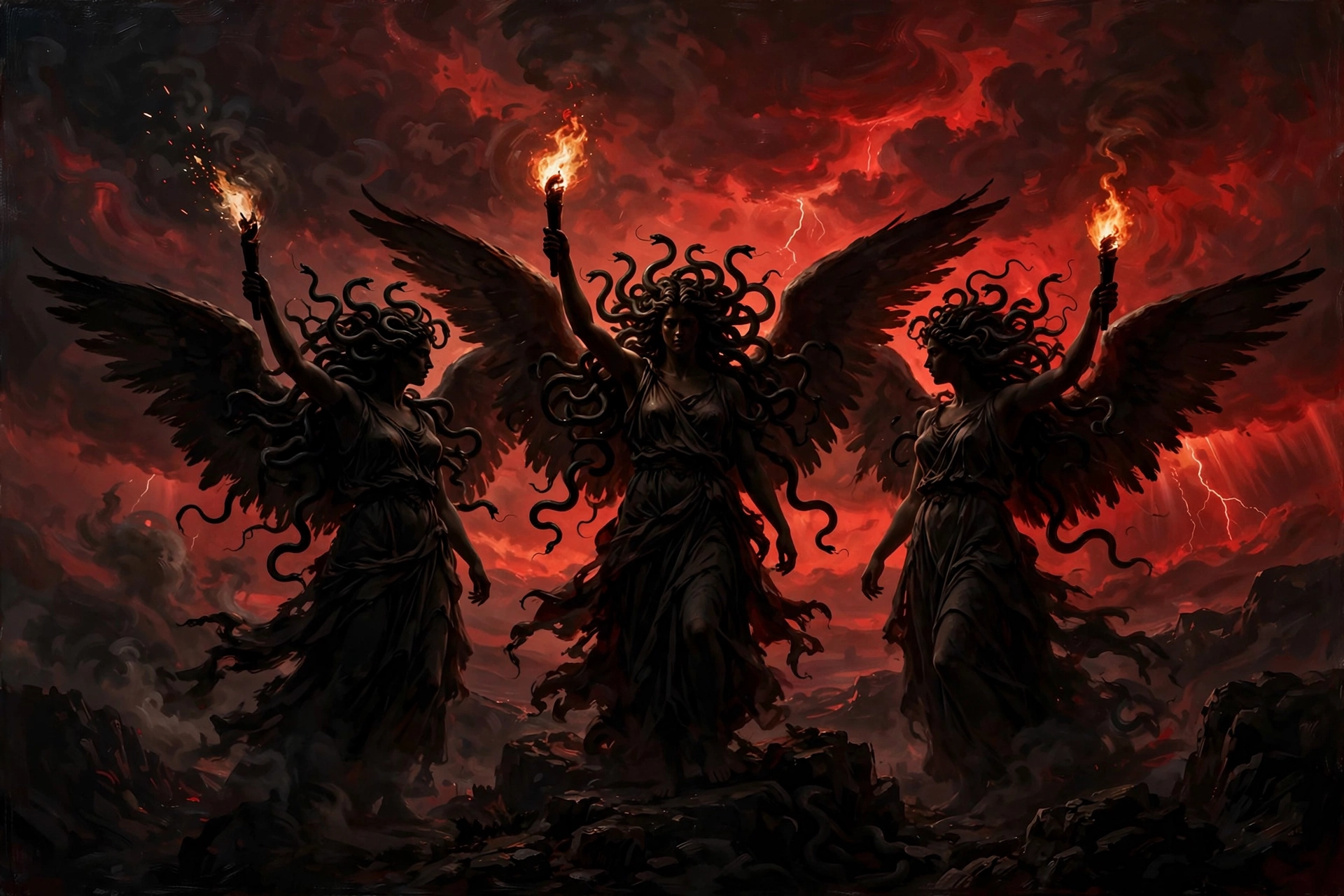
| Tisiphone | Greek | Avenger of murder | The Fury who punished killers, snakes writhing in her hair |
| Megaera | Greek | The jealous one | The Fury of grudges and envy’s rage |
| Mania | Greek | Madness | The spirit of insane fury, companion to Lyssa |
| Ate | Greek | Ruin; blind folly | The goddess of the rash rage that destroys its owner |
| Adrestia | Greek | She who cannot be escaped | Daughter of Ares who deals out retribution |
| Poena | Greek / Latin | Penalty; vengeance | The spirit of punishment who attends Nemesis |
| Alastor | Greek | The avenger | A spirit of blood-feuds who never lets a wrong rest |
| Deimos | Greek | Terror; dread | Son of Ares who marched beside his father into war |
| Phobos | Greek | Panic fear | Deimos’s brother — the rout that rage leaves behind |
| Ker | Greek | Doom; violent death | The spirit who dragged heroes down in battle |
| Kydoimos | Greek | Battle-din | The spirit of the roar and confusion of combat |
| Homados | Greek | Battle-noise | The crash of shields given a name and a temper |
| Phonoi | Greek | Murders | The spirits of killing who followed the Furies |
| Machai | Greek | Battles | The daimones of fighting itself |
| Palioxis | Greek | Rout; pursuit | The spirit of the furious chase after a broken enemy |
| Proioxis | Greek | Onslaught | Palioxis’s twin — the first screaming charge |
| Hybris | Greek | Insolence; outrage | The arrogance that provokes wrath in gods and men |
| Zelos | Greek | Rivalrous zeal | The burning envy that turns competition to rage |
Wrath Goddesses
From the lioness who nearly ended mankind to the goddess whose scream emptied battlefields, the fiercest tempers in mythology are female. These goddesses are not ‘angry for a reason’ footnotes — wrath is their office.
| Name | Origin | Meaning | Note |
|---|---|---|---|
| Durga | Sanskrit | The invincible | Created from the combined rage of the gods to kill the buffalo demon |
| Chamunda | Sanskrit | Slayer of Chanda and Munda | The most terrifying form of the Hindu mother goddess |
| Chandi | Sanskrit | The fierce one | Durga in her wrathful, demon-destroying aspect |
| Kalaratri | Sanskrit | The dark night | The goddess form that even other gods fear to behold |
| Pratyangira | Sanskrit | The lion-faced goddess | Born from Shiva’s fury to calm a rampaging lion god |
| Bagalamukhi | Sanskrit | She who paralyses | The goddess who seizes tongues and freezes enemies mid-word |
| Chinnamasta | Sanskrit | The self-decapitated goddess | The most shocking image of sacred rage in Hindu art |
| Dhumavati | Sanskrit | The smoky one | The widow goddess of fury, hunger and calamity |
| Badb | Irish | Crow; fury | The battle-crow goddess whose shriek broke armies |
| Macha | Irish | (war goddess) | Who cursed the men of Ulster to suffer birth-pangs in battle |
| Lamashtu | Akkadian | (demoness) | The Mesopotamian terror mothers prayed against nightly |
| Ereshkigal | Sumerian | Queen of the great below | Whose rage at a slight nearly emptied the world of the living |
| Anat | Canaanite | (war goddess) | Who waded thigh-deep in battle and laughed, says the ancient poem |
| Pakhet | Egyptian | She who tears | The lioness war goddess of the desert cliffs |
| Ekajati | Sanskrit / Tibetan | One braid of hair | The one-eyed wrathful protectress of Tibetan Buddhism |
| Palden Lhamo | Tibetan | Glorious goddess | The only female protector among Tibet’s great eight guardians |
| Simhamukha | Sanskrit | Lion-faced | The wisdom dakini whose roar dissolves anger itself |
| Kurukulla | Sanskrit | (red goddess) | The magnetising goddess who dances on the demon of ego |
| Bellona | Roman | War | The Roman war goddess who hurled the spear that declared war |
| Discordia | Roman | Discord | The Roman name for Eris, starter of the Trojan War |
| Enyo | Greek | War; horror | The goddess who sacked cities beside Ares |
| Eris | Greek | Strife | Whose golden apple of discord started the Trojan War |
| Invidia | Roman | Envy | The personified, poisonous jealousy of Roman poetry |
| Tiamat | Babylonian | The salt sea | The chaos dragon whose fury raised an army against the gods |
| Ishtar | Akkadian | (goddess of war and love) | Who threatened to smash the gates of the underworld and raise the dead |
Gods of Wrath, War and Punishment
Every pantheon keeps a god whose job is anger — the punisher, the howler, the one even other gods step around. Several of these are everyday names in their home cultures today.
| Name | Origin | Meaning | Note |
|---|---|---|---|
| Mars | Roman | War | The Roman war god, angrier and grander than his Greek twin |
| Rudra | Sanskrit | The howler | The Vedic storm god whose name means a roar of rage |
| Bhairava | Sanskrit | The terrifying | Shiva as the wrathful destroyer who beheads arrogance |
| Veerabhadra | Sanskrit | Distinguished hero | Born from Shiva’s matted hair of rage to wreck a sacrifice |
| Narasimha | Sanskrit | Man-lion | The avatar who burst from a pillar in fury to kill a demon king |
| Parashurama | Sanskrit | Rama with the axe | The avatar who swept the earth of corrupt warriors twenty-one times |
| Mahakala | Sanskrit | Great time; great death | The wrathful guardian form of Shiva in Buddhism |
| Yamantaka | Sanskrit | Destroyer of death | The buffalo-headed wrathful deity who out-rages death itself |
| Vajrapani | Sanskrit | Thunderbolt in hand | The Buddha’s wrathful bodyguard, wreathed in flame |
| Acala | Sanskrit | The immovable | The scowling, sword-bearing king of wrath in Buddhism |
| Set | Egyptian | (god of storms and chaos) | The red god of desert rage who murdered his own brother Osiris |
| Nergal | Sumerian | (god of war and plague) | Whose wrath flooded the underworld’s queen with threats of the dead |
| Erra | Akkadian | (god of mayhem) | The plague god who had to be talked out of ending the world |
| Ninurta | Sumerian | (war god) | Who crushed the demon Asag and the rebellious mountains |
| Zababa | Sumerian | (war god) | The battle god of Kish, patron of head-on assault |
| Resheph | Canaanite | Flame; burning | The plague-and-war god whose arrows were fever and fury |
| Neit | Irish | (war god) | The Celtic battle god, grandfather of Balor of the evil eye |
| Tyr | Norse | (war god) | Who kept his hand in the wolf’s mouth and paid for the world’s safety |
| Wotan | German | Fury; rage | The Old High German Odin — his very name means inspired fury |
| Woden | Anglo-Saxon | Fury; rage | The English form of the rage-named god; Wednesday is his day |
| Montu | Egyptian | (falcon war god) | The Theban god of blazing, bull-like battlefield rage |
| Anhur | Egyptian | (war god) | The lion-slayer god of war and the desert hunt |
| Huitzilopochtli | Aztec | Hummingbird of the south | The war god fed daily, the Aztecs believed, to keep the sun alive |
| Tezcatlipoca | Aztec | Smoking mirror | The god of conflict and strife who set brother against brother |
| Kartikeya | Sanskrit | Son of the Krittikas | The six-faced Hindu war god born to destroy a demon |
| Guan Yu | Chinese | (deified general) | The Chinese god of war, red-faced with righteous fury |
| Chiyou | Chinese | (war god) | The horned inventor of weapons who fought the Yellow Emperor |
| Xingtian | Chinese | (headless god) | Decapitated in battle, he fought on with eyes in his chest |
| Nezha | Chinese | (rebel child god) | The fiery wheel-riding boy god who raged against heaven itself |
Demons and Monsters of Rage
Below the gods come the beings anger made monstrous: hounds of hell, many-headed serpents, and demons whose entire existence is a grudge. Writers and gamers mine this shelf constantly — every name here is ancient or canonical.
| Name | Origin | Meaning | Note |
|---|---|---|---|
| Typhon | Greek | (storm monster) | The hundred-headed father of monsters who nearly unseated Zeus |
| Echidna | Greek | She-viper | The mother of monsters, mate of Typhon |
| Stheno | Greek | The mighty one | The most rage-filled of the three Gorgon sisters |
| Euryale | Greek | Far-roaming | The Gorgon whose scream could kill |
| Cerberus | Greek | (hound of Hades) | The three-headed dog whose temper guarded the dead |
| Orthrus | Greek | (two-headed hound) | Cerberus’s brother, slain by Heracles |
| Geryon | Greek | (three-bodied giant) | The monster Heracles crossed the world to rob and kill |
| Hydra | Greek | Water serpent | Cut off one raging head and two grew back |
| Chimera | Greek | She-goat | The fire-breathing lion-goat-serpent of Lycia |
| Balor | Irish | (king of the Fomorians) | Whose single poisonous eye blasted armies where it opened |
| Humbaba | Akkadian | (forest guardian) | The roaring ogre Gilgamesh travelled to kill |
| Grendel | Anglo-Saxon | (monster) | Who tore apart Heorot hall nightly for twelve years of fury |
| Pazuzu | Assyrian | (demon king) | The wind demon whose image warded off worse evils |
| Namtar | Sumerian | Fate; plague demon | The underworld vizier who carried sickness to mankind |
| Asag | Sumerian | (demon) | So hideous the rivers boiled with fish as he passed |
| Anzu | Sumerian | (storm bird) | The lion-headed eagle who stole the Tablet of Destinies in rage |
| Aeshma | Avestan | Wrath | The Zoroastrian demon of wrath himself — anger with a name and a mace |
| Fenrir | Norse | Fen-dweller | The wolf whose fury the gods could only bind, never tame |
| Mahishasura | Sanskrit | Buffalo demon | Whose arrogance forced the gods to forge Durga from their rage |
| Shumbha | Sanskrit | (demon king) | The demon whose pride summoned the goddess’s fiercest form |
| Nishumbha | Sanskrit | (demon general) | Shumbha’s brother, undone by the same overflowing wrath |
| Raktabija | Sanskrit | Blood-seed | The demon who cloned himself from every drop of spilled blood |
| Legion | Latin / Biblical | A multitude | The name the swarm of demons gives itself in the Gospel |
| Mara | Sanskrit / Buddhist | The killer | The demon who assaulted the Buddha on the night of enlightenment |
| Ahriman | Persian | Destructive spirit | The Zoroastrian lord of darkness, anger and destruction |
| Kamsa | Sanskrit | (demon king) | The tyrant whose rage at a prophecy made him hunt a god-child |
Norse and Germanic Fury
Old Norse had a whole vocabulary of rage: the berserkers’ battle-madness, Odin’s byname ‘the Terrible’, and valkyries whose names are simply words for war. This is the most name-dense fury tradition in Europe.
| Name | Origin | Meaning | Note |
|---|---|---|---|
| Modi | Norse | The wrathful; courage | Thor’s son, whose name is anger itself — fated to survive Ragnarok |
| Hati | Norse | Hate; enemy | The wolf who chases the moon, named simply Hate |
| Angrboda | Norse | Bringer of grief | The giantess whose name joins angr — grief and anger — to a messenger |
| Grim | Norse | The fierce one | An Odin byname meaning masked and grim with menace |
| Yggr | Norse | The terrible one | Odin’s name as the god even gods fear |
| Bolverk | Norse | Evil-doer | The alias Odin wore for a season of ruthless vengeance |
| Herjan | Norse | Lord of hosts | Odin as the ravager who musters the slain |
| Hildr | Norse | Battle | A valkyrie whose name is the ordinary word for combat |
| Gunnr | Norse | War | One of Odin’s valkyries, pure battle in a name |
| Gondul | Norse | Wand-wielder | The valkyrie who stirred kings to war with a magic staff |
| Herja | Norse | Devastator | A valkyrie named for laying lands waste |
| Radgrid | Norse | Counsel-swift | A valkyrie of Odin’s war-band |
| Randgrid | Norse | Shield-destroyer | The valkyrie who smashes the shield-wall |
| Geirskogul | Norse | Spear-shaker | A valkyrie brandishing her spear over the field |
| Skogul | Norse | Shaker; battle | A valkyrie named for the shock of impact |
| Hlokk | Norse | Battle-noise | The valkyrie of the din of clashing armies |
| Thrud | Norse | Strength | Thor’s daughter, a valkyrie of pure force |
| Kara | Norse | The wild one (by lore) | A valkyrie who sang her lover to death in battle |
Japanese Rage: Onryo, Demons and Wrathful Deities
Japan gave anger its most haunting form: the onryo, the vengeful ghost of someone wronged in life. Add the scowling Wisdom Kings of Buddhism and you get a section of names with stories like nowhere else.
| Name | Origin | Meaning | Note |
|---|---|---|---|
| Michizane | Japanese | (courtier and god) | Sugawara no Michizane, whose ghost’s wrath forced an emperor to deify him |
| Masakado | Japanese | (rebel lord) | Taira no Masakado, Japan’s first great vengeful spirit |
| Sutoku | Japanese | (retired emperor) | Emperor Sutoku, whose curse was blamed for a generation of wars |
| Hannya | Japanese | (demon mask) | The horned female demon of jealous rage in Noh theatre |
| Enma | Japanese | (king of hell) | The scowling judge who sentences the dead |
| Rasetsu | Japanese | Rakshasa demon | The flesh-eating ogres of Buddhist hell |
| Yasha | Japanese | (demon) | The yaksha turned wrathful guardian of temples |
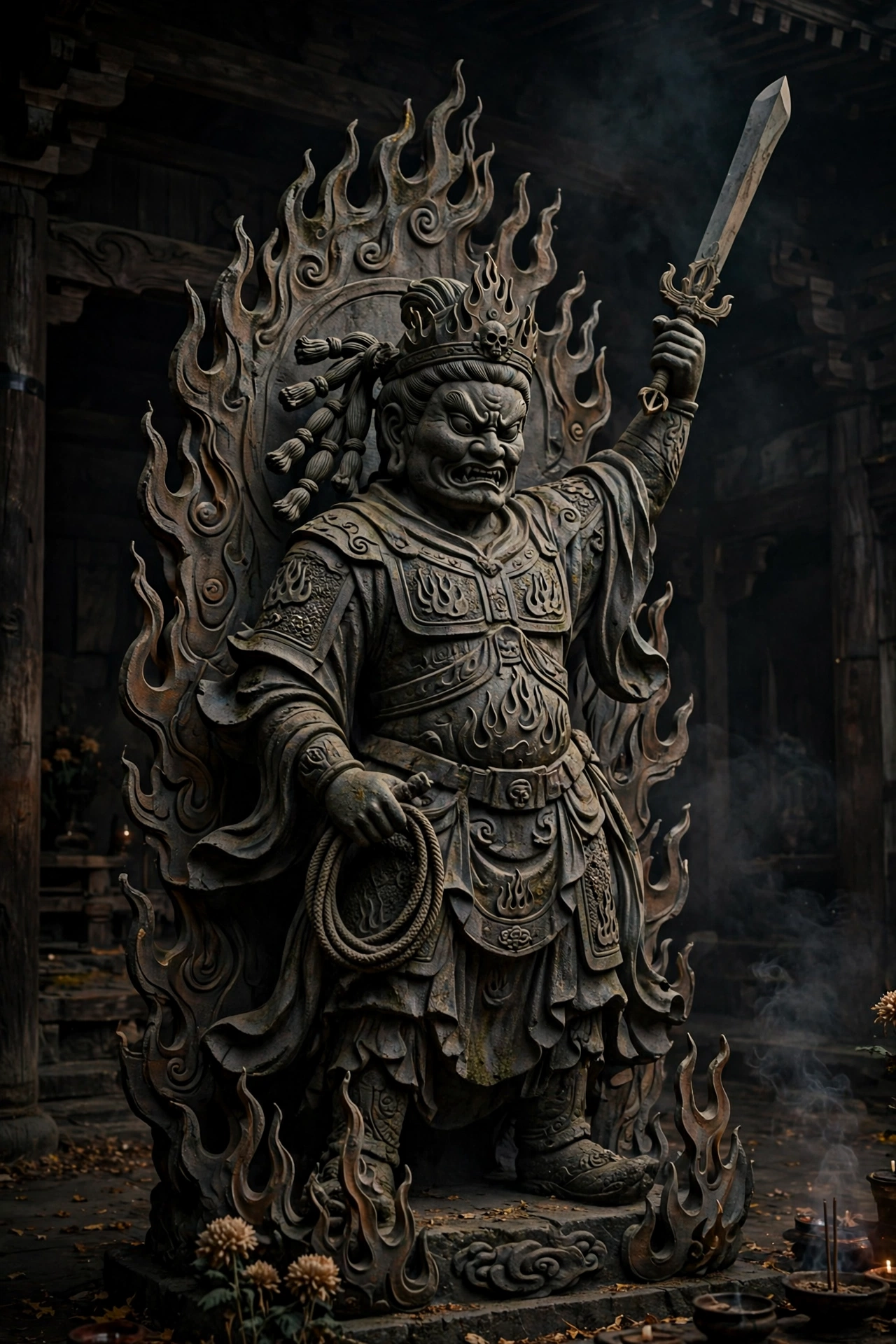
| Fudo | Japanese | The immovable | Fudo Myoo, the glaring Wisdom King who cuts delusion with a sword |
| Gundari | Japanese | (Wisdom King) | The multi-armed wrathful deity of Esoteric Buddhism |
| Daiitoku | Japanese | Great awe-inspiring king | The Wisdom King who rides a buffalo over death |
| Kiyohime | Japanese | (woman of Anchin) | Who loved a monk, was refused, and became a fire-breathing serpent |
| Hashihime | Japanese | Bridge princess | The woman who prayed seven nights and woke a living demon of jealousy |
| Gozu | Japanese | Ox-head | One of the two fearsome wardens of the underworld |
| Mezu | Japanese | Horse-head | Gozu’s partner at the gates of hell |
| Kijo | Japanese | Demoness | The general word for a female ogre of rage |
| Onibaba | Japanese | Demon hag | The old woman of Adachigahara who hunted travellers |
| Shutendoji | Japanese | (demon king) | The drunken ogre-lord of Mount Oe, terror of Kyoto |
| Ibarakidoji | Japanese | (demon) | Shutendoji’s lieutenant, who lost an arm to a hero’s sword and stole it back |
Biblical Wrath: Raging Kings, Villains and Demons
Scripture is full of tempers: cursed anger in Genesis, kings who flew at prophets, and the demons tradition assigned to the sin of wrath itself. Every name here is a real given name from the text or its tradition.
| Name | Origin | Meaning | Note |
|---|---|---|---|
| Cain | Hebrew | (first murderer) | Whose jealous rage at his brother Abel is the Bible’s first killing |
| Haman | Persian / Hebrew | (vizier of Persia) | Whose wrath at one man’s refusal built a gallows — for himself |
| Saul | Hebrew | Asked for | The king whose jealous rages hurled spears at David |
| Esau | Hebrew | Hairy | Who came in from the field furious and sold his birthright |
| Simeon | Hebrew | He has heard | Whose anger, with Levi’s, was cursed by dying Jacob |
| Levi | Hebrew | Joined | Co-author of the massacre Jacob condemned |
| Korah | Hebrew | Baldness; ice | The rebel swallowed by the earth for his uprising |
| Absalom | Hebrew | Father of peace | The beautiful son whose revolt broke David’s heart |
| Jezebel | Phoenician | (queen of Israel) | Whose threats made the prophet Elijah run for his life |
| Athaliah | Hebrew | (queen of Judah) | Who seized the throne by murdering her own grandchildren |
| Manasseh | Hebrew | Causing to forget | The king whose provocations, says Kings, kindled unstoppable wrath |
| Goliath | Hebrew | (Philistine champion) | Who cursed David by his gods before the stone flew |
| Joab | Hebrew | (general) | David’s ruthless commander, who murdered rivals against orders |
| Nabal | Hebrew | Fool | The churl whose insulting rage nearly brought a massacre on his house |
| Doeg | Hebrew | Anxious | The informer whose report killed eighty-five priests |
| Shimei | Hebrew | (of Benjamin) | Who cursed and stoned David on the road — and begged for his life later |
| Herod | Greek | (king of Judea) | Whose rage at the wise men ordered the Bethlehem massacre |
| Asmodeus | Persian / Hebrew | Creature of wrath | From Aeshma, the wrath demon, by way of the Book of Tobit |
| Abaddon | Hebrew | Destruction | The angel of the bottomless pit, king of the locusts |
| Azazel | Hebrew | (desert demon) | The fallen one who, in Enoch, taught men the sword |
| Belial | Hebrew | Worthlessness | The spirit whose ‘sons’ are scripture’s shorthand for violent wickedness |
| Mastema | Hebrew | Hostility | The demon chief of the Book of Jubilees who tests mankind |
| Sammael | Hebrew | Venom of God | The archangel tradition casts as accuser, seducer and destroyer |
Storm and Fire Gods with a Temper
Before weather had science it had tempers: thunder was a god shouting. These storm, sea and fire powers were worshipped precisely because their anger was the weather — and several are beautiful, usable names.
| Name | Origin | Meaning | Note |
|---|---|---|---|
| Surt | Norse | The black one | The fire giant whose sword-flames end the world at Ragnarok |
| Logi | Norse | Flame | The fire personified, who out-ate Thor’s whole company |
| Zeus | Greek | Sky; thunder | Whose thunderbolt was the ancient world’s image of sudden wrath |
| Thor | Norse | Thunder | Whose hammer answered insults before his words could |
| Indra | Sanskrit | (storm king) | The thunderbolt-hurling king of the Vedic gods |
| Perun | Slavic | The striker | The Slavic thunder god of oak, axe and storm-rage |
| Perkunas | Lithuanian | Thunder | The Baltic thunder god who still lends his name to storms |
| Susanoo | Japanese | (storm god) | Exiled from heaven for rampages that destroyed the rice fields of the sky |
| Raijin | Japanese | Thunder god | Who beats the drums of the storm with a ring of hammers |
| Fujin | Japanese | Wind god | Raijin’s green-skinned brother, bag of winds on his shoulder |
| Takemikazuchi | Japanese | Brave thunder god | The sword-god who wrestled a catfish to still the earthquakes |
| Huracan | Maya | One-legged | The storm god whose name gave English the word ‘hurricane’ |
| Chaac | Maya | (rain god) | Who splits the clouds with a lightning axe |
| Tlaloc | Nahuatl | He who makes things sprout | The Aztec rain god whose withheld or flooding rains meant life or death |
| Agni | Sanskrit | Fire | The fire god who carries every offering — and every curse — to heaven |
| Vulcan | Roman | (forge god) | Whose volcano-forge shook the earth when his temper rose |
| Hephaestus | Greek | (smith god) | Hurled from Olympus as a baby, he forged the gods’ weapons anyway |
| Prometheus | Greek | Forethought | Who defied Zeus and stole fire for mankind in open rebellion |
| Xiuhtecuhtli | Nahuatl | Turquoise lord | The Aztec god of fire and time, oldest of gods |
| Huehueteotl | Nahuatl | Old god | The bent fire god carried on men’s backs in effigy |
| Chantico | Nahuatl | (hearth goddess) | The fire goddess who broke a fast and was cursed for it |
| Lei Gong | Chinese | Lord of thunder | The blue thunder god with a chisel for the wicked |
| Jupiter | Roman | Sky father | Rome’s thunderbolt king, Zeus with a senate |
| Taranis | Celtic | Thunderer | The Gaulish thunder god of the wheel and the bolt |
| Baal | Canaanite | Lord | The storm god whose voice was thunder over Mount Zaphon |
| Tempest | English | A violent storm | A word name for weather at its angriest |
| Storm | English / Norse | A tempest | The simplest storm name of all |
Girl Names That Mean Anger — Warrior Queens and Fierce Women
The competitor pages bury their girl names under invented surname pairings. Here is the honest version: goddesses’ attendants, valkyries, Amazons and historical queens whose fury is documented in epic and history.
| Name | Origin | Meaning | Note |
|---|---|---|---|
| Scathach | Irish | The shadowy one | The warrior woman who trained Cuchulainn in her fortress of shadows |
| Agrona | Celtic | Battle; slaughter | The war goddess whose name survives in Welsh rivers |
| Fea | Irish | Hateful | One of the war goddesses of the Morrigan’s company |
| Andraste | British Celtic | Invincible | The war goddess Boudica invoked before burning Roman London |
| Cathubodua | Gaulish | Battle raven | The Gaulish goddess of the war-crow’s fury |
| Cailleach | Irish / Scottish | The veiled hag | The storm goddess who strides across winter Scotland with a hammer |
| Boudica | British | Victory | The queen whose revenge for her daughters burned three Roman cities |
| Penthesilea | Greek | (Amazon queen) | Who led the Amazons to Troy and fell to Achilles |
| Hippolyta | Greek | She who looses horses | The Amazon queen of the famous girdle |
| Antiope | Greek | (Amazon) | The Amazon carried off by Theseus, mother of Hippolytus |
| Atalanta | Greek | Equal in weight | The huntress who raced, wrestled and out-shot every suitor |
| Camilla | Latin | (warrior maiden) | The Volscian queen who ran so fast she skimmed the corn |
| Bradamante | Italian | (warrior knight) | The lady knight of Ariosto’s epic, ancestress of a dynasty |
| Marfisa | Italian | (warrior queen) | Bradamante’s peer, a Saracen queen-at-arms |
| Clorinda | Italian / Persian | (warrior maiden) | The Saracen heroine of Tasso’s Jerusalem Delivered |
| Britomart | English (literary) | Sweet maiden | Spenser’s lady knight of chastity and the spear |
| Lagertha | Norse | (shieldmaiden) | The Viking shieldmaiden of the sagas, wife of Ragnar |
| Hervor | Norse | (warrior woman) | Who woke her dead father in his barrow to claim his cursed sword |
| Brynhild | Norse | Armour battle | The valkyrie whose betrayed love destroyed two royal houses |
| Sigrun | Norse | Victory secret | The valkyrie who chose her lover against her father’s will |
| Eowyn | Anglo-Saxon | Horse joy | Who rode to war in disguise and slew the Witch-king |
| Artemisia | Greek | (queen of Halicarnassus) | Who fought at Salamis and out-thought the Persian king |
| Gorgo | Greek | Grim; fierce | The Spartan queen whose name itself means fierce-looking |
| Tomyris | Scythian | (queen of the Massagetae) | Who defeated Cyrus the Great avenging her son |
| Zenobia | Greek | Life of Zeus | The Palmyrene queen who defied Rome across the East |
| Xena | Greek | Guest; stranger | The warrior princess who made a rare Greek name famous |
| Valkyrie | Norse | Chooser of the slain | The word itself, worn as a name for Odin’s battle-maidens |
Boy Names That Mean Anger — Heroes of Rage
Western literature begins with a sentence about rage: ‘Sing of the wrath of Achilles.’ These are the heroes, kings and champions whose tempers drive their stories — including Cuchulainn, whose battle-frenzy literally warped his body.
| Name | Origin | Meaning | Note |
|---|---|---|---|
| Ajax | Greek | (hero of Troy) | Whose madness and shame after Achilles’ armour remain tragedy’s fiercest fall |
| Diomedes | Greek | God-like cunning | Who wounded two gods in one day of unstoppable fury |
| Agamemnon | Greek | The steadfast | The commander whose quarrel with Achilles opens the Iliad |
| Neoptolemus | Greek | New war | Achilles’ son, whose brutality at fallen Troy shocked even the Greeks |
| Turnus | Latin | (Rutulian king) | The Aeneid’s furious last obstacle to Rome |
| Mezentius | Latin | (Etruscan king) | The ‘contemnor of the gods’ who charged whole armies alone |
| Cuchulainn | Irish | Hound of Culann | Ireland’s greatest hero, gripped by the warp-spasm of battle rage |
| Fergus | Irish | Man-strength | The Ulster king exiled by treachery, who fought his own people in rage |
| Egill | Norse | (berserk poet) | Egil Skallagrimsson — killer at seven, Iceland’s most dangerous poet |
| Grettir | Norse | (outlaw hero) | The strongman whose temper kept him outlawed for twenty years |
| Kveldulf | Norse | Evening wolf | Egil’s grandfather, a berserker whose grief-rage killed him |
| Starkad | Norse | (cursed hero) | Odin’s champion, granted long life and cursed with crimes in each age |
| Heremod | Anglo-Saxon | Battle-mind | The Danish king Beowulf holds up as the warning of a raging ruler |
| Gilgamesh | Sumerian | (king of Uruk) | Whose tyrant’s rage at a friend’s death turned him against death itself |
| Enkidu | Sumerian | (wild man) | The untamed rival whose wrestling match with Gilgamesh shook a city |
| Orlando | Italian | Famous land (Roland) | Ariosto’s paladin, who went literally mad — furioso — for love |
| Roland | Germanic | Famous land | The paladin whose defiance held the pass at Roncevaux |
| Rodomonte | Italian | (Saracen king) | The embodiment of furious pride in Orlando Furioso |
| Mandricardo | Italian | (Saracen knight) | The Tartar king who hunted Hector’s sword across the epic |
| Ferrau | Italian / Spanish | (Saracen champion) | The invulnerable warrior of the Carolingian epics |
| Heracles | Greek | Glory of Hera | Driven mad by Hera, his redemption built the twelve labours |
| Orestes | Greek | Of the mountain | Who avenged his father and was hunted mad by the Furies |
| Jason | Greek | Healer | Whose betrayal of Medea lit the most famous vengeance in myth |
Vengeance and Retribution Names
Anger’s longest form is vengeance — the debt that waits. Greek tragedy, Norse prophecy and scripture all name it. This section is the angle most anger lists miss entirely.
| Name | Origin | Meaning | Note |
|---|---|---|---|
| Clytemnestra | Greek | (queen of Mycenae) | Who waited ten years to avenge her daughter with an axe |
| Prokne | Greek | (Athens princess) | Who avenged her sister in the most terrible way in Greek myth |
| Hecuba | Greek / Trojan | (queen of Troy) | Who blinded the king who murdered her last son |
| Elektra | Greek | Amber; shining | Who kept her father’s murder alive in memory until her brother returned |
| Vidar | Norse | The wide-ruling | Odin’s silent son, born and raised for one act: avenging his father |
| Vali | Norse | (son of Odin) | Born fully grown to avenge Baldr before his first day ended |
| Hamlet | Danish | (prince of Denmark) | Literature’s most famous delayed revenge |
| Vendetta | Italian | Blood feud | The Italian word for a feud of honour, worn as a name |
| Revenge | English | Retaliation | A stark Puritan-era word name |
| Justice | English / Latin | Fairness | Vengeance civilised — the virtue name of balance |
| Dike | Greek | Justice | The goddess who reports men’s crimes to Zeus |
| Themis | Greek | Divine law | The Titaness of the law that even kings answer to |
| Astraea | Greek | Star-maiden | The justice goddess who last walked the earth |
| Maat | Egyptian | Truth; order | The feather every heart is weighed against after death |
| Raguel | Hebrew | Friend of God | The archangel Enoch assigns to watch and punish the fallen |
| Praxidice | Greek | Exacting justice | The goddess who ensures vengeance is carried out |
| Ultio | Latin | Vengeance | Rome’s personified vengeance, honoured with an altar by Augustus |
| Olga | Russian | Holy | Saint Olga of Kiev, whose revenge for her husband is legend |
| Judith | Hebrew | (woman of Judea) | Who charmed and beheaded the general besieging her city |
| Jael | Hebrew | Mountain goat | Who ended a war with a tent peg while the enemy slept |
How to Choose an Anger Name
Start with the temperature. Literal anger words — the Sanskrit, Japanese and Turkish names in the first table — are the boldest and the most honest: the meaning is the dictionary meaning. Mythology names carry stories, and the stories differ wildly in weight. A thunder god is a playground-safe hero; a Fury is a commitment. Read the myth in the Note column before you fall in love with the sound. For more mythic heat in the same family, see girl names that mean chaos and the broader names that mean fierce.
Next, separate the name from the sentence you will say a thousand times. You will shout this name up the stairs, write it on lunchboxes and hear it at graduation. Names from the storm-god and hero sections pass that test easily; the demon shelf is magnificent for characters, pets and gamer tags, which is exactly how most people use it.
Finally, respect the source. Many of these names belong to living religions — Hindu, Buddhist, Shinto and indigenous traditions among them. A name chosen with knowledge of its story is a gift; the same name chosen as a costume is not. Learn the pronunciation, know the tale, and be ready to pass both on.
Frequently Asked Questions
What name literally means anger?
Krodha and Manyu in Sanskrit, Ikari and Gekido in Japanese, Raivo in Estonian, and Öfke and Gazap in Turkish are all dictionary words for anger or wrath that are worn as names. In Latin, Ira — the root of ‘irate’ — does the same job.
What are the names of the Furies?
The three Greek Furies are Alecto (unceasing anger), Tisiphone (avenger of murder) and Megaera (the jealous one) — the Erinyes of Greek religion. They hunted those who broke oaths or shed kindred blood, and their full story anchors our list of names that mean vengeance.
What girl name means wrath?
The strongest true-wrath girl names are the goddesses: Kali and Durga from India, Sekhmet from Egypt, Nemain and the Morrigan from Ireland, and Lyssa, the Greek spirit of raging madness. Our wrath goddesses section profiles twenty-five of them.
What name means anger in Japanese?
Ikari is the standard Japanese word for anger and Gekido the word for violent rage; both are used as dramatic names. Japan’s deeper anger tradition is the onryo — vengeful ghosts like Michizane and Sutoku, whose names fill the Japanese section above.
Are anger names suitable for real babies?
Many are ordinary names at home: Ira, Kali, Durga, Tyr, Mars and Raivo are unremarkable in their own countries. The heaviest mythology — the Furies, the demons, the headless god — is best saved for characters, where a terrifying story is pure asset. If you love the energy but want it gentler, the storm and fire sections are the wearable middle, and names that mean destroyer shows the far end of the scale.
Conclusion
From a one-syllable Latin word for wrath to a headless Chinese god still swinging his axe, these 270 names prove that anger is the most storied emotion in the naming traditions of the world. There is a name here for every register of fire: a thunder god for a bold son, a battle goddess for a fierce daughter, a dictionary word for a parent who wants the meaning exact, and a vengeance name for a character who never forgets. Choose the temper you actually want to live with — the name will do the rest.