270 Names That Mean Death and Destruction: Dark and Apocalyptic Names
Introduction
Every culture on earth has looked at the end of things and given it a name. Death has been a ferryman, a queen, a horseman, a grandmother and a harvest — and the names those figures left behind are some of the most powerful in world mythology. This list gathers them all: the gods and goddesses who rule the dead, the destroyers who unmake the world, the demons, monsters, fates and folklore terrors, and the plain words for death in the world’s languages.
Every name below is real — a deity, spirit, legendary figure or genuine given name with a checkable origin — and every name appears exactly once, with no repeats dressed up as new entries. For the figure behind so many of them, see the survey of Death personified on Wikipedia.
A note on tone: these are dark names, gathered for writers, game-makers, mythology lovers and parents who genuinely love the gothic end of the name pool. Meanings and notes are honest — where a name is a place, a word or a fictional figure rather than a god, the note says so.
Quick Picks: The 15 Best Names That Mean Death and Destruction
The fifteen names we would shortlist first: the greatest death deities, the strongest destroyers and the most usable dark names on the whole list.
| Name | Origin | Meaning |
|---|---|---|
| Kali | Sanskrit | The black goddess of time and death |
| Thanatos | Greek | Death itself, personified |
| Azrael | Islamic / Judeo-Christian | The angel of death |
| Morrigan | Irish | Phantom queen of battle and death |
| Shiva | Sanskrit | The Destroyer of the Hindu trinity |
| Lilith | Mesopotamian / Hebrew | Night demoness, first wife of legend |
| Anubis | Egyptian | Jackal god of the dead |
| Hel | Norse | Queen of the dead |
| Abaddon | Hebrew | Destruction; the destroyer angel |
| Persephone | Greek | Queen of the underworld |
| Osiris | Egyptian | Murdered god, king of the dead |
| Samael | Hebrew | Angel of death and severity |
| Mot | Ugaritic | Death, the god who swallows gods |
| Ereshkigal | Sumerian | Queen of the Great Below |
| Sekhmet | Egyptian | Lioness of plague and war |
Gods of Death and the Underworld
The kings of the dead, from four thousand years of religion. Greece alone fills a shelf — our dedicated list of Greek names that mean death goes deeper into that single pantheon.
| Name | Origin | Meaning | Note |
|---|---|---|---|
| Hades | Greek | The unseen one | Lord of the underworld and of the dead |
| Pluto | Roman | The rich one | Rome’s Hades, keeper of the dead and of gold |
| Yama | Hindu / Buddhist | Judge of the dead | The first mortal to die; now death’s king |
| Enma | Japanese | King of the underworld | The fearsome judge Enma-O of Japanese Buddhism |
| Yanluo | Chinese | King Yama of the Chinese hells | Yanluo Wang, lord of the fifth court of Diyu |
| Donn | Irish | The dark one | First man of Ireland, now god of the dead |
| Arawn | Welsh | King of the underworld | Lord of Annwn in the Mabinogion |
| Tuoni | Finnish | God of the land of the dead | King of Tuonela across the black river |
| Veles | Slavic | God of the underworld waters | The horned god of the dead and of cattle |
| Orcus | Roman / Etruscan | God of the underworld | The oath-punisher of Roman religion |
| Zalmoxis | Thracian | God of the afterlife | The deified sage of the Getae |
| Ah Puch | Maya | God of death and decay | The stinking lord of the Maya underworld |
| Kisin | Maya (Lacandon) | The death god | The earthquake-linked lord of the dead |
| Mictlantecuhtli | Aztec | Lord of the land of the dead | The skeletal king of Mictlan |
| Supay | Inca / Quechua | God of death and the underworld | His name later became the word for demon |
| Nergal | Mesopotamian | God of plague, war and the underworld | The burning king of the Great Below |
| Namtar | Mesopotamian | Fate; the plague vizier | Herald and minister of the queen of the dead |
| Erra | Akkadian | God of plague and mayhem | The destroyer who nearly wiped out mankind |
| Chernobog | Slavic | The black god | The dark god of misfortune and death |
| Velnias | Lithuanian | God of the dead and the marshes | Later demonised as the devil |
| Gangrim | Korean | Reaper of souls | The messenger who escorts the dead in Korean myth |
| Balor | Irish | The smiter | The Fomorian king whose single eye kills |
| Erlik | Turkic / Mongolian | King of the underworld | Judge of the dead in Siberian shamanism |
| Ninazu | Sumerian | Lord of healing and the underworld | A chthonic god of snakes and serpents |
| Dumuzi | Sumerian | The shepherd god | He spends half of every year among the dead |
| Sokar | Egyptian | God of the necropolis | The falcon god of the Memphite dead |
| Whiro | Maori | God of darkness and death | Lord of the underworld realm Rarohenga |
| Tlaloc | Aztec | Rain god of the drowned dead | His paradise received those who died by water |
| Omolu | Yoruba | God of plague and disease | The feared orisha of smallpox and healing |
| Acheron | Greek | River of woe | The underworld river itself, named as a god |
| Kur | Sumerian | The underworld; the death dragon | The first dragon, and the land of the dead |
Goddesses of Death and the Dead
The queens of the dead are, if anything, more feared than the kings — from Babylon’s Ereshkigal to the Aztec Lady of the Place of the Dead.
| Name | Origin | Meaning | Note |
|---|---|---|---|
| Nephthys | Egyptian | Mistress of the house | Mourning goddess, sister of Isis, mother of Anubis |
| Vanth | Etruscan | Demoness of death | The winged guide who escorts Etruscan souls |
| Libitina | Roman | Goddess of funerals | Her temple kept Rome’s death registers |
| Mania | Roman / Etruscan | Mother of ghosts | An underworld goddess, mother of the Manes |
| Macaria | Greek | The blessed one | Daughter of Hades, linked to blessed death |
| Melinoe | Greek | Goddess of ghosts | The Orphic bringer of nightmare and madness |
| Achlys | Greek | Mist of death | The primordial haze that settles on dying eyes |
| Morana | Slavic | Goddess of winter and death | Her effigy is drowned each spring to end winter |
| Giltine | Lithuanian | Goddess of death | The white-robed reaper with the poisonous tongue |
| Izanami | Japanese | Queen of the land of the dead | The creator goddess who became death’s ruler |
| Mictecacihuatl | Aztec | Lady of the land of the dead | Queen of Mictlan, honoured at the Day of the Dead |
| Itzpapalotl | Aztec | Obsidian butterfly | The skeletal star-demoness of the night sky |
| Coatlicue | Aztec | Serpent-skirted mother | The earth goddess of life, death and rebirth |
| Maman Brigitte | Haitian Vodou | Guardian of the dead | The foul-mouthed, rum-loving mistress of cemeteries |
| Louhi | Finnish | Mistress of the north | The witch-queen of Pohjola, death’s cold country |
| Tuonetar | Finnish | Queen of the land of the dead | Wife of Tuoni, ferryman’s mistress of Tuonela |
| Kalma | Finnish | The stench of graves | A death goddess whose name means grave-odour |
| Cailleach | Scottish / Irish | The veiled hag | The winter goddess who herds the dead season |
| Sedna | Inuit | Goddess of the deep and the dead | Her anger raises storms over drowned hunters |
| Yami | Hindu | Lady of the dead | Twin of Yama, first woman and death’s sister |
| Baba Yaga | Slavic | The witch of the dark forest | The bone-fenced hut-keeper between life and death |
| Hine-nui-te-po | Maori | Great lady of the night | Goddess of death and the underworld night |
| Allani | Hurrian | Queen of the underworld | The sun sees her when it sets into the dead lands |
| Anput | Egyptian | Goddess of funerals | Female counterpart of Anubis in the 17th nome |
| Lethe | Greek | River of forgetfulness | The underworld river, personified as a spirit |
| Styx | Greek | The hateful river | The goddess-river by whom even gods swear |
| Brimo | Greek | The terrible one | An underworld epithet of Hecate and Demeter |
Destroyer Gods and World-Ending Spirits
Death takes one soul at a time; destruction takes everything. These are the unmakers — and our full list of names that mean destroyer is devoted to exactly this shelf.
| Name | Origin | Meaning | Note |
|---|---|---|---|
| Rudra | Sanskrit | The howler | The Vedic storm god who became Shiva the Destroyer |
| Bhairava | Sanskrit | The terrible | Shiva’s most fearsome destroyer form |
| Virabhadra | Sanskrit | The auspicious hero | Shiva’s warrior born to destroy a sacrifice and an army |
| Mahakala | Sanskrit / Buddhist | Great time; great death | The devouring wrathful form of Shiva and Avalokiteshvara |
| Yamantaka | Tibetan Buddhist | The death-conqueror | The bull-headed destroyer of the lord of death |
| Apophis | Egyptian | The great serpent of chaos | The chaos snake who tries to swallow the sun each night |
| Set | Egyptian | God of chaos and deserts | Murderer of Osiris, lord of storms and disorder |
| Tezcatlipoca | Aztec | The smoking mirror | The capricious god who destroyed the first world |
| Huitzilopochtli | Aztec | God of war and human sacrifice | The hummingbird god fed on hearts to hold back the dark |
| Xipe Totec | Aztec | Our lord the flayed one | The god of death, rebirth and the flaying rite |
| Camazotz | Maya | The death bat | The bat god who took a hero’s head in the Popol Vuh |
| Buluc Chabtan | Maya | God of war and sudden death | The blood-mouthed god of sacrifice and violence |
| Typhon | Greek | The monstrous storm father | The giant who nearly destroyed Olympus itself |
| Cronus | Greek | The devouring Titan | The king who ate his own children |
| Tartarus | Greek | The abyss | The pit below Hades, a god and a prison in one |
| Loki | Norse | The trickster of the end | Father of the wolf and serpent who end the world |
| Kala | Sanskrit / Balinese | Time; death | The devouring time-spirit of Hindu and Balinese myth |
| Mara | Buddhist | The killer | The demon of death and desire who tempted the Buddha |
| Resheph | Canaanite | God of plague and war | His arrows are the plague shafts of the Levant |
| Narasimha | Sanskrit | The man-lion | Vishnu’s avatar who tore the demon king apart |
| Parashurama | Sanskrit | Rama with the axe | The avatar who cleared the warrior class from the earth |
| Alastor | Greek | The avenging spirit | A blood-feud demon, later a name for an avenger |
Goddesses of Destruction, War and Vengeance
The battlefield goddesses and the widowed furies of grief — this shelf is the divine end of our list of names that mean vengeance.
| Name | Origin | Meaning | Note |
|---|---|---|---|
| Durga | Sanskrit | The invincible | The warrior goddess who slays the buffalo demon |
| Chamunda | Sanskrit | The emaciated slayer | The gaunt goddess who destroys the demons Chanda and Munda |
| Dhumavati | Sanskrit | The smoky one | The widow goddess of hunger, loss and desolation |
| Chinnamasta | Sanskrit | The self-decapitated goddess | She holds her own severed head — destruction and sacrifice in one image |
| Nirriti | Sanskrit | Goddess of death and corruption | The dark goddess of decay in the Vedas |
| Anat | Canaanite | Goddess of war and slaughter | She wades waist-deep in blood in the Ugaritic epics |
| Ishtar | Mesopotamian | Goddess of love and war | When spurned, she threatens to raise the dead to eat the living |
| Astarte | Phoenician | Goddess of war and love | The armed queen of heaven of the Levant |
| Bellona | Roman | Goddess of war | Her priests gashed their own arms in her rites |
| Enyo | Greek | Goddess of war’s horror | She delights in the destruction of cities |
| Andraste | British Celtic | Goddess of war and victory | Boudica sacrificed to her before the revolt |
| Cathubodua | Gaulish | The battle crow | Gaul’s Morrigan, goddess of slaughter |
| Badb | Irish | The scald-crow | The war goddess whose shriek routs armies |
| Macha | Irish | Goddess of war and sovereignty | One of the three forms of the Morrigan |
| Nemain | Irish | Venomous frenzy | The war goddess whose cry kills with terror |
| Scathach | Irish / Scottish | The shadowy one | The warrior-queen who trains heroes to kill |
| Alakshmi | Sanskrit | Goddess of misfortune | The elder sister who brings poverty and ruin |
| Jyeshtha | Sanskrit | The eldest | Goddess of misfortune, sloth and inauspicious things |
| Putana | Sanskrit | The child-killing demoness | She came to murder the infant Krishna |
| Holika | Sanskrit | The burning demoness | Burned in the fire she prepared for another |
| Pakhet | Egyptian | She who tears | The lioness goddess of the desert edge |
| Alala | Greek | The war cry | Personification of the battle shout itself |
| Nerio | Roman | Goddess of war valour | The Sabine partner of Mars |
| Lua | Roman | Goddess of expiated blood | The weapons of the slain enemy were burned to her |
| Alecto | Greek / Roman | The unceasing one | The Fury who infects hearts with war-lust |
| Tisiphone | Greek | Avenger of murder | The Fury who whips the guilty dead |
| Megaera | Greek | The jealous one | The third of the avenging Furies |
| Eris | Greek | Discord | Her golden apple started the Trojan War |
Gods of War, Battle and the Slain
War is destruction organised, and every pantheon kept a god for it. The war gods own the harvest of the battlefield — the dead themselves.
| Name | Origin | Meaning | Note |
|---|---|---|---|
| Ares | Greek | God of war’s bloodshed | The Greeks hated and needed him in equal measure |
| Mars | Roman | God of war | Father of Romulus, patron of soldiers |
| Tyr | Norse | God of war and law | He gave his hand to bind the great wolf |
| Odin | Norse | The all-father of the slain | He harvests the best of the battle-dead for Valhalla |
| Polemos | Greek | War personified | Father of Alala, the war cry |
| Zababa | Mesopotamian | God of war | The warrior god of Kish, consort of Ishtar |
| Anhur | Egyptian | God of war and hunting | The slayer of enemies, lord of Thinis |
| Montu | Egyptian | Falcon god of war | The raging patron of Theban pharaohs |
| Maahes | Egyptian | Lion god of war | The lord of slaughter, son of Sekhmet |
| Wepwawet | Egyptian | Opener of the ways | The wolf god who clears the road for armies and the dead |
| Chiyou | Chinese | God of war and weapons | The horned inventor of metal weapons |
| Xingtian | Chinese | The headless warrior | He fights on with eyes in his chest after beheading |
| Triglav | Slavic | The three-headed god | The black-stallioned war god of the Pomeranians |
| Svetovid | Slavic | The four-faced god | War and harvest god of the Rani |
| Ogun | Yoruba | God of iron and war | The orisha of blades, blood and the road |
| Deimos | Greek | Terror | Son of Ares, who rides beside his father into battle |
| Phobos | Greek | Fear and panic | The other son of Ares; Mars’s moon bears his name |
| Camulus | Celtic | God of war | The invincible one, later merged with Mars |
| Esus | Gaulish | The lord | A god honoured, the Roman poet says, with grim sacrifice |
| Toutatis | Gaulish | God of the tribe | Famous now from Asterix — ‘by Toutatis!’ |
| Hachiman | Japanese | God of war and archery | The divine protector of samurai Japan |
| Shango | Yoruba | God of thunder and fire | The deified king whose lightning punishes liars |
The Fates, the Doom of the World and the Keres
Behind the death gods stand the powers who decide — the spinners and shears of the thread of life, in Greece, Rome and the Viking north alike.
| Name | Origin | Meaning | Note |
|---|---|---|---|
| Atropos | Greek | The inflexible | The Fate who cuts the thread of life |
| Clotho | Greek | The spinner | The Fate who spins the thread |
| Lachesis | Greek | The measurer | The Fate who measures the thread’s length |
| Morta | Roman | Death | Rome’s Fate of the cutting — her name is death itself |
| Nona | Roman | The ninth | The Fate of the spinning |
| Decima | Roman | The tenth | The Fate of the measuring |
| Urd | Norse | What has become | The Norn of the past at the well of fate |
| Verdandi | Norse | What is becoming | The Norn of the present |
| Skuld | Norse | What shall be; debt | The Norn of the future, who rides with the Valkyries |
| Ananke | Greek | Necessity | The mother of the Fates, whom even Zeus obeys |
| Wyrd | Old English | Fate; doom | The Anglo-Saxon web of destiny |
| Nemesis | Greek | Retribution | The goddess who balances fortune with ruin |
| Ker | Greek | Doom; violent death | The death-spirits who haunt the battlefield for blood |
Horsemen, Apocalypse and the End of the World
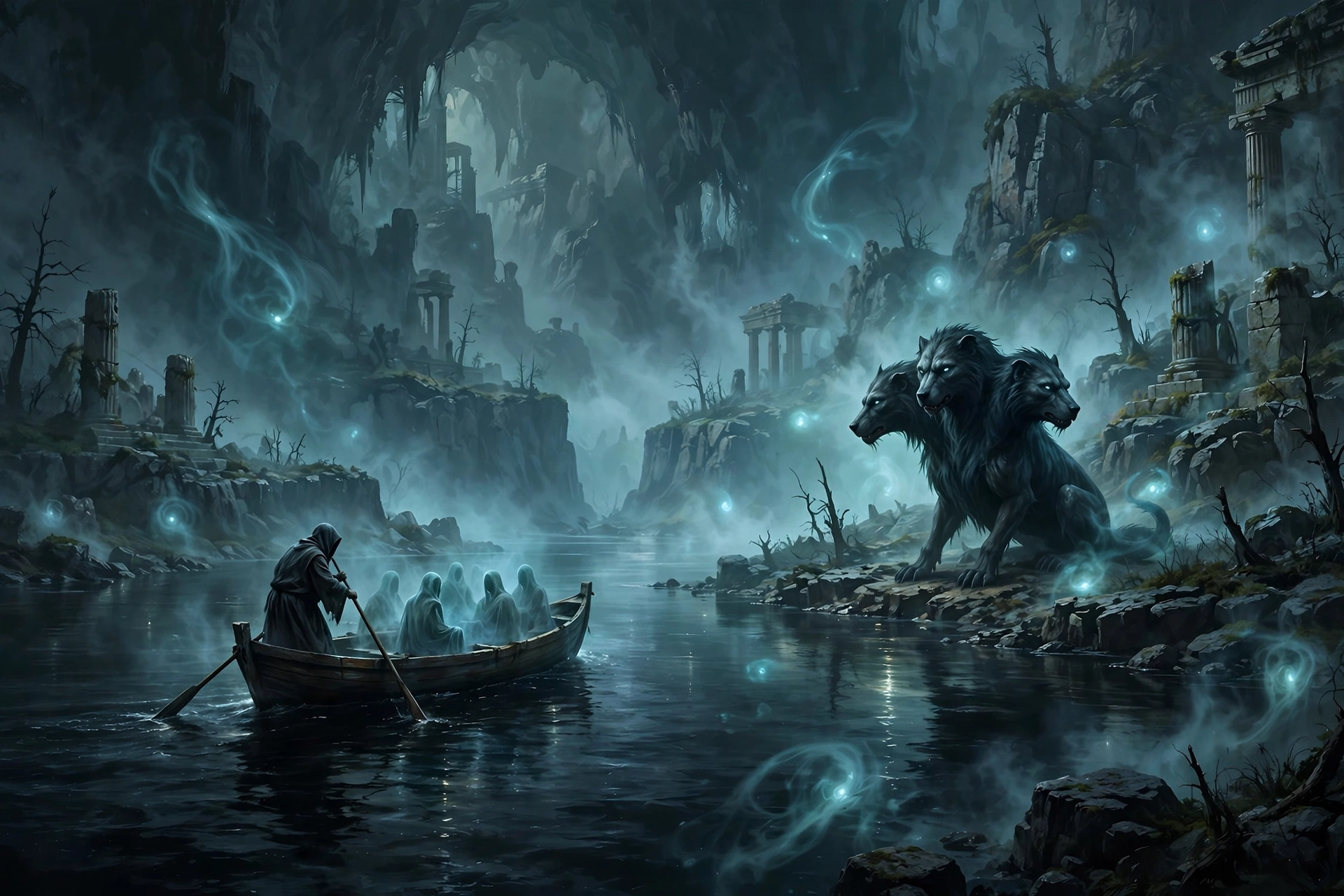
The end of everything has names too: the riders of Revelation, the wolf and fire giant of Ragnarok, and the honest English words for total ruin.
| Name | Origin | Meaning | Note |
|---|---|---|---|
| Apollyon | Greek (biblical) | The destroyer | The angel of the bottomless pit in Revelation |
| Pestilence | English (biblical tradition) | Disease that kills multitudes | The rider on the white horse in popular tradition |
| Fenrir | Norse | The great wolf | He breaks his chains at Ragnarok and swallows Odin |
| Jormungandr | Norse | The world serpent | His final battle with Thor ends both their lives |
| Surtr | Norse | The black fire giant | He burns the whole world at the end of time |
| Gog | Hebrew (biblical) | The invading prince of the end | Of Gog and Magog, the final enemies |
| Magog | Hebrew (biblical) | The land of Gog | The second half of the apocalyptic pair |
| Armageddon | Hebrew (biblical) | The final battlefield | The place-name that became the word for the end |
| Ragnarok | Norse | Doom of the gods | The prophesied last battle and burning of the world |
| Kalki | Sanskrit | The final avatar | Vishnu’s last incarnation, who ends the age of darkness |
| Omega | Greek | The end | The last letter — ‘the Alpha and the Omega’ |
| Doom | English | Judgment; ruin | An old legal word that came to mean the end of all things |
| Havoc | English | Devastation | The war-cry ‘havoc!’ once licensed total destruction |
| Calamity | Latin / English | Great disaster | A word name for ruin on a national scale |
| Apocalypse | Greek | The revelation of the end | The unveiling that now means the world’s destruction |
| Cataclysm | Greek | Deluge; upheaval | The great flood-word of Greek geography |
Demons, Devils and Fallen Angels
Below the gods come the rebels and the tempters. This shelf runs from the biblical names to the grimoire demons — and readers who want the character side should see our list of boy names that mean evil.
| Name | Origin | Meaning | Note |
|---|---|---|---|
| Satan | Hebrew | The adversary | The accuser who became the devil |
| Lucifer | Latin | The light-bearer | The fallen morning star of Isaiah and Milton |
| Azazel | Hebrew | The scapegoat demon | The fallen angel of the wilderness |
| Belial | Hebrew | Worthlessness | A prince of darkness in the Dead Sea Scrolls |
| Asmodeus | Persian / Hebrew | Demon of wrath and lust | The book of Tobit’s murderous demon |
| Beelzebub | Philistine / Hebrew | Lord of the flies | The prince of demons of the Gospels |
| Moloch | Canaanite | The devouring fire god | The idol to whom children were burned |
| Mammon | Aramaic | Wealth personified as evil | The demon of greed in Paradise Lost |
| Belphegor | Moabite / grimoire | Demon of sloth | A prince of hell in the old grimoires |
| Mephistopheles | German (legend) | The devil of the contract | Faust’s smooth-talking destroyer |
| Astaroth | Phoenician / grimoire | Grand duke of hell | A goddess’s name degraded into a demon |
| Baal | Canaanite | The lord | The storm god reviled as a demon in the Bible |
| Dagon | Philistine | The fish-grain god | His temple falls in the book of Judges |
| Chemosh | Moabite | The destroyer | The national god of Moab, ‘abomination’ to Israel |
| Ahriman | Persian | The destructive spirit | Zoroastrianism’s lord of darkness and death |
| Iblis | Islamic | The devil | The jinn who refused to bow and became Satan |
| Ifrit | Arabic | Demon of the underworld | The powerful fire-jinn of Arabian lore |
| Gadreel | Aramaic (Enoch) | The fallen watcher | The angel blamed for leading Eve astray |
| Ramiel | Aramaic (Enoch) | Thunder of God | A fallen watcher in the Book of Enoch |
| Sariel | Hebrew (Enoch) | Prince of God | A watcher linked to the courses of the moon |
| Kalfu | Haitian Vodou | Master of the crossroads of night | The dangerous Petro spirit of misfortune |
| Pishacha | Sanskrit | Flesh-eating demon | The corpse-haunting demons of Hindu lore |
| Rakshasa | Sanskrit | Destroyer demon | The shape-shifting flesh-eaters of the epics |
| Aamon | Grimoire | Marquis of hell | An owl-headed demon of the old spellbooks |
| Agares | Grimoire | Duke of hell | He rides a crocodile and teaches languages |
Monsters and Beasts of Death
The creatures posted at the gates: three-headed dogs, flesh-eating sphinxes, and the giants of bone that stalk Japanese nights.
| Name | Origin | Meaning | Note |
|---|---|---|---|
| Medusa | Greek | The guardian; the petrifier | Her gaze turns the living to stone |
| Echidna | Greek | Mother of monsters | Half woman, half serpent, mother of them all |
| Hydra | Greek | The many-headed water serpent | Cut one head and two grow back |
| Chimera | Greek | The fire-breathing she-goat | Lion, goat and serpent in one monster |
| Cetus | Greek | The sea monster | Sent to devour Andromeda on the shore |
| Charybdis | Greek | The whirlpool monster | She swallows the sea three times a day |
| Sphinx | Greek / Egyptian | The strangler | Her riddle devoured those who failed it |
| Cerberus | Greek | The hound of Hades | Three heads, and he lets no one leave |
| Garmr | Norse | The hound of Hel | His breaking loose signals Ragnarok |
| Ammit | Egyptian | Devourer of the dead | She eats the hearts that fail the weighing |
| Anzu | Mesopotamian | The storm bird | The lion-headed eagle who stole the tablet of fate |
| Humbaba | Mesopotamian | Guardian of the cedar forest | His face is a coil of entrails in the Gilgamesh epic |
| Lamashtu | Mesopotamian | The child-snatching demoness | The most feared demon of Babylonian mothers |
| Pazuzu | Mesopotamian | King of the wind demons | The fever-bringer made famous by The Exorcist |
| Gallu | Mesopotamian | The dragger demon | The demons who drag souls to the underworld |
| Kingu | Mesopotamian | The slain god of chaos | Mankind was made from his blood in the Enuma Elish |
| Empusa | Greek | The shape-shifting vampire | Hecate’s bronze-legged blood drinker |
| Lamia | Greek / Libyan | The child-eating serpent queen | Her name haunts the nurseries of the Mediterranean |
| Gello | Greek | The child-stealing demoness | The ghost blamed for deaths of mothers and infants |
| Mormo | Greek | The hobgoblin | The Corinthian bogey of Greek nurseries |
| Minotaur | Greek | The bull of Minos | The man-eater at the heart of the labyrinth |
| Basilisk | Greek | The little king of serpents | Its gaze and breath are death |
| Manticore | Persian | The man-eater | Lion, scorpion and human face in one beast |
| Kraken | Norwegian | The island-sized monster | The sea terror of sailor’s tales |
| Gashadokuro | Japanese | The starving skeleton | A fifteen-metre skeleton of the unburied dead |
Psychopomps, Ferrymen and Judges of the Dead
The staff of the other world: the ferryman who rows you over, the old lady who makes you forget, and the three judges waiting at the gate.
| Name | Origin | Meaning | Note |
|---|---|---|---|
| Charon | Greek | The ferryman of the dead | One coin for the crossing of the Styx |
| Xolotl | Aztec | The lightning dog god | He guides the dead through the nine rivers |
| Valkyrie | Norse | Chooser of the slain | The shield-maidens who harvest the battlefield dead |
| Meng Po | Chinese | Lady of forgetfulness | Her soup erases memory before rebirth |
| Modgud | Norse | The bridge guardian | She watches the Gjallarbru bridge to Hel |
| Hraesvelgr | Norse | The corpse-swallower | The eagle-giant whose wings make the wind |
| Crom Cruach | Irish | The crooked one of the mound | The idol said to demand firstborn sacrifice |
| Tethra | Irish | King of the land of the dead | A Fomorian king ruling Mag Mell’s dark side |
| Pushan | Sanskrit | Guide of the dead | The Vedic god who conducts souls to the fathers |
| Ksitigarbha | Sanskrit / Buddhist | The earth-womb bodhisattva | He vows to empty the hells — Jizo in Japan |
| Hypnos | Greek | Sleep | The twin brother of Thanatos, Death |
| Minos | Greek | Judge of the dead | The Cretan king who sentences souls |
| Rhadamanthus | Greek | Judge of the dead | The stern brother of Minos |
| Aeacus | Greek | Keeper of the keys of Hades | The third judge, guard of the gate |
| Bari | Korean | The abandoned princess | The shaman goddess who journeys for the dead |
Names That Literally Mean Death or Destruction
The plainest shelf on the list: the word for death itself, in language after language — the close cousins of our dedicated names that mean death bringer list.
| Name | Origin | Meaning | Note |
|---|---|---|---|
| Mort | French / Catalan | Death | The plain word, also a short form of Morten or Mortimer |
| Morte | Portuguese / Italian | Death | The word itself in two languages |
| Muerte | Spanish | Death | Santa Muerte, Saint Death, is venerated under this name |
| Smrt | Czech / Slavic | Death | The word personified as a pale figure in Czech tales |
| Tod | German | Death | A surname that is simply the German word |
| Mors | Latin | Death | Rome’s personified Death, pale on a pale horse |
| Letum | Latin | Death; annihilation | The poetic Latin word for utter destruction |
| Thanos | Greek | From Thanatos, death | A short form echoing Thanatos — now inseparable from the Marvel villain |
| Pralaya | Sanskrit | Dissolution; cosmic destruction | The flood that dissolves the universe between ages |
| Vinash | Sanskrit / Hindi | Destruction | The everyday Hindi word for ruin |
| Laya | Sanskrit | Dissolution | The cosmic dissolving at the end of a world-age |
| Surma | Finnish | Death; slaughter | The death-hound spirit of the Kalevala |
Undead, Plague Spirits and Folklore Terrors
The village-level horrors: the undead who will not stay buried, the old woman who is the Plague herself, and the night-hags of a dozen peasant cultures.
| Name | Origin | Meaning | Note |
|---|---|---|---|
| Koschei | Russian | The deathless one | The ogre who hides his death inside an egg |
| Viy | Ukrainian | The iron-fingered demon | Gogol’s monster whose eyelids must be lifted by others |
| Zmora | Slavic | The night hag | The mare-spirit who suffocates sleepers |
| Ajatar | Finnish | The female devil of the forest | The dragon-mother of disease in Pohjola |
| Hiisi | Finnish | The demon of horrors | His name became the Finnish word for a devil |
| Draugr | Norse | The barrow-dweller | The swollen undead guardian of grave-treasure |
| Wraith | Scottish | Ghost; spectre | The apparition of a person about to die |
| Revenant | French / English | The one who returns | The walking corpse of medieval chronicles |
| Ghoul | Arabic | The grave-robber demon | The corpse-eater of Arabian nights |
| Pesta | Norwegian | The plague hag | The old woman who carries the Black Death farm to farm |
| Febris | Roman | Fever | The goddess of fever, propitiated with amulets |
| Loviatar | Finnish | Mother of the nine diseases | The blind daughter of Death who births plague and pestilence |
| Rusalka | Slavic | The drowned maiden | Her song pulls the living under the water |
| Samodiva | Bulgarian | The wild forest maiden | Beautiful, winged, and fatal to meet at night |
| Poludnitsa | Slavic | Lady Midday | The noon demon who strikes field-workers with madness |
| Jiangshi | Chinese | The hopping vampire | The stiff corpse of Chinese horror, controlled by a talisman |
| Churel | South Asian | The back-footed ghost | The vengeful spirit of a woman wronged in life |
| Vetala | Sanskrit | The corpse-dwelling vampire | The riddle-telling spirit of the Vetala Panchavimshati |
| Dybbuk | Hebrew | The clinging soul | The dead soul that possesses the living in Jewish folklore |
Women Who Kill: Queens, Warriors and Avenging Wives
Not goddesses — women of scripture, history and epic who did the killing themselves, from Jael’s tent-peg to Tomyris and her skin of blood.
| Name | Origin | Meaning | Note |
|---|---|---|---|
| Jael | Hebrew (biblical) | Mountain goat | She drove a tent peg through the general Sisera’s skull |
| Judith | Hebrew (biblical) | Woman of Judea | She beheaded the general Holofernes in his own tent |
| Medea | Greek | The cunning one | The sorceress who murdered her own children in revenge |
| Clytemnestra | Greek | Famed for her plots | She murdered Agamemnon in his bath |
| Salome | Hebrew / Greek | Peace | Her dance demanded the head of John the Baptist |
| Tomyris | Scythian (historical) | Queen of the Massagetae | She defeated Cyrus the Great and drowned his head in blood |
| Boudica | Celtic (historical) | Victory | Her revolt burned three Roman cities to the ground |
| Bellatrix | Latin | Female warrior | A star of Orion — and a name that means war itself |
| Artemis | Greek | Goddess of the hunt | Her arrows bring sudden death to women in the epics |
| Diana | Roman | Goddess of the hunt | Rome’s Artemis, lady of the wild places |
| Hippolyta | Greek | Looser of horses | The Amazon queen killed in Heracles’ ninth labour |
| Penthesilea | Greek | Mourned by the people | The Amazon queen slain by Achilles at Troy |
| Camilla | Roman (legend) | The warrior maiden | Virgil’s Volscian queen, faster than the wind, killed in battle |
| Brunhild | Germanic | Battle armour | The Valkyrie-queen whose betrayal ends in murder |
| Atalanta | Greek | Equal in weight | The huntress who drew first blood on the Calydonian boar |
| Semiramis | Assyrian (legend) | The warrior queen | The legendary conqueror of Babylon and India |
| Electra | Greek | Amber; shining | She plots her mother’s murder to avenge her father |
Tyrants, Conquerors and Biblical Killers
The human destroyers: the conquerors whose names became bywords for slaughter, and the killers of scripture from Cain onward.
| Name | Origin | Meaning | Note |
|---|---|---|---|
| Attila | Gothic (historical) | Little father | The Scourge of God, terror of two empires |
| Genghis | Mongolian (historical) | Universal ruler | His conquests killed a tenth of the world’s people |
| Timur | Turkic (historical) | Iron | Tamerlane, builder of pyramids of skulls |
| Vlad | Romanian (historical) | The ruler | Vlad the Impaler, the original of Dracula |
| Dracula | Romanian (literary) | Son of the dragon; devil | Stoker’s count, named from Vlad’s house of the Dragon |
| Nero | Roman (historical) | Black; strong | The emperor who fiddled over a burning Rome |
| Caligula | Roman (historical) | Little boot | The mad emperor of cruelty and spectacle |
| Herod | Greek (biblical) | Heroic | The king of the Massacre of the Innocents |
| Hannibal | Punic (historical) | Grace of Baal | He crossed the Alps to bleed Rome for fifteen years |
| Cain | Hebrew (biblical) | Acquired | The first murderer, who killed his brother Abel |
| Abimelech | Hebrew (biblical) | My father is king | He murdered his seventy brothers on one stone |
| Athaliah | Hebrew (biblical) | Afflicted of God | The queen who slaughtered the royal house she married into |
| Jezebel | Hebrew (biblical) | Not exalted | The queen thrown to the dogs in the book of Kings |
| Zahhak | Persian (legend) | The serpent king | Shoulder-snakes fed on the brains of the young |
Modern and Literary Dark Names
The newest shelf: gothic fiction’s great inventions and modern word names, each flagged for what it is. Several are now carried by real children.
| Name | Origin | Meaning | Note |
|---|---|---|---|
| Morticia | Invented (literature) | From Latin mors, death | Charles Addams’ elegant matriarch of the Addams Family |
| Carmilla | Invented (literature) | From Carmel, rearranged | Le Fanu’s vampire countess, older than Dracula |
| Ruthven | Scottish (literature) | A Scottish surname | Polidori’s Lord Ruthven, literature’s first aristocratic vampire |
| Orlok | Invented (film) | Count Orlok | The plague-rat vampire of the 1922 film Nosferatu |
| Nosferatu | Romanian (pseudo-archaic) | The undead; the plague-carrier | The word itself, worn as a name by the famous film count |
| Salem | Hebrew / English | Peace | Now darkened forever by the witch trials of 1692 |
| Omen | Latin / English | A sign of coming evil | A modern word name with a horror-film echo |
| Chaos | Greek | The void; disorder | The primordial emptiness, now a bold modern name |
| Ruin | English | Destruction; collapse | A stark modern word name |
| Reaper | English | The harvester of souls | An occupational name straight from the Grim Reaper |
How to Choose a Death and Destruction Name
Be honest about what you are naming. A death-and-destruction name works beautifully for a character, a game avatar, a pet with a dramatic streak, a band or a boat — and some of them (Lilith, Persephone, Kali, Yama) are living religious names carried by millions of real people with pride. The first question is always: who has to live with this name, and where?
If it is a baby name, test three things. The story: can you tell it at the school gate without flinching — ‘she’s named for the queen of the Greek underworld’ lands very differently from ‘he’s named for the destroyer of worlds’. The sound: dark names with soft sounds (Melinoe, Samael, Morta) age far better than pure menace. The search test: look the name up — check the first page of results for associations you cannot live with.
Finally, remember that destruction in mythology is rarely the whole story. Shiva destroys so the world can be remade; Persephone’s underworld blooms every spring; Kali’s slaughter is a mother’s protection. The best names on this list carry that second half too — ending and beginning.
Frequently Asked Questions
What name means death itself?
Thanatos is death personified in Greek, Mot is the death god of Ugarit, Mors is death in Latin, Smrt in Czech, Tod in German, Muerte in Spanish and Mort in French. For a given name rather than a word, Azrael, Yama and Ereshkigal are the great traditional choices.
What is the name of the god of death?
Every culture has one: Hades in Greece, Pluto in Rome, Yama in Hindu and Buddhist tradition, Enma in Japan, Mictlantecuhtli among the Aztecs, Arawn in Wales, Tuoni in Finland and Donn in Ireland. The oldest recorded is probably Nergal of Mesopotamia.
Who is the goddess of death and destruction?
Kali is Hinduism’s great goddess of death, time and destruction; Ereshkigal rules the Mesopotamian dead; Mictecacihuatl is the Aztec Lady of the Dead; Hel rules the Norse dead; and the Morrigan decides who dies in Irish battle myth.
What name means destroyer of worlds?
Shiva in his role as Destroyer of the Hindu trinity is the classic answer; Apophis tries nightly to destroy the Egyptian world; Fenrir and Surtr end the Norse one; and Pralaya is the Sanskrit name for the dissolution of the whole universe.
Are death names actually used for babies?
Yes — more than you might expect. Lilith, Persephone, Kali, Thanos-adjacent Thanatos variants, Salem and even Dracula-adjacent Vlad all appear in modern birth records. Most parents choose the mythological layer (the story, the sound) rather than the literal meaning, and many cultures have always named children after death deities as protection.
Conclusion
Two hundred and seventy names, and one pattern: humanity has never been able to leave death unnamed. We made it a king and a grandmother, a ferryman and a wolf, a plague-hag and a queen of flowers. Whether you are naming a character, a game build, a pet or — bravely — a person, choose the figure whose story you can stand behind, and the darkest names on earth will carry exactly the weight you want them to.